
Nur für Forschungszwecke
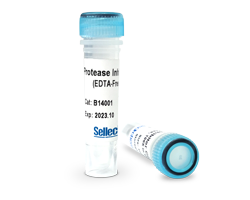
Protease Inhibitor Cocktail (EDTA-Free, 100X in DMSO)
Protease Inhibitor Cocktail (EDTA-frei, 100X in DMSO) wird in Säugetierzelllysaten oder Gewebeextrakten verwendet, um die Proteinstabilität zu erhöhen.
Sellecks Wurde zitiert von 1162 Publikationen
Vorteile
Genaue Inhaltsstoffe: Die Kenntnis der Komponenten und Konzentrationen hilft Ihnen, Unsicherheiten zu vermeiden.
Umfassender Schutz: Bietet Schutz für alle Arten von Proteinen, insbesondere für große.
Geringere Kosten: Der Preis beträgt weniger als die Hälfte der Konkurrenzprodukte.
Produktvergleich
Beschreibung
Endogene Proteine werden in einem ausgewogenen Zustand produziert und entfernt, sodass ihre zellulären Spiegel unter stabilen Umweltbedingungen im Allgemeinen stabil sind. Die Proteinproduktion wird jedoch stark gehemmt und der Abbau verstärkt, wenn Zellen in vitro untersucht werden. Um den Abbau von Proteinen unter solchen Bedingungen zu verhindern, kann man einen Cocktail aus niedermolekularen Inhibitoren verwenden, um die Wirkung von Proteasen zu blockieren.
Im Allgemeinen werden Proteaseinhibitor-Cocktails in Säugetierzelllysaten oder Gewebeextrakten verwendet, um die Proteinstabilität zu erhöhen. Wie der Name schon sagt, hemmt der Cocktail Proteasen, die entweder phosphorylierte oder nicht-phosphorylierte Proteinsubstrate abbauen würden.
Contents
| Inhaltsstoff | 100x Konz. | ZielTarget |
|---|---|---|
| AEBSF | 104 mM | Serine proteases |
| Aprotinin | 80 μM | Serine proteases |
| Bestatin | 5 mM | Aminopeptidases |
| E-64 | 1.5 mM | Cysteine proteases |
| Leupeptin | 2 mM | Serine and cysteine proteases |
| Pepstatin A | 1.5 mM | Aspartic proteases |
Lagerung (ab dem Datum des Erhalts)
Das Produkt sollte bei -20 °C gelagert werden und ist mindestens 2 Jahre stabil.
Protokoll
| Anwendungsgebiete | Western Blot Analyse, Co-IP, Pull-down, IF, IHC, Kinase-Assay usw. |
|---|---|
| Experimentelles Protokoll | Bei Raumtemperatur auftauen, vor dem Assay in einem Verdünnungsverhältnis von 1:100 (v/v) zu Probenlösungen (wie Zelllysate oder Gewebeextrakte) geben. |
Verwandte andere Produkte
Technischer Support
Wenn Sie weitere Anfragen haben, hinterlassen Sie bitte eine Nachricht.
Fehlerbehebung
Frage 1:
Why to use protease inhibitor cocktail?
Antwort:
Protease inhibitor cocktail is low-toxic agent which comprehensively protect proteins from degradation by various proteases. As the development of life science, more and more researches focus on proteins of low concentration, such as proteins in signal pathway. Precious as these low content protein, protease inhibitor cocktail offer more reliable protection than single inhibitor like PMSF.
Frage 2:
Could protease inhibitor cocktail be diluted more than instructed?
Antwort:
The inhibition effects relies on many factors, such as the protein degradation tendency, the concentrations and activities of proteases, inhibitor concentrations. Selleck protease inhibitor cocktail uses classic combination of inhibitors of sufficient concentration to ensure full protection against different proteases. To achieve best protection, the products should be diluted strictly according to instructed proportion.
Frage 3:
PMSF is often used to protect proteins. Does protease inhibitor cocktail possess advantage over PMSF?
Antwort:
PMSF is a traditional serine protease inhibitor, widely used inprotein purification by addition to cell lysis buffer. As PMSF have many shortages, it is gradually replaced by protease inhibitor cocktail which has better protective performance and is safer to use. To minimize the toxicity, AEBSF is chose to replace PMSF in protease inhibitor cocktail. AEBSF and PMSF have equal inhibitory efficiency but AEBSF is 14 times safer than PMSF. As LD50 of AEBSF and PMSF are 2834mg/kg and 200mg/kg, respectively. Another flaw of PMSF is that it is easy to degrade in water solution, with half-time period of 30 minutes. Protease inhibitor cocktail provides protection not only more comprehensive but also more durable.
Frage 4:
Tablet or solution, which kind of protease inhibitor cocktail should I choose?
Antwort:
Some details are important when choosing which cocktail to use. Both formulas contain additives. The tablet has several pharmaceutical components which are usually proprietary and non-publicized, while the solution cocktail has DMSO as a solvent. Generally, these additives do not influence product performance. In industrial production, solutions are less processed than tablets, which results in a better quality and lower prices for solutions. On the other hand, tablets possess advantages over solutions in both storage and shipment, as tablets can be stored at 4 degrees instead of -20 degrees. We recommend solution products, as they have a lower price, more accurate inhibitor doses, and readiness to aliquot.
Frage 5:
Could DMSO cause problems in my experiments?
Antwort:
The possibility that DMSO will influence experimental results is very low. DMSO is widely used as a solvent for biologically active compounds in life science experiments, including high requirement applications such as protein crystallization and CoIP. DMSO is stable at room temperature, and is a perfect cryoprotectant for cell storage in low temperatures.
Frage 6:
Even after using the protease inhibitor cocktail, experimental results were poor. How can this problem be improved?
Antwort:
Selleck's protease inhibitor cocktail can provide adequate protection for most proteins. If protein degradation remains severe with cocktail addition, carefully check the experimental protocol and procedures for optimal use of the protease inhibitor cocktail. For example, the lysis buffer system must be carefully prepared, and with the addition of protease inhibitor cocktail, the cell samples should be treated immediately after being collected or thawed.
Frage 7:
Why does it take so long to thaw?
Antwort:
DMSO thaws very slowly, especially at low temperatures. It is recommended to thaw in a 25°C water bath. It can be dispensed into 100 µl x 10 pieces, which can shorten the thawing time.

Produkte sind nur für Forschungszwecke bestimmt. Nicht für den menschlichen Gebrauch. Wir verkaufen nicht an Patienten.
©Copyright 2013 Selleck Chemicals. Alle Rechte vorbehalten.