
Tyrosinase Inhibitoren | Tyrosinase Inhibitors
| Kat.-Nr. | Produktname | Informationen | Publikationen | Validierung |
|---|---|---|---|---|
| S2375 | Aloin (Barbaloin) | Aloin (Barbaloin), ein natürliches Anthracyclin aus Aloe vera, ist ein Tyrosinase-Inhibitor. |
|
|
| S2263 | Arbutin | Arbutin (Uva, p-Arbutin, β-Arbutin) ist ein Tyrosinase-Inhibitor mit einer IC50 von 0,9 mM für Monophenolase bzw. 0,7 mM für Diphenolase. |
|
|
| S6237 | 2-Ketoglutaric acid (alpha-ketoglutarate) | 2-Ketoglutaric acid (alpha-ketoglutarate) ist ein Schlüsselmolekül im TCA-Zyklus und spielt eine grundlegende Rolle bei der Bestimmung der Gesamtrate dieses wichtigen Stoffwechselprozesses. Im TCA-Zyklus wird es durch die AKG-Dehydrogenase, die als wichtiger Kontrollpunkt des TCA-Zyklus fungiert, zu Succinyl-CoA und Kohlendioxid decarboxyliert. Diese Verbindung ist ein reversibler Inhibitor von tyrosinase. |
|
|
| S9111 | Isorhamnetin | Isorhamnetin (3-Methylquercetin, 3'-Methoxyquercetin, Isorhamnetol), ein natürliches Flavonol-Aglykon, ist ein Tyrosinase-Inhibitor und hat antioxidative Aktivität. |
|
|
| S1652 | Monobenzone | Monobenzone (Benoquin) ist eine Verbindung, die als topisches Mittel zur medizinischen Depigmentierung verwendet wird. Es kann spezifisch Tyrosinase blockieren.Monobenzone kann verwendet werden, um Tiermodelle der Vitiligo zu induzieren. |
|
|
| S4739 | Oxyresveratrol | Oxyresveratrol (Tetrahydroxystilben, 2,3',4,5'-Tetrahydroxystilben), eine natürlich vorkommende Verbindung, die insbesondere in Morus alba L. gefunden wird, zeigt eine potente hemmende Wirkung auf die Dopaoxidase-Aktivität von Tyrosinase, die die geschwindigkeitsbestimmenden Schritte der Melaninsynthese katalysiert. |
|
|
| S5174 | Kojic acid | Kojic acid ist ein Fungal-Metabolit, der Tyrosinase mit einem IC50-Wert von 30,6 M f r Pilztyrosinase hemmt. Es ist ein synthetisches Zwischenprodukt, das zur Herstellung von Lebensmittelzusatzstoffen verwendet wird. |
|
|
| S4132 | Deoxyarbutin | DeoxyArbutin(D-Arbutin,D-Arb) ist ein reversibler Tyrosinase-Inhibitor, der die Tyrosinase-Aktivität mit einer IC50 von 50 nM hemmt. | ||
| S4571 | Hexylresorcinol | Hexylresorcinol (4-Hexylresorcinol) ist eine organische Verbindung mit lokalanästhetischen, antiseptischen und anthelmintischen Eigenschaften und ein potenter Inhibitor von mushroom tyrosinase. Die IC50-Werte dieser Verbindung für Monophenolase betragen 1,24 μM und für Diphenolase 0,85 μM. | ||
| S6272 | Glycolic acid | Glycolic acid (Dicarbonosäure, Hydroxyessigsäure, Hydroessigsäure) ist die kleinste Alpha-Hydroxysäure. Aufgrund ihrer hervorragenden Fähigkeit, in die Haut einzudringen, wird diese Verbindung häufig in Hautpflegeprodukten verwendet, meistens als chemisches Peeling. Sie ist ein Inhibitor von Tyrosinase, der die Melaninbildung unterdrückt und zu einer Aufhellung der Hautfarbe führt. | ||
| E2861 | Kojic acid dipalmitate | Kojic acid ist ein langsam bindender Inhibitor der Catecholase-Aktivität von tyrosinase mit einem Ki von 2,75 µM. | ||
| S9284 | Aloesin | Aloesin (Aloe Harz B) ist eine Art Kräuterextrakt aus der Aloe Vera. Es ist ein starker Inhibitor der Tyrosinase-Aktivität und reguliert die Cyclin-E-abhängige Kinase-Aktivität in vitro hoch. | ||
| S4997 | 4-Butylresorcinol | 4-Butylresorcinol (4-n-Butylresorcinol, Rucinol) ist ein potenter Inhibitor von Tyrosinase und wird in Kosmetika als Depigmentierungsmittel verwendet. | ||
| S3691 | 4-Chlorosalicylic acid | 4-Chlorosalicylic acid (4-Chlor-2-hydroxybenzoesäure, 4-Chloro-Salicylsäure) wurde zur empfindlichen spektrofluorometrischen Bestimmung von Terbium in gemischten seltenen Erden und zur Herstellung von Poly(4-chlorosalicylic acid-Formaldehyd) durch Kondensation mit Formaldehyd verwendet. Diese Verbindung ist ein pharmazeutisches Zwischenprodukt. Sie hemmt die Monophenolase- und Diphenolase-Aktivität mit IC50-Werten von 1,89 mM und 1,10 mM. Sie besitzt eine starke antimikrobielle Aktivität. Sie ist aktiv gegen E. coli mit einem MHK-Wert von 250 μg/mL und einem MBK-Wert von 500 μg/mL. | ||
| E2908 | 1-PHENYL-2-THIOUREA | 1-PHENYL-2-THIOUREA (N-Phenylthioharnstoff, PTU, Phenylthiocarbamid) ist ein Inhibitor der Tyrosinase (Tyr). Diese Verbindung blockiert die Pigmentierung und verbessert die optische Transparenz im Zebrafisch-Embryo (Danio rerio). | ||
| S9089 | Magnoflorine | Magnoflorine (Escholin, Thalictrin), eine wichtige Verbindung in Aristolochia, wurde üblicherweise als anxiolytische Chemikalie verwendet. Es zeigt eine signifikante antioxidative Aktivität als DPPH-Radikalfänger und hemmt α-Tyrosinase. | ||
| S3166 | Calcium 2-oxoglutarate | Calcium 2-oxoglutarate (Calcium oxoglurate, Calcium 2-oxopentanedioate, Calcium α-ketoglutarate, Calcium AKG, Calcium 2-ketoglutaric acid, Calcium oxoglutaric acid) ist die Calciumsalzform von 2-oxoglutarate. 2-oxoglutarate kommt natürlicherweise in Organismen vor und ist ein bekanntes Zwischenprodukt bei der Produktion von ATP oder GTP im Krebszyklus. 2-oxoglutarate ist ein reversibler Inhibitor von tyrosinase mit einer IC50 von 15 mM. | ||
| S9376 | Benzylacetone | Benzylacetone (4-Phenyl-2-butanon, Methyl-2-phenylethylketon) ist eine anziehende Verbindung in Blumen. Diese Verbindung zeigt eine potente und reversible Antityrosinase-(Pilz-)Aktivität mit IC50-Werten von 2,8 mM und 0,6 mM für Monophenolase bzw. Diphenolase. | ||
| S6221 | Methyl cinnamate | Methyl cinnamate, ein aktiver Bestandteil von Zanthoxylum armatum, ist eine weit verbreitete natürliche Geschmacksverbindung mit antimikrobiellen und Tyrosinase-hemmenden Aktivitäten. Methyl Cinnamate hemmt die Adipozytendifferenzierung über die Aktivierung des CaMKK2--AMPK-Signalwegs in 3T3-L1-Präadipozyten. | ||
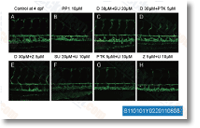
| S1021 | Dasatinib (BMS-354825) | Dasatinib ist ein neuartiger, potenter und Multi-Target-Inhibitor, der Abl, Src und c-Kit mit IC50 von <1 nM, 0,8 nM bzw. 79 nM in zellfreien Assays hemmt. Dasatinib induziert Autophagie und Apoptose mit Antitumoraktivität. |
|
|
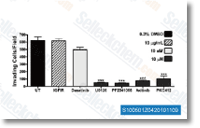
| S1005 | Axitinib (AG-013736) | Axitinib ist ein Multi-Ziel-Inhibitor von VEGFR1, VEGFR2, VEGFR3, PDGFRβ und c-Kit mit IC50 von 0,1 nM, 0,2 nM, 0,1-0,3 nM, 1,6 nM bzw. 1,7 nM in Endothelzellen der Schweineaorta. |
|
|
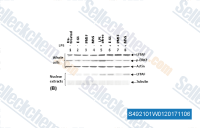
| S4921 | MNS (3,4-Methylenedioxy-β-nitrostyrene) | MNS (3,4-Methylendioxy-β-nitrostyrol) ist ein Tyrosinkinase-Inhibitor, der Syk, Src und p97 mit IC50-Werten von 2,5 μM, 29,3 μM bzw. 1,7 μM hemmt. |
|
|
| E1509 | Bezuclastinib | Bezuclastinib (CGT9486; PLX 9486) ist ein potenter Inhibitor von c-kit und c-kit D816V mit einem IC50-Wert von <1 μM. Diese Verbindung ist auch ein Inhibitor der tyrosine kinase. |

Produkte sind nur für Forschungszwecke bestimmt. Nicht für den menschlichen Gebrauch. Wir verkaufen nicht an Patienten.
©Copyright 2013 Selleck Chemicals. Alle Rechte vorbehalten.