
nur für Forschungszwecke
Amphotericin B Antibiotics for Mammalian Cell Culture Inhibitor
Kat.-Nr.: S1636
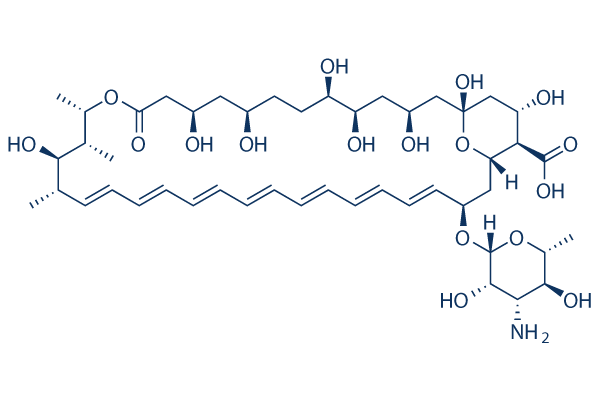
Chemische Struktur
Molekulargewicht: 924.08
Qualitätskontrolle (Quality Control)
| Verwandte Ziele | Integrase Bacterial Antibiotics Anti-infection Fungal Antiviral COVID-19 Parasite Reverse Transcriptase HIV |
|---|---|
| Weitere Antibiotics for Mammalian Cell Culture Inhibitoren | Tylosin tartrate |
Chemische Informationen, Lagerung & Stabilität (Chemical Information, Storage & Stability)
| Molekulargewicht | 924.08 | Formel | C47H73NO17 |
Lagerung (Ab dem Eingangsdatum) | |
|---|---|---|---|---|---|
| CAS-Nr. | 1397-89-3 | SDF herunterladen | Lagerung von Stammlösungen |
|
|
| Synonyme | NSC 527017 | Smiles | CC1C=CC=CC=CC=CC=CC=CC=CC(CC2C(C(CC(O2)(CC(CC(C(CCC(CC(CC(=O)OC(C(C1O)C)C)O)O)O)O)O)O)O)C(=O)O)OC3C(C(C(C(O3)C)O)N)O | ||
Löslichkeit (Solubility)
|
In vitro |
DMSO
: 4.5 mg/mL
(4.86 mM)
Water : 4.5 mg/mL Ethanol : Insoluble |
Molaritätsrechner
|
In vivo |
|||||
In-vivo-Formulierungsrechner (Klare Lösung)
Schritt 1: Geben Sie die untenstehenden Informationen ein (Empfohlen: Ein zusätzliches Tier zur Berücksichtigung von Verlusten während des Experiments)
Schritt 2: Geben Sie die In-vivo-Formulierung ein (Dies ist nur der Rechner, keine Formulierung. Bitte kontaktieren Sie uns zuerst, wenn es im Abschnitt "Löslichkeit" keine In-vivo-Formulierung gibt.)
Berechnungsergebnisse:
Arbeitskonzentration: mg/ml;
Methode zur Herstellung der DMSO-Stammlösung: mg Wirkstoff vorgelöst in μL DMSO ( Konzentration der Stammlösung mg/mL, Bitte kontaktieren Sie uns zuerst, wenn die Konzentration die DMSO-Löslichkeit der Wirkstoffcharge überschreitet. )
Methode zur Herstellung der In-vivo-Formulierung: Nehmen Sie μL DMSO Stammlösung, dann hinzufügenμL PEG300, mischen und klären, dann hinzufügenμL Tween 80, mischen und klären, dann hinzufügen μL ddH2O, mischen und klären.
Methode zur Herstellung der In-vivo-Formulierung: Nehmen Sie μL DMSO Stammlösung, dann hinzufügen μL Maisöl, mischen und klären.
Hinweis: 1. Bitte stellen Sie sicher, dass die Flüssigkeit klar ist, bevor Sie das nächste Lösungsmittel hinzufügen.
2. Achten Sie darauf, das/die Lösungsmittel der Reihe nach hinzuzufügen. Sie müssen sicherstellen, dass die bei der vorherigen Zugabe erhaltene Lösung eine klare Lösung ist, bevor Sie mit der Zugabe des nächsten Lösungsmittels fortfahren. Physikalische Methoden wie Vortex, Ultraschall oder ein heißes Wasserbad können zur Unterstützung des Lösens verwendet werden.
Wirkmechanismus (Mechanism of Action)
| Targets/IC50/Ki |
ergosterol
|
|---|---|
| In vitro |
Amphotericin B administration is limited by infusion-related toxicity, including fever and chills, an effect postulated to result from proinflammatory cytokine production by innate immune cells. This compound induces signal transduction and inflammatory cytokine release from cells expressing TLR2 and CD14. It interacts with cholesterol, the major sterol of mammal membranes, thus limiting the usefulness of this chemical due to its relatively high toxicity. This drug is dispersed as a pre-micellar or as a highly aggregated state in the subphase. It only kills unicellular Leishmania promastigotes (LPs) when aqueous pores permeable to small cations and anions are formed. This compound (0.1 mM) induces a polarization potential, indicating K+ leakage in KCl-loaded liposomes suspended in an iso-osmotic sucrose solution. It (0.05 mM) exhibits a nearly total collapse of the negative membrane potential, indicating Na+ entry into the cells.
|
| In vivo |
Amphotericin B results in prolonging the incubation time and decreasing PrPSc accumulation in the hamster scrapie model. This compound markedly reduces PrPSc levels in mice with transmissible subacute spongiform encephalopathies (TSSE). It exerts a direct effect on Plasmodium falciparum and influences eryptosis of infected erythrocytes, parasitemia and hostsurvival in murine malaria. This chemical tends to delay the increase of parasitemia and significantly delays host death plasmodium berghei-infected mice.
|
Literatur |
|
Klinische Studieninformationen (Clinical Trial Information)
(Daten von https://clinicaltrials.gov, aktualisiert am 2026-07-27)
| NCT-Nummer | Rekrutierung | Erkrankungen | Sponsor/Kooperationspartner | Startdatum | Phasen |
|---|---|---|---|---|---|
| NCT05814432 | RECRUITING | Disseminated Histoplasma Capsulatum Infection; AIDS and Infections; Immunosuppression; Fungal Infection |
Federal University of Health Science of Porto Alegre |
2025-01-16 | PHASE3 |
| NCT06525389 | NOT_YET_RECRUITING | Talaromycosis |
Duke University |
2026-09-01 | PHASE3 |
| NCT07463040 | NOT_YET_RECRUITING | Cutaneous Leihmaniasis |
Institute of Tropical Medicine, Belgium |
2027-01-01 | PHASE3 |
| NCT07559032 | NOT_YET_RECRUITING | Invasive Fungal Disease |
Peking University People's Hospital |
2026-04 | |
| NCT07725874 | NOT_YET_RECRUITING | Invasive Mold Diseases |
Beijing Friendship Hospital |
2026-08-08 | |
| NCT07530263 | NOT_YET_RECRUITING | Chronic Pulmonary Aspergillosis |
Radboud University Medical Center |
2026-10-01 | PHASE1 |

Produkte sind nur für Forschungszwecke bestimmt. Nicht für den menschlichen Gebrauch. Wir verkaufen nicht an Patienten.
©Copyright 2013 Selleck Chemicals. Alle Rechte vorbehalten.