
nur für Forschungszwecke
Nystatin Antibiotics for Mammalian Cell Culture Inhibitor
Kat.-Nr.S1934
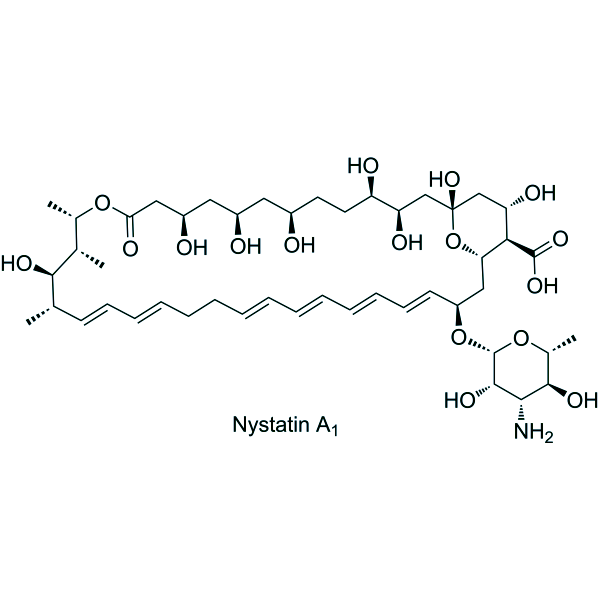
Chemische Struktur
Molekulargewicht: 926.09
Qualitätskontrolle
- Antibiotic Titer ≥ 4400 u/mg
- Zitiert in Nature Medicine für seine erstklassige Qualität
- COA
- Datenblatt
- SDS
| Verwandte Ziele | Integrase Bacterial Antibiotics Anti-infection Fungal Antiviral COVID-19 Parasite Reverse Transcriptase HIV |
|---|---|
| Weitere Antibiotics for Mammalian Cell Culture Inhibitoren | Tylosin tartrate |
Chemische Informationen, Lagerung & Stabilität
| Molekulargewicht | 926.09 | Formel | C47H75NO17 |
Lagerung (Ab dem Eingangsdatum) | |
|---|---|---|---|---|---|
| CAS-Nr. | 1400-61-9 | SDF herunterladen | Lagerung von Stammlösungen |
|
|
| Synonyme | Fungicidin | Smiles | CC1C=CC=CCCC=CC=CC=CC=CC(CC2C(C(CC(O2)(CC(C(CCC(CC(CC(CC(=O)OC(C(C1OC3CC(C(C(O3)C)O)O)C)C)O)O)O)O)O)O)O)C(=O)O)OC4C(C(C(C(O4)C)O)N)O | ||
Molaritätsrechner
|
In vivo |
|||||
In-vivo-Formulierungsrechner (Klare Lösung)
Schritt 1: Geben Sie die untenstehenden Informationen ein (Empfohlen: Ein zusätzliches Tier zur Berücksichtigung von Verlusten während des Experiments)
Schritt 2: Geben Sie die In-vivo-Formulierung ein (Dies ist nur der Rechner, keine Formulierung. Bitte kontaktieren Sie uns zuerst, wenn es im Abschnitt "Löslichkeit" keine In-vivo-Formulierung gibt.)
Berechnungsergebnisse:
Arbeitskonzentration: mg/ml;
Methode zur Herstellung der DMSO-Stammlösung: mg Wirkstoff vorgelöst in μL DMSO ( Konzentration der Stammlösung mg/mL, Bitte kontaktieren Sie uns zuerst, wenn die Konzentration die DMSO-Löslichkeit der Wirkstoffcharge überschreitet. )
Methode zur Herstellung der In-vivo-Formulierung: Nehmen Sie μL DMSO Stammlösung, dann hinzufügenμL PEG300, mischen und klären, dann hinzufügenμL Tween 80, mischen und klären, dann hinzufügen μL ddH2O, mischen und klären.
Methode zur Herstellung der In-vivo-Formulierung: Nehmen Sie μL DMSO Stammlösung, dann hinzufügen μL Maisöl, mischen und klären.
Hinweis: 1. Bitte stellen Sie sicher, dass die Flüssigkeit klar ist, bevor Sie das nächste Lösungsmittel hinzufügen.
2. Achten Sie darauf, das/die Lösungsmittel der Reihe nach hinzuzufügen. Sie müssen sicherstellen, dass die bei der vorherigen Zugabe erhaltene Lösung eine klare Lösung ist, bevor Sie mit der Zugabe des nächsten Lösungsmittels fortfahren. Physikalische Methoden wie Vortex, Ultraschall oder ein heißes Wasserbad können zur Unterstützung des Lösens verwendet werden.
Wirkmechanismus
| In vitro |
Nystatin führt zu einer signifikanten Reduktion der Adhäsion von bukkalen Epithelzellen aller sechs Candida-Arten. Diese Verbindung ist ein Antibiotikum, das die Permeabilität von Plasmamembranen für kleine monovalente Ionen, einschließlich Chloridion, erhöht. Es erhöht die apikale Chloridionenpermeabilität bis zu dem Punkt, an dem der transepitheliale Chloridionentransport durch den Transport über die basolaterale Membran von Trachea-Epithelzellen begrenzt wird, was hauptsächlich die Aktivität des Co-Transporters widerspiegelt. Diese Chemikalie (400 Einheiten/ml) erhöht den basalen 36Cl-Fluss transepithelial um etwa das 1,5-fache und eliminiert die UTP-Stimulation dieses Flusses. Diese Behandlung hebt auch die UTP-Stimulation der sättigbaren, basolateralen [3H]Bumetanid-Bindung auf, ein Maß für funktionierende Na-K-Cl-Co-Transporter in diesen Zellen; die Isoproterenol-Stimulation der Bindung wird durch Nystatin-Behandlung nur geringfügig gehemmt. Es verbessert die Endostatin-Aufnahme durch Endothelzellen signifikant, indem es die Endostatin-Internalisierung überwiegend auf den Clathrin-vermittelten Weg umstellt. Diese durch die Verbindung verbesserte Internalisierung von Endostatin erhöht auch dessen hemmende Wirkung auf die Endothelzell-Röhrenbildung und -Migration. |
|---|---|
| In vivo |
Nystatin kombiniert mit Endostatin verbessert selektiv die Endostatin-Aufnahme und -Biodistribution in Tumorgefäßen und Tumorgeweben, aber nicht in normalen Geweben von tumortragenden Mäusen, was letztendlich zu erhöhten antiangiogenen und Antitumor-Wirkungen von Endostatin in vivo führt. Liposomales this compound schützt neutropenische Mäuse in Dosen von nur 2 mg/kg Körpergewicht/Tag statistisch signifikant vor Aspergillus-induziertem Tod zum 50-Tage-Zeitpunkt im Vergleich zur unbehandelten, der Salzlösung oder der leeren Liposomengruppe. |
Literatur |
|
Klinische Studieninformationen
(Daten von https://clinicaltrials.gov, aktualisiert am 2024-05-22)
| NCT-Nummer | Rekrutierung | Erkrankungen | Sponsor/Kooperationspartner | Startdatum | Phasen |
|---|---|---|---|---|---|
| NCT01531192 | Completed | Very Low Birth Weight Infants |
Zekai Tahir Burak Women''s Health Research and Education Hospital |
June 2012 | Phase 4 |
| NCT01411748 | Unknown status | Anticandidal Property of Saccharomyces Boulardii on Very Low Birth Weight Infants |
Zekai Tahir Burak Women''s Health Research and Education Hospital |
July 2011 | Phase 4 |
| NCT01427738 | Completed | HIV-1 Infection |
Advancing Clinical Therapeutics Globally for HIV/AIDS and Other Infections|National Institute of Allergy and Infectious Diseases (NIAID) |
June 2011 | Phase 3 |
| NCT03390374 | Completed | Fungal Infections Systemic |
Dr Cipto Mangunkusumo General Hospital |
October 2010 | Phase 4 |
| NCT02642900 | Completed | Photochemotherapy Reaction |
University of Sao Paulo |
July 2009 | Phase 4 |
Technischer Support
Tel: +1-832-582-8158 Ext:3
Wenn Sie weitere Fragen haben, hinterlassen Sie bitte eine Nachricht.

Produkte sind nur für Forschungszwecke bestimmt. Nicht für den menschlichen Gebrauch. Wir verkaufen nicht an Patienten.
©Copyright 2013 Selleck Chemicals. Alle Rechte vorbehalten.