
nur für Forschungszwecke
Azithromycin Antibiotics for Mammalian Cell Culture Hemmer
Kat.-Nr.: S1835
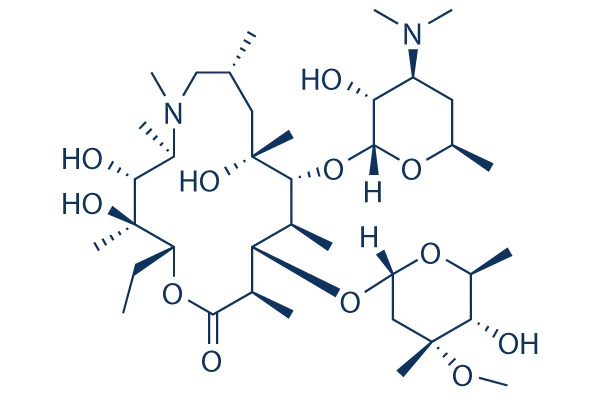
Chemische Struktur
Molekulargewicht: 748.98
Qualitätskontrolle (Quality Control)
- Zitiert in Nature Medicine für seine erstklassige Qualität
- COA
- NMR
- Datenblatt
- SDS
- Zitiert in Nature Medicine für seine erstklassige Qualität
- COA
- NMR
- Datenblatt
- SDS
- Zitiert in Nature Medicine für seine erstklassige Qualität
- COA
- NMR
- Datenblatt
- SDS
- Zitiert in Nature Medicine für seine erstklassige Qualität
- COA
- Datenblatt
- SDS
- Zitiert in Nature Medicine für seine erstklassige Qualität
- COA
- Datenblatt
- SDS
Zellkultur, Behandlung & Arbeitskonzentration
(Cell Culture, Treatment & Working Concentration)
| Zelllinien | Assay-Typ | Konzentration | Inkubationszeit | Formulierung | Aktivitätsbeschreibung | PMID |
|---|---|---|---|---|---|---|
| HeLa 299 | Antichlamydial assay | 44 to 48 hrs | Antichlamydial activity against Chlamydia trachomatis serovar L2 infected in human HeLa 299 cells assessed as reduction in number of inclusion bodies measured after 44 to 48 hrs by DAPI staining-based HCS assay, IC50=0.727μM. | 29232584 | ||
| THP1 | Function assay | 30 mins | Drug uptake in human THP1 cells at pH 6 to 7 after 30 mins | 19564365 | ||
| THP1 | Function assay | 24 hrs | Drug uptake in human THP1 cells after 24 hrs in presence of verapamil | 19564365 | ||
| THP1 | Function assay | 24 hrs | Drug uptake in human THP1 cells after 24 hrs in presence of gemfibrozil | 19564365 | ||
| Hep2 | Antichlamydial assay | 4 ug/ml | 8 hrs | Anti-Chlamydial activity against Chlamydia trachomatis Serovar LGV-L2 infected in Hep2 cells assessed as reduction in size and number of chlamydial inclusion at 4 ug/ml treated at 8 hrs post-infection and 24 hrs later re-infecting fresh Hep2 cells monolay | 32227948 | |
| Vero E6 | Antiviral assay | 2 days | Antiviral efficacy against SARS-CoV-2 (strain BavPat1) in Vero E6 cells assessed by inhibition of viral RNA replication measured by RT-PCR after 2 days, EC50=2.12μM. | ChEMBL | ||
| Vero E6 | Antiviral assay | 2 days | Antiviral efficacy against SARS-CoV-2 (strain BavPat1) in Vero E6 cells assessed by inhibition of viral RNA replication measured by RT-PCR after 2 days, EC90=8.65μM. | ChEMBL | ||
| Klicken Sie hier, um weitere experimentelle Daten zu Zelllinien anzuzeigen | ||||||
Chemische Informationen, Lagerung & Stabilität (Chemical Information, Storage & Stability)
| Molekulargewicht | 748.98 | Formel | C38H72N2O12 |
Lagerung (Ab dem Eingangsdatum) | |
|---|---|---|---|---|---|
| CAS-Nr. | 83905-01-5 | SDF herunterladen | Lagerung von Stammlösungen |
|
|
| Synonyme | XZ-450,CP-62993 | Smiles | CCC1C(C(C(N(CC(CC(C(C(C(C(C(=O)O1)C)OC2CC(C(C(O2)C)O)(C)OC)C)OC3C(C(CC(O3)C)N(C)C)O)(C)O)C)C)C)O)(C)O | ||
Löslichkeit (Solubility)
|
In vitro |
DMSO
: 100 mg/mL
(133.51 mM)
Ethanol : 100 mg/mL Water : Insoluble |
Molaritätsrechner
|
In vivo |
|||||
In-vivo-Formulierungsrechner (Klare Lösung)
Schritt 1: Geben Sie die untenstehenden Informationen ein (Empfohlen: Ein zusätzliches Tier zur Berücksichtigung von Verlusten während des Experiments)
Schritt 2: Geben Sie die In-vivo-Formulierung ein (Dies ist nur der Rechner, keine Formulierung. Bitte kontaktieren Sie uns zuerst, wenn es im Abschnitt "Löslichkeit" keine In-vivo-Formulierung gibt.)
Berechnungsergebnisse:
Arbeitskonzentration: mg/ml;
Methode zur Herstellung der DMSO-Stammlösung: mg Wirkstoff vorgelöst in μL DMSO ( Konzentration der Stammlösung mg/mL, Bitte kontaktieren Sie uns zuerst, wenn die Konzentration die DMSO-Löslichkeit der Wirkstoffcharge überschreitet. )
Methode zur Herstellung der In-vivo-Formulierung: Nehmen Sie μL DMSO Stammlösung, dann hinzufügenμL PEG300, mischen und klären, dann hinzufügenμL Tween 80, mischen und klären, dann hinzufügen μL ddH2O, mischen und klären.
Methode zur Herstellung der In-vivo-Formulierung: Nehmen Sie μL DMSO Stammlösung, dann hinzufügen μL Maisöl, mischen und klären.
Hinweis: 1. Bitte stellen Sie sicher, dass die Flüssigkeit klar ist, bevor Sie das nächste Lösungsmittel hinzufügen.
2. Achten Sie darauf, das/die Lösungsmittel der Reihe nach hinzuzufügen. Sie müssen sicherstellen, dass die bei der vorherigen Zugabe erhaltene Lösung eine klare Lösung ist, bevor Sie mit der Zugabe des nächsten Lösungsmittels fortfahren. Physikalische Methoden wie Vortex, Ultraschall oder ein heißes Wasserbad können zur Unterstützung des Lösens verwendet werden.
Wirkmechanismus (Mechanism of Action)
| Targets/IC50/Ki |
protein synthesis
|
|---|---|
| In vitro |
Azithromycin reduces about 40% of IL-8 mRNA and protein expression in cystic fibrosis (CF) cells reaching the levels of non-CF cells. This compound results in 50% and 70% reduction of NF-kappaB and AP-1 DNA binding, respectively, leading to levels of non-CF cells. It significantly enhances the intensity of a co-stimulatory molecule, CD80, on DCs but not CD86 and CD40 in dendritic cells (DCs). This macrolide significantly increases the production of IL-10 and Clarithromycin (CAM) significantly inhibits the production of IL-6 by DCs. It increases IL-10 and CAM decreases IL-2 productions significantly, when naive T cells derived from spleen are co-cultured with DCs treated in advance with LPS and these macrolides. This agent selectively inhibits fluid-phase endocytosis of horseradish peroxidase and lucifer yellow in J774 mouse macrophages. It delays sequestration of receptor-bound transferrin and peroxidase-anti-peroxidase immune complexes into cell-surface endocytic pits and vesicles. This chemical down-regulates cell surface transferrin receptors, but not Fc gamma receptors, by causing a major delay in the accessibility of internalized transferrin receptors to the recycling route, without slowing down subsequent efflux, resulting in redistribution of the surface pool to an intracellular pool. It inserts into the DOPC lipid bilayer, so as to decrease its cohesion and to facilitate the merging of DPPC into the DOPC fluid matrix.
|
Literatur |
|
Klinische Studieninformationen (Clinical Trial Information)
(Daten von https://clinicaltrials.gov, aktualisiert am 2025-06-13)
| NCT-Nummer | Rekrutierung | Erkrankungen | Sponsor/Kooperationspartner | Startdatum | Phasen |
|---|---|---|---|---|---|
| NCT06461429 | NOT_YET_RECRUITING | Preterm Birth |
University of Melbourne |
2025-11-01 | |
| NCT07485010 | NOT_YET_RECRUITING | Mycobacterium Abscessus Pulmonary Disease; Mycobacterium Abscessus Infection; Non-Tuberculous Mycobacterial (NTM) Infections; Non-Tuberculous Mycobacteria Pulmonary Disease |
The University of Queensland |
2027-04 | PHASE2 |
| NCT07625228 | NOT_YET_RECRUITING | Rheumatic Fever; Valvular Heart Diseases; Valvular Cardiomyopathy |
Ladoke Akintola University of Technology, Ogbomoso, Nigeria |
2027-01-05 | |
| NCT05763693 | NOT_YET_RECRUITING | Neonatal Death; Infectious Disease; Nutritional Deficiency |
University of California, San Francisco |
2026-04 | PHASE4 |
| NCT06906757 | NOT_YET_RECRUITING | PPROM; Preterm |
University of Melbourne |
2025-09 | |
| NCT07052942 | RECRUITING | Asthma; Asthma Attack; Asthma Exacerbations |
DARTNet Institute |
2025-08-01 | PHASE4 |

Produkte sind nur für Forschungszwecke bestimmt. Nicht für den menschlichen Gebrauch. Wir verkaufen nicht an Patienten.
©Copyright 2013 Selleck Chemicals. Alle Rechte vorbehalten.