
nur für Forschungszwecke
Thalidomide E3 ligase Ligand chemical
Kat.-Nr.S1193
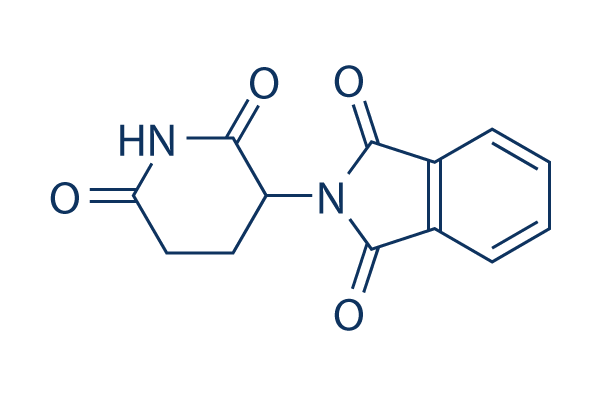
Chemische Struktur
Molekulargewicht: 258.23
Qualitätskontrolle
| Verwandte Ziele | Proteasome E1 Activating E3 Ligase DUB p97 SUMO E2 conjugating |
|---|---|
| Weitere E3 ligase Ligand Inhibitoren | CC-99282 |
Zellkultur, Behandlung & Arbeitskonzentration
| Zelllinien | Assay-Typ | Konzentration | Inkubationszeit | Formulierung | Aktivitätsbeschreibung | PMID |
|---|---|---|---|---|---|---|
| HeLa | Function assay | Inhibition of IL-1-alpha-induced NF-kappaB activation in HeLa cells assessed as blocking of p50/p65 nuclear translocation, IC50=2.04μM | 17845850 | |||
| RAW264.7 | Antiinflammatory assay | 10 uM | 3 hrs | Antiinflammatory activity in mouse LPS-activated RAW264.7 cells assessed as ROS scavenging activity at 10 uM pretreated for 3 hrs before LPS challenge measured by decrease in fluorescent intensity by confocal microscopy | 18723357 | |
| RAW264.7 | Function assay | 1 uM | 3 hrs | Reduction in iNOS expression in LPS-activated mouse RAW264.7 cells at 1 uM pretreated for 3 hrs before LPS challenge assessed after 24 hrs by Western blot | 18723357 | |
| RAW264.7 | Function assay | 10 uM | 3 hrs | Reduction in iNOS expression in LPS-activated mouse RAW264.7 cells at 10 uM pretreated for 3 hrs before LPS challenge assessed after 24 hrs by Western blot | 18723357 | |
| RAW264.7 | Function assay | 10 uM | 3 hrs | Reduction in pERK1/2 expression in LPS-activated mouse RAW264.7 cells at 10 uM pretreated for 3 hrs before LPS challenge assessed after 24 hrs by Western blot | 18723357 | |
| Ehrlich ascites carcinoma cells | Toxicity assay | 1.25 mM/kg | 7 days | Toxicity in Swiss albino mouse bearing mouse Ehrlich ascites carcinoma cells assessed as focal degeneration of hepatocytes treated after 7 days post-tumor implantation at 1.25 mM/kg, sc for 5 days by histopathological analysis | 18951804 | |
| Ehrlich ascites carcinoma cells | Toxicity assay | 1.25 mM/kg | 7 days | Toxicity in Swiss albino mouse bearing mouse Ehrlich ascites carcinoma cells assessed as focal necrosis of hepatocytes treated after 7 days post-tumor implantation at 1.25 mM/kg, sc for 5 days by histopathological analysis | 18951804 | |
| BTI-TN-5B1-4 | Function assay | 30 mins | Binding affinity to human CRBN (1 to 442 residues)/N-terminal 6His-tagged human DDB1 (1 to 1140 residues) expressed in baculovirus infected BTI-TN-5B1-4 insect cells after 30 mins by cy5 probe based fluorescence polarization assay, Kd=0.25μM | 31117518 | ||
| Klicken Sie hier, um weitere experimentelle Daten zu Zelllinien anzuzeigen | ||||||
Chemische Informationen, Lagerung & Stabilität
| Molekulargewicht | 258.23 | Formel | C13H10N2O4 |
Lagerung (Ab dem Eingangsdatum) | |
|---|---|---|---|---|---|
| CAS-Nr. | 50-35-1 | SDF herunterladen | Lagerung von Stammlösungen |
|
|
| Synonyme | K17 | Smiles | C1CC(=O)NC(=O)C1N2C(=O)C3=CC=CC=C3C2=O | ||
Löslichkeit
|
In vitro |
DMSO
: 150 mg/mL
(580.87 mM)
Mit 50°C Wasserbad erwärmt;
Ultraschallbehandelt;
Water : Insoluble Ethanol : Insoluble |
Molaritätsrechner
|
In vivo |
|||||
In-vivo-Formulierungsrechner (Klare Lösung)
Schritt 1: Geben Sie die untenstehenden Informationen ein (Empfohlen: Ein zusätzliches Tier zur Berücksichtigung von Verlusten während des Experiments)
Schritt 2: Geben Sie die In-vivo-Formulierung ein (Dies ist nur der Rechner, keine Formulierung. Bitte kontaktieren Sie uns zuerst, wenn es im Abschnitt "Löslichkeit" keine In-vivo-Formulierung gibt.)
Berechnungsergebnisse:
Arbeitskonzentration: mg/ml;
Methode zur Herstellung der DMSO-Stammlösung: mg Wirkstoff vorgelöst in μL DMSO ( Konzentration der Stammlösung mg/mL, Bitte kontaktieren Sie uns zuerst, wenn die Konzentration die DMSO-Löslichkeit der Wirkstoffcharge überschreitet. )
Methode zur Herstellung der In-vivo-Formulierung: Nehmen Sie μL DMSO Stammlösung, dann hinzufügenμL PEG300, mischen und klären, dann hinzufügenμL Tween 80, mischen und klären, dann hinzufügen μL ddH2O, mischen und klären.
Methode zur Herstellung der In-vivo-Formulierung: Nehmen Sie μL DMSO Stammlösung, dann hinzufügen μL Maisöl, mischen und klären.
Hinweis: 1. Bitte stellen Sie sicher, dass die Flüssigkeit klar ist, bevor Sie das nächste Lösungsmittel hinzufügen.
2. Achten Sie darauf, das/die Lösungsmittel der Reihe nach hinzuzufügen. Sie müssen sicherstellen, dass die bei der vorherigen Zugabe erhaltene Lösung eine klare Lösung ist, bevor Sie mit der Zugabe des nächsten Lösungsmittels fortfahren. Physikalische Methoden wie Vortex, Ultraschall oder ein heißes Wasserbad können zur Unterstützung des Lösens verwendet werden.
Wirkmechanismus
| Targets/IC50/Ki |
E3 Ligase
(Cell-free assay) TNF-alpha
(Cell-free assay) |
|---|---|
| In vitro |
Thalidomide muss von der Leber metabolisiert werden, um ein Epoxid zu bilden, das der aktive teratogene Metabolit sein könnte. Diese Verbindung hemmt selektiv die Produktion des humanen Monozyten-Tumornekrosefaktors alpha (TNF-alpha), wenn humane Monozyten mit Lipopolysaccharid und anderen Agonisten in Kultur stimuliert werden. Es übt seine hemmende Wirkung auf den Tumornekrosefaktor alpha aus, indem es den mRNA-Abbau verstärkt. Diese Chemikalie wirkt direkt, indem sie Apoptose oder G1-Wachstumsarrest in MM-Zelllinien und in Patienten-MM-Zellen induziert, die gegen Melphalan, Doxorubicin und Dexamethason (Dex) resistent sind. Sie verstärkt die Anti-MM-Aktivität von Dex und wird umgekehrt durch Interleukin 6 gehemmt. Dieser Wirkstoff ist ein potenter Kostimulator primärer menschlicher T-Zellen in vitro, der mit der Stimulation über den T-Zellrezeptorkomplex synergiert, um die Interleukin-2-vermittelte T-Zellproliferation und die Interferon-Gamma-Produktion zu erhöhen. Es erhöht auch die primäre CD8+-zytotoxische T-Zellantwort, die durch allogene dendritische Zellen in Abwesenheit von CD4+-T-Zellen induziert wird. |
| In vivo |
Thalidomide (200 mg/kg) führte in drei Experimenten zu einer Hemmung der vaskularisierten Hornhautfläche von Kaninchen, die zwischen 30 % und 51 % lag, mit einer mittleren Hemmung von 36 %. |
Literatur |
|
Anwendungen
| Methoden | Biomarker | Bilder | PMID |
|---|---|---|---|
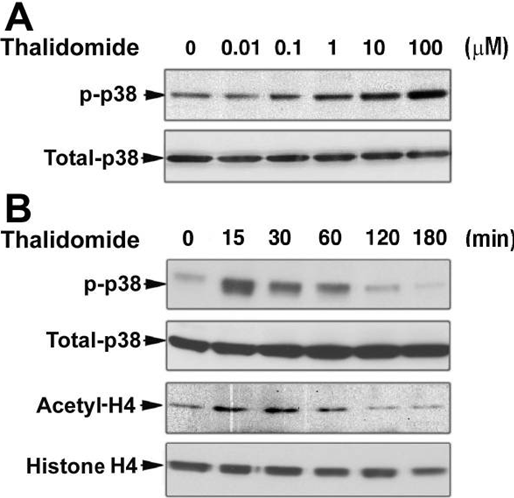
| Western blot | p-p38 / p38 / Acetyl-H4 |
|
17620452 |
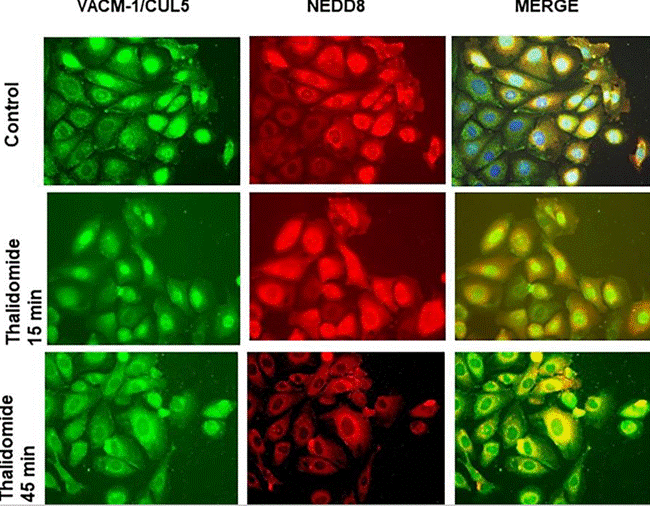
| Immunofluorescence | VCAM-1/CUL5 / NEDD8 bFGF |
|
29746508 |
Klinische Studieninformationen
(Daten von https://clinicaltrials.gov, aktualisiert am 2024-05-22)
| NCT-Nummer | Rekrutierung | Erkrankungen | Sponsor/Kooperationspartner | Startdatum | Phasen |
|---|---|---|---|---|---|
| NCT06146478 | Completed | Transfusion-dependent Beta-Thalassemia |
Blood Care Clinic|Khyber Medical University Peshawar |
January 25 2022 | Phase 3 |
| NCT04680195 | Unknown status | Chronic Radiation Proctitis |
Sixth Affiliated Hospital Sun Yat-sen University |
December 14 2020 | Phase 2 |
| NCT04469556 | Active not recruiting | Pancreatic Cancer Metastatic|Pancreatic Ductal Adenocarcinoma|Advanced Pancreatic Cancer |
University Health Network Toronto|Johns Hopkins University|Cold Spring Harbor Laboratory|Ontario Institute for Cancer Research|Dana-Farber Cancer Institute|Memorial Sloan Kettering Cancer Center|Stand Up To Cancer |
October 14 2020 | Phase 2 |
Technischer Support
Tel: +1-832-582-8158 Ext:3
Wenn Sie weitere Fragen haben, hinterlassen Sie bitte eine Nachricht.

Produkte sind nur für Forschungszwecke bestimmt. Nicht für den menschlichen Gebrauch. Wir verkaufen nicht an Patienten.
©Copyright 2013 Selleck Chemicals. Alle Rechte vorbehalten.