
nur für Forschungszwecke
Emtricitabine (FTC) NRT-Inhibitor
Kat.-Nr.S1704
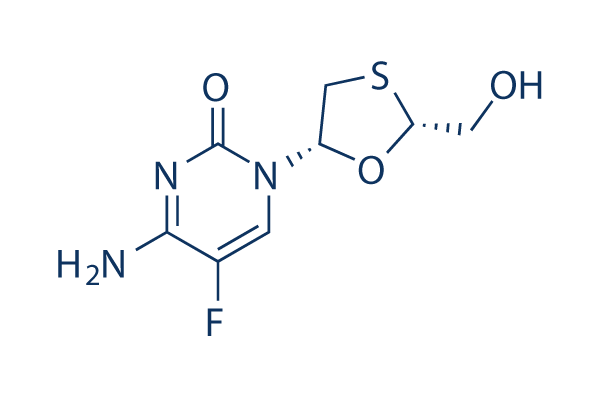
Chemische Struktur
Molekulargewicht: 247.25
Qualitätskontrolle
| Verwandte Ziele | Integrase Bacterial Antibiotics Anti-infection Fungal Antiviral COVID-19 Parasite HIV HCV Protease |
|---|---|
| Weitere Reverse Transcriptase Inhibitoren | Dapivirine (TMC120) Fangchinoline Salicylanilide 3'-Fluoro-3'-deoxythymidine (Alovudine) Ulonivirine Lersivirine (UK-453061) Bifendate 4-Chloro-2-(trifluoroacetyl)aniline hydrochloride |
Zellkultur, Behandlung & Arbeitskonzentration
| Zelllinien | Assay-Typ | Konzentration | Inkubationszeit | Formulierung | Aktivitätsbeschreibung | PMID |
|---|---|---|---|---|---|---|
| HepAD38 cell | Function assay | Inhibition of hepatitis B virus replication in the HepAD38 cell line, ED50=0.03 μM | ||||
| MT2 cells | Function assay | Antiviral activity against HIV1 infected in human MT2 cells assessed as inhibition of viral replication, IC50=0.044 μM | ||||
| HeLa P4/R5 cells | Function assay | Antiviral activity against HIV1 infected in human HeLa P4/R5 cells assessed as inhibition of viral replication, IC50=0.17 μM | ||||
| HepG2 cells | Cytotoxicity assay | 9 days | Cytotoxicity against human HepG2 cells after 9 days by MTT assay, IC50=27.7 μM | |||
| MDCK2 cells | Function assay | 10 μM | Inhibition of human MRP3 expressed in MDCK2 cells assessed as increase in intracellular CMF fluorescence at 10 uM by CMFDA assay | |||
| Klicken Sie hier, um weitere experimentelle Daten zu Zelllinien anzuzeigen | ||||||
Chemische Informationen, Lagerung & Stabilität
| Molekulargewicht | 247.25 | Formel | C8H10FN3O3S |
Lagerung (Ab dem Eingangsdatum) | |
|---|---|---|---|---|---|
| CAS-Nr. | 143491-57-0 | SDF herunterladen | Lagerung von Stammlösungen |
|
|
| Synonyme | BW 1592 | Smiles | C1C(OC(S1)CO)N2C=C(C(=NC2=O)N)F | ||
Löslichkeit
|
In vitro |
DMSO
: 49 mg/mL
(198.17 mM)
Water : 49 mg/mL Ethanol : 13 mg/mL |
Molaritätsrechner
|
In vivo |
|||||
In-vivo-Formulierungsrechner (Klare Lösung)
Schritt 1: Geben Sie die untenstehenden Informationen ein (Empfohlen: Ein zusätzliches Tier zur Berücksichtigung von Verlusten während des Experiments)
Schritt 2: Geben Sie die In-vivo-Formulierung ein (Dies ist nur der Rechner, keine Formulierung. Bitte kontaktieren Sie uns zuerst, wenn es im Abschnitt "Löslichkeit" keine In-vivo-Formulierung gibt.)
Berechnungsergebnisse:
Arbeitskonzentration: mg/ml;
Methode zur Herstellung der DMSO-Stammlösung: mg Wirkstoff vorgelöst in μL DMSO ( Konzentration der Stammlösung mg/mL, Bitte kontaktieren Sie uns zuerst, wenn die Konzentration die DMSO-Löslichkeit der Wirkstoffcharge überschreitet. )
Methode zur Herstellung der In-vivo-Formulierung: Nehmen Sie μL DMSO Stammlösung, dann hinzufügenμL PEG300, mischen und klären, dann hinzufügenμL Tween 80, mischen und klären, dann hinzufügen μL ddH2O, mischen und klären.
Methode zur Herstellung der In-vivo-Formulierung: Nehmen Sie μL DMSO Stammlösung, dann hinzufügen μL Maisöl, mischen und klären.
Hinweis: 1. Bitte stellen Sie sicher, dass die Flüssigkeit klar ist, bevor Sie das nächste Lösungsmittel hinzufügen.
2. Achten Sie darauf, das/die Lösungsmittel der Reihe nach hinzuzufügen. Sie müssen sicherstellen, dass die bei der vorherigen Zugabe erhaltene Lösung eine klare Lösung ist, bevor Sie mit der Zugabe des nächsten Lösungsmittels fortfahren. Physikalische Methoden wie Vortex, Ultraschall oder ein heißes Wasserbad können zur Unterstützung des Lösens verwendet werden.
Wirkmechanismus
| Targets/IC50/Ki |
Reverse transcriptase
|
|---|---|
| In vitro |
Emtricitabine (FTC) reduziert die Proliferation von Hepatozyten moderat, unabhängig von Auswirkungen auf die mtDNA in HepG2-Hepatomzellen des Menschen, und in Kombination mit Tenofovir reduziert es die Zellproliferation geringfügig, ohne mitochondriale Parameter zu beeinflussen. Es wandelt sich in PBMCs und CEM-Zellen effizient in seine aktiven Metaboliten um und zeigt eine additive bis synergistische Aktivität gegen die HIV-Replikation in PBMCs, wenn es mit Tenofovir kombiniert wird, was zu einer stark synergistischen Anti-HIV-Aktivität in MT-2-Zellen sowohl gegen Wildtyp- als auch gegen mutierte Viren führt. Diese Verbindung zeigt antivirale Aktivität gegen im Labor adaptierte Stämme von HIV-1 und HIV-2 in verschiedenen Zellsystemen und weist auch antivirale Aktivität in Zellkulturen gegen feline und simiane Immundefizienzviren (SIVs) auf. Es zeigt durchweg eine bis zu 10-fach höhere Aktivität als Lamivudin gegen alle getesteten Viren in allen T-Zelllinien und demonstriert im Allgemeinen eine größere Wirksamkeit in vitro in menschlichen PBMCs als in MT-4-Linien. Zusätzlich zeigt es eine Anti-HBV-Aktivität in vitro (EC50, 0,01–0,04 µM), die mit der Anti-HBV-Aktivität von 3TC vergleichbar ist. Es ist ungefähr viermal aktiver als 3TC in Assays in der transformierten T-Zelllinie MT-4, die mit HIV-(1IIIB) infiziert ist, während Zidovudin aktiver ist als diese Verbindung. Emtricitabine, Lamivudin und Zidovudin sind gleichermaßen aktiv gegen eine Gruppe von acht primären HIV-1-Isolaten von antiretroviral naiven Probanden in PBMCs.
|
Literatur |
|
Klinische Studieninformationen
(Daten von https://clinicaltrials.gov, aktualisiert am 2024-05-22)
| NCT-Nummer | Rekrutierung | Erkrankungen | Sponsor/Kooperationspartner | Startdatum | Phasen |
|---|---|---|---|---|---|
| NCT06005610 | Recruiting | HIV I Infection |
National Institute of Allergy and Infectious Diseases (NIAID) |
January 4 2024 | Phase 2 |
| NCT05924438 | Recruiting | HIV-1-infection |
Professor Francois Venter|Africa Health Research Institute|Merck Sharp & Dohme LLC|University of Witwatersrand South Africa |
November 8 2023 | Phase 3 |
Technischer Support
Tel: +1-832-582-8158 Ext:3
Wenn Sie weitere Fragen haben, hinterlassen Sie bitte eine Nachricht.

Produkte sind nur für Forschungszwecke bestimmt. Nicht für den menschlichen Gebrauch. Wir verkaufen nicht an Patienten.
©Copyright 2013 Selleck Chemicals. Alle Rechte vorbehalten.