
nur für Forschungszwecke
OSU-03012 (AR-12) PDPK1 Inhibitor
Kat.-Nr.S1106
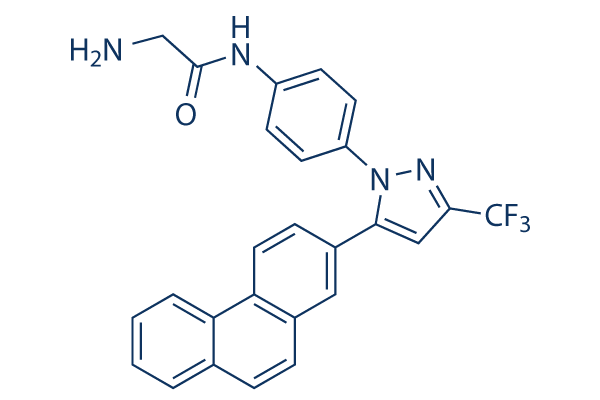
Chemische Struktur
Molekulargewicht: 460.45
Qualitätskontrolle
Zellkultur, Behandlung & Arbeitskonzentration
| Zelllinien | Assay-Typ | Konzentration | Inkubationszeit | Formulierung | Aktivitätsbeschreibung | PMID |
|---|---|---|---|---|---|---|
| mouse RAW264.7 cells | Function assay | 8 h | Antimicrobial activity against Salmonella enterica serovar Typhimurium ATCC 14028 infected in mouse RAW264.7 cells assessed as inhibition of intracellular bacterial growth after 8 hrs, IC50=0.2 μM | |||
| mouse RAW264.7 cells | Cytotoxic assay | 24 h | Cytotoxicity against mouse RAW264.7 cells assessed as cell viability after 24 hrs by MTT assay, IC50=10 μM | |||
| Klicken Sie hier, um weitere experimentelle Daten zu Zelllinien anzuzeigen | ||||||
Chemische Informationen, Lagerung & Stabilität
| Molekulargewicht | 460.45 | Formel | C26H19F3N4O |
Lagerung (Ab dem Eingangsdatum) | |
|---|---|---|---|---|---|
| CAS-Nr. | 742112-33-0 | SDF herunterladen | Lagerung von Stammlösungen |
|
|
| Synonyme | N/A | Smiles | C1=CC=C2C(=C1)C=CC3=C2C=CC(=C3)C4=CC(=NN4C5=CC=C(C=C5)NC(=O)CN)C(F)(F)F | ||
Löslichkeit
|
In vitro |
DMSO
: 11 mg/mL
(23.88 mM)
Water : Insoluble Ethanol : Insoluble |
Molaritätsrechner
|
In vivo |
|||||
In-vivo-Formulierungsrechner (Klare Lösung)
Schritt 1: Geben Sie die untenstehenden Informationen ein (Empfohlen: Ein zusätzliches Tier zur Berücksichtigung von Verlusten während des Experiments)
Schritt 2: Geben Sie die In-vivo-Formulierung ein (Dies ist nur der Rechner, keine Formulierung. Bitte kontaktieren Sie uns zuerst, wenn es im Abschnitt "Löslichkeit" keine In-vivo-Formulierung gibt.)
Berechnungsergebnisse:
Arbeitskonzentration: mg/ml;
Methode zur Herstellung der DMSO-Stammlösung: mg Wirkstoff vorgelöst in μL DMSO ( Konzentration der Stammlösung mg/mL, Bitte kontaktieren Sie uns zuerst, wenn die Konzentration die DMSO-Löslichkeit der Wirkstoffcharge überschreitet. )
Methode zur Herstellung der In-vivo-Formulierung: Nehmen Sie μL DMSO Stammlösung, dann hinzufügenμL PEG300, mischen und klären, dann hinzufügenμL Tween 80, mischen und klären, dann hinzufügen μL ddH2O, mischen und klären.
Methode zur Herstellung der In-vivo-Formulierung: Nehmen Sie μL DMSO Stammlösung, dann hinzufügen μL Maisöl, mischen und klären.
Hinweis: 1. Bitte stellen Sie sicher, dass die Flüssigkeit klar ist, bevor Sie das nächste Lösungsmittel hinzufügen.
2. Achten Sie darauf, das/die Lösungsmittel der Reihe nach hinzuzufügen. Sie müssen sicherstellen, dass die bei der vorherigen Zugabe erhaltene Lösung eine klare Lösung ist, bevor Sie mit der Zugabe des nächsten Lösungsmittels fortfahren. Physikalische Methoden wie Vortex, Ultraschall oder ein heißes Wasserbad können zur Unterstützung des Lösens verwendet werden.
Wirkmechanismus
| Targets/IC50/Ki |
PDPK1
(Cell-free assay) 5 μM
|
|---|---|
| In vitro |
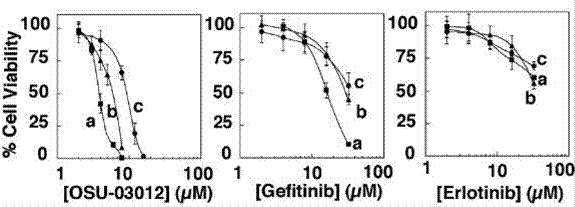
OSU-03012 (AR-12) induziert den apoptotischen Zelltod in PC-3-Zellen mit einer IC50 von 5 µM und reduziert die Aktivität der immunpräzipitierten p70S6K. Es unterdrückt das Zellwachstum in einer Vielzahl von Tumorzelllinien bei Konzentrationen von 3–5 μm vollständig, verglichen mit einer Konzentration von mindestens 50 μm. Diese Verbindung fördert das Abtöten von Gliazellen in größerem Maße als in nicht transformierten Astrozyten. Sie verursacht eine dosisabhängige Induktion des Zelltods, der durch p53-Mutation, Expression von ERBB1 VIII oder den Verlust der Phosphatase- und Tensin-Funktion aufgrund einer homologen Deletion auf Chromosom 10 nicht verändert wird. OSU-03012 und ionisierende Strahlung verursachen eine additive, Caspase-unabhängige Erhöhung des Zelltods. Ihre Letalität als Einzelwirkstoff oder in Kombination mit Signalmodulatoren wird in Zellen, denen die Expression von BIM oder von BAX/BAK fehlt, nicht modifiziert. Sie fördert die Freisetzung von Cathepsin B aus dem lysosomalen Kompartiment und von AIF aus den Mitochondrien. Die Letalität dieser Verbindung ist in Protein-Kinase-R-ähnlichen Endoplasmatisches-Retikulum-Kinase-/-Zellen abgeschwächt, was mit der reduzierten Spaltung von BID und der Unterdrückung der Freisetzung von Cathepsin B und AIF in das Zytosol korrelierte. Es hemmt die Proliferation und Migration von Schilddrüsenkrebszellen (NPA-, WRO- und ARO-Zellen) und induziert Apoptose, was zu einer Zunahme der Zellen in der S-Phase ohne Zunahme der Zellen in G2 führt. OSU-03012 ist ein ATP-kompetitiver Inhibitor der PAK-Aktivität und unterdrückt die Phosphorylierung von AKT in Schilddrüsenkrebszellen. Es hemmt das Zellwachstum von hepatozellulären Karzinomzelllinien, einschließlich Huh7-, Hep3B- und HepG2-Zellen, mit IC50-Werten unter 1 μM. Diese Verbindung unterdrückt weder die PDK1- oder AKT-Aktivität noch induziert sie die zelluläre Apoptose, sondern induziert Autophagie in Huh7-Zellen. Darüber hinaus wird nach ihrer Behandlung eine Akkumulation reaktiver Sauerstoffspezies (ROS) nachgewiesen. Eine aktuelle Studie zeigt, dass sie die Anfälligkeit von (Bcr)-Abl-mutierten Zelllinien für Apoptose verstärken könnte. |
| Kinase-Assay |
PDK-1 Kinase-Assay
|
|
Dieser In-vitro-Assay wird unter Verwendung eines PDK-1-Kinase-Assay-Kits durchgeführt. Dieser zellfreie Assay basiert auf der Fähigkeit der rekombinanten PDK-1, in Gegenwart von DMSO-Vehikel oder OSU-03012 (AR-12), ihre nachgeschaltete Serum- und Glukokortikoid-regulierte Kinase zu aktivieren, die wiederum das Akt/Serum- und Glukokortikoid-regulierte Kinase-spezifische Peptidsubstrat RPRAATF mit [γ-32P]ATP phosphoryliert. Das 32P-phosphorylierte Peptidsubstrat wird dann mittels P81-Phosphocellulosepapier von dem restlichen [γ-32P]-ATP getrennt und nach drei Waschvorgängen mit 0,75%iger Phosphorsäure in einem Szintillationszähler quantifiziert.
|
|
| In vivo |
OSU-03012 (AR-12) unterdrückt das Tumorwachstum um 57,59% und erhöht gespaltenes LC3 in Huh7-Tumor-Xenografts bei 200 mg/kg. Diese Verbindung verringert die Expression des EGFR-Proteins in den Tumoren um 48% im Vergleich zu Vehikelkontrollen und verhindert auch, dass YB-1 an den EGFR-Promotor in MDA-MB-435/LCC6-Xenografts bindet. Es wird gut vertragen und hemmt das Wachstum von HMS-97-Schwannom-Xenografts um 55% nach oraler Verabreichung. |
Literatur |
|
Anwendungen
| Methoden | Biomarker | Bilder | PMID |
|---|---|---|---|
| Western blot | p-Akt / Akt |

|
18413750 |
| Growth inhibition assay | Cell viability |
|
18413750 |
Technischer Support
Tel: +1-832-582-8158 Ext:3
Wenn Sie weitere Fragen haben, hinterlassen Sie bitte eine Nachricht.

Produkte sind nur für Forschungszwecke bestimmt. Nicht für den menschlichen Gebrauch. Wir verkaufen nicht an Patienten.
©Copyright 2013 Selleck Chemicals. Alle Rechte vorbehalten.