
nur für Forschungszwecke
Hydrocortisone (Cortisol) Glucocorticoid Receptor Agonist
Kat.-Nr.S1696
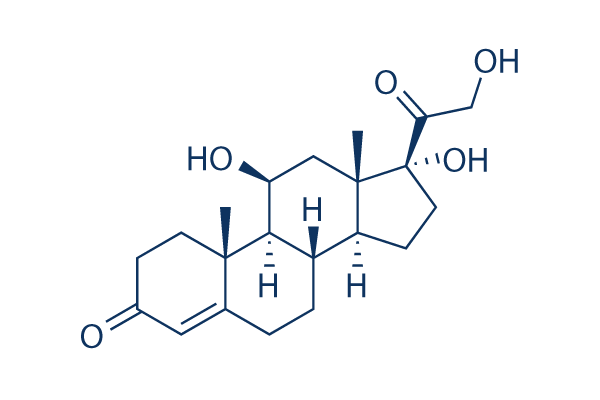
Chemische Struktur
Molekulargewicht: 362.46
Qualitätskontrolle
| Verwandte Ziele | Adrenergic Receptor Estrogen/progestogen Receptor GPR Androgen Receptor ACE RAAS Progesterone Receptor Opioid Receptor PGES THR |
|---|---|
| Weitere Glucocorticoid Receptor Inhibitoren | Corticosterone AL082D06 (20S)-Protopanaxatriol Cortodoxone |
Zellkultur, Behandlung & Arbeitskonzentration
| Zelllinien | Assay-Typ | Konzentration | Inkubationszeit | Formulierung | Aktivitätsbeschreibung | PMID |
|---|---|---|---|---|---|---|
| mouse RAW264.7 cells | Function assay | 24 h | Antiinflammatory activity in mouse RAW264.7 cells assessed as inhibition of IFN-gamma induced NO production after 24 hrs by Griess reaction, IC50=0.061 μM | 21361338 | ||
| mouse L929 cells | Growth inhibition assay | 6 days | Growth inhibition of mouse L929 cells after 6 days | 926113 | ||
| RAW264.7 | Antiinflammatory assay | Antiinflammatory activity in mouse RAW264.7 cells assessed as inhibition of LPS-induced NO production by MTT assay, IC50 = 40.64 μM. | 20879743 | |||
| RAW264.7 | Function assay | 24 hrs | Inhibition of LPS-induced nitric oxide production in mouse RAW264.7 cells after 24 hrs by Griess reaction based spectrophotometry, IC50 = 40.64 μM. | 21807513 | ||
| RAW264.7 | Function assay | 24 hrs | Inhibition of LPS-induced NO production in mouse RAW264.7 cells after 24 hrs by Griess reaction, IC50 = 40.64 μM. | 23067550 | ||
| RAW264.7 | Antiinflammatory assay | 24 hrs | Antiinflammatory activity in mouse RAW264.7 cells assessed as inhibition of LPS-induced nitric oxide production after 24 hrs by Griess assay, IC50 = 43.8 μM. | 23755850 | ||
| L929 | Function assay | 20 hrs | Displacement of 1 x 10'-8 M of [1,2,3-3H]-triamcinolone acetonide from glucocorticoid receptor in soluble fraction of mouse L929 cells after 20 hrs, Kd = 0.043 μM. | 926113 | ||
| HEK293 | Function assay | Inhibition of MR-mediated transactivation of galactosidase reporter gene in HEK293 cells expressing 11betaHSD1 | 16759088 | |||
| RAW264.7 | Antiinflammatory assay | 0.5 to 50 ug/ml | 4 hrs | Antiinflammatory activity against LPS-stimulated mouse RAW264.7 cells assessed as inhibition of IL-10 production at 0.5 to 50 ug/ml pretreated for 4 hrs followed by challenge with 1 ug/mL LPS for 48 hrs by ELISA relative to control | 21384845 | |
| RAW264.7 | Antiinflammatory assay | 0.5 to 50 ug/ml | 4 hrs | Antiinflammatory activity against LPS-stimulated mouse RAW264.7 cells assessed as inhibition of IL-6 production at 0.5 to 50 ug/ml pretreated for 4 hrs followed by challenge with 1 ug/mL LPS for 48 hrs by ELISA relative to control | 21384845 | |
| RAW264.7 | Antiinflammatory assay | 0.5 to 50 ug/ml | 4 hrs | Antiinflammatory activity against LPS-stimulated mouse RAW264.7 cells assessed as inhibition of IL1-beta production at 0.5 to 50 ug/ml pretreated for 4 hrs followed by challenge with 1 ug/mL LPS for 48 hrs by ELISA relative to control | 21384845 | |
| RAW264.7 | Antiinflammatory assay | 0.5 to 50 ug/ml | 4 hrs | Antiinflammatory activity against LPS-stimulated mouse RAW264.7 cells assessed as inhibition of TNFalpha production at 0.5 to 50 ug/ml pretreated for 4 hrs followed by challenge with 1 ug/mL LPS for 48 hrs by ELISA relative to control | 21384845 | |
| RAW264.7 | Antiinflammatory assay | 0.5 to 50 ug/ml | 4 hrs | Antiinflammatory activity against LPS-stimulated mouse RAW264.7 cells assessed as inhibition of nitric oxide production at 0.5 to 50 ug/ml pretreated for 4 hrs followed by challenge with 1 ug/mL LPS for 48 hrs by Griess reaction method relative to control | 21384845 | |
| neural precursor cells | Function assay | Inhibition of neurosphere proliferation of mouse neural precursor cells by MTT assay | 17417631 | |||
| RAW264.7 | Antiinflammatory assay | 10 uM | 2 hrs | Antiinflammatory activity in mouse RAW264.7 cells assessed as inhibition of LPS-induced increase in TNF-alpha level at 10 uM incubated for 2 hrs prior to LPS challenge measured after 22 hrs by ELISA relative to control | 25515561 | |
| RAW264.7 | Antiinflammatory assay | 10 uM | 2 hrs | Antiinflammatory activity in mouse RAW264.7 cells assessed as inhibition of LPS-induced increase in IL-6 level at 10 uM incubated for 2 hrs prior to LPS challenge measured after 22 hrs by ELISA relative to control | 25515561 | |
| RAW264.7 | Antiinflammatory assay | 10 uM | 2 hrs | Antiinflammatory activity in mouse RAW264.7 cells assessed as inhibition of LPS-induced increase in IL-1beta level at 10 uM incubated for 2 hrs prior to LPS challenge measured after 22 hrs by ELISA relative to control | 25515561 | |
| RAW264.7 | Antiinflammatory assay | 10 uM | 2 hrs | Antiinflammatory activity in mouse RAW264.7 cells assessed as inhibition of LPS-induced nitric oxide production at 10 uM incubated for 2 hrs prior to LPS challenge measured after 22 hrs relative to vehicle-treated control | 25515561 | |
| B16F10 | Apoptosis assay | 20 uM | 36 hrs | Induction of apoptosis in mouse B16F10 cells assessed as increase in cleaved caspase 3 level at 20 uM after 36 hrs by western blot analysis | 26695732 | |
| B16F10 | Apoptosis assay | 20 uM | 36 hrs | Induction of apoptosis in mouse B16F10 cells assessed as increase in p53 expression at 20 uM after 36 hrs by propidium iodide staining based FACS analysis | 26695732 | |
| B16F10 | Apoptosis assay | 20 uM | 36 hrs | Induction of apoptosis in mouse B16F10 cells assessed as increased Bax expression at 20 uM after 36 hrs by western blot analysis | 26695732 | |
| B16F10 | Antitumor activity assay | 6.11 mg/kg | Antitumor activity against mouse B16F10 cells xenografted in C57BL/J mouse assessed as inhibition of tumor growth at 6.11 mg/kg, ip | 26695732 | ||
| B16F10 | Apoptosis assay | 20 uM | 36 hrs | Induction of apoptosis in mouse B16F10 cells assessed as increase in cytochrome C level at 20 uM after 36 hrs by western blot analysis | 26695732 | |
| Klicken Sie hier, um weitere experimentelle Daten zu Zelllinien anzuzeigen | ||||||
Chemische Informationen, Lagerung & Stabilität
| Molekulargewicht | 362.46 | Formel | C21H30O5 |
Lagerung (Ab dem Eingangsdatum) | |
|---|---|---|---|---|---|
| CAS-Nr. | 50-23-7 | SDF herunterladen | Lagerung von Stammlösungen |
|
|
| Synonyme | NSC 10483 | Smiles | CC12CCC(=O)C=C1CCC3C2C(CC4(C3CCC4(C(=O)CO)O)C)O | ||
Löslichkeit
|
In vitro |
DMSO
: 72 mg/mL
(198.64 mM)
Ethanol : 15 mg/mL Water : Insoluble |
Molaritätsrechner
|
In vivo |
|||||
In-vivo-Formulierungsrechner (Klare Lösung)
Schritt 1: Geben Sie die untenstehenden Informationen ein (Empfohlen: Ein zusätzliches Tier zur Berücksichtigung von Verlusten während des Experiments)
Schritt 2: Geben Sie die In-vivo-Formulierung ein (Dies ist nur der Rechner, keine Formulierung. Bitte kontaktieren Sie uns zuerst, wenn es im Abschnitt "Löslichkeit" keine In-vivo-Formulierung gibt.)
Berechnungsergebnisse:
Arbeitskonzentration: mg/ml;
Methode zur Herstellung der DMSO-Stammlösung: mg Wirkstoff vorgelöst in μL DMSO ( Konzentration der Stammlösung mg/mL, Bitte kontaktieren Sie uns zuerst, wenn die Konzentration die DMSO-Löslichkeit der Wirkstoffcharge überschreitet. )
Methode zur Herstellung der In-vivo-Formulierung: Nehmen Sie μL DMSO Stammlösung, dann hinzufügenμL PEG300, mischen und klären, dann hinzufügenμL Tween 80, mischen und klären, dann hinzufügen μL ddH2O, mischen und klären.
Methode zur Herstellung der In-vivo-Formulierung: Nehmen Sie μL DMSO Stammlösung, dann hinzufügen μL Maisöl, mischen und klären.
Hinweis: 1. Bitte stellen Sie sicher, dass die Flüssigkeit klar ist, bevor Sie das nächste Lösungsmittel hinzufügen.
2. Achten Sie darauf, das/die Lösungsmittel der Reihe nach hinzuzufügen. Sie müssen sicherstellen, dass die bei der vorherigen Zugabe erhaltene Lösung eine klare Lösung ist, bevor Sie mit der Zugabe des nächsten Lösungsmittels fortfahren. Physikalische Methoden wie Vortex, Ultraschall oder ein heißes Wasserbad können zur Unterstützung des Lösens verwendet werden.
Wirkmechanismus
| Targets/IC50/Ki |
Glucocorticoid receptor
|
|---|---|
| In vitro |
Hydrocortisone verhindert den Zusammenbruch der Endothelbarriere als Reaktion auf proinflammatorische Stimuli (TNFalpha-Verabreichung) in der menschlichen Hirnmikrovaskulären Endothelzelllinie hCMEC/D3, was teilweise auf der Aufrechterhaltung der Occludin-Spiegel beruhen konnte. Diese Verbindung-behandelten dendritischen Zellen (DCs) zeigen eine verringerte Expression von MHC-II-Molekülen, dem kostimulatorischen Molekül CD86 und dem DC-spezifischen Marker CD83, sowie eine stark reduzierte IL-12-Sekretion. Es hemmt die Produktion von IFN-gamma, induziert aber eine erhöhte Freisetzung von IL-4 und keine Änderung von IL-5. Diese Chemikalie reduziert die T-Zell-Proliferation in dendritischen Zellen. Es verhindert die TNF-alpha-induzierte schwere Degradation des Glykokalix, erhöhten Koronarwiderstand, erhöhte vaskuläre Leckage und Permeabilität für Hydroxyethylstärke und verursachte Mastzell-Degranulation in isolierten Meerschweinchenherzen. Diese Verbindung reduziert postischämischen oxidativen Stress, Perfusionsdruck und Transsudatbildung in isolierten Meerschweinchenherzen. Es hemmt das postischämische Shedding von Syndecan-1, Heparansulfat und Hyaluronan sowie die Freisetzung von Histamin aus residenten Mastzellen. Es erhöht die Spiegel von IL-4-induzierten Keimbahn-C-epsilon-Transkripten um das Zweifache und liefert das Signal, das für die Transkription von reifer C-epsilon-mRNA erforderlich ist. Diese Chemikalie induziert die S-mu-S-epsilon-Deletions-Switch-Rekombination in IL-4-behandelten B-Zellen und unterstützt ein Modell des sequenziellen Isotyp-Switches von IgM zu IgE über IgG4. |
Literatur |
|
Anwendungen
| Methoden | Biomarker | Bilder | PMID |
|---|---|---|---|
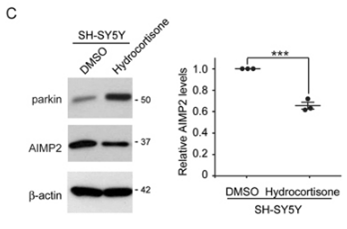
| Western blot | parkin / AIMP2 CREB |
|
28366931 |
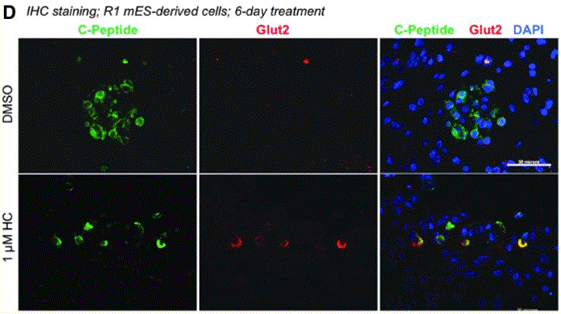
| Immunofluorescence | Glut2 |
|
29717618 |
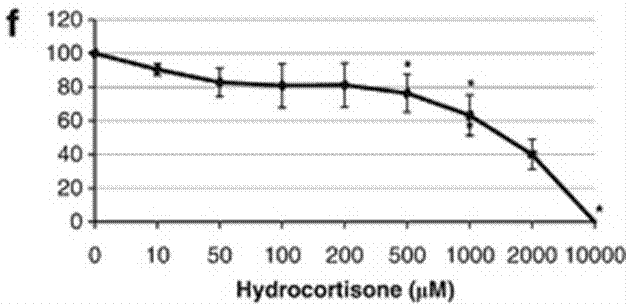
| Growth inhibition assay | Cell viability |
|
22829975 |
Klinische Studieninformationen
(Daten von https://clinicaltrials.gov, aktualisiert am 2024-05-22)
| NCT-Nummer | Rekrutierung | Erkrankungen | Sponsor/Kooperationspartner | Startdatum | Phasen |
|---|---|---|---|---|---|
| NCT05741762 | Active not recruiting | Critical Illness|Adrenal Insufficiency|Septic Shock |
Dr Adnan Agha|United Arab Emirates University |
January 31 2023 | -- |
| NCT05607901 | Recruiting | Dermatologic Disease |
Tanta University |
October 28 2022 | Phase 2 |
| NCT05324618 | Completed | Atopic|Dermatitis |
Ain Shams University|National Hepatology & Tropical Medicine Research Institute |
May 15 2022 | Phase 4 |
Technischer Support
Tel: +1-832-582-8158 Ext:3
Wenn Sie weitere Fragen haben, hinterlassen Sie bitte eine Nachricht.

Produkte sind nur für Forschungszwecke bestimmt. Nicht für den menschlichen Gebrauch. Wir verkaufen nicht an Patienten.
©Copyright 2013 Selleck Chemicals. Alle Rechte vorbehalten.