
nur für Forschungszwecke
ISX-9 (Isoxazole 9) Induktor der Neuralen Stammzelldifferenzierung
Kat.-Nr.S7914
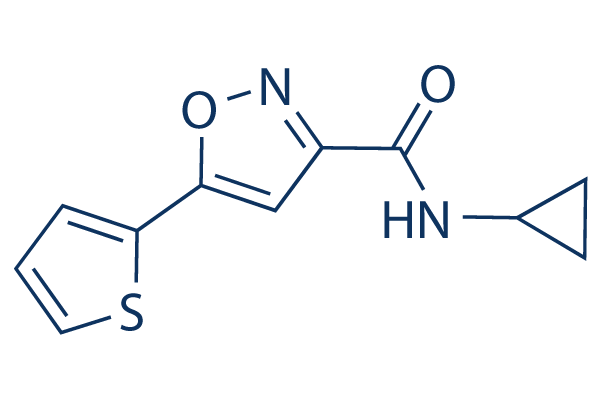
Chemische Struktur
Molekulargewicht: 234.27
Qualitätskontrolle
Zellkultur, Behandlung & Arbeitskonzentration
| Zelllinien | Assay-Typ | Konzentration | Inkubationszeit | Formulierung | Aktivitätsbeschreibung | PMID |
|---|---|---|---|---|---|---|
| HCN | Function assay | Induction of NMDA receptor-mediated Ca2+ influx in rat HCN cells in presence of NMDA receptor antagonist MK801 | 18552832 | |||
| HCN | Function assay | 5 uM | Induction of L-type calcium channel/NMDA receptor-mediated Ca2+ influx in rat HCN cells at 5 uM by Fura-2 imaging analysis in presence of multiple of inhibitors | 18552832 | ||
| HCN | Function assay | 50 uM | 3 hrs | Induction of NMDA receptor-mediated neuroD gene expression in rat HCN cells at 50 uM after 3 hrs by RT-PCR analysis in presence of NMDA receptor antagonist MK801 | 18552832 | |
| HCN | Function assay | 25 uM | 4 days | Inhibition of gliogenesis differentiation in rat HCN cells at 25 uM after 4 days | 18552832 | |
| HCN | Function assay | 5 uM | Induction of L-type calcium channel/NMDA receptor-mediated Ca2+ influx in rat HCN cells at 5 uM by Fura-2 imaging analysis | 18552832 | ||
| HCN | Function assay | 5 uM | Induction of NMDA receptor-mediated Ca2+ influx in rat HCN cells at 5 uM by Fura-2 imaging analysis in presence of NMDA receptor antagonist MK801 | 18552832 | ||
| HCN | Function assay | 50 uM | 3 hrs | Induction of L-type calcium channel/NMDA receptor-mediated neuroD gene expression in rat HCN cells at 50 uM after 3 hrs by RT-PCR analysis in presence of multiple inhibitors | 18552832 | |
| HCN | Function assay | Induction of L-type calcium channel/NMDA receptor-mediated Ca2+ influx in rat HCN cells | 18552832 | |||
| HCN | Function assay | Induction of L-type calcium channel/NMDA receptor-mediated Ca2+ influx in rat HCN cells in presence multiple inhibitors | 18552832 | |||
| HCN | Function assay | 50 uM | 24 hrs | Induction of NMDA receptor-mediated neuroD gene expression in rat HCN cells at 50 uM after 24 hrs by RT-PCR analysis in presence of NMDA receptor antagonist MK801 | 18552832 | |
| HCN | Function assay | 50 uM | 24 hrs | Induction of NMDA receptor-mediated neuroD gene expression in rat HCN cells at 50 uM after 24 hrs by RT-PCR analysis in presence of NMDA receptor antagonist nifedipine | 18552832 | |
| HCN | Function assay | 50 uM | 24 hrs | Induction of L-type calcium channel/NMDA receptor-mediated neuroD gene expression in rat HCN cells at 50 uM after 24 hrs by RT-PCR analysis in presence of multiple inhibitors | 18552832 | |
| HCN | Function assay | 8 to 64 uM | 9 hrs | Induction of neurogenesis in undifferentiated rat HCN cells assessed as MAP2AB protein level at 8 to 64 uM after 9 hrs by protein blotting analysis | 18552832 | |
| HCN | Function assay | Induction of HDAC5 translocation in cytoplasm of rat HCN cells assessed as phosphorylated HDAC5 accumulation | 18552832 | |||
| HCN | Function assay | Induction of CAMK-mediated MREx3 activity in rat HCN cells by luciferase reporter gene assay in presence of 2.5 uM potassium channel inhibitor KN92 | 18552832 | |||
| HCN | Function assay | 8 to 64 uM | 9 hrs | Induction of neurogenesis in undifferentiated rat HCN cells assessed as GlR2/3 protein level at 8 to 64 uM after 9 hrs by protein blotting analysis | 18552832 | |
| HCN | Function assay | 6 hrs | Induction of HDAC5 phosphorylation in rat HCN cells after 6 hrs | 18552832 | ||
| HCN | Function assay | 24 hrs | Induction of HDAC5 phosphorylation in rat HCN cells after 24 hrs | 18552832 | ||
| HCN | Function assay | Induction of HDAC5 translocation in nucleus of rat HCN cells assessed as phosphorylated HDAC5 accumulation | 18552832 | |||
| HCN | Function assay | 5 uM | Induction of HDAC5 translocation in nucleus of rat HCN cells assessed as GFP-HDAC5 S258A S498A mutant fusion protein accumulation at 5 uM by fluorescence assay | 18552832 | ||
| HCN | Function assay | 50 uM | 3 hrs | Induction of NMDA receptor-mediated neuroD gene expression in rat HCN cells at 50 uM after 3 hrs by RT-PCR analysis in presence of NMDA receptor antagonist nifedipine | 18552832 | |
| HCN | Function assay | 20 uM | Induction of HDAC5 translocation in nucleus of rat HCN cells assessed as GFP-HDAC5 fusion protein accumulation at 20 uM by fluorescence assay | 18552832 | ||
| HCN | Function assay | Induction of CAMK-mediated MREx3 activity in rat HCN cells by luciferase reporter gene assay in presence of 200 nM PKC inhibitor Go6976 | 18552832 | |||
| HCN | Function assay | 24 hrs | Induction of L-type calcium channel-mediated neuroD gene expression in rat HCN cells after 24 hrs by luciferase reporter gene assay in presence of multiple inhibitors | 18552832 | ||
| HCN | Function assay | 24 hrs | Induction of L-type calcium channel-mediated neuroD gene expression in rat HCN cells after 24 hrs by luciferase reporter gene assay in presence of NMDA receptor antagonist MK801 | 18552832 | ||
| HCN | Function assay | 24 hrs | Induction of L-type calcium channel-mediated neuroD gene expression in rat HCN cells after 24 hrs by luciferase reporter gene assay in presence of NMDA receptor antagonist nifedipine | 18552832 | ||
| Klicken Sie hier, um weitere experimentelle Daten zu Zelllinien anzuzeigen | ||||||
Chemische Informationen, Lagerung & Stabilität
| Molekulargewicht | 234.27 | Formel | C11H10N2O2S |
Lagerung (Ab dem Eingangsdatum) | |
|---|---|---|---|---|---|
| CAS-Nr. | 832115-62-5 | SDF herunterladen | Lagerung von Stammlösungen |
|
|
| Synonyme | N/A | Smiles | C1CC1NC(=O)C2=NOC(=C2)C3=CC=CS3 | ||
Löslichkeit
|
In vitro |
DMSO
: 47 mg/mL
(200.62 mM)
Ethanol : 12 mg/mL Water : Insoluble |
Molaritätsrechner
|
In vivo |
|||||
In-vivo-Formulierungsrechner (Klare Lösung)
Schritt 1: Geben Sie die untenstehenden Informationen ein (Empfohlen: Ein zusätzliches Tier zur Berücksichtigung von Verlusten während des Experiments)
Schritt 2: Geben Sie die In-vivo-Formulierung ein (Dies ist nur der Rechner, keine Formulierung. Bitte kontaktieren Sie uns zuerst, wenn es im Abschnitt "Löslichkeit" keine In-vivo-Formulierung gibt.)
Berechnungsergebnisse:
Arbeitskonzentration: mg/ml;
Methode zur Herstellung der DMSO-Stammlösung: mg Wirkstoff vorgelöst in μL DMSO ( Konzentration der Stammlösung mg/mL, Bitte kontaktieren Sie uns zuerst, wenn die Konzentration die DMSO-Löslichkeit der Wirkstoffcharge überschreitet. )
Methode zur Herstellung der In-vivo-Formulierung: Nehmen Sie μL DMSO Stammlösung, dann hinzufügenμL PEG300, mischen und klären, dann hinzufügenμL Tween 80, mischen und klären, dann hinzufügen μL ddH2O, mischen und klären.
Methode zur Herstellung der In-vivo-Formulierung: Nehmen Sie μL DMSO Stammlösung, dann hinzufügen μL Maisöl, mischen und klären.
Hinweis: 1. Bitte stellen Sie sicher, dass die Flüssigkeit klar ist, bevor Sie das nächste Lösungsmittel hinzufügen.
2. Achten Sie darauf, das/die Lösungsmittel der Reihe nach hinzuzufügen. Sie müssen sicherstellen, dass die bei der vorherigen Zugabe erhaltene Lösung eine klare Lösung ist, bevor Sie mit der Zugabe des nächsten Lösungsmittels fortfahren. Physikalische Methoden wie Vortex, Ultraschall oder ein heißes Wasserbad können zur Unterstützung des Lösens verwendet werden.
Wirkmechanismus
| In vitro |
ISX-9 (Isoxazole 9) erhöht die Zellzahl und fördert die Zelldifferenzierung in NSPCs, während es in OPCs Zellschäden induziert. In Auswachs-EPCs verringert diese Verbindung die Röhrchenbildung ohne Auswirkungen auf frühe EPCs.
|
|---|---|
| In vivo |
Bei Mäusen überwindet ISX-9 (Isoxazole 9) (20 mg/kg, i.p.) die BBB und erhöht die Proliferation von Neuroblasten und die Neurogenese über Mef2-spezifische Mechanismen in der hippocampalen SGZ. Diese Verbindung erhöht auch die Differenzierung und dendritische Komplexität unreifer Neuronen und verbessert das Gedächtnis. Im MWM verbessert es das räumliche Gedächtnis.
|
Literatur |
|
Technischer Support
Tel: +1-832-582-8158 Ext:3
Wenn Sie weitere Fragen haben, hinterlassen Sie bitte eine Nachricht.

Produkte sind nur für Forschungszwecke bestimmt. Nicht für den menschlichen Gebrauch. Wir verkaufen nicht an Patienten.
©Copyright 2013 Selleck Chemicals. Alle Rechte vorbehalten.