
nur für Forschungszwecke
CAL-101 (Idelalisib) PI3Kδ-Inhibitor
Kat.-Nr.S2226
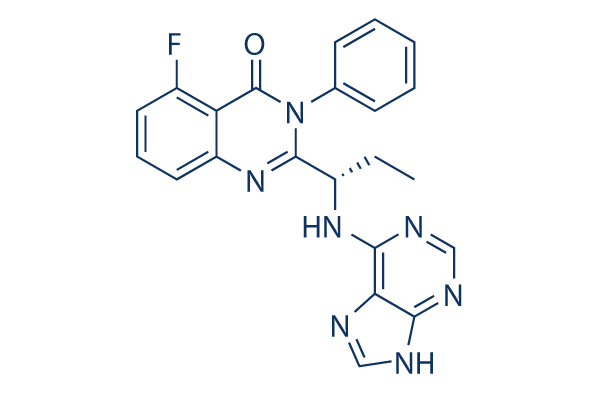
Chemische Struktur
Molekulargewicht: 415.42
Qualitätskontrolle
| Verwandte Ziele | Akt mTOR GSK-3 ATM/ATR DNA-PK AMPK PDPK1 PTEN PP2A PDK |
|---|---|
| Weitere PI3K Inhibitoren | GDC-0077 (Inavolisib) SAR405 Quercetin (Sophoretin) LY294002 XL147 analogue Tersolisib (STX-478) Buparlisib (BKM120) 740 Y-P (PDGFR 740Y-P) GO-203 TFA Eganelisib (IPI-549) |
Zellkultur, Behandlung & Arbeitskonzentration
| Zelllinien | Assay-Typ | Konzentration | Inkubationszeit | Formulierung | Aktivitätsbeschreibung | PMID |
|---|---|---|---|---|---|---|
| MEC1 | Growth Inhibition Assay | DMSO | IC50=20.4 μM | 25999352 | ||
| CLL PBMCs | Growth Inhibition Assay | DMSO | IC50=2.9 nM | 25917267 | ||
| U266 | Growth Inhibition Assay | 40 μM | 48 h | 79.5% inhibition rate | 25339332 | |
| K562 | Function Assay | 1 μM | 3 h | Inhibition of Akt phosphorylation | 25014775 | |
| K562 | Function Assay | 1 μM | 3 h | Inhibition of P70S6K phosphorylation | 25014775 | |
| K562 | Function Assay | 1 μM | 3 h | Inhibition of GSK3 phosphorylation | 25014775 | |
| K562 | Growth Inhibition Assay | 1 μM | 72 h | Inhibition of proliferation | 25014775 | |
| Primary AML cell | Function Assay | 1 μM | 3 h | Inhibition of Akt phosphorylation | 25014775 | |
| Primary AML cell | Function Assay | 1 μM | 3 h | Inhibition of P70S6K phosphorylation | 25014775 | |
| Primary AML cell | Function Assay | 1 μM | 3 h | Inhibition of GSK3 phosphorylation | 25014775 | |
| Primary AML cell | Growth Inhibition Assay | 1 μM | 3 h | Suppression of rRNA synthesis | 25014775 | |
| Microglia | Function Assay | 5 μM | 10 h | DMSO | Decrease of TNFa secretion from LPS-stimulated p110δD910A/D910A microglia | 24625684 |
| Primary CLL cell | Function Assay | 1 μM | 15 min | DMSO | Blocks BCR-induced LCP1 serine-5 activation | 24009233 |
| JEKO-1 | Function Assay | 1 μM | 72 h | Inhibition of Akt phosphorylation in IgM-stimulated JEKO-1 | 23341541 | |
| Granta-519 | Function Assay | 1 μM | 2 h | Inhibition of Akt(t308) phosphorylation | 23341541 | |
| Granta-519 | Function Assay | 1 μM | 2 h | Inhibition of Akt(s473) phosphorylation | 23341541 | |
| JEKO-1 | Growth Inhibition Assay | 10 μM | 72 h | Inhibition of proliferation slightly | 23341541 | |
| JEKO-1 | Growth Inhibition Assay | 5 μM | 72 h | does not induce cell cycle arrest or apoptosis | 23676220 | |
| MAVER-1 | Growth Inhibition Assay | 5 μM | 72 h | does not induce cell cycle arrest or apoptosis | 23676220 | |
| MINO | Growth Inhibition Assay | 5 μM | 72 h | does not induce cell cycle arrest or apoptosis | 23676220 | |
| SP53 | Growth Inhibition Assay | 0.1 μM | 72 h | does not induce cell cycle arrest or apoptosis | 23676220 | |
| HH | Growth Inhibition Assay | 10 μM | 72 h | DMSO | Induction of apoptosis slightly | 22801959 |
| Myla | Growth Inhibition Assay | 10 μM | 72 h | DMSO | does not induce apoptosis | 22801959 |
| SR786 | Growth Inhibition Assay | 10 μM | 72 h | DMSO | does not induce apoptosis | 22801959 |
| HuT78 | Growth Inhibition Assay | 10 μM | 72 h | DMSO | does not induce apoptosis | 22801959 |
| MJ | Growth Inhibition Assay | 10 μM | 72 h | DMSO | does not induce apoptosis | 22801959 |
| DERL7 | Growth Inhibition Assay | 10 μM | 72 h | DMSO | does not induce apoptosis | 22801959 |
| L1236 | Function Assay | 10 μM | 2 h | Inhibition of Akt phosphorylation | 22210877 | |
| L428 | Function Assay | 10 μM | 2 h | Inhibition of Akt phosphorylation | 22210877 | |
| L591 | Function Assay | 10 μM | 2 h | Inhibition of Akt phosphorylation | 22210877 | |
| KMH-2 | Function Assay | 10 μM | 2 h | Inhibition of Akt phosphorylation | 22210877 | |
| L1236 | Function Assay | 5 μM | 24 h | Blocks secretion of the CCL5 | 22210877 | |
| L591 | Function Assay | 5 μM | 24 h | Blocks secretion of the CCL5 | 22210877 | |
| L1236 | Apoptosis Assay | 5 μM | 24 h | Induction of apoptosis | 22210877 | |
| L591 | Apoptosis Assay | 5 μM | 24 h | Induction of apoptosis | 22210877 | |
| U-87MG | Function Assay | 100 nM | 24 h | DMSO | Inhibition of cell migration | 22079609 |
| SW1783 | Function Assay | 100 nM | 24 h | DMSO | Inhibition of cell migration | 22079609 |
| U-87MG | Function Assay | 5 μM | 24 h | DMSO | Inhibition of Akt phosphorylation substantially | 22079609 |
| SW1783 | Function Assay | 5 μM | 24 h | DMSO | Inhibition of Akt phosphorylation substantially | 22079609 |
| U-373MG | Function Assay | 5 μM | 24 h | DMSO | Inhibition of Akt phosphorylation substantially | 22079609 |
| SK-MG3 | Function Assay | 5 μM | 24 h | DMSO | Inhibition of Akt phosphorylation substantially | 22079609 |
| SU-DHL-5 | Function Assay | 1 μM | 24 h | DMSO | Induction of apoptosis | 20959606 |
| WSU-NHL | Function Assay | 1 μM | 24 h | DMSO | Induction of apoptosis | 20959606 |
| CCRF-SB | Function Assay | 1 μM | 24 h | DMSO | Induction of apoptosis | 20959606 |
| INA-6 | Function Assay | 5 μM | 6 h | Inhibition of PI3K/Akt and ERK pathway | 20505158 | |
| LB | Function Assay | 5 μM | 6 h | Inhibition of PI4K/Akt and ERK pathway | 20505158 | |
| B-cells | Function assay | Inhibition of PI3Kdelta in B-cells by proliferation assay, IC50 = 0.0061 μM. | 22924688 | |||
| MOLM14 | Antiproliferative assay | 3 days | Antiproliferative activity against human MOLM14 cells after 3 days by CellTiter-Glo assay, IC50 = 3.6 μM. | 27774127 | ||
| MV4-11 | Antiproliferative assay | 3 days | Antiproliferative activity against human MV4-11 cells after 3 days by CellTiter-Glo assay, IC50 = 6.3 μM. | 27774127 | ||
| Jurkat | Antiproliferative assay | 3 days | Antiproliferative activity against human Jurkat cells after 3 days by CellTiter-Glo assay, IC50 = 7.9 μM. | 27774127 | ||
| Loucy | Antiproliferative assay | 3 days | Antiproliferative activity against human Loucy cells after 3 days by CellTiter-Glo assay, IC50 = 8.4 μM. | 27774127 | ||
| MOLT4 | Antiproliferative assay | 3 days | Antiproliferative activity against human MOLT4 cells after 3 days by CellTiter-Glo assay, IC50 = 10.6 μM. | 27774127 | ||
| insect cells | Function assay | Inhibition of recombinant human full length His-tagged PI3Kgamma expressed in insect cells, IC50 = 0.089 μM. | 27846451 | |||
| SUDHL6 | Antiproliferative assay | 72 hrs | Antiproliferative activity against human SUDHL6 cells measured after 72 hrs by alamar blue assay, IC50 = 0.1176 μM. | 27846451 | ||
| insect cells | Function assay | Inhibition of recombinant human full length His-tagged PI3Kbeta expressed in insect cells, IC50 = 0.565 μM. | 27846451 | |||
| SU-DHL4 | Antiproliferative assay | 72 hrs | Antiproliferative activity against human SU-DHL4 cells measured after 72 hrs by alamar blue assay, IC50 = 1.6 μM. | 27846451 | ||
| Pfeiffer | Antiproliferative assay | 72 hrs | Antiproliferative activity against human Pfeiffer cells measured after 72 hrs by alamar blue assay, IC50 = 6.8 μM. | 27846451 | ||
| KARPAS422 | Antiproliferative assay | 72 hrs | Antiproliferative activity against human KARPAS422 cells measured after 72 hrs by alamar blue assay, IC50 = 8.1 μM. | 27846451 | ||
| Sf21 | Function assay | 30 mins | Inhibition of N-terminal His6-tagged recombinant full-length human PI3K p110beta/untagged recombinant full length human p85alpha expressed in baculovirus infected Sf21 insect cells using PIP2/ATP as substrate after 30 mins by TR-FRET assay, IC50 = 3.7 μM. | 28106991 | ||
| Sf21 | Function assay | 30 mins | Inhibition of N-terminal His6-tagged recombinant full-length human PI3K p110beta/untagged recombinant full length human p85alpha expressed in baculovirus infected Sf21 insect cells using PIP2/ATP as substrate after 30 mins by TR-FRET assay, IC50 = 3.7 μM. | 28106991 | ||
| RPMI8266 | Antiproliferative assay | 72 hrs | Antiproliferative activity against human RPMI8266 cells after 72 hrs by MTT assay, IC50 = 0.00549 μM. | 28325601 | ||
| Raji | Antiproliferative assay | 72 hrs | Antiproliferative activity against human Raji cells after 72 hrs by MTT assay, IC50 = 0.00995 μM. | 28325601 | ||
| KARPAS422 | Growth inhibition assay | Growth inhibition of human KARPAS422 cells by CCK8 assay, GI50 = 0.68 μM. | 28835805 | |||
| Pfeiffer | Growth inhibition assay | Growth inhibition of human Pfeiffer cells by CCK8 assay, GI50 = 0.74 μM. | 28835805 | |||
| Saos-2 | qHTS assay | qHTS of pediatric cancer cell lines to identify multiple opportunities for drug repurposing: Primary screen for Saos-2 cells | 29435139 | |||
| SK-N-SH | qHTS assay | qHTS of pediatric cancer cell lines to identify multiple opportunities for drug repurposing: Primary screen for SK-N-SH cells | 29435139 | |||
| MG 63 (6-TG R) | qHTS assay | qHTS of pediatric cancer cell lines to identify multiple opportunities for drug repurposing: Primary screen for MG 63 (6-TG R) cells | 29435139 | |||
| NB1643 | qHTS assay | qHTS of pediatric cancer cell lines to identify multiple opportunities for drug repurposing: Primary screen for NB1643 cells | 29435139 | |||
| OHS-50 | qHTS assay | qHTS of pediatric cancer cell lines to identify multiple opportunities for drug repurposing: Primary screen for OHS-50 cells | 29435139 | |||
| Rh41 | qHTS assay | qHTS of pediatric cancer cell lines to identify multiple opportunities for drug repurposing: Primary screen for Rh41 cells | 29435139 | |||
| SK-N-MC | qHTS assay | qHTS of pediatric cancer cell lines to identify multiple opportunities for drug repurposing: Primary screen for SK-N-MC cells | 29435139 | |||
| NB-EBc1 | qHTS assay | qHTS of pediatric cancer cell lines to identify multiple opportunities for drug repurposing: Primary screen for NB-EBc1 cells | 29435139 | |||
| LAN-5 | qHTS assay | qHTS of pediatric cancer cell lines to identify multiple opportunities for drug repurposing: Primary screen for LAN-5 cells | 29435139 | |||
| SUDHL6 | Antiproliferative assay | 72 hrs | Antiproliferative activity against human SUDHL6 cells after 72 hrs by CCK8 assay, IC50 = 0.65 μM. | 29534936 | ||
| RPMI8226 | Antiproliferative assay | 72 hrs | Antiproliferative activity against human RPMI8226 cells after 72 hrs by MTT assay, IC50 = 5.49 μM. | 29534936 | ||
| Raji | Antiproliferative assay | 72 hrs | Antiproliferative activity against human Raji cells after 72 hrs by MTT assay, IC50 = 9.95 μM. | 29534936 | ||
| SU-DHL6 | Growth inhibition assay | Growth inhibition of human SU-DHL6 cells by CellTiter-Glo assay, GI50 = 0.042 μM. | 29601991 | |||
| MOLM13 | Growth inhibition assay | 72 hrs | Growth inhibition of human MOLM13 cells after 72 hrs by CellTiter-Glo luminescent assay, GI50 = 1.7 μM. | 30053721 | ||
| MOLM14 | Growth inhibition assay | 72 hrs | Growth inhibition of human MOLM14 cells after 72 hrs by CellTiter-Glo luminescent assay, GI50 = 6.4 μM. | 30053721 | ||
| MOLM14 | Antitumor assay | 100 mg/kg | 14 days | Antitumor activity against human MOLM14 cells xenografted in nu/nu mouse assessed as tumor growth inhibition at 100 mg/kg, po administered daily via gavage dosed for 14 days and measured daily during compound dosing relative to control | 30053721 | |
| MOLM14 | Antitumor assay | 100 mg/kg | 14 days | Antitumor activity against human MOLM14 cells xenografted in nu/nu mouse assessed as induction of apoptosis at 100 mg/kg, po administered daily via gavage dosed for 14 days and measured daily during compound dosing by TUNEL based assay | 30053721 | |
| MOLM14 | Antitumor assay | 100 mg/kg | 14 days | Antitumor activity against human MOLM14 cells xenografted in nu/nu mouse assessed as inhibition of tumor proliferation 100 mg/kg, po administered daily via gavage dosed for 14 days and measured daily during compound dosing by Ki-67 labelling based immunoh | 30053721 | |
| Klicken Sie hier, um weitere experimentelle Daten zu Zelllinien anzuzeigen | ||||||
Chemische Informationen, Lagerung & Stabilität
| Molekulargewicht | 415.42 | Formel | C22H18FN7O |
Lagerung (Ab dem Eingangsdatum) | |
|---|---|---|---|---|---|
| CAS-Nr. | 870281-82-6 | SDF herunterladen | Lagerung von Stammlösungen |
|
|
| Synonyme | GS-1101 | Smiles | CCC(C1=NC2=C(C(=CC=C2)F)C(=O)N1C3=CC=CC=C3)NC4=NC=NC5=C4NC=N5 | ||
Löslichkeit
|
In vitro |
DMSO
: 83 mg/mL
(199.79 mM)
Water : Insoluble Ethanol : Insoluble |
Molaritätsrechner
|
In vivo |
|||||
In-vivo-Formulierungsrechner (Klare Lösung)
Schritt 1: Geben Sie die untenstehenden Informationen ein (Empfohlen: Ein zusätzliches Tier zur Berücksichtigung von Verlusten während des Experiments)
Schritt 2: Geben Sie die In-vivo-Formulierung ein (Dies ist nur der Rechner, keine Formulierung. Bitte kontaktieren Sie uns zuerst, wenn es im Abschnitt "Löslichkeit" keine In-vivo-Formulierung gibt.)
Berechnungsergebnisse:
Arbeitskonzentration: mg/ml;
Methode zur Herstellung der DMSO-Stammlösung: mg Wirkstoff vorgelöst in μL DMSO ( Konzentration der Stammlösung mg/mL, Bitte kontaktieren Sie uns zuerst, wenn die Konzentration die DMSO-Löslichkeit der Wirkstoffcharge überschreitet. )
Methode zur Herstellung der In-vivo-Formulierung: Nehmen Sie μL DMSO Stammlösung, dann hinzufügenμL PEG300, mischen und klären, dann hinzufügenμL Tween 80, mischen und klären, dann hinzufügen μL ddH2O, mischen und klären.
Methode zur Herstellung der In-vivo-Formulierung: Nehmen Sie μL DMSO Stammlösung, dann hinzufügen μL Maisöl, mischen und klären.
Hinweis: 1. Bitte stellen Sie sicher, dass die Flüssigkeit klar ist, bevor Sie das nächste Lösungsmittel hinzufügen.
2. Achten Sie darauf, das/die Lösungsmittel der Reihe nach hinzuzufügen. Sie müssen sicherstellen, dass die bei der vorherigen Zugabe erhaltene Lösung eine klare Lösung ist, bevor Sie mit der Zugabe des nächsten Lösungsmittels fortfahren. Physikalische Methoden wie Vortex, Ultraschall oder ein heißes Wasserbad können zur Unterstützung des Lösens verwendet werden.
Wirkmechanismus
| Targets/IC50/Ki |
p110δ
(Cell-free assay) 2.5 nM
p110γ
(Cell-free assay) 89 nM
|
|---|---|
| In vitro |
Idelalisib (CAL-101) ist nicht empfindlich gegenüber anderen PI3K-Klasse-I-Untereinheiten, einschließlich p110α, p110β und p110γ. Es blockiert spezifisch die FcϵR1 p110δ-vermittelte CD63-Expression mit einer EC50 von 8 nM in primären Basophilen. Diese Verbindung zeigt eine größere Aktivität in Zellen der B-Zell-akuten lymphoblastischen Leukämie (B-ALL) und der chronischen lymphatischen Leukämie (CLL) im Vergleich zu Zellen der akuten myeloischen Leukämie (AML) und der myeloproliferativen Neoplasie (MPN). Es führt zu einer Reduktion von pAktS473, pAktT308 und dem nachgeschalteten Zielprotein S6 in SU-DHL-5-, KARPAS-422- und CCRF-SB-Zellen mit einer EC50 von 0,1 bis 1,0 μM. Es induziert eine selektive Zytotoxizität in CLL-Zellen, unabhängig vom IgVH-Mutationsstatus oder der Interphasenzytogenetik, hauptsächlich über einen Caspase-abhängigen Mechanismus. Die Verbindung induziert die Zytotoxizität bevorzugt in CLL-Zellen im Vergleich zu normalen B-Zellen, ohne Zytotoxizität in anderen hämatopoetischen Zellen zu erzeugen, im Vergleich zu LY294002. Es fehlt das direkte zytotoxische Potenzial gegenüber T-Zellen und natürlichen Killerzellen (NK-Zellen). Es kann die Produktion entzündlicher Zytokine, wie IL-6, IL-10, TNF-α und IFN-γ, und aktivierungsinduzierter Zytokine, wie CD40L, hemmen. Es antagonisiert auch das CD40L-vermittelte Überleben von CLL-Zellen. Es induziert eine Akkumulation von Zellen in G1 und eine Abnahme der S-Phasen-Population in L1236- und L591-Zellen, was diese Verbindung als neue Strategie zur Behandlung des Hodgkin-Lymphoms (HL) kennzeichnet. |
| Kinase-Assay |
PI3K-Assay
|
|
Der PI3K-Assay wird an Ganzzelllysaten von CLL- oder normalen B-Zellen durchgeführt. Ein PI3K-ELISA-Assay wird durchgeführt. Kurz gesagt, Ganzzellextrakte werden einer Mischung aus PI(4,5)P2-Substrat und Reaktionspuffer, der Adenosintriphosphat (ATP) enthält, zugesetzt und bei Raumtemperatur inkubiert. Die Reaktion wird durch Zugabe von PI(3,4,5)P3-Detektor, gemischt mit EDTA (Ethylendiamintetraessigsäure), gestoppt und 1 Stunde bei Raumtemperatur inkubiert. Danach wird die Mischung aus jeder Vertiefung auf eine PI3K-ELISA-Platte übertragen und 1 Stunde inkubiert. Die Platten werden gewaschen und dann 30 Minuten lang mit einem Sekundärdetektor inkubiert. Die Platten werden erneut gewaschen, und 3,3′,5,5′-Tetramethylbenzidinlösung wird 5 Minuten lang hinzugefügt, woraufhin H2SO4 hinzugefügt wird, um alle Reaktionen zu stoppen. Die Platten werden bei 450 nm auf einem Labsystems 96-Well-Plattenleser abgelesen.
|
Literatur |
|
Anwendungen
| Methoden | Biomarker | Bilder | PMID |
|---|---|---|---|
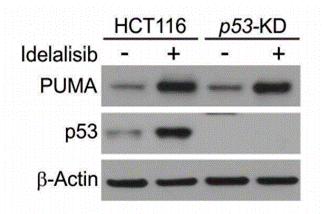
| Western blot | PUMA / p53 Bim / Bcl-xl / Bid / Mcl-1 p-p65 p-AKT / AKT Cleaved caspase 3 / Cleaved caspase 9 Mcl-1 / Bcl-2 / Bid / Bcl-xl / Noxa / Bak / Bax p-FoxO3a / FoxO3a Akt(T308) / PDK1(S241) / GSK-3β(S9) |
|
28008149 |
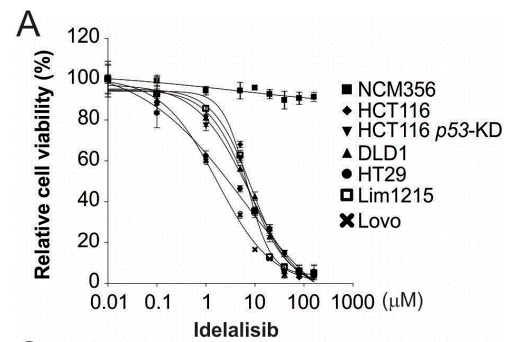
| Growth inhibition assay | Cell viability Cell viability |
|
28008149 |
Klinische Studieninformationen
(Daten von https://clinicaltrials.gov, aktualisiert am 2024-05-22)
| NCT-Nummer | Rekrutierung | Erkrankungen | Sponsor/Kooperationspartner | Startdatum | Phasen |
|---|---|---|---|---|---|
| NCT03582098 | Completed | Chronic Lymphocytic Leukaemia |
Gilead Sciences |
September 12 2018 | -- |
| NCT03151057 | Terminated | B Cells-Tumors|B Cell Chronic Lymphocytic Leukemia|Follicular Lymphoma|Mantle Cell Lymphoma|Large B-Cell Diffuse Lymphoma of Bone (Diagnosis) |
Sidney Kimmel Comprehensive Cancer Center at Johns Hopkins|Gilead Sciences |
July 31 2018 | Phase 1 |
| NCT03568929 | Completed | Follicular Non-Hodgkin''s Lymphoma Refractory |
Gilead Sciences |
May 25 2018 | -- |
Technischer Support
Tel: +1-832-582-8158 Ext:3
Wenn Sie weitere Fragen haben, hinterlassen Sie bitte eine Nachricht.
Häufig gestellte Fragen
Frage 1:
What is the recommended dose and the route of administration for it in mouse studies?
Antwort:
According to the following paper, it can be used by I.V. administration at the concentration of 40 mg/kg. https://www.ncbi.nlm.nih.gov/pubmed/24625684

Produkte sind nur für Forschungszwecke bestimmt. Nicht für den menschlichen Gebrauch. Wir verkaufen nicht an Patienten.
©Copyright 2013 Selleck Chemicals. Alle Rechte vorbehalten.