
nur für Forschungszwecke
Eltrombopag Olamine TpoR Agonist
Kat.-Nr.: S2229
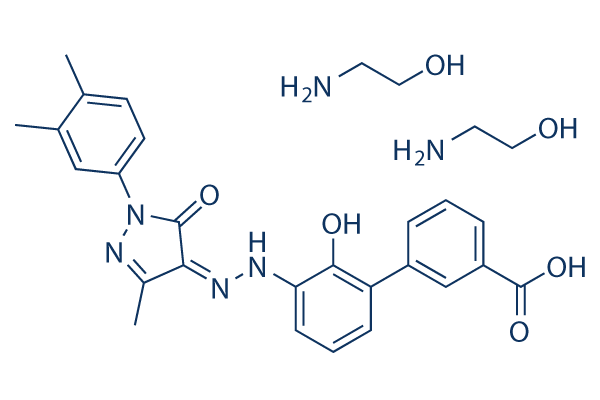
Chemische Struktur
Molekulargewicht: 564.63
Qualitätskontrolle (Quality Control)
| Verwandte Ziele | PD-1/PD-L1 CXCR STING AhR Immunology & Inflammation related CD markers Interleukins Anti-infection Antioxidant COX |
|---|---|
| Weitere TpoR Inhibitoren | Butyzamide |
Chemische Informationen, Lagerung & Stabilität (Chemical Information, Storage & Stability)
| Molekulargewicht | 564.63 | Formel | C29H36N6O6 |
Lagerung (Ab dem Eingangsdatum) | |
|---|---|---|---|---|---|
| CAS-Nr. | 496775-62-3 | SDF herunterladen | Lagerung von Stammlösungen |
|
|
| Synonyme | SB497115,SB-497115-GR | Smiles | CC1=C(C=C(C=C1)N2C(=O)C(=C(N2)C)N=NC3=CC=CC(=C3O)C4=CC(=CC=C4)C(=O)O)C.C(CO)N.C(CO)N | ||
Löslichkeit (Solubility)
|
In vitro |
DMSO
: 89 mg/mL
(157.62 mM)
Water : Insoluble Ethanol : Insoluble |
Molaritätsrechner
|
In vivo |
|||||
In-vivo-Formulierungsrechner (Klare Lösung)
Schritt 1: Geben Sie die untenstehenden Informationen ein (Empfohlen: Ein zusätzliches Tier zur Berücksichtigung von Verlusten während des Experiments)
Schritt 2: Geben Sie die In-vivo-Formulierung ein (Dies ist nur der Rechner, keine Formulierung. Bitte kontaktieren Sie uns zuerst, wenn es im Abschnitt "Löslichkeit" keine In-vivo-Formulierung gibt.)
Berechnungsergebnisse:
Arbeitskonzentration: mg/ml;
Methode zur Herstellung der DMSO-Stammlösung: mg Wirkstoff vorgelöst in μL DMSO ( Konzentration der Stammlösung mg/mL, Bitte kontaktieren Sie uns zuerst, wenn die Konzentration die DMSO-Löslichkeit der Wirkstoffcharge überschreitet. )
Methode zur Herstellung der In-vivo-Formulierung: Nehmen Sie μL DMSO Stammlösung, dann hinzufügenμL PEG300, mischen und klären, dann hinzufügenμL Tween 80, mischen und klären, dann hinzufügen μL ddH2O, mischen und klären.
Methode zur Herstellung der In-vivo-Formulierung: Nehmen Sie μL DMSO Stammlösung, dann hinzufügen μL Maisöl, mischen und klären.
Hinweis: 1. Bitte stellen Sie sicher, dass die Flüssigkeit klar ist, bevor Sie das nächste Lösungsmittel hinzufügen.
2. Achten Sie darauf, das/die Lösungsmittel der Reihe nach hinzuzufügen. Sie müssen sicherstellen, dass die bei der vorherigen Zugabe erhaltene Lösung eine klare Lösung ist, bevor Sie mit der Zugabe des nächsten Lösungsmittels fortfahren. Physikalische Methoden wie Vortex, Ultraschall oder ein heißes Wasserbad können zur Unterstützung des Lösens verwendet werden.
Wirkmechanismus (Mechanism of Action)
| Targets/IC50/Ki |
thrombopoietin receptor
|
|---|---|
| In vitro |
Eltrombopag demonstrates a half maximal effective concentration (EC50) of 0.27 μM in murine BAF3 cells transfected with the luciferase reporter gene under direction of the STAT-activated IRF-1 promoter and human TpoR (BAF3/IRF-1/hTpoR). Eltrombopag activates the receptor by association with metal ions (i.e., Zn2+) and specific amino acids within the transmembrane and juxtamembrane domains of the TpoR. Eltrombopag (30 μM) results in activation of STAT5 in N2C-Tpo cells, as detected with an antiphospho-STAT5 antibody on Western blots. Eltrombopag stimulates proliferation after a 2-day incubation with an EC50 of 0.03 μM in a BrdU assay conducted in BAF3/hTpoR cells. Eltrombopag also induces differentiation of hematopoietic stem cells into committed megakaryocyte progenitor cells. Eltrombopag increases the differentiation of bone marrow CD34+ cells into CD41+ megakaryocytes in a dose-dependent manner with an EC50 of 0.1 μM. Eltrombopag inhibits N2C-Tpo cell and HEL92.1.7 cell proliferating with IC50 of 20.7 μg/mL and 2.3 μg/mL. Eltrombopag (20 μg/mL) leads to a decreased cell division rate, a block in G(1) phase of cell cycle, and increased differentiation in human and murine leukemia cells. Eltrombopag (5 μg/mL) shows clear signs of differentiation, significant changes in the organization of the nuclear contents, and an increase in the cytoplasm/nucleus ratio in HL60 cells. Eltrombopag (5 μg/mL) causes an increase in CD11b, which is consistent with a premacrophage state in U937 cells, and also causes an increase in CD11b in URE cells. Eltrombopag leads to a reduction in free intracellular iron in leukemic cells in a dose-dependent manner in HL60 cells. |
| In vivo |
Eltrombopag (10 mg/kg per day) increases platelet counts over twofold approximately 1 week after the last dose for one chimpanzee and approximately 1.5-fold for the other two chimpanzees. Eltrombopag (1 mg/mL) prolongs survival in mouse models of leukemia. |
Literatur |
|
Klinische Studieninformationen (Clinical Trial Information)
(Daten von https://clinicaltrials.gov, aktualisiert am 2025-09-24)
| NCT-Nummer | Rekrutierung | Erkrankungen | Sponsor/Kooperationspartner | Startdatum | Phasen |
|---|---|---|---|---|---|
| NCT07189910 | NOT_YET_RECRUITING | Primary Immune Thrombocytopenia (ITP) |
Union Hospital, Tongji Medical College, Huazhong University of Science and Technology |
2025-12-01 | PHASE4 |
| NCT05961410 | RECRUITING | Lymphoma; Peripheral Blood Stem Cell Transplantation |
National Taiwan University Hospital |
2023-08-15 | PHASE2 |
| NCT01927731 | COMPLETED | Bone Marrow Transplantation Recipient; Cord Blood Transplant Recipient; Hematopoietic Cell Transplantation Recipient |
M.D. Anderson Cancer Center |
2013-10-14 | PHASE2 |
| NCT06768619 | COMPLETED | Thrombocytopenia |
Chia Tai Tianqing Pharmaceutical Group Co., Ltd. |
2023-03-20 | |
| NCT01428635 | COMPLETED | Accelerated Phase Chronic Myelogenous Leukemia, BCR-ABL1 Positive; Blast Phase Chronic Myelogenous Leukemia, BCR-ABL1 Positive; Chronic Phase Chronic Myelogenous Leukemia, BCR-ABL1 Positive; Primary Myelofibrosis; Thrombocytopenia |
M.D. Anderson Cancer Center |
2012-01-13 | PHASE2; PHASE3 |
| NCT01772420 | COMPLETED | Adult Myelodysplastic Syndrome; Anemia; Chronic Myelomonocytic Leukemia |
Albert Einstein College of Medicine |
2012-10 | PHASE2 |

Produkte sind nur für Forschungszwecke bestimmt. Nicht für den menschlichen Gebrauch. Wir verkaufen nicht an Patienten.
©Copyright 2013 Selleck Chemicals. Alle Rechte vorbehalten.