
nur für Forschungszwecke
FTY720 (Fingolimod) Hydrochloride S1P Receptor Antagonist
Kat.-Nr.S5002
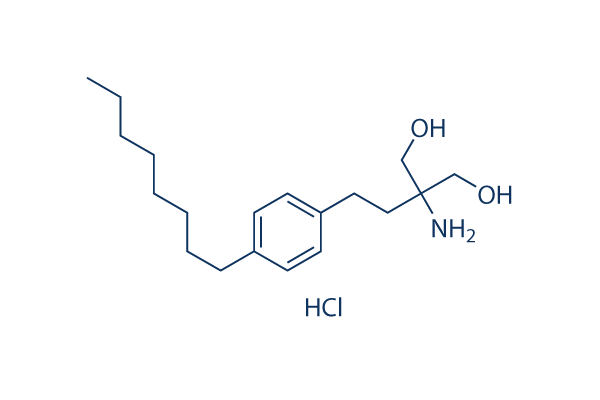
Chemische Struktur
Molekulargewicht: 343.9
Springe zu
Qualitätskontrolle
Charge:
Reinheit:
99.99%
99.99
| Verwandte Ziele | CXCR Hedgehog/Smoothened PKA Adrenergic Receptor AChR 5-HT Receptor Histamine Receptor Dopamine Receptor Ras KRas |
|---|---|
| Weitere S1P Receptor Inhibitoren | JTE 013 PF 429242 CAY10444 CYM5541 CYM-5520 SEW 2871 SLF1081851 hydrochloride CYM50308 MP-A08 Etrasimod(APD334) |
Zellkultur, Behandlung & Arbeitskonzentration
| Zelllinien | Assay-Typ | Konzentration | Inkubationszeit | Formulierung | Aktivitätsbeschreibung | PMID |
|---|---|---|---|---|---|---|
| human U2OS cells | Function assay | Agonist activity at human S1P1 receptor expressed in human U2OS cells co-expressing eGFP assessed as receptor internalization into cytoplasm using Hoechst dye staining, EC50=0.002 μM. | 22104144 | |||
| human PC3 cells | Cytotoxic assay | 72 h | Cytotoxicity against human PC3 cells after 72 hrs by vital dye exclusion/flow cytometric analysis, IC50=9.8 μM. | 24273632 | ||
| human NALM6 cells | Cytotoxic assay | 72 h | Cytotoxicity against Ph-negative human NALM6 cells after 72 hrs by vital dye exclusion/flow cytometric analysis, IC50=9.6 μM. | 24273632 | ||
| human CCRF-CEM cells | Cytotoxic assay | 72 h | Cytotoxicity against Ph-negative human CCRF-CEM cells after 72 hrs by vital dye exclusion/flow cytometric analysis, IC50=6.8 μM. | 24273632 | ||
| human SUP-B15 cells | Cytotoxic assay | 72 h | Cytotoxicity against Ph-positive human SUP-B15 cells after 72 hrs by vital dye exclusion/flow cytometric analysis, IC50=6.8 μM. | 24273632 | ||
| human DU145 cells | Cytotoxic assay | 72 h | Cytotoxicity against human DU145 cells after 72 hrs by vital dye exclusion/flow cytometric analysis, IC50=6.5 μM. | 24273632 | ||
| human BV173 cells | Cytotoxic assay | 72 h | Cytotoxicity against Ph-positive human BV173 cells after 72 hrs by vital dye exclusion/flow cytometric analysis, IC50=6.3 μM. | 24273632 | ||
| human BLIN-1 cells | Cytotoxic assay | 72 h | Cytotoxicity against Ph-negative human BLIN-1 cells after 72 hrs by vital dye exclusion/flow cytometric analysis, IC50=5.5 μM. | 24273632 | ||
| mouse bone marrow cells | Cytotoxic assay | 72 h | Cytotoxicity against BCR-ABL fusion protein 190 expressing mouse bone marrow cells after 72 hrs by vital dye exclusion/flow cytometric analysis, IC50=3.3 μM. | 24273632 | ||
| Sf9 insect cells | Function assay | 1 h | Inhibition of human recombinant S1PL (62 to 568) expressed in Sf9 insect cells using S1P as substrate after 1 hr | 24809814 | ||
| mouse MN9D cells | Function assay | 5 μM | Induction of PP2A catalytic subunit activity in mouse MN9D cells assessed as phosphate level at 5 uM | 25050165 | ||
| rat PC12 cells | Function assay | 5 μM | 30 to 120 mins | Induction of PP2A catalytic subunit activity in rat PC12 cells assessed as phosphate level at 5 uM measured 30 to 120 mins. | 25050165 | |
| mouse MN9D cells | Function assay | 0.16 μM | 24 h | Neuroprotective activity in mouse MN9D cells assessed as stimulation of BDNF expression at 0.16 uM after 24 hrs | 25050165 | |
| mouse MN9D cells | Function assay | 0.16 μM | 72 h | Neuroprotective activity in mouse MN9D cells assessed as blocking of TNF-alpha associated toxicity at 0.16 uM after 72 hrs by Trypan blue staining. | 25050165 | |
| CHO | Function assay | Displacement of [33P]sphingosine 1 phosphate from human S1P1 receptor expressed in CHO cells, IC50=0.84μM. | 15615513 | |||
| CHO | Function assay | Displacement of [33P]sphingosine 1 phosphate from human S1P5 receptor expressed in CHO cells, IC50=2.1μM. | 15615513 | |||
| Jurkat | Function assay | 18 hrs | Reversal of inhibition of mitochondrial function in human Jurkat cells after 18 hrs in presence of Z-VAD-fmk | 17400555 | ||
| T-cells | Function assay | 96 hrs | Immunosuppressive activity in BALB/c/C57BL/6 mouse T cells assessed as inhibition of alloantigen-induced cell proliferation after 96 hrs by measuring [3H]thymidine uptake by mixed lymphocyte reaction assay, IC50=0.0061μM. | 21456524 | ||
| SK-BR-3 | Antiproliferative assay | 78 hrs | Antiproliferative activity against human SK-BR-3 cells assessed as growth inhibition after 78 hrs by WST-1 assay, IC50=5μM. | 21456524 | ||
| MDA-MB-231 | Antiproliferative assay | 78 hrs | Antiproliferative activity against human MDA-MB-231 cells assessed as growth inhibition after 78 hrs by WST-1 assay, IC50=5μM. | 21456524 | ||
| HCT116 | Antiproliferative assay | 78 hrs | Antiproliferative activity against human HCT116 cells assessed as growth inhibition after 78 hrs by WST-1 assay, IC50=5μM. | 21456524 | ||
| SW620 | Antiproliferative assay | 78 hrs | Antiproliferative activity against human SW620 cells assessed as growth inhibition after 78 hrs by WST-1 assay, IC50=5μM. | 21456524 | ||
| MCF7 | Antiproliferative assay | 78 hrs | Antiproliferative activity against human MCF7 cells assessed as growth inhibition after 78 hrs by WST-1 assay, IC50=5μM. | 21456524 | ||
| LNCAP-AI | Antiproliferative assay | 78 hrs | Antiproliferative activity human LNCAP-AI cells assessed as growth inhibition after 78 hrs by WST-1 assay, IC50=5μM. | 21456524 | ||
| MGC803 | Antitumor assay | 10 mg/kg | 20 days | Antitumor activity against human MGC803 cells xenografted in nude mouse assessed as inhibition of tumor growth at 10 mg/kg for 20 days | 21456524 | |
| U2OS | Function assay | 18 hrs | Agonist activity at human S1P1 receptor expressed in EDG1-bla U2OS cells incubated for 18 hrs prior to GenBlazer substrate addition by beta-arrestin recruitment assay, EC50=0.0072μM. | 26687487 | ||
| FL5.12A | Cytotoxicity assay | 48 hrs | Cytotoxicity against mouse FL5.12A cells after 48 hrs by DAPI staining-based flow cytometric analysis, IC50=2.4μM. | 27475534 | ||
| SH-SY5Y | Cytotoxicity assay | 24 hrs | Cytotoxicity against human SH-SY5Y cells measured after 24 hrs by crystal-violet staining based assay, EC10=0.54μM. | 27913115 | ||
| SK-N-SH | Cytotoxicity assay | 24 hrs | Cytotoxicity against human SK-N-SH cells measured after 24 hrs by crystal-violet staining based assay, EC10=0.55μM. | 27913115 | ||
| U118MG | Cytotoxicity assay | 24 hrs | Cytotoxicity against human U118MG cells measured after 24 hrs by crystal-violet staining based assay, EC10=0.61μM. | 27913115 | ||
| SH-SY5Y | Function assay | Agonist activity at sphingosine-1-phosphate receptor in human SH-SY5Y cells assessed as increase in cAMP level at EC10 by direct immunoassay | 27913115 | |||
| U118MG | Function assay | Agonist activity at sphingosine-1-phosphate receptor in human U118MG cells assessed as increase in cAMP level at EC10 by direct immunoassay | 27913115 | |||
| SK-N-SH | Function assay | Agonist activity at sphingosine-1-phosphate receptor human SK-N-SH cells assessed as increase in cAMP level at EC10 by direct immunoassay | 27913115 | |||
| HEK293 | Function assay | 18 hrs | Agonist activity at sphingosine-1-phosphate receptor (unknown origin) expressed in HEK293 cells assessed as increase in cAMP level at EC10 after 18 hrs by CRE-responsive renilla luciferase reporter gene assay | 27913115 | ||
| SJ-GBM2 | qHTS assay | qHTS of pediatric cancer cell lines to identify multiple opportunities for drug repurposing: Primary screen for SJ-GBM2 cells | 29435139 | |||
| A673 | qHTS assay | qHTS of pediatric cancer cell lines to identify multiple opportunities for drug repurposing: Primary screen for A673 cells | 29435139 | |||
| SK-N-MC | qHTS assay | qHTS of pediatric cancer cell lines to identify multiple opportunities for drug repurposing: Primary screen for SK-N-MC cells | 29435139 | |||
| BT-37 | qHTS assay | qHTS of pediatric cancer cell lines to identify multiple opportunities for drug repurposing: Primary screen for BT-37 cells | 29435139 | |||
| NB-EBc1 | qHTS assay | qHTS of pediatric cancer cell lines to identify multiple opportunities for drug repurposing: Primary screen for NB-EBc1 cells | 29435139 | |||
| Saos-2 | qHTS assay | qHTS of pediatric cancer cell lines to identify multiple opportunities for drug repurposing: Primary screen for Saos-2 cells | 29435139 | |||
| SK-N-SH | qHTS assay | qHTS of pediatric cancer cell lines to identify multiple opportunities for drug repurposing: Primary screen for SK-N-SH cells | 29435139 | |||
| NB1643 | qHTS assay | qHTS of pediatric cancer cell lines to identify multiple opportunities for drug repurposing: Primary screen for NB1643 cells | 29435139 | |||
| LAN-5 | qHTS assay | qHTS of pediatric cancer cell lines to identify multiple opportunities for drug repurposing: Primary screen for LAN-5 cells | 29435139 | |||
| BT-12 | qHTS assay | qHTS of pediatric cancer cell lines to identify multiple opportunities for drug repurposing: Primary screen for BT-12 cells | 29435139 | |||
| Rh18 | qHTS assay | qHTS of pediatric cancer cell lines to identify multiple opportunities for drug repurposing: Primary screen for Rh18 cells | 29435139 | |||
| OHS-50 | qHTS assay | qHTS of pediatric cancer cell lines to identify multiple opportunities for drug repurposing: Primary screen for OHS-50 cells | 29435139 | |||
| RD | qHTS assay | qHTS of pediatric cancer cell lines to identify multiple opportunities for drug repurposing: Primary screen for RD cells | 29435139 | |||
| MG 63 (6-TG R) | qHTS assay | qHTS of pediatric cancer cell lines to identify multiple opportunities for drug repurposing: Primary screen for MG 63 (6-TG R) cells | 29435139 | |||
| Rh30 | qHTS assay | qHTS of pediatric cancer cell lines to identify multiple opportunities for drug repurposing: Primary screen for Rh30 cells | 29435139 | |||
| Rh41 | qHTS assay | qHTS of pediatric cancer cell lines to identify multiple opportunities for drug repurposing: Primary screen for Rh41 cells | 29435139 | |||
| FL5.12 | Cytotoxicity assay | 48 hrs | Cytotoxicity against mouse FL5.12 cells after 48 hrs by DAPI or propidium iodide staining-based flow cytometric analysis, IC50=2.1μM. | 30292898 | ||
| FL5.12 | Cytotoxicity assay | 10 uM | 3 hrs | Cytotoxicity against mouse FL5.12 cells assessed as vacuole formation at 10 uM after 3 hrs by fluorescence microscopic analysis | 30292898 | |
| FL5.12 | Cytotoxicity assay | 2.5 uM | 3 hrs | Cytotoxicity against mouse FL5.12 cells assessed as vacuole formation at 2.5 uM after 3 hrs by fluorescence microscopic analysis | 30292898 | |
| HepG2 | qHTS assay | HepG2 cells viability qHTS for Zika virus inhibitors | 33229545 | |||
| CHO | Function assay | Agonist activity at human S1P3 receptor expressed in CHO cells assessed as increase in calcium flux by aequorin-derived luminescence assay, EC50=2.51189μM. | ChEMBL | |||
| CHO | Function assay | Agonist activity at human S1P5 receptor expressed in CHO cells assessed as increase in calcium flux by aequorin-derived luminescence assay, EC50=3.16228μM. | ChEMBL | |||
| Klicken Sie hier, um weitere experimentelle Daten zu Zelllinien anzuzeigen | ||||||
Chemische Informationen, Lagerung & Stabilität
| Molekulargewicht | 343.9 | Formel | C19H33NO2.HCl |
Lagerung (Ab dem Eingangsdatum) | |
|---|---|---|---|---|---|
| CAS-Nr. | 162359-56-0 | SDF herunterladen | Lagerung von Stammlösungen |
|
|
| Synonyme | Fingolimod Hydrochloride,FTY720 | Smiles | CCCCCCCCC1=CC=C(C=C1)CCC(CO)(CO)N.Cl | ||
Löslichkeit
|
In vitro |
DMSO
: 69 mg/mL
(200.63 mM)
Water : 69 mg/mL Ethanol : 69 mg/mL |
Molaritätsrechner
Verdünnungsrechner
Molekulargewichtsrechner
|
In vivo |
|||||
In-vivo-Formulierungsrechner (Klare Lösung)
Schritt 1: Geben Sie die untenstehenden Informationen ein (Empfohlen: Ein zusätzliches Tier zur Berücksichtigung von Verlusten während des Experiments)
mg/kg
g
μL
Schritt 2: Geben Sie die In-vivo-Formulierung ein (Dies ist nur der Rechner, keine Formulierung. Bitte kontaktieren Sie uns zuerst, wenn es im Abschnitt "Löslichkeit" keine In-vivo-Formulierung gibt.)
% DMSO
%
% Tween 80
% ddH2O
%DMSO
%
Berechnungsergebnisse:
Arbeitskonzentration: mg/ml;
Methode zur Herstellung der DMSO-Stammlösung: mg Wirkstoff vorgelöst in μL DMSO ( Konzentration der Stammlösung mg/mL, Bitte kontaktieren Sie uns zuerst, wenn die Konzentration die DMSO-Löslichkeit der Wirkstoffcharge überschreitet. )
Methode zur Herstellung der In-vivo-Formulierung: Nehmen Sie μL DMSO Stammlösung, dann hinzufügenμL PEG300, mischen und klären, dann hinzufügenμL Tween 80, mischen und klären, dann hinzufügen μL ddH2O, mischen und klären.
Methode zur Herstellung der In-vivo-Formulierung: Nehmen Sie μL DMSO Stammlösung, dann hinzufügen μL Maisöl, mischen und klären.
Hinweis: 1. Bitte stellen Sie sicher, dass die Flüssigkeit klar ist, bevor Sie das nächste Lösungsmittel hinzufügen.
2. Achten Sie darauf, das/die Lösungsmittel der Reihe nach hinzuzufügen. Sie müssen sicherstellen, dass die bei der vorherigen Zugabe erhaltene Lösung eine klare Lösung ist, bevor Sie mit der Zugabe des nächsten Lösungsmittels fortfahren. Physikalische Methoden wie Vortex, Ultraschall oder ein heißes Wasserbad können zur Unterstützung des Lösens verwendet werden.
Wirkmechanismus
| Targets/IC50/Ki |
S1P receptor
(K562, NK cells ) 0.033 nM
|
|---|---|
| In vitro |
Die hemmende Wirkung von S1P wird durch verschiedene Konzentrationen von FTY720 mit einem IC50-Effekt von 173 nM aufgehoben. Darüber hinaus hat FTY720 (10 nM) allein keinen Einfluss auf die Expression kostimulatorischer Moleküle. FTY720 hebt die durch S1P induzierte erhöhte Expression von HLA-I sowohl für die Prozentsätze der Zellen als auch für den MFI auf, wenn der Effekt von S1P mit dem Effekt der Kombination von S1P mit FTY720 verglichen wird. Mittlere und hochdosierte FTY720-P erhöhen auch die TGF-β1-Spiegel. Die TGF-β1- und Foxp3-mRNA-Expression sind in der hochdosierten FTY720-P-Gruppe hochreguliert. Die Proliferation von Effektor-T-Zellen wird in der mittleren und hochdosierten FTY720-P-Gruppe bei einem Treg/Teff-Zellverhältnis von 1:1 signifikant unterdrückt. Bei einem Verhältnis von 1:1 wird die Proliferation von Effektor-T-Zellen auch in der hochdosierten FTY720-Gruppe unterdrückt. |
| In vivo |
FTY720 ist bei Ph+, aber nicht bei Ph- ALL-Xenotransplantaten unter Verwendung eines frühen Krankheitsmodells wirksam. FTY720 führt zu einer signifikanten Reduktion der Krankheitslast in den Ph+ ALL-Xenotransplantaten unter Verwendung eines frühen Krankheitsmodells. Ph+ menschliche ALL-Xenotransplantate sprechen auf FTY720 mit einer 80%igen Reduktion der Gesamterkrankung an, wenn die Behandlung frühzeitig begonnen wurde. Im Gegensatz dazu führt die Behandlung von Mäusen mit FTY720 nicht zu einer reduzierten Leukämie im Vergleich zu Kontrollen unter Verwendung von vier separaten menschlichen Ph- ALL-Xenotransplantaten. |
Literatur |
|
Anwendungen
| Methoden | Biomarker | Bilder | PMID |
|---|---|---|---|
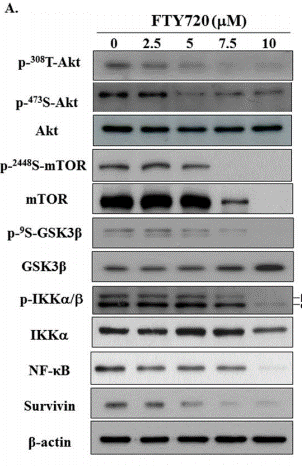
| Western blot | p-AKT / AKT / p-mTOR / mTOR / p-GSK3β / GSK3β / p-IKKα/β / IKKα / NF-κB / Survivin p-STAT3 / STAT3 / Bcl-xl / Bcl-2 / Bax Cyclin D1 / CDK4 / cyclin E / CDK2 / p27 / p16 |
|
28717222 |
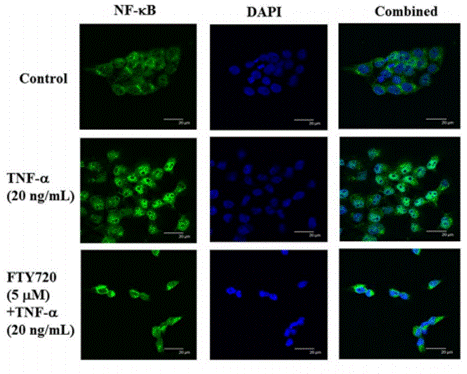
| Immunofluorescence | NF-κB N-cadherin / Vimentin |
|
28717222 |
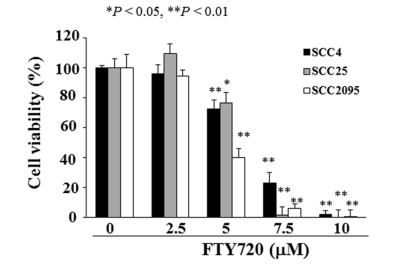
| Growth inhibition assay | Cell viability |
|
28717222 |
Klinische Studieninformationen
(Daten von https://clinicaltrials.gov, aktualisiert am 2024-05-22)
| NCT-Nummer | Rekrutierung | Erkrankungen | Sponsor/Kooperationspartner | Startdatum | Phasen |
|---|---|---|---|---|---|
| NCT05141669 | Completed | Multiple Sclerosis |
Novartis Pharmaceuticals|Novartis |
May 18 2020 | -- |
| NCT03345940 | Terminated | Relapsing Remitting Multiple Sclerosis |
Fondazione I.R.C.C.S. Istituto Neurologico Carlo Besta|Patient-Centered Outcomes Research Institute|Universita degli Studi di Genova |
April 30 2017 | Phase 4 |
| NCT02575365 | Terminated | Cognition|Brain Volume Loss |
Novartis Pharmaceuticals|Novartis |
February 16 2016 | Phase 4 |
Technischer Support
Tel: +1-832-582-8158 Ext:3
Wenn Sie weitere Fragen haben, hinterlassen Sie bitte eine Nachricht.

Produkte sind nur für Forschungszwecke bestimmt. Nicht für den menschlichen Gebrauch. Wir verkaufen nicht an Patienten.
©Copyright 2013 Selleck Chemicals. Alle Rechte vorbehalten.