Sphingosine 1-phosphate receptors are G-protein-coupling receptors which contain 5 members called S1P1, S1P2, S1P3, S1P4, S1P5 receptors. The activation of S1P receptors can result in activation of the small guanosine triphosphatase (GTPase) Ras and the extracellular signal-regulated kinase (ERK) leading to proliferation. Signaling started from S1P receptor is associated with activation of phosphatidylinositol 3-kinase (PI3-K) and protein kinase B (PKB or Akt) which are involved in increasing survival or inhibiting apoptosis. Activation of protein kinase C (PKC) and phospholipase C (PLC) are also related to S1P receptors leading to increasing free calcium in cell.

S1P Receptor Modulatoren/Antagonisten (S1P Receptor Modulators/antagonists)
Weitere GPCR & G Protein Inhibitoren
| Kat.-Nr. | Produktname | Informationen | Publikationen | Validierung |
|---|---|---|---|---|
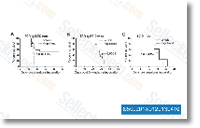
| S5002 | FTY720 (Fingolimod) Hydrochloride | Fingolimod (FTY720, Fingolimod Hydrochloride) HCl ist ein S1P-Antagonist mit einer IC50 von 0,033 nM in K562- und NK-Zellen. Bitte verwenden Sie zur Verdünnung Kochsalzlösung anstelle von PBS. PBS kann zur Ausfällung führen. |
|
|
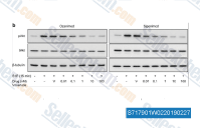
| S7791 | PMA chemical (Phorbol 12-myristate 13-acetate) | PMA (Phorbol 12-myristate 13-acetate), ein potenter Aktivator von PKC, ist in nanomolaren Konzentrationen aktiv. Phorbol 12-myristate 13-acetate (PMA) induziert sphingosine-1-phosphate (S1P). PMA hat eine starke Erregbarkeit auf der Haut und den Schleimhäuten. Bei der Verwendung von PMA ist besonderer Schutz erforderlich. Tragen Sie Handschuhe und eine Maske, um direkten Kontakt in jeglicher Weise zu vermeiden. |
|
|
| S5950 | Fingolimod (FTY-720) | Fingolimod (FTY-720) ist ein Sphingosin-1-Phosphat-Rezeptor-Modulator, der zur Behandlung der schubförmig-remittierenden Multiplen Sklerose eingesetzt wird. |
|
|
| S7179 | Siponimod (BAF312) | Siponimod (BAF312) ist ein S1P-Rezeptor-Agonist der nächsten Generation, selektiv für S1P1- und S1P5-Rezeptoren mit einem EC50-Wert von 0,39 nM und 0,98 nM, und zeigt eine über 1000-fache Selektivität gegenüber S1P2-, S1P3- und S1P4-Rezeptoren. Diese Verbindung hat Phase 3 erreicht. |
|
|
| S7182 | JTE 013 | JTE 013 ist ein potenter und selektiver S1P2-Antagonist mit einer IC50 von 17,6 nM. |
|
|
| S7952 | Ozanimod | Ozanimod ist ein selektiver oraler S1P Receptor 1 Modulator. Phase 3. |
|
|
| S8241 | Ponesimod (ACT-128800) | Ponesimod (ACT-128800) ist ein oral aktiver, selektiver Sphingosin-1-phosphat-Rezeptor-1 (S1P1)-Immunmodulator mit einem EC50-Wert von 5,7 nM. |
|
|
| E1158 | CAY10444 | CAY10444 (BML-241) ist ein Sphingosin-1-phosphat 3 (S1P3)-Antagonist, der die S1P-Antwort der S1P3-Zelllinie mit einer Hemmrate von 78 % und einem IC50 von 4,6 μM hemmen kann. |
|
|
| S6418 | PF 429242 | PF 429242 ist als ein S1P-Inhibitor mit einer IC50 von 170 nM bekannt und zeigt keine signifikante Hemmung von Trypsin, Elastase, Proteinase K, Plasmin, Kallikrein, Faktor XIa, Thrombin oder Furin bei Konzentrationen bis zu 100 μM und nur eine moderate Hemmung von Urokinase (IC50 = 50 μM) und Faktor Xa (IC50 = 100 μM). |
|
|
| S6552 | CYM5541 | CYM5541 (ML249) ist ein selektiver, allosterischer Agonist von S1P3 mit einem EC50-Wert zwischen 72 und 132 nM und zeigt in vitro eine exquisite Selektivität gegenüber anderen S1P Receptor-Subtypen: S1P1 EC50 > 10 μM, S1P2 EC50 > 50 μM, S1P4 EC50 > 50 μM und S1P5 EC50 > 25 μM. |
|
|

Produkte sind nur für Forschungszwecke bestimmt. Nicht für den menschlichen Gebrauch. Wir verkaufen nicht an Patienten.
©Copyright 2013 Selleck Chemicals. Alle Rechte vorbehalten.