
nur für Forschungszwecke
H-89 Dihydrochloride PKA Inhibitor
Kat.-Nr.S1582
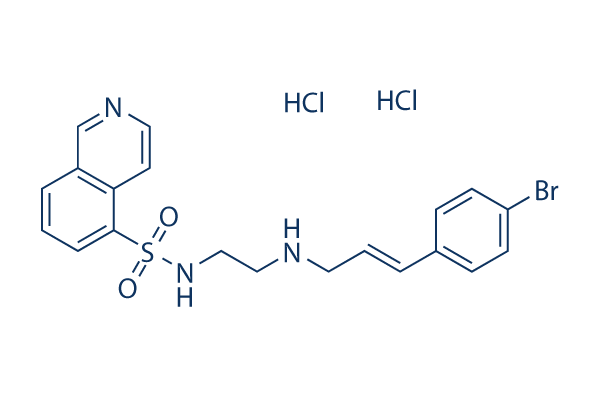
Chemische Struktur
Molekulargewicht: 519.28
Qualitätskontrolle
| Verwandte Ziele | PI3K Akt mTOR GSK-3 ATM/ATR DNA-PK AMPK PDPK1 PTEN PP2A |
|---|---|
| Weitere PKA Inhibitoren | Dibutyryl cAMP (db cAMP/Bucladesine) sodium 8-Bromo-cAMP (8-Br-cAMP) Sodium Salt H-89 PKI 14-22 amide,myristoylated Bucladesine calcium A-3 hydrochloride Malantide CREBtide PKI(5-24) |
Zellkultur, Behandlung & Arbeitskonzentration
| Zelllinien | Assay-Typ | Konzentration | Inkubationszeit | Formulierung | Aktivitätsbeschreibung | PMID |
|---|---|---|---|---|---|---|
| CHO | Growth Inhibition Assay | 10 μM | 1 h | inhibits 5-HT induced cAMP production decrease | 12569069 | |
| SK-N-MC | Function Assay | 30 μM | 24 h | DMSO | reduces the down-regulation of β1-AR by isoproterenol by 50% | 11705454 |
| Sf9 | Function assay | Inhibition of His-tagged human MSK1 expressed in Sf9 cells, IC50 = 0.12 μM. | 10998351 | |||
| Sf9 | Function assay | Inhibition of rat ROCK2 expressed in Sf9 cells, IC50 = 0.27 μM. | 10998351 | |||
| SF9 | Function assay | Inhibition of human PKBalpha expressed in SF9 cells, IC50 = 2.6 μM. | 10998351 | |||
| OVCAR8 | Cytotoxicity assay | 72 hrs | Cytotoxicity against human OVCAR8 cells assessed as growth inhibition after 72 hrs by MTT assay, IC50 = 10.5 μM. | 24508830 | ||
| OVCAR8 | Antiproliferative assay | 72 hrs | Antiproliferative activity against human OVCAR8 cells after 72 hrs by MTT assay, IC50 = 10.5 μM. | 24389511 | ||
| HL60 | Antiproliferative assay | 72 hrs | Antiproliferative activity against human HL60 cells after 72 hrs by MTT assay, IC50 = 11.4 μM. | 24389511 | ||
| PC3M | Function assay | Inhibition of GSK3-beta in human PC3M cells by ELISA, IC50 = 15 μM. | 18345609 | |||
| U87MG | Growth inhibition assay | Growth inhibition of human U87MG cells by SRB assay, IC50 = 15 μM. | 18345609 | |||
| U87MG | Antiproliferative assay | 96 hrs | Antiproliferative activity against human U87MG cells after 96 hrs by SRB assay, IC50 = 15 μM. | 20151677 | ||
| HCT116 | Cytotoxicity assay | 72 hrs | Cytotoxicity against human HCT116 cells assessed as growth inhibition after 72 hrs by MTT assay, IC50 = 15.7 μM. | 24508830 | ||
| HCT116 | Antiproliferative assay | 72 hrs | Antiproliferative activity against human HCT116 cells after 72 hrs by MTT assay, IC50 = 15.7 μM. | 24389511 | ||
| PC3M | Function assay | 96 hrs | Inhibition of PC3M cells by SRB assay after 96 hrs, GI50 = 18 μM. | 17451235 | ||
| PC3M | Growth inhibition assay | Growth inhibition of human PC3M cells by SRB assay, IC50 = 18 μM. | 18345609 | |||
| LS174T | Function assay | 20 uM | 6 hrs | Inhibition of PGE2-stimulated TCF/LEF transactivation in human LS174T cells at 20 uM measured after 6 hrs by dual luciferase reporter gene assay | 27736063 | |
| Klicken Sie hier, um weitere experimentelle Daten zu Zelllinien anzuzeigen | ||||||
Chemische Informationen, Lagerung & Stabilität
| Molekulargewicht | 519.28 | Formel | C20H20BrN3O2S.2HCl |
Lagerung (Ab dem Eingangsdatum) | |
|---|---|---|---|---|---|
| CAS-Nr. | 130964-39-5 | SDF herunterladen | Lagerung von Stammlösungen |
|
|
| Synonyme | N/A | Smiles | C1=CC2=C(C=CN=C2)C(=C1)S(=O)(=O)NCCNCC=CC3=CC=C(C=C3)Br.Cl.Cl | ||
Löslichkeit
|
In vitro |
DMSO
: 100 mg/mL
(192.57 mM)
Water : 10 mg/mL Ethanol : Insoluble |
Molaritätsrechner
|
In vivo |
|||||
In-vivo-Formulierungsrechner (Klare Lösung)
Schritt 1: Geben Sie die untenstehenden Informationen ein (Empfohlen: Ein zusätzliches Tier zur Berücksichtigung von Verlusten während des Experiments)
Schritt 2: Geben Sie die In-vivo-Formulierung ein (Dies ist nur der Rechner, keine Formulierung. Bitte kontaktieren Sie uns zuerst, wenn es im Abschnitt "Löslichkeit" keine In-vivo-Formulierung gibt.)
Berechnungsergebnisse:
Arbeitskonzentration: mg/ml;
Methode zur Herstellung der DMSO-Stammlösung: mg Wirkstoff vorgelöst in μL DMSO ( Konzentration der Stammlösung mg/mL, Bitte kontaktieren Sie uns zuerst, wenn die Konzentration die DMSO-Löslichkeit der Wirkstoffcharge überschreitet. )
Methode zur Herstellung der In-vivo-Formulierung: Nehmen Sie μL DMSO Stammlösung, dann hinzufügenμL PEG300, mischen und klären, dann hinzufügenμL Tween 80, mischen und klären, dann hinzufügen μL ddH2O, mischen und klären.
Methode zur Herstellung der In-vivo-Formulierung: Nehmen Sie μL DMSO Stammlösung, dann hinzufügen μL Maisöl, mischen und klären.
Hinweis: 1. Bitte stellen Sie sicher, dass die Flüssigkeit klar ist, bevor Sie das nächste Lösungsmittel hinzufügen.
2. Achten Sie darauf, das/die Lösungsmittel der Reihe nach hinzuzufügen. Sie müssen sicherstellen, dass die bei der vorherigen Zugabe erhaltene Lösung eine klare Lösung ist, bevor Sie mit der Zugabe des nächsten Lösungsmittels fortfahren. Physikalische Methoden wie Vortex, Ultraschall oder ein heißes Wasserbad können zur Unterstützung des Lösens verwendet werden.
Wirkmechanismus
| Targets/IC50/Ki |
PKA
(Cell-free assay) 48 nM(Ki)
S6K1
(Cell-free assay) 80 nM
PKG
(Cell-free assay) 0.48 μM(Ki)
|
|---|---|
| In vitro |
H89 2HCl ist ein potenter PKA (cAMP-abhängiger) Proteinkinase A-Inhibitor mit einem Ki von 48 nM, zeigt eine 10-fache Selektivität gegenüber PKG und eine >500-fache Selektivität gegenüber PKC, MLCK, Calmodulin-Kinase II und Casein-Kinase I/II. Eine Vorbehandlung der Zellen mit dieser Verbindung (30 μM) 1 Stunde vor der Zugabe von Forskolin hemmt die Forskolin-induzierte Proteinphosphorylierung dosisabhängig. Diese Verbindung hemmt auch mehrere andere Kinasen mit IC50-Werten von 80, 120, 135, 270, 2600 und 2800 nM für S6K1, MSK1, PKA, ROCKII, PKBα bzw. MAPKAP-K1b. Es hat auch Aktivität an einigen zellulären Rezeptoren und Ionenkanälen, einschließlich Kv1.3 K+-Kanälen, β1AR und β2AR. |
| Kinase-Assay |
PKA-Enzymaktivität
|
|
Die cAMP-abhängige Proteinkinaseaktivität wird in einer Reaktionsmischung, die in einem Endvolumen von 0,2 ml 50 mM Tris-HC1 (pH 7,0), 10 mM Magnesiumacetat, 2 mM EGTA, 1 μM cAMP oder ohne cAMP, 3,3-20 μM [γ-32P]ATP (4 × 10⁵ cpm), 0,5 μg des Enzyms, 100 μg Histon H2B und jede angegebene Verbindung enthält, getestet.
|
|
| In vivo |
H89 verursacht deutliche Modifikationen der Proteinphosphorylierung, wobei die stärksten Änderungen der Phosphorylierung Fructose-1,6-Bisphosphatase, heterogenes nukleäres Ribonukleoprotein (hnRNP) und NSFL1-Kofaktor p47 betreffen, die alle potenzielle regulatorische Verbindungen zu cAMP/PKA aufweisen. |
Literatur |
|
Anwendungen
| Methoden | Biomarker | Bilder | PMID |
|---|---|---|---|
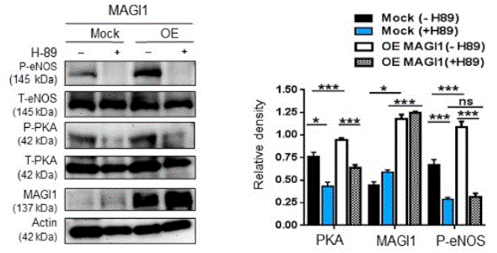
| Western blot | p-eNOS / T-eNOS / p-PKA p-GPIbβ / GPIbβ / p-BAD p-S6K1 / p-rpS6 / p-GSK3β |
|
31035633 |
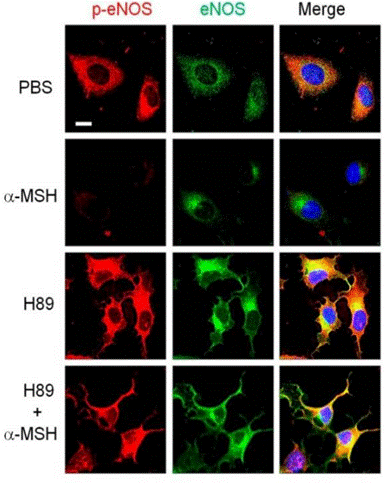
| Immunofluorescence | p-eNOS / eNOS iNOS / NFκB p65 myopodin |
|
30513637 |
Technischer Support
Tel: +1-832-582-8158 Ext:3
Wenn Sie weitere Fragen haben, hinterlassen Sie bitte eine Nachricht.

Produkte sind nur für Forschungszwecke bestimmt. Nicht für den menschlichen Gebrauch. Wir verkaufen nicht an Patienten.
©Copyright 2013 Selleck Chemicals. Alle Rechte vorbehalten.