
nur für Forschungszwecke
Zosuquidar 3HCl P-gp Modulator
Kat.-Nr.S1481
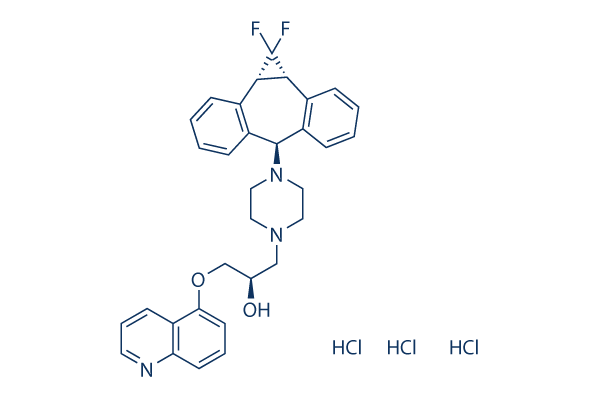
Chemische Struktur
Molekulargewicht: 636.99
Qualitätskontrolle
| Verwandte Ziele | CFTR CRM1 CD markers AChR Calcium Channel Sodium Channel Potassium Channel GABA Receptor TRP Channel ATPase |
|---|---|
| Weitere P-gp Inhibitoren | Tariquidar (XR9576) Elacridar (GF120918) (20S)-Protopanaxadiol Solamargine Sinapine Levistilide A Evodine Valspodar Wilforine Encequidar (HM30181) |
Zellkultur, Behandlung & Arbeitskonzentration
| Zelllinien | Assay-Typ | Konzentration | Inkubationszeit | Formulierung | Aktivitätsbeschreibung | PMID |
|---|---|---|---|---|---|---|
| CCRF-CEM/VCR1000 | Function assay | 240 secs | Inhibition of P-glycoprotein-mediated efflux from human CCRF-CEM/VCR1000 cells after 240 secs by FACS flow cytometric analysis, IC50=0.05888μM | 22452412 | ||
| DAOY | qHTS assay | qHTS of pediatric cancer cell lines to identify multiple opportunities for drug repurposing: Primary screen for DAOY cells | 29435139 | |||
| SJ-GBM2 | qHTS assay | qHTS of pediatric cancer cell lines to identify multiple opportunities for drug repurposing: Primary screen for SJ-GBM2 cells | 29435139 | |||
| A673 | qHTS assay | qHTS of pediatric cancer cell lines to identify multiple opportunities for drug repurposing: Primary screen for A673 cells | 29435139 | |||
| SK-N-MC | qHTS assay | qHTS of pediatric cancer cell lines to identify multiple opportunities for drug repurposing: Primary screen for SK-N-MC cells | 29435139 | |||
| NB-EBc1 | qHTS assay | qHTS of pediatric cancer cell lines to identify multiple opportunities for drug repurposing: Primary screen for NB-EBc1 cells | 29435139 | |||
| SK-N-SH | qHTS assay | qHTS of pediatric cancer cell lines to identify multiple opportunities for drug repurposing: Primary screen for SK-N-SH cells | 29435139 | |||
| NB1643 | qHTS assay | qHTS of pediatric cancer cell lines to identify multiple opportunities for drug repurposing: Primary screen for NB1643 cells | 29435139 | |||
| LAN-5 | qHTS assay | qHTS of pediatric cancer cell lines to identify multiple opportunities for drug repurposing: Primary screen for LAN-5 cells | 29435139 | |||
| BT-12 | qHTS assay | qHTS of pediatric cancer cell lines to identify multiple opportunities for drug repurposing: Primary screen for BT-12 cells | 29435139 | |||
| OHS-50 | qHTS assay | qHTS of pediatric cancer cell lines to identify multiple opportunities for drug repurposing: Primary screen for OHS-50 cells | 29435139 | |||
| RD | qHTS assay | qHTS of pediatric cancer cell lines to identify multiple opportunities for drug repurposing: Primary screen for RD cells | 29435139 | |||
| MG 63 (6-TG R) | qHTS assay | qHTS of pediatric cancer cell lines to identify multiple opportunities for drug repurposing: Primary screen for MG 63 (6-TG R) cells | 29435139 | |||
| Rh30 | qHTS assay | qHTS of pediatric cancer cell lines to identify multiple opportunities for drug repurposing: Primary screen for Rh30 cells | 29435139 | |||
| Rh41 | qHTS assay | qHTS of pediatric cancer cell lines to identify multiple opportunities for drug repurposing: Primary screen for Rh41 cells | 29435139 | |||
| Klicken Sie hier, um weitere experimentelle Daten zu Zelllinien anzuzeigen | ||||||
Chemische Informationen, Lagerung & Stabilität
| Molekulargewicht | 636.99 | Formel | C32H31F2N3O2.3HCl |
Lagerung (Ab dem Eingangsdatum) | |
|---|---|---|---|---|---|
| CAS-Nr. | 167465-36-3 | SDF herunterladen | Lagerung von Stammlösungen |
|
|
| Synonyme | LY335979 3HCl, RS 33295-198 3HCl, D06387 3HCl | Smiles | C1CN(CCN1CC(COC2=CC=CC3=C2C=CC=N3)O)C4C5=CC=CC=C5C6C(C6(F)F)C7=CC=CC=C47.Cl.Cl.Cl | ||
Löslichkeit
|
In vitro |
DMSO
: 127 mg/mL
(199.37 mM)
Water : 23 mg/mL Ethanol : Insoluble |
Molaritätsrechner
|
In vivo |
|||||
In-vivo-Formulierungsrechner (Klare Lösung)
Schritt 1: Geben Sie die untenstehenden Informationen ein (Empfohlen: Ein zusätzliches Tier zur Berücksichtigung von Verlusten während des Experiments)
Schritt 2: Geben Sie die In-vivo-Formulierung ein (Dies ist nur der Rechner, keine Formulierung. Bitte kontaktieren Sie uns zuerst, wenn es im Abschnitt "Löslichkeit" keine In-vivo-Formulierung gibt.)
Berechnungsergebnisse:
Arbeitskonzentration: mg/ml;
Methode zur Herstellung der DMSO-Stammlösung: mg Wirkstoff vorgelöst in μL DMSO ( Konzentration der Stammlösung mg/mL, Bitte kontaktieren Sie uns zuerst, wenn die Konzentration die DMSO-Löslichkeit der Wirkstoffcharge überschreitet. )
Methode zur Herstellung der In-vivo-Formulierung: Nehmen Sie μL DMSO Stammlösung, dann hinzufügenμL PEG300, mischen und klären, dann hinzufügenμL Tween 80, mischen und klären, dann hinzufügen μL ddH2O, mischen und klären.
Methode zur Herstellung der In-vivo-Formulierung: Nehmen Sie μL DMSO Stammlösung, dann hinzufügen μL Maisöl, mischen und klären.
Hinweis: 1. Bitte stellen Sie sicher, dass die Flüssigkeit klar ist, bevor Sie das nächste Lösungsmittel hinzufügen.
2. Achten Sie darauf, das/die Lösungsmittel der Reihe nach hinzuzufügen. Sie müssen sicherstellen, dass die bei der vorherigen Zugabe erhaltene Lösung eine klare Lösung ist, bevor Sie mit der Zugabe des nächsten Lösungsmittels fortfahren. Physikalische Methoden wie Vortex, Ultraschall oder ein heißes Wasserbad können zur Unterstützung des Lösens verwendet werden.
Wirkmechanismus
| Targets/IC50/Ki |
P-gp
(Cell-free assay) 60 nM(Ki)
|
|---|---|
| In vitro |
LY335979 hemmt kompetitiv die Gleichgewichtsbindung von Pgp, indem es die [3H]Azidopin-Photoaffinitätsmarkierung des Pgp in CEM/VLB100-Plasmamembranen blockiert. LY335979 allein zeigt die Zytotoxizität gegenüber medikamentenempfindlichen und MDR-Zelllinien mit IC50-Werten von 6 μM bis 16 μM und bewirkt seine Fähigkeit, die Resistenz der Onkolytika gegenüber den MDR-Zelllinien P388/ADR, MCF7/ADR, 2780AD oder UCLA-P3.003VLB bei Konzentrationen von 0,1 und 0,5 μM vollständig umzukehren. LY335979 stellt die Medikamentenempfindlichkeit in P-gp-exprimierenden Leukämiezelllinien wie K562/HHT40, K562/HHT90, K562/DOX und HL60/DNR signifikant wieder her und erhöht die Zytotoxizität von Anthrazyklinen und Ozogamicin (Mylotarg) in primären AML-Blasten mit aktivem P-gp. Ein aktueller Artikel zeigt, dass LY335979 den apikal gerichteten Transport von (Z)-Endoxifen in den ABCB1-transduzierten Zellen vollständig hemmt. |
| Kinase-Assay |
ATPase-Assay
|
|
Die P-Glycoprotein-ATPase-Aktivität wird durch die Freisetzung von anorganischem Phosphat aus ATP gemessen. Der Assay wird in einer 96-Well-Platte für 90 Minuten bei 37 °C durchgeführt. Membranen (8 μg-10 μg Protein) werden in einem Gesamtvolumen von 100 μL Puffer A inkubiert, der 5 mM Natriumazid, 1 mM Ouabain, 1 mM EGTA, 3 mM ATP, ein ATP-regenerierendes System bestehend aus 5 mM Phosphoenolpyruvat und 3,6 Einheiten/mL Pyruvatkinase in Anwesenheit und Abwesenheit von 1 mM Natriumvanadat enthält. Die Pgp-ATPase-Aktivität ist als der Vanadat-sensitive Anteil der gesamten ATPase-Aktivität definiert. Die Platten werden 3 Minuten nach Zugabe der Detektionslösung abgelesen. Die Absorption wird bei 690 nm mit einem Mikrotiterplattenleser gemessen. Eine Phosphat-Standardkurve wird verwendet, um die gebildete μmol Phosphat zu berechnen. Proben werden in dreifacher Ausführung gemessen.
|
Literatur |
|
Technischer Support
Tel: +1-832-582-8158 Ext:3
Wenn Sie weitere Fragen haben, hinterlassen Sie bitte eine Nachricht.

Produkte sind nur für Forschungszwecke bestimmt. Nicht für den menschlichen Gebrauch. Wir verkaufen nicht an Patienten.
©Copyright 2013 Selleck Chemicals. Alle Rechte vorbehalten.