
nur für Forschungszwecke
Elacridar (GF120918) P-gp Inhibitor
Kat.-Nr.S7772
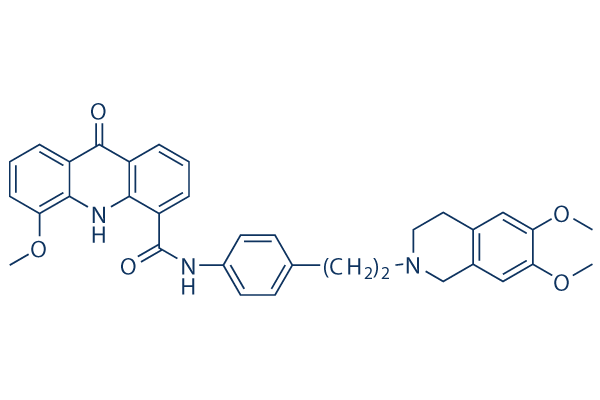
Chemische Struktur
Molekulargewicht: 563.64
Qualitätskontrolle
| Verwandte Ziele | CFTR CRM1 CD markers AChR Calcium Channel Sodium Channel Potassium Channel GABA Receptor TRP Channel ATPase |
|---|---|
| Weitere P-gp Inhibitoren | Tariquidar (XR9576) Zosuquidar 3HCl (20S)-Protopanaxadiol Solamargine Sinapine Levistilide A Evodine Valspodar Wilforine Encequidar (HM30181) |
Zellkultur, Behandlung & Arbeitskonzentration
| Zelllinien | Assay-Typ | Konzentration | Inkubationszeit | Formulierung | Aktivitätsbeschreibung | PMID |
|---|---|---|---|---|---|---|
| primary glioblastoma stem cells | Function assay | 1 uM | 24 hrs | Inhibition of MDR1 in human primary glioblastoma stem cells assessed as increase in doxorubicin-induced reduction in cell viability at 1 uM after 24 hrs by by LDH release assay | 30584838 | |
| primary mesothelioma stem cells | Function assay | 1 uM | 72 hrs | Inhibition of MDR1 in human primary mesothelioma stem cells assessed as increase in doxorubicin-induced reduction in cell viability at 1 uM after 72 hrs by ATPlite luminescence assay | 30584838 | |
| primary glioblastoma stem cells | Function assay | 1 uM | 72 hrs | Inhibition of MDR1 in human primary glioblastoma stem cells assessed as increase in doxorubicin-induced reduction in cell viability at 1 uM after 72 hrs by ATPlite luminescence assay | 30584838 | |
| primary mesothelioma stem cells | Function assay | 10 to 10000 nM | 3 hrs | Inhibition of MDR1 in human primary mesothelioma stem cells assessed as increase in intracellular doxorubicin accumulation at 10 to 10000 nM after 3 hrs by spectrofluorimetric analysis | 30584838 | |
| primary glioblastoma stem cells | Function assay | 10 to 10000 nM | 3 hrs | Inhibition of MDR1 in human primary glioblastoma stem cells assessed as increase in intracellular doxorubicin accumulation at 10 to 10000 nM after 3 hrs by spectrofluorimetric analysis | 30584838 | |
| NB1643 | qHTS assay | qHTS of pediatric cancer cell lines to identify multiple opportunities for drug repurposing: Primary screen for NB1643 cells | 29435139 | |||
| SK-N-SH | qHTS assay | qHTS of pediatric cancer cell lines to identify multiple opportunities for drug repurposing: Primary screen for SK-N-SH cells | 29435139 | |||
| SK-N-MC | qHTS assay | qHTS of pediatric cancer cell lines to identify multiple opportunities for drug repurposing: Primary screen for SK-N-MC cells | 29435139 | |||
| KBV1 | Function assay | 10 mins | Inhibition of ABCB1 in human KBV1 cells after 10 mins by Calcein-AM microplate assay, IC50=0.193μM | 24900683 | ||
| MCF7/Topo | Function assay | 2 hrs | Inhibition of ABCG2 in human MCF7/Topo cells after 2 hrs by Hoechst 33342 microplate assay, IC50=0.127μM | 24900683 | ||
| CCRF-CEM/VCR1000 | Function assay | Inhibition of P-glycoprotein-mediated daunorubicin efflux from human CCRF-CEM/VCR1000 cells after 240 secs by FACS flow cytometric analysis, IC50=0.07244μM | 22452412 | |||
| Caco2 | Function assay | 3 uM | 30 mins | Inhibition of BCRP-mediated [3H]estrone-3-sulfate transport in human Caco2 cells at 3 uM after 30 mins | 22266779 | |
| Caco2 | Function assay | 3 uM | 30 mins | Inhibition of P-gp-mediated transport in human Caco2 cells at 3 uM after 30 mins | 22266779 | |
| Kb-V1 | Function assay | 10 mins | Inhibition of ABCB1 expressed in Kb-V1 cells after 10 mins by calcein-AM assay, IC50=0.193μM | 21570282 | ||
| MCF7/Topo | Function assay | Inhibition of ABCG2 expressed in human MCF7/Topo cells by Hoechst microplate assay, IC50=0.127μM | 21570282 | |||
| MDCK2-MDR1 | Function assay | 60 mins | Inhibition of human Pgp overexpressed in human MDCK2-MDR1 cells assessed as inhibition of R123 efflux after 60 mins, IC50=0.4μM | 21419632 | ||
| MDCK | Function assay | Inhibition of BCRP expressed in MDCK cells by pheophorbide A assay, IC50=0.43μM | 19932960 | |||
| MCF7 MX | Function assay | Inhibition of BCRP expressed in MCF7 MX cells by Hoechst 33342 staining, IC50=0.4μM | 19932960 | |||
| KBv1 | Function assay | Inhibition of ABCB1 overexpressed in human KBv1 cells by flow cytometric-based calcein-AM efflux assay, IC50=0.193μM | 19170519 | |||
| SKVLB1 | Cytotoxicity assay | Cytotoxicity against human multidrug-resistant SKVLB1 cells in presence of adriamycin, IC50=0.02μM | 11754602 | |||
| SKOV3 | Cytotoxicity assay | Cytotoxicity against human SKOV3 cells, IC50=8.1μM | 11754602 | |||
| SKVLB1 | Cytotoxicity assay | Cytotoxicity against human multidrug-resistant SKVLB1 cells, IC50=1.4μM | 11754602 | |||
| A673 | qHTS assay | qHTS of pediatric cancer cell lines to identify multiple opportunities for drug repurposing: Primary screen for A673 cells | 29435139 | |||
| primary mesothelioma stem cells | Function assay | 1 uM | 24 hrs | Inhibition of MDR1 in human primary mesothelioma stem cells assessed as increase in doxorubicin-induced reduction in cell viability at 1 uM after 24 hrs by by LDH release assay | 30584838 | |
| Klicken Sie hier, um weitere experimentelle Daten zu Zelllinien anzuzeigen | ||||||
Chemische Informationen, Lagerung & Stabilität
| Molekulargewicht | 563.64 | Formel | C34H33N3O5 |
Lagerung (Ab dem Eingangsdatum) | |
|---|---|---|---|---|---|
| CAS-Nr. | 143664-11-3 | SDF herunterladen | Lagerung von Stammlösungen |
|
|
| Synonyme | GW120918, GG918, GW0918 | Smiles | COC1=CC=CC2=C1NC3=C(C2=O)C=CC=C3C(=O)NC4=CC=C(C=C4)CCN5CCC6=CC(=C(C=C6C5)OC)OC | ||
Löslichkeit
|
In vitro |
DMSO
: 100 mg/mL
(177.41 mM)
Water : Insoluble Ethanol : Insoluble |
Molaritätsrechner
|
In vivo |
|||||
In-vivo-Formulierungsrechner (Klare Lösung)
Schritt 1: Geben Sie die untenstehenden Informationen ein (Empfohlen: Ein zusätzliches Tier zur Berücksichtigung von Verlusten während des Experiments)
Schritt 2: Geben Sie die In-vivo-Formulierung ein (Dies ist nur der Rechner, keine Formulierung. Bitte kontaktieren Sie uns zuerst, wenn es im Abschnitt "Löslichkeit" keine In-vivo-Formulierung gibt.)
Berechnungsergebnisse:
Arbeitskonzentration: mg/ml;
Methode zur Herstellung der DMSO-Stammlösung: mg Wirkstoff vorgelöst in μL DMSO ( Konzentration der Stammlösung mg/mL, Bitte kontaktieren Sie uns zuerst, wenn die Konzentration die DMSO-Löslichkeit der Wirkstoffcharge überschreitet. )
Methode zur Herstellung der In-vivo-Formulierung: Nehmen Sie μL DMSO Stammlösung, dann hinzufügenμL PEG300, mischen und klären, dann hinzufügenμL Tween 80, mischen und klären, dann hinzufügen μL ddH2O, mischen und klären.
Methode zur Herstellung der In-vivo-Formulierung: Nehmen Sie μL DMSO Stammlösung, dann hinzufügen μL Maisöl, mischen und klären.
Hinweis: 1. Bitte stellen Sie sicher, dass die Flüssigkeit klar ist, bevor Sie das nächste Lösungsmittel hinzufügen.
2. Achten Sie darauf, das/die Lösungsmittel der Reihe nach hinzuzufügen. Sie müssen sicherstellen, dass die bei der vorherigen Zugabe erhaltene Lösung eine klare Lösung ist, bevor Sie mit der Zugabe des nächsten Lösungsmittels fortfahren. Physikalische Methoden wie Vortex, Ultraschall oder ein heißes Wasserbad können zur Unterstützung des Lösens verwendet werden.
Wirkmechanismus
| Targets/IC50/Ki |
P-gp
BCRP
|
|---|---|
| In vitro |
Elacridar (GF120918) hemmt die P-Glykoprotein (P-gp)-Markierung durch [3H]Azidopin mit einer IC50 von 0,16 μM. In Caki-1- und ACHN-Zellen hemmt es (2,5 μM) signifikant das Zellwachstum. Es wurde festgestellt, dass die P-Glykoprotein-Aktivität durch diese Verbindung gehemmt wird. Ihre Kombination führte zu einer signifikanten Reduktion der ABC-Subfamilie B Member 2 (ABCG2)-Expression in 786-O-Zellen. |
| Kinase-Assay |
Photoaffinitäts-Radiomarkierung von P-gp
|
|
10 μL unmarkierte Zellmembransuspension (bei 0,4 mg Protein/mL) werden in jede Vertiefung von 96-Well-Platten aliquotiert. Anschließend werden 5 μL Elacridar (GF120918) zu jeder Vertiefung gegeben. Die Platte wird 25 min bei 25
est-de in the dark inkubiert. 5 μL tritiertes Azidopin (1,8 TBq/mmol) (0,6 μM in HCI 0,2 mM) werden zu jeder Vertiefung gegeben. Nach 25 min Inkubation bei 25
est-de in the dark werden die Proben gleichzeitig 2 min bei 254 nm bei 0
est-de mit einer für Dünnschichtchromatographie entwickelten UV-Lampe direkt in Kontakt mit der Platte bestrahlt. Die Proben werden in Natriumdodecylsulfat-Polyacrylamidgel-Elektrophorese-Probenpuffer solubilisiert, aber nicht erhitzt. Nach der Trennung auf einem 7,5%igen Polyacrylamidgel wird das Gel zur Fluorographie mit Amplify behandelt und 3 Tage lang auf einen fotosensitiven Film exponiert. Die Fluorographie wird mit einem Camag Dünnschichtchromatographie Scanner II Densitometer analysiert.
|
|
| In vivo |
Elacridar (GF120918) erhöht die Plasma- und Hirnkonzentrationen sowie die Hirn-Plasma-Verhältnisse bei Wildtyp-Mäusen, wenn es oral (100 mg/kg, p.o.) ko-administriert wird, was den Spiegeln in Abcb1a/1b; Abcg2-/- Mäusen entspricht. Bei Friend-Leukämie-Virusstamm-B-Mäusen beträgt der Hirn-Plasma-Verteilungskoeffizient (Kp, Hirn) dieser Verbindung 0,82, 0,43 und 4,31 nach intravenöser (2,5 mg/kg), intraperitonealer (100 mg/kg) bzw. oraler (100 mg/kg) Behandlung. In Mrp4(-/-) Mäusen hemmt es den P-gp-vermittelten Transport vollständig, ohne signifikante Auswirkungen auf den Bcrp1-vermittelten Transport. |
Literatur |
|
Anwendungen
| Methoden | Biomarker | Bilder | PMID |
|---|---|---|---|
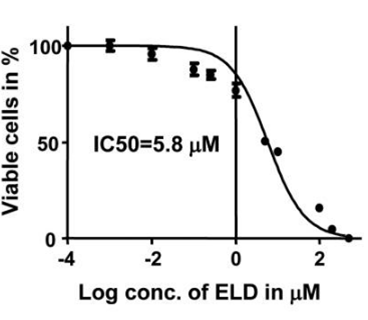
| Growth inhibition assay | Cell viability |
|
25862759 |
Technischer Support
Tel: +1-832-582-8158 Ext:3
Wenn Sie weitere Fragen haben, hinterlassen Sie bitte eine Nachricht.

Produkte sind nur für Forschungszwecke bestimmt. Nicht für den menschlichen Gebrauch. Wir verkaufen nicht an Patienten.
©Copyright 2013 Selleck Chemicals. Alle Rechte vorbehalten.