
nur für Forschungszwecke
Lopinavir (ABT-378) HIV Protease Inhibitor
Kat.-Nr.S1380
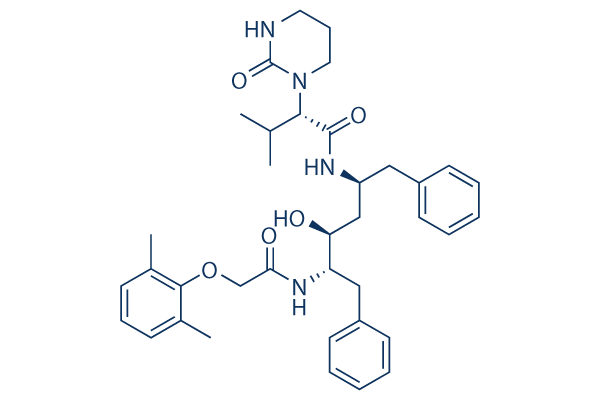
Chemische Struktur
Molekulargewicht: 628.8
Qualitätskontrolle
| Verwandte Ziele | HDAC Caspase Proteasome Secretase MMP HCV Protease Cysteine Protease DPP Tyrosinase Serine Protease |
|---|---|
| Weitere HIV Protease Inhibitoren | Pepstatin A Limonin Temsavir (BMS-626529) NBD-556 Bevirimat GS-6207 Rosamultin Dextran sulfate sodium (DSS) Mericitabine Azvudine |
Zellkultur, Behandlung & Arbeitskonzentration
| Zelllinien | Assay-Typ | Konzentration | Inkubationszeit | Formulierung | Aktivitätsbeschreibung | PMID |
|---|---|---|---|---|---|---|
| MT2 cells | Function assay | Antiviral activity against HIV2 EHO in MT2 cells assessed as inhibition of p24 Gag protein expression by MTT assay, EC50=0.0026 μM | ||||
| HEK293 cells | Function assay | 48 h | Antiviral activity against wild type HIV1 NL4-3 in HEK293 cells after 48 hrs by replication-deffective luciferase reporter gene-based phenotypic assay, EC50=0.0028 μM | |||
| human MT4 cells | Function assay | 5 days | Antiviral activity against HIV2 MS infected in human MT4 cells assessed as inhibition of virus production after 5 days by Lenti-RT activity assay, EC50=0.006 μM | |||
| human PBMC cells | Function assay | 5 days | Antiviral activity against HIV2 MS infected in human PBMC cells assessed as inhibition of virus production after 5 days by Lenti-RT activity assay, EC50=0.015 μM | |||
| Klicken Sie hier, um weitere experimentelle Daten zu Zelllinien anzuzeigen | ||||||
Chemische Informationen, Lagerung & Stabilität
| Molekulargewicht | 628.8 | Formel | C37H48N4O5 |
Lagerung (Ab dem Eingangsdatum) | |
|---|---|---|---|---|---|
| CAS-Nr. | 192725-17-0 | SDF herunterladen | Lagerung von Stammlösungen |
|
|
| Synonyme | ABT-378 | Smiles | CC1=C(C(=CC=C1)C)OCC(=O)NC(CC2=CC=CC=C2)C(CC(CC3=CC=CC=C3)NC(=O)C(C(C)C)N4CCCNC4=O)O | ||
Löslichkeit
|
In vitro |
DMSO
: 100 mg/mL
(159.03 mM)
Ethanol : 100 mg/mL Water : Insoluble |
Molaritätsrechner
|
In vivo |
|||||
In-vivo-Formulierungsrechner (Klare Lösung)
Schritt 1: Geben Sie die untenstehenden Informationen ein (Empfohlen: Ein zusätzliches Tier zur Berücksichtigung von Verlusten während des Experiments)
Schritt 2: Geben Sie die In-vivo-Formulierung ein (Dies ist nur der Rechner, keine Formulierung. Bitte kontaktieren Sie uns zuerst, wenn es im Abschnitt "Löslichkeit" keine In-vivo-Formulierung gibt.)
Berechnungsergebnisse:
Arbeitskonzentration: mg/ml;
Methode zur Herstellung der DMSO-Stammlösung: mg Wirkstoff vorgelöst in μL DMSO ( Konzentration der Stammlösung mg/mL, Bitte kontaktieren Sie uns zuerst, wenn die Konzentration die DMSO-Löslichkeit der Wirkstoffcharge überschreitet. )
Methode zur Herstellung der In-vivo-Formulierung: Nehmen Sie μL DMSO Stammlösung, dann hinzufügenμL PEG300, mischen und klären, dann hinzufügenμL Tween 80, mischen und klären, dann hinzufügen μL ddH2O, mischen und klären.
Methode zur Herstellung der In-vivo-Formulierung: Nehmen Sie μL DMSO Stammlösung, dann hinzufügen μL Maisöl, mischen und klären.
Hinweis: 1. Bitte stellen Sie sicher, dass die Flüssigkeit klar ist, bevor Sie das nächste Lösungsmittel hinzufügen.
2. Achten Sie darauf, das/die Lösungsmittel der Reihe nach hinzuzufügen. Sie müssen sicherstellen, dass die bei der vorherigen Zugabe erhaltene Lösung eine klare Lösung ist, bevor Sie mit der Zugabe des nächsten Lösungsmittels fortfahren. Physikalische Methoden wie Vortex, Ultraschall oder ein heißes Wasserbad können zur Unterstützung des Lösens verwendet werden.
Wirkmechanismus
| Targets/IC50/Ki |
HIV protease
(Cell-free assay) 1.3 pM(Ki)
|
|---|---|
| In vitro |
Lopinavir (ABT-378) bindet an mutierte HIV protease (V82A, V82F und V82T) mit Ki von 4,9 pM, 3,7 pM bzw. 3,6 pM. Es hemmt 93 % der Wildtyp-HIV protease-Aktivität bei 0,5 nM und unterdrückt auch die HIV protease-Aktivität in Abwesenheit und Anwesenheit von 50 % HS mit EC50 von 17 nM bzw. 102 nM in MT4-Zellen. Diese Verbindung wird in Lebermikrosomen NADPH-abhängig in mehrere Metaboliten umgewandelt, wobei die primären Metaboliten M-3 und M-4 sind. Es ist ein potenter Inhibitor des Rh123-Efflux in Caco-2-Monolayern mit einer IC50 von 1,7 mM. Seine Exposition (72 Stunden) in LS 180V-Zellen reduziert den Gehalt an intrazellulärem Rh123 und induziert P-Glykoprotein-immunreaktive Protein- und Boten-RNA-Spiegel in LS 180V-Zellen. Es hemmt den Subtyp C-Klon C6 mit einer IC50 von 9,4 nM. Zusätzlich hemmt es CYP3A mit einer IC50 von 7,3 mM in menschlichen Lebermikrosomen, während es eine vernachlässigbare oder schwache Hemmung von menschlichem CYP1A2, 2B6, 2C9, 2C19 und 2D6 hervorruft.
|
| In vivo |
Lopinavir (ABT-378) (10 mg/kg, oral) führt bei Ratten zu einem Cmax von 0,8 μg/mL und einer oralen Bioverfügbarkeit von 25 %.
|
Literatur |
|
Klinische Studieninformationen
(Daten von https://clinicaltrials.gov, aktualisiert am 2024-05-22)
| NCT-Nummer | Rekrutierung | Erkrankungen | Sponsor/Kooperationspartner | Startdatum | Phasen |
|---|---|---|---|---|---|
| NCT04335123 | Completed | COVID-19 |
University of Kansas Medical Center |
April 4 2020 | Phase 1 |
| NCT04307693 | Terminated | COVID-19 |
Asan Medical Center |
March 11 2020 | Phase 2 |
Technischer Support
Tel: +1-832-582-8158 Ext:3
Wenn Sie weitere Fragen haben, hinterlassen Sie bitte eine Nachricht.
Häufig gestellte Fragen
Frage 1:
How should I go about proceeding with in vitro work to attain high concentration of it?
Antwort:
It can be dissolved in 2% DMSO, 49% PEG and 49% culture medium at 5 mg/ml.

Produkte sind nur für Forschungszwecke bestimmt. Nicht für den menschlichen Gebrauch. Wir verkaufen nicht an Patienten.
©Copyright 2013 Selleck Chemicals. Alle Rechte vorbehalten.