
nur für Forschungszwecke
Nobiletin MMP Inhibitor
Kat.-Nr.S2333
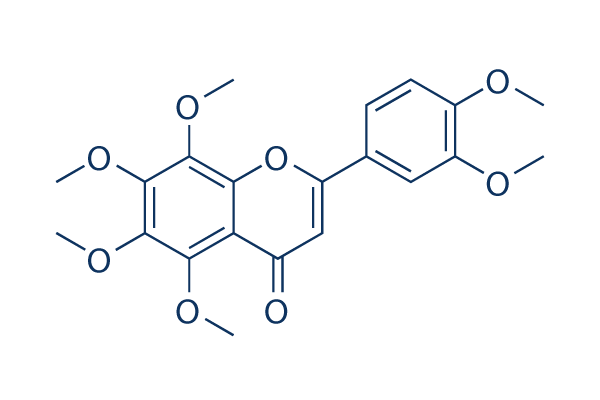
Chemische Struktur
Molekulargewicht: 402.39
Qualitätskontrolle
| Verwandte Ziele | HDAC Caspase Proteasome Secretase HCV Protease Cysteine Protease DPP Tyrosinase HIV Protease Serine Protease |
|---|---|
| Weitere MMP Inhibitoren | Ilomastat (GM6001) Marimastat (BB-2516) Batimastat (BB-94) SB-3CT T-5224 MMP-9-IN-1 NSC 405020 1, 10-Phenanthroline monohydrate JNJ0966 Cordycepin |
Zellkultur, Behandlung & Arbeitskonzentration
| Zelllinien | Assay-Typ | Konzentration | Inkubationszeit | Formulierung | Aktivitätsbeschreibung | PMID |
|---|---|---|---|---|---|---|
| MCF-7 MX | Function assay | Inhibition of BCRP expressed in MCF-7 MX cells using Hoechst 33342 staining, IC50=4.4μM | 21354800 | |||
| MDCK | Function assay | Inhibition of BCRP expressed in MDCK cells using Hoechst 33342 staining, IC50=4.9μM | 21354800 | |||
| NIH-3T3-G185 | Function assay | TP_TRANSPORTER: inhibition of Daunorubicin efflux in NIH-3T3-G185 cells, IC50=11.5μM | 11743742 | |||
| SRA 01/04 | Function assay | 24 hrs | Inhibition of TNF-alpha-induced proMMP9 production in human SRA 01/04 cells after 24 hrs by SDS-PAGE analysis, IC50=17μM | 21723726 | ||
| SRA 01/04 | Function assay | 24 hrs | Inhibition of TNFalpha-stimulated pro MMP9 production in human SRA 01/04 cells after 24 hrs by SDS-PAGE based gelatin zymography assay, IC50=17μM | 22047798 | ||
| SRA 01/04 | Function assay | 24 hrs | Inhibition of PMA-induced proMMP9 production in human SRA 01/04 cells after 24 hrs by SDS-PAGE analysis, IC50=20.9μM | 21723726 | ||
| SRA 01/04 | Function assay | 24 hrs | Inhibition of PMA-stimulated pro MMP9 production in human SRA 01/04 cells after 24 hrs by SDS-PAGE based gelatin zymography assay, IC50=20.9μM | 22047798 | ||
| HT-29 | Anticancer assay | 72 hrs | Anticancer activity against human HT-29 cells after 72 hrs by MTT assay, IC50=24μM | 19054677 | ||
| SHSY5Y | Function assay | 12 hrs | Reduction of hydrogen peroxide-induced apoptotic cell death in human SHSY5Y cells assessed as DNA ladder formation after 12 hrs | 18282757 | ||
| SHSY5Y | Function assay | 30 uM | 3 hrs | Elevation of phosphorylated ERK level in hydrogen peroxide-treated human SHSY5Y cells at 30 uM after 3 hrs by Western blot analysis | 18282757 | |
| SHSY5Y | Function assay | 30 uM | 3 hrs | Elevation of phosphorylated p38 level in hydrogen peroxide-treated human SHSY5Y cells at 30 uM after 3 hrs by Western blot analysis | 18282757 | |
| SHSY5Y | Function assay | 30 uM | 3 hrs | Elevation of phosphorylated JNk level in hydrogen peroxide-treated human SHSY5Y cells at 30 uM after 3 hrs by Western blot analysis | 18282757 | |
| ST-13 | Function assay | 10 uM | 11 days | Induction of preadipocyte differentiation in mouse ST-13 cells assessed as lipid accumulation at 10 uM within 11 days by oil red-staining relative to control | 19268587 | |
| ST-13 | Function assay | 0.1 to 30 uM | 11 days | Induction of adipocyte differentiation in mouse ST-13 cells assessed as stimulation of adipsin mRNA expression at 0.1 to 30 uM within 11 days by semi-quantitative RT-PCR | 19268587 | |
| ST-13 | Function assay | 0.1 to 30 uM | 11 days | Induction of adipocyte differentiation in mouse ST-13 cells assessed as stimulation of adipocyte P2 mRNA expression at 0.1 to 30 uM within 11 days by semi-quantitative RT-PCR | 19268587 | |
| ST-13 | Function assay | 11 days | Induction of adipocyte differentiation in mouse ST-13 cells assessed as increase in PPARgamma2 mRNA level after 11 days by semi-quantitative RT-PCR relative to control | 19268587 | ||
| SRA 01/04 | Growth inhibition assay | 64 uM | 4 days | Growth inhibition of human SRA 01/04 cells assessed as reduction in PCNA expression at 64 uM after 4 days by Western blot analysis | 23199882 | |
| Klicken Sie hier, um weitere experimentelle Daten zu Zelllinien anzuzeigen | ||||||
Chemische Informationen, Lagerung & Stabilität
| Molekulargewicht | 402.39 | Formel | C21H22O8 |
Lagerung (Ab dem Eingangsdatum) | |
|---|---|---|---|---|---|
| CAS-Nr. | 478-01-3 | SDF herunterladen | Lagerung von Stammlösungen |
|
|
Löslichkeit
|
In vitro |
DMSO
: 80 mg/mL
(198.81 mM)
Ethanol : 3 mg/mL Water : Insoluble |
Molaritätsrechner
|
In vivo |
|||||
In-vivo-Formulierungsrechner (Klare Lösung)
Schritt 1: Geben Sie die untenstehenden Informationen ein (Empfohlen: Ein zusätzliches Tier zur Berücksichtigung von Verlusten während des Experiments)
Schritt 2: Geben Sie die In-vivo-Formulierung ein (Dies ist nur der Rechner, keine Formulierung. Bitte kontaktieren Sie uns zuerst, wenn es im Abschnitt "Löslichkeit" keine In-vivo-Formulierung gibt.)
Berechnungsergebnisse:
Arbeitskonzentration: mg/ml;
Methode zur Herstellung der DMSO-Stammlösung: mg Wirkstoff vorgelöst in μL DMSO ( Konzentration der Stammlösung mg/mL, Bitte kontaktieren Sie uns zuerst, wenn die Konzentration die DMSO-Löslichkeit der Wirkstoffcharge überschreitet. )
Methode zur Herstellung der In-vivo-Formulierung: Nehmen Sie μL DMSO Stammlösung, dann hinzufügenμL PEG300, mischen und klären, dann hinzufügenμL Tween 80, mischen und klären, dann hinzufügen μL ddH2O, mischen und klären.
Methode zur Herstellung der In-vivo-Formulierung: Nehmen Sie μL DMSO Stammlösung, dann hinzufügen μL Maisöl, mischen und klären.
Hinweis: 1. Bitte stellen Sie sicher, dass die Flüssigkeit klar ist, bevor Sie das nächste Lösungsmittel hinzufügen.
2. Achten Sie darauf, das/die Lösungsmittel der Reihe nach hinzuzufügen. Sie müssen sicherstellen, dass die bei der vorherigen Zugabe erhaltene Lösung eine klare Lösung ist, bevor Sie mit der Zugabe des nächsten Lösungsmittels fortfahren. Physikalische Methoden wie Vortex, Ultraschall oder ein heißes Wasserbad können zur Unterstützung des Lösens verwendet werden.
Wirkmechanismus
| Targets/IC50/Ki |
MMP
|
|---|---|
| In vitro |
Nobiletin, ein Zitrus-Flavonoid, das aus Zitrusschalen, wie z. B. in Mandarinen, isoliert wurde, besitzt entzündungshemmende und Antitumor-Aktivitäten. Diese Verbindung, ein Polymethoxyflavonoid, wurde als Inhibitor sowohl der NO- als auch der O2--Generierung identifiziert. Es hemmt signifikant zwei durch doppelte TPA-Anwendung induzierte Hautentzündungen. Es unterdrückt auch die Expression von Cyclooxygenase-2- und induzierbaren NO-Synthase-Proteinen und die Prostaglandin-E2-Freisetzung. Diese Chemikalie hemmt die tumorinvasive Aktivität menschlicher Fibrosarkom-HT-1080-Zellen im Matrigel-Modell, nicht nur durch Unterdrückung der Expression von MMPs, sondern auch durch Erhöhung der TIMP-1-Produktion durch Störung des Phosphatidylinositol-3-Kinase-Signalwegs (PI3-K). Es kann auch Atherosklerose auf der Ebene der Gefäßwand verhindern, indem es die Bildung von Makrophagen-Schaumzellen hemmt.
|
| In vivo |
LD50: 780 mg/kg (i.g.).
|
Literatur |
|
Technischer Support
Tel: +1-832-582-8158 Ext:3
Wenn Sie weitere Fragen haben, hinterlassen Sie bitte eine Nachricht.

Produkte sind nur für Forschungszwecke bestimmt. Nicht für den menschlichen Gebrauch. Wir verkaufen nicht an Patienten.
©Copyright 2013 Selleck Chemicals. Alle Rechte vorbehalten.