
nur für Forschungszwecke
Pemetrexed Disodium (LY231514) Antifolate
Kat.-Nr.S1135
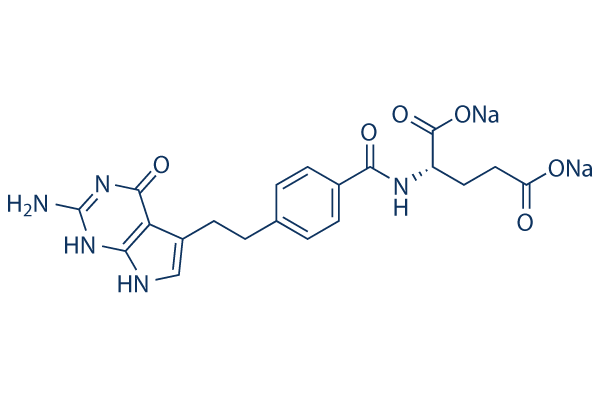
Chemische Struktur
Molekulargewicht: 471.37
Qualitätskontrolle
| Verwandte Ziele | Bcl-2 Caspase PD-1/PD-L1 Ferroptosis p53 Apoptosis related Synthetic Lethality STAT TNF-alpha Ras |
|---|---|
| Weitere Antifolate Inhibitoren | L-5-Methyltetrahydrofolate calcium Calcium N5-methyltetrahydrofolate |
Zellkultur, Behandlung & Arbeitskonzentration
| Zelllinien | Assay-Typ | Konzentration | Inkubationszeit | Formulierung | Aktivitätsbeschreibung | PMID |
|---|---|---|---|---|---|---|
| PANC-1 | Function Assay | 84 μM | 24 h | enhances EGFR, HER3 and AKT phosphorylation levels | 22977607 | |
| BXPC-3 | Function Assay | 39.86 μM | 24 h | enhances EGFR, HER3 and AKT phosphorylation levels | 22977607 | |
| PANC-1 | Function Assay | 84 μM | 24 h | enhances EGFR phosphorylated levels, and the protein levels | 22977607 | |
| BXPC-3 | Function Assay | 39.86 μM | 24 h | enhances EGFR phosphorylated levels, and the protein levels | 22977607 | |
| BXPC-3 | Function Assay | 39.86 μM | 24 h | induces S arrest (P<0.05) and decreases the number of cells in the G2/M phase | 22977607 | |
| PANC-1 | Growth Inhibition Assay | IC50=83.76±0.19 μM | 22977607 | |||
| BXPC-3 | Growth Inhibition Assay | IC50=39.86±1.68 μM | 22977607 | |||
| Jurkat | Growth Inhibition Assay | 48 h | proportion of live cells=76.7±4.3 % | 23840376 | ||
| DM-3 | Growth Inhibition Assay | 48 h | proportion of live cells=101.3±2.8 % | 23840376 | ||
| JL-1 | Growth Inhibition Assay | 48 h | proportion of live cells=98.2±2.2 % | 23840376 | ||
| ZL-34 | Growth Inhibition Assay | 48 h | proportion of live cells=95.7±6.5 % | 23840376 | ||
| STAV-FCS | Growth Inhibition Assay | 48 h | proportion of live cells=88.1±8.9 % | 23840376 | ||
| M-14-K | Growth Inhibition Assay | 48 h | proportion of live cells=81.8±12.9 % | 23840376 | ||
| STAV-AB | Growth Inhibition Assay | 48 h | proportion of live cells=64.4±21.8 % | 23840376 | ||
| LoVo | Function Assay | 0.05 μM | 72 h | DMSO | increases the percentage of cells in the S phase | 23959460 |
| HT-29 | Function Assay | 0.05 μM | 72 h | DMSO | increases the percentage of cells in the S phase | 23959460 |
| WiDr | Growth Inhibition Assay | 72 h | DMSO | IC50=0.019 ± 0.002 μM | 23959460 | |
| SW1116 | Growth Inhibition Assay | 72 h | DMSO | IC50=1.70 ± 0.03 μM | 23959460 | |
| HCT116 | Growth Inhibition Assay | 72 h | DMSO | IC50=0.049 ± 0.013 μM | 23959460 | |
| SW620 | Growth Inhibition Assay | 72 h | DMSO | IC50=1.09 ± 0.01 μM | 23959460 | |
| LoVo | Growth Inhibition Assay | 72 h | DMSO | IC50=0.032 ± 0.002 μM | 23959460 | |
| HT-29 | Growth Inhibition Assay | 72 h | DMSO | IC50=10.07 ± 0.94 μM | 23959460 | |
| A549/PEM-16 | Growth Inhibition Assay | 96 h | IC50=51.45 μM | 24348854 | ||
| A549/PEM-6.4 | Growth Inhibition Assay | 96 h | IC50=23.39 μM | 24348854 | ||
| A549/PEM-1.6 | Growth Inhibition Assay | 96 h | IC50=5.03 μM | 24348854 | ||
| A549 | Growth Inhibition Assay | 96 h | IC50=1.35 μM | 24348854 | ||
| MSTO-211H | Cell Viability Assay | 1-10 μg/ml | 72 h | IC50~0.04 μg/ml | 24378576 | |
| Y-meso14 | Cell Viability Assay | 1-10 μg/ml | 72 h | IC50>10 μg/ml | 24378576 | |
| H290 | Cell Viability Assay | 1-10 μg/ml | 72 h | IC50>10 μg/ml | 24378576 | |
| H226 | Cell Viability Assay | 1-10 μg/ml | 72 h | IC50>10 μg/ml | 24378576 | |
| H1299 | Growth Inhibition Assay | IC50=1.84 μM | 24418519 | |||
| H1993 | Growth Inhibition Assay | IC50=0.17 μM | 24418519 | |||
| A549 | Function Assay | 0.1/0.3/0.5/1 μM | 24/48 h | DMSO | produces the formation of AVOs in a dose-dependent manner | 24626722 |
| A549 | Cell Viability Assay | 0.1/0.3/0.5/1 μM | 24/48 h | DMSO | inhibits cell viability dose and time dependently | 24626722 |
| MES04 | Growth Inhibition Assay | IC50>100 μM | 24714722 | |||
| MES01 | Growth Inhibition Assay | IC50>100 μM | 24714722 | |||
| H2452 | Growth Inhibition Assay | IC50>100 μM | 24714722 | |||
| H2052 | Growth Inhibition Assay | IC50=0.57±0.34 μM | 24714722 | |||
| 211H | Growth Inhibition Assay | IC50=0.07±0.01 μM | 24714722 | |||
| H28 | Growth Inhibition Assay | IC50=0.07±0.02 μM | 24714722 | |||
| PC9/GR | Function Assay | 4.94 μM | 72 h | increases p-AKT levels | 24840891 | |
| PC9/GR | Function Assay | 4.94 μM | 72 h | increases p-ERK levels | 24840891 | |
| PC9/GR | Apoptosis Assay | 4.94 μM | 72 h | induces 19.54﹪ apoptosis | 24840891 | |
| PC9 | Apoptosis Assay | 16 nM | 72 h | induces 14.54﹪ apoptosis | 24840891 | |
| PC9/GR | Function Assay | 4.94 μM | 72 h | induces S-phase arrest | 24840891 | |
| PC9 | Function Assay | 16 nM | 72 h | induces S-phase arrest | 24840891 | |
| PC9/GR | Growth Inhibition Assay | 72 h | IC50=4.94±0.440 μM | 24840891 | ||
| PC9 | Growth Inhibition Assay | 72 h | IC50=16.05±1.85 nM | 24840891 | ||
| A549 | Function Assay | 0.1/0.3/1 μM | 48 h | increases the ratio of S-phase population | 24847863 | |
| A549 | Apoptosis Assay | 0.1/0.3/1 μM | 48 h | induces apoptosis in a dose dependent manner | 24847863 | |
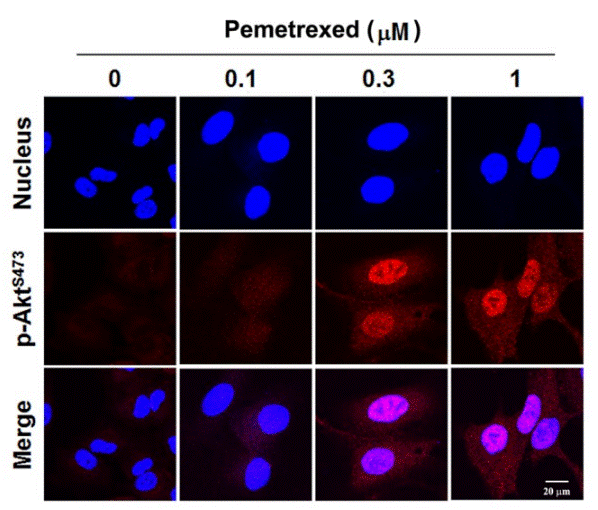
| A549 | Function Assay | 0.1/0.3/1 μM | 48 h | increases the level of phosphorylated Akt in a dose dependent manner | 24847863 | |
| A549 | Function Assay | 1 µM | 4/8/12/24/48 h | increases the level of phosphorylated Akt in a time dependent manner | 24847863 | |
| A549 | Function Assay | 5 μM | 8 h | increases Mcl-1 ubiquitination levels | 24991768 | |
| A549 | Apoptosis Assay | 2.5 μM | 48 h | induces apoptosis | 24991768 | |
| H1792 | Function Assay | 2.5/5/10 μM | 48 h | downregulates Mcl-1 | 24991768 | |
| A549 | Function Assay | 2.5/5/10 μM | 48 h | downregulates Mcl-1 | 24991768 | |
| H1792 | Function Assay | 2.5 μM | 48 h | induces caspase-9, caspase-3 and poly (ADP-ribose) polymerase (PARP) cleavage | 24991768 | |
| A549 | Function Assay | 2.5 μM | 48 h | induces caspase-9, caspase-3 and poly (ADP-ribose) polymerase (PARP) cleavage | 24991768 | |
| H1792 | Function Assay | 2.5/5/10 μM | 48 h | increases Noxa expression significantly | 24991768 | |
| A549 | Function Assay | 2.5/5/10 μM | 48 h | increases Noxa expression significantly | 24991768 | |
| A549 | Function Assay | 1 μM | 48 h | leads to mitochondrial dysfunction combined with simvastatin | 25096993 | |
| MSTO-211 | Function Assay | 1 μM | 48 h | leads to mitochondrial dysfunction combined with simvastatin | 25096993 | |
| A549 | Function Assay | 1 μM | 48 h | enhances intracellular ROS production combined with simvastatin | 25096993 | |
| MSTO-211 | Function Assay | 1 μM | 48 h | enhances intracellular ROS production combined with simvastatin | 25096993 | |
| A549 | Apoptosis Assay | 1 μM | 48 h | enhances caspase-dependent apoptosis combined with simvastatin | 25096993 | |
| MSTO-211 | Apoptosis Assay | 1 μM | 48 h | enhances caspase-dependent apoptosis combined with simvastatin | 25096993 | |
| A549 | Cell Viability Assay | 1 μM | 48 h | produces a synergistic inhibitory effect on the cell growth combined with simvastatin | 25096993 | |
| MSTO-211 | Cell Viability Assay | 1 μM | 48 h | produces a synergistic inhibitory effect on the cell growth combined with simvastatin | 25096993 | |
| H1299 | Cell Viability Assay | 1-1000 nM | 72 h | IC50=178 nM | 25145669 | |
| A549 | Cell Viability Assay | 1-1000 nM | 72 h | IC50=137 nM | 25145669 | |
| MG-63 | Cell Viability Assay | 0.01-100 μM | 72 h | inhibits cell viability dosedependently | 25152399 | |
| U20S | Cell Viability Assay | 0.01-100 μM | 72 h | inhibits cell viability dosedependently | 25152399 | |
| HepG3 | Function Assay | 10 μM | 48 h | upregulates phosphorylated (p-) MEK1/2 (Ser217/221) and p-ERK1/2 (Thr202/Tyr204) | 25446102 | |
| HepG3 | Function Assay | 0.1–100 μM | 48 h | activates cyto-protective autophagy | 25446102 | |
| HepG3 | Function Assay | 0.1–100 μM | 48 h | induces p62 downregulation as well as Beclin-1 and LC3B-II upregulation | 25446102 | |
| HepG2 | Apoptosis Assay | 0.1–100 μM | 72 h | induces apoptosis slightly at high concerntration | 25446102 | |
| HepG2 | Cell Viability Assay | 0.1–100 μM | 72 h | high concentrations of pemetrexed at (10/100 μM) only slightly inhibits HepG2 cell survival | 25446102 | |
| A459 | Apoptosis Assay | 4μM | 48 h | induces apoptosis | 25743822 | |
| A459 | Function Assay | 1/2/4 μM | 48 h | decreases the levels of p-Akt | 25743822 | |
| A459 | Function Assay | 1/2/4 μM | 24/48 h | induces G1 phase arrest in dose- and time dependent manner | 25743822 | |
| T47D | Growth Inhibition Assay | 0.234 mM | 72 h | growth inhibition=30﹪ | 25975637 | |
| HeLa | Growth Inhibition Assay | 0.234 mM | 72 h | growth inhibition=20﹪ | 25975637 | |
| A549 | Growth Inhibition Assay | 0.234 mM | 72 h | growth inhibition=50﹪ | 25975637 | |
| Vero | Growth Inhibition Assay | 0.234 mM | 72 h | growth inhibition=20﹪ | 25975637 | |
| T47D | Growth Inhibition Assay | 0.234 mM | 48 h | growth inhibition=20﹪ | 25975637 | |
| HeLa | Growth Inhibition Assay | 0.234 mM | 48 h | growth inhibition=10﹪ | 25975637 | |
| A549 | Growth Inhibition Assay | 0.234 mM | 48 h | growth inhibition=30﹪ | 25975637 | |
| Vero | Growth Inhibition Assay | 0.234 mM | 48 h | growth inhibition=10﹪ | 25975637 | |
| T47D | Growth Inhibition Assay | 0.234 mM | 24 h | growth inhibition=10﹪ | 25975637 | |
| HeLa | Growth Inhibition Assay | 0.234 mM | 24 h | growth inhibition=5﹪ | 25975637 | |
| A549 | Growth Inhibition Assay | 0.234 mM | 24 h | growth inhibition=10﹪ | 25975637 | |
| Vero | Growth Inhibition Assay | 0.234 mM | 24 h | growth inhibition=5﹪ | 25975637 | |
| A549 | Function Assay | 1 μM | 48 h | increases AMPK phosphorylation and a concomitant decrease in AKT and mTOR phosphorylation cotreated with simvastatin | 26334320 | |
| MSTO-211H | Function Assay | 1 μM | 48 h | increases AMPK phosphorylation and a concomitant decrease in AKT and mTOR phosphorylation cotreated with simvastatin | 26334320 | |
| A549 | Apoptosis Assay | 1 μM | 24 h | induces apoptosis cotreated with simvastatin | 26334320 | |
| MSTO-211H | Apoptosis Assay | 1 μM | 24 h | induces apoptosis cotreated with simvastatin | 26334320 | |
| A549 | Function Assay | 1 μM | 24 h | enhances autophagy cotreated with simvastatin | 26334320 | |
| MSTO-211H | Function Assay | 1 μM | 24 h | enhances autophagy cotreated with simvastatin | 26334320 | |
| A549 | Cell Viability Assay | 1 μM | 48 h | enhances simvastatin inhibited viability | 26334320 | |
| MSTO-211H | Cell Viability Assay | 1 μM | 48 h | enhances simvastatin inhibited viability | 26334320 | |
| KB | Function assay | IC50 = 0.03 μM | 18680275 | |||
| RT16 | Antiproliferative assay | IC50 = 0.042 μM | 18680275 | |||
| D4 | Antiproliferative assay | IC50 = 0.06 μM | 18680275 | |||
| KB | Antiproliferative assay | IC50 = 0.068 μM | 18680275 | |||
| IGROV1 | Antiproliferative assay | IC50 = 0.102 μM | 18680275 | |||
| PC43-10 | Antiproliferative assay | IC50 = 0.138 μM | 18680275 | |||
| IGROV1 | Antiproliferative assay | IC50 = 0.2 μM | 18680275 | |||
| D4 | Antiproliferative assay | IC50 = 0.254 μM | 18680275 | |||
| KB | Antiproliferative assay | IC50 = 0.327 μM | 18680275 | |||
| RT16 | Antiproliferative assay | IC50 = 0.388 μM | 18680275 | |||
| R2 | Antiproliferative assay | IC50 = 0.894 μM | 18680275 | |||
| KB | Function assay | 30 mins | IC50 = 0.03 μM | 19371039 | ||
| R2 | Function assay | Ki = 0.096 μM | 20085328 | |||
| R2 | Function assay | Ki = 1.54 μM | 20085328 | |||
| KB | Function assay | IC50 = 30 μM | 20085328 | |||
| R2 | Antiproliferative assay | 10 to 14 days | IC50 = 0.00494 μM | 21879757 | ||
| R2 | Antiproliferative assay | 96 hrs | IC50 = 0.0132 μM | 21879757 | ||
| RT16 | Antiproliferative assay | 96 hrs | IC50 = 0.042 μM | 21879757 | ||
| D4 | Antiproliferative assay | 96 hrs | IC50 = 0.06 μM | 21879757 | ||
| KB | Antiproliferative assay | 96 hrs | IC50 = 0.068 μM | 21879757 | ||
| IGROV1 | Antiproliferative assay | 96 hrs | IC50 = 0.102 μM | 21879757 | ||
| PC43-10 | Antiproliferative assay | 96 hrs | IC50 = 0.138 μM | 21879757 | ||
| IGROV1 | Antiproliferative assay | 96 hrs | IC50 = 0.2 μM | 21879757 | ||
| D4 | Antiproliferative assay | 96 hrs | IC50 = 0.254 μM | 21879757 | ||
| KB | Antiproliferative assay | 96 hrs | IC50 = 0.327 μM | 21879757 | ||
| RT16 | Antiproliferative assay | 96 hrs | IC50 = 0.388 μM | 21879757 | ||
| R2 | Antiproliferative assay | 96 hrs | IC50 = 0.894 μM | 21879757 | ||
| R2(VC) | Antiproliferative assay | 96 hrs | IC50 = 0.974 μM | 21879757 | ||
| R2 | Function assay | Ki = 0.094 μM | 22243528 | |||
| R2 | Function assay | Ki = 2.54 μM | 22243528 | |||
| R2 | Growth inhibition assay | 96 hrs | IC50 = 0.0132 μM | 24111942 | ||
| RT16 | Growth inhibition assay | 96 hrs | IC50 = 0.042 μM | 24111942 | ||
| D4 | Growth inhibition assay | 96 hrs | IC50 = 0.06 μM | 24111942 | ||
| KB | Growth inhibition assay | 96 hrs | IC50 = 0.068 μM | 24111942 | ||
| PC43-10 | Growth inhibition assay | 96 hrs | IC50 = 0.138 μM | 24111942 | ||
| D4 | Growth inhibition assay | 96 hrs | IC50 = 0.254 μM | 24111942 | ||
| KB | Growth inhibition assay | 96 hrs | IC50 = 0.327 μM | 24111942 | ||
| RT16 | Growth inhibition assay | 96 hrs | IC50 = 0.388 μM | 24111942 | ||
| MTXRII-OuaR2-4 | Growth inhibition assay | 96 hrs | IC50 = 0.894 μM | 24111942 | ||
| R2(VC) | Growth inhibition assay | 96 hrs | IC50 = 0.974 μM | 24111942 | ||
| KB | Cytotoxicity assay | 96 hrs | IC50 = 0.00994 μM | 24256410 | ||
| KB | Function assay | 30 mins | IC50 = 0.01174 μM | 24256410 | ||
| RT16 | Cytotoxicity assay | 96 hrs | IC50 = 0.0182 μM | 24256410 | ||
| R2 | Cytotoxicity assay | 96 hrs | IC50 = 0.0223 μM | 24256410 | ||
| PC43-10 | Cytotoxicity assay | 96 hrs | IC50 = 0.0306 μM | 24256410 | ||
| KB | Cytotoxicity assay | 96 hrs | IC50 = 0.69 μM | 24256410 | ||
| R2/PCFT4 | Function assay | 96 hrs | IC50 = 0.0132 μM | 25234128 | ||
| RT16 | Function assay | 96 hrs | IC50 = 0.042 μM | 25234128 | ||
| D4 | Function assay | 96 hrs | IC50 = 0.06 μM | 25234128 | ||
| KB | Cytotoxicity assay | 96 hrs | IC50 = 0.068 μM | 25234128 | ||
| PC43-10 | Function assay | 96 hrs | IC50 = 0.138 μM | 25234128 | ||
| D4 | Function assay | 96 hrs | IC50 = 0.254 μM | 25234128 | ||
| KB | Cytotoxicity assay | 96 hrs | IC50 = 0.327 μM | 25234128 | ||
| RT16 | Function assay | 96 hrs | IC50 = 0.388 μM | 25234128 | ||
| R2 | Cytotoxicity assay | 96 hrs | IC50 = 0.894 μM | 25234128 | ||
| R2 | Cytotoxicity assay | 96 hrs | IC50 = 0.974 μM | 25234128 | ||
| KB | Function assay | 1 hr | IC50 = 0.01174 μM | 25602637 | ||
| R2/PCFT4 | Function assay | 96 hrs | IC50 = 0.0132 μM | 25602637 | ||
| RT16 | Function assay | 96 hrs | IC50 = 0.042 μM | 25602637 | ||
| R2 | Cytotoxicity assay | 96 hrs | IC50 = 0.042 μM | 25602637 | ||
| KB | Antiproliferative assay | 96 hrs | IC50 = 0.068 μM | 25602637 | ||
| PC43-10 | Function assay | 96 hrs | IC50 = 0.138 μM | 25602637 | ||
| R2(VC) | Cytotoxicity assay | 96 hrs | IC50 = 0.974 μM | 25602637 | ||
| KB | Cytotoxicity assay | 72 hrs | IC50 = 0.07 μM | 25668494 | ||
| A549 | Cytotoxicity assay | 72 hrs | IC50 = 0.08 μM | 25668494 | ||
| HepG2 | Cytotoxicity assay | 72 hrs | IC50 = 1.26 μM | 25668494 | ||
| R2/PCFT4 | Function assay | 2 mins | K = 0.044 μM | 26317331 | ||
| R2/PCFT4 | Function assay | 2 mins | K = 0.27 μM | 26317331 | ||
| KB | Antiproliferative assay | 72 hrs | IC50 = 0.07 μM | 27017552 | ||
| SW620 | Antiproliferative assay | 72 hrs | IC50 = 0.08 μM | 27017552 | ||
| A549 | Antiproliferative assay | 72 hrs | IC50 = 1.26 μM | 27017552 | ||
| KB | Function assay | 72 hrs | IC50 = 0.07 μM | 28830032 | ||
| SW620 | Antiproliferative assay | 72 hrs | IC50 = 0.09 μM | 28830032 | ||
| MCF7 | Antiproliferative assay | 72 hrs | IC50 = 0.65 μM | 28830032 | ||
| R2/PCFT4 | Function assay | 96 hrs | IC50 = 0.0132 μM | 29425443 | ||
| RT16 | Function assay | 96 hrs | IC50 = 0.042 μM | 29425443 | ||
| D4 | Function assay | 96 hrs | IC50 = 0.06 μM | 29425443 | ||
| KB | Antiproliferative assay | 96 hrs | IC50 = 0.068 μM | 29425443 | ||
| PC43-10 | Function assay | 96 hrs | IC50 = 0.138 μM | 29425443 | ||
| D4 | Function assay | 96 hrs | IC50 = 0.254 μM | 29425443 | ||
| R2/PCFT4 | Function assay | 2 mins | Ki = 0.259 μM | 29425443 | ||
| KB | Antiproliferative assay | 96 hrs | IC50 = 0.327 μM | 29425443 | ||
| R2 | Cytotoxicity assay | 96 hrs | IC50 = 0.849 μM | 29425443 | ||
| RT16 | Function assay | 96 hrs | IC50 = 0.894 μM | 29425443 | ||
| R2(VC) | Growth inhibition assay | 96 hrs | IC50 = 0.974 μM | 29425443 | ||
| A549 | Antiproliferative assay | 24 hrs | IC50 = 3.31 μM | 29807332 | ||
| MDA-MB-231 | Antiproliferative assay | 24 hrs | IC50 = 3.85 μM | 29807332 | ||
| OVCAR3 | Antiproliferative assay | 24 hrs | IC50 = 6.9 μM | 29807332 | ||
| SGC7901 | Antiproliferative assay | 24 hrs | IC50 = 9.08 μM | 29807332 | ||
| KB | Function assay | 1 uM | 24 hrs | Induction of apoptotic activity in human KB cells at 1 uM after 24 hrs | 18680275 | |
| R2 | Antiproliferative assay | Antiproliferative activity against chinese hamster R2 cells expressing human PCFT assessed as growth inhibition in the presence of 10 uM thymidine and 320 uM AICA | 21879757 | |||
| R2 | Antiproliferative assay | Antiproliferative activity against chinese hamster R2 cells expressing human PCFT assessed as growth inhibition in the presence of 60 uM adenosine | 21879757 | |||
| R2 | Function assay | Inhibition of GARFTase in chinese hamster R2 cells expressing human PCFT assessed as incorporation of [14C]glycine into [14C]formyl GAR in the presence of 4 uM azaserine | 21879757 | |||
| R2 | Function assay | 10 uM | Inhibition of human PCFT-mediated [3H]MTX uptake ectopically expressed in chinese hamster R2 cells at 10 uM at pH 5.5 to 7.2 | 21879757 | ||
| PC43-10 | Function assay | 10 uM | 2 mins | Inhibition of human RFC-mediated [3H]MTX uptake in chinese hamster PC43-10 cells at 10 uM after 2 mins relative to control | 21879757 | |
| KB | Function assay | 1 uM | 48 hrs | Inhibition of AICARFTase in human KB cells assessed as phosphorylated AMPK at 1 uM after 48 hrs by Western blot analysis | 24256410 | |
| KB | Cytotoxicity assay | 96 hrs | Cytotoxicity against human KB cells expressing human RFC/FRalpha/PCFT after 96 hrs by CellTitre-Blue fluorescence assay in presence of adenosine/AICA/thymidine | 24256410 | ||
| KB | Cell cycle arrest assay | 1 uM | 48 hrs | Cell cycle arrest in human KB cells assessed as accumulation at G1/G0 phase at 1 uM after 48 hrs by propidium iodide staining-based flow cytometry relative to control | 24256410 | |
| KB | Function assay | 48 hrs | Inhibition of AICARFTase in human KB cells assessed as accumulation of ZMP after 48 hrs by HPLC analysis | 24256410 | ||
| R2/PCFT4 | Function assay | 0.5 uM | 5 mins | Binding affinity to human PCFT expressed in Chinese hamster R2/PCFT4 cells assessed as intracellular drug level at 0.5 uM at 37 degC at pH 5.5 measured over 5 mins | 26317331 | |
| TC32 | qHTS assay | qHTS of pediatric cancer cell lines to identify multiple opportunities for drug repurposing: Primary screen for TC32 cells | 29435139 | |||
| A673 | qHTS assay | qHTS of pediatric cancer cell lines to identify multiple opportunities for drug repurposing: Confirmatory screen for A673 cells) | 29435139 | |||
| SK-N-MC | qHTS assay | qHTS of pediatric cancer cell lines to identify multiple opportunities for drug repurposing: Primary screen for SK-N-MC cells | 29435139 | |||
| NB-EBc1 | qHTS assay | qHTS of pediatric cancer cell lines to identify multiple opportunities for drug repurposing: Primary screen for NB-EBc1 cells | 29435139 | |||
| NB1643 | qHTS assay | qHTS of pediatric cancer cell lines to identify multiple opportunities for drug repurposing: Confirmatory screen for NB1643 cells | 29435139 | |||
| SK-N-MC | qHTS assay | qHTS of pediatric cancer cell lines to identify multiple opportunities for drug repurposing: Confirmatory screen for SK-N-MC cells | 29435139 | |||
| TC32 | qHTS assay | qHTS of pediatric cancer cell lines to identify multiple opportunities for drug repurposing: Confirmatory screen for TC32 cells | 29435139 | |||
| IGROV1 | Function assay | Effect on TS protein expression in human IGROV1 cells by Western blot analysis | 30035541 | |||
| IGROV1 | Function assay | Effect on DHFR protein expression in human IGROV1 cells by Western blot analysis | 30035541 | |||
| IGROV1 | Function assay | Effect on HSP90 protein expression in human IGROV1 cells by Western blot analysis | 30035541 | |||
| Klicken Sie hier, um weitere experimentelle Daten zu Zelllinien anzuzeigen | ||||||
Chemische Informationen, Lagerung & Stabilität
| Molekulargewicht | 471.37 | Formel | C20H19N5Na2O6 |
Lagerung (Ab dem Eingangsdatum) | |
|---|---|---|---|---|---|
| CAS-Nr. | 150399-23-8 | SDF herunterladen | Lagerung von Stammlösungen |
|
|
| Synonyme | LY-231514 disodium | Smiles | C1=CC(=CC=C1CCC2=CNC3=C2C(=O)NC(=N3)N)C(=O)NC(CCC(=O)[O-])C(=O)[O-].[Na+].[Na+] | ||
Löslichkeit
|
In vitro |
Water : 94 mg/mL
DMSO
: Insoluble
Ethanol : Insoluble |
Molaritätsrechner
|
In vivo |
|||||
In-vivo-Formulierungsrechner (Klare Lösung)
Schritt 1: Geben Sie die untenstehenden Informationen ein (Empfohlen: Ein zusätzliches Tier zur Berücksichtigung von Verlusten während des Experiments)
Schritt 2: Geben Sie die In-vivo-Formulierung ein (Dies ist nur der Rechner, keine Formulierung. Bitte kontaktieren Sie uns zuerst, wenn es im Abschnitt "Löslichkeit" keine In-vivo-Formulierung gibt.)
Berechnungsergebnisse:
Arbeitskonzentration: mg/ml;
Methode zur Herstellung der DMSO-Stammlösung: mg Wirkstoff vorgelöst in μL DMSO ( Konzentration der Stammlösung mg/mL, Bitte kontaktieren Sie uns zuerst, wenn die Konzentration die DMSO-Löslichkeit der Wirkstoffcharge überschreitet. )
Methode zur Herstellung der In-vivo-Formulierung: Nehmen Sie μL DMSO Stammlösung, dann hinzufügenμL PEG300, mischen und klären, dann hinzufügenμL Tween 80, mischen und klären, dann hinzufügen μL ddH2O, mischen und klären.
Methode zur Herstellung der In-vivo-Formulierung: Nehmen Sie μL DMSO Stammlösung, dann hinzufügen μL Maisöl, mischen und klären.
Hinweis: 1. Bitte stellen Sie sicher, dass die Flüssigkeit klar ist, bevor Sie das nächste Lösungsmittel hinzufügen.
2. Achten Sie darauf, das/die Lösungsmittel der Reihe nach hinzuzufügen. Sie müssen sicherstellen, dass die bei der vorherigen Zugabe erhaltene Lösung eine klare Lösung ist, bevor Sie mit der Zugabe des nächsten Lösungsmittels fortfahren. Physikalische Methoden wie Vortex, Ultraschall oder ein heißes Wasserbad können zur Unterstützung des Lösens verwendet werden.
Wirkmechanismus
| Targets/IC50/Ki |
TS
(Cell-free assay) 1.3 nM(Ki)
DHFR
(Cell-free assay) 7.2 nM(Ki)
GARFT
(Cell-free assay) 65 nM(Ki)
|
|---|---|
| In vitro |
Pemetrexed disodium zeigt die antiproliferative Aktivität in CCRF-CEM Leukämie-, GC3/C1 Kolonkarzinom- und HCT-8 Ileozökarzinomzellen mit IC50-Werten von 25 nM, 34 nM bzw. 220 nM. Eine aktuelle Studie zeigt, dass Cisplatin plus diese Verbindung in Kombination mit der SOCS-1-Genabgabe den Antitumoreffekt durch Hemmung der Zellproliferation, Invasivität und Induktion von Apoptosis in MPM-Zellen zeigt, die mit einem Adenovirus-exprimierenden SOCS-1-Vektor infiziert sind.
|
| Kinase-Assay |
Enzymassays und -methoden.
|
|
Die TS-Aktivität wird mittels einer spektrophotometrischen Methode bestimmt, bei der die Zunahme der Absorption bei 340 nm überwacht wird, die durch die Bildung des Produkts 7,8-Dihydrofolat entsteht. Der Assaypuffer enthält 50 mM N-Tris[hydroxymethyl]methyl-2-aminoethansulfonsäure, 25 mM MgC12, 6,5 mM Formaldehyd, 1 mM EDTA und 75 mM 2-Mercaptoethanol, pH 7,4. Die Konzentrationen von Deoxyuridylatmonophosphat, 6R-MTHF und hIS betragen 100 μM, 30 μM bzw. 30 nM (1,7 Milliunits/mL). Bei der 6R-MTHF-Konzentration werden eine ungehemmte Reaktion und sechs Inhibitorkonzentrationen getestet. Ki app-Werte werden durch Anpassung der Daten an die Morrison-Gleichung mittels nichtlinearer Regressionsanalyse mit Hilfe des Programms ENZFITTER bestimmt. Ki-Werte werden mit der Gleichung berechnet: Ki app = Ki(1 + [S]/Km), wobei [S] gleich 30 μM und Km gleich 3 μM ist. Die DHFR-Aktivität wird spektrophotometrisch durch Überwachung des Verschwindens der Substrate NADPH und 7,8-Dihydrofolat bei 340 nm bestimmt. Die Reaktion findet bei 25 °C in 0,5 mL 50 mM Kaliumphosphatpuffer statt, der 150 mM KCl und 10 nM 2-Mercaptoethanol, pH 7,5, und 14 nM (0,34 Milliunit/mL) DHFR enthält. Die NADPH-Konzentration beträgt 10 μM und 7,8-Dihydrofolat wird bei 5, 10 oder 15 μM variiert. Bei jeder 7,8-Dihydrofolat-Konzentration werden eine ungehemmte Reaktion und sieben Inhibitorkonzentrationen getestet. Das Mikrocomputerprogramm ENZFITI'ER wird verwendet, um Ki app-Werte durch Anpassung der Daten an die Morrison-Gleichung mittels nichtlinearer Regressionsanalyse zu erhalten. Ki app = Ki(1 + [S]/Km), wobei [S] gleich der verwendeten Konzentration von 7,8-Dihydrofolat ist und Km von 7,8-Dihydrofolat gleich 0,15 μM ist. Die GARFT-Aktivität wird spektrophotometrisch durch Überwachung der Zunahme der Absorption bestimmt, die durch die Bildung des Produkts 5,8-Dideazafolat bei 295 nm entsteht. Das Reaktionslösungsmittel enthält 75 mM HEPES, 20 % Glycerin und 50 mM α-Thioglycerol, pH 7,5, bei 25 °C. Die Konzentrationen der verwendeten Substrate und Enzyme betragen 10 μM α,β-Glycinamid-Ribonucleotid, 0–10 μM 10-Formyl-5,8-dideazafolsäure und 10 nM (1,9 Milliunits/mL) GARFT. Ki-Werte werden mit dem Enzymmechanismusprogramm des Beckman DU640 Spektrophotometers berechnet, das die nichtlineare Regressionsanalyse verwendet, um Daten an die Michaelis-Menten-Gleichung für kompetitive Hemmung anzupassen.
|
|
| In vivo |
In dem humanen H460 nicht-kleinzelligen Lungenkarzinom-Xenograft bewirkt Pemetrexed disodium eine dosisabhängige Tumorwachstumsverzögerung (TGD).
|
Literatur |
|
Anwendungen
| Methoden | Biomarker | Bilder | PMID |
|---|---|---|---|
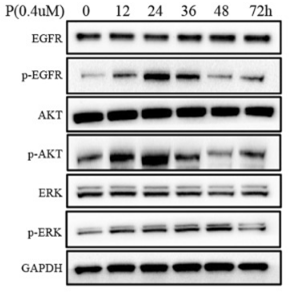
| Western blot | EGFR / p-EGFR AKT / p-AKT / GSK3β / p-GSK3β Topo IIα / Topo I / γH2AX / Cleaved PARP / Survivin p-Chk1 / Chk1 / Cyclin D / Cyclin E / p-Histone H3 / Histone H3 / Cyclin B1 / p-Cdc2 / Cdc2 |
|
30953548 |
| Immunofluorescence | p-AKT |
|
24847863 |
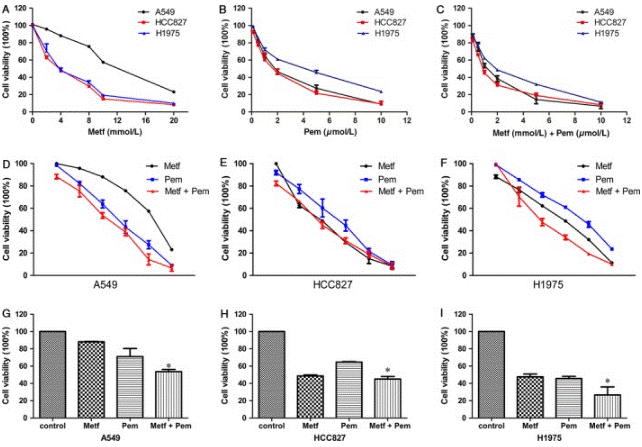
| Growth inhibition assay | Cell viability |
|
28719077 |
Klinische Studieninformationen
(Daten von https://clinicaltrials.gov, aktualisiert am 2024-05-22)
| NCT-Nummer | Rekrutierung | Erkrankungen | Sponsor/Kooperationspartner | Startdatum | Phasen |
|---|---|---|---|---|---|
| NCT06378892 | Recruiting | Non Small Cell Lung Cancer Metastatic|ALK Gene Mutation |
Centro di Riferimento Oncologico - Aviano |
March 15 2024 | Phase 2 |
| NCT06010277 | Recruiting | NSCLC|Mesothelioma|Thymoma |
Amphia Hospital|Albert Schweitzer Hospital |
February 6 2023 | Phase 4 |
Technischer Support
Tel: +1-832-582-8158 Ext:3
Wenn Sie weitere Fragen haben, hinterlassen Sie bitte eine Nachricht.

Produkte sind nur für Forschungszwecke bestimmt. Nicht für den menschlichen Gebrauch. Wir verkaufen nicht an Patienten.
©Copyright 2013 Selleck Chemicals. Alle Rechte vorbehalten.