Bcl-2 (B-cell lymphoma 2) is the founding pro-survival member of the Bcl-2 protein family, exerting its pro-survival function in response to a broad range of apoptotic stimuli through the inhibition of the mitochondrial outer membrane permeabilization (MOMP) process and the release of mitochondrial cytochrome c. [show the full text]

Bcl-2 Inhibitoren (Bcl-2 Inhibitors)
Weitere Apoptosis Inhibitoren
- Ausgewählte Inhibitoren
- Inhibitoren (41)
- Modulatoren (5)
- Chemikalie (1)
- Aktivatoren (7)
- Agonisten (5)
| Kat.-Nr. | Produktname | Informationen | Publikationen | Validierung |
|---|---|---|---|---|
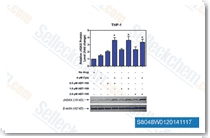
| S8048 | ABT-199 (Venetoclax) | Venetoclax (ABT-199, GDC-0199) ist ein Bcl-2-selektiver Inhibitor mit einem Ki von <0,01 nM in zellfreien Assays, über 4800-fach selektiver gegenüber Bcl-xL und Bcl-w und keiner Aktivität gegenüber Mcl-1. Venetoclax induziert Berichten zufolge Zellwachstumshemmung, Apoptose, Zellzyklusarrest und Autophagie in dreifach negativen Brustkrebs-MDA-MB-231-Zellen. Phase 3. |
|
|
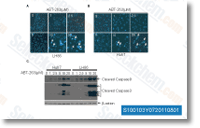
| S1001 | Navitoclax (ABT-263) | Als potenter Inhibitor von Bcl-xL, Bcl-2 und Bcl-w mit Ki von ≤ 0,5 nM, ≤1 nM und ≤1 nM in zellfreien Assays, bindet Navitoclax (ABT-263) schwächer an Mcl-1 und A1. Phase 2. |
|
|
| S8383 | S63845 | S63845 ist ein neuer, selektiver MCL-1-Inhibitor mit einem Kd-Wert von 0,19 nM und keiner erkennbaren Bindung an die anderen BCL-2-Mitglieder, BCL-2 oder BCL-XL. |
|
|
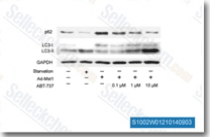
| S1002 | ABT-737 | ABT-737 ist ein BH3-mimetischer Inhibitor von Bcl-xL, Bcl-2 und Bcl-w mit einer EC50 von 78,7 nM, 30,3 nM bzw. 197,8 nM in zellfreien Assays; keine Hemmung wurde gegen Mcl-1, Bcl-B oder Bfl-1 beobachtet. ABT-737 induziert die Mitochondrienweg-Apoptose und Mitophagy. Phase 2. |
|
|
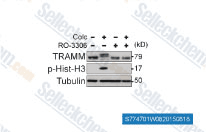
| S7747 | Ro-3306 | RO-3306 ist ein ATP-kompetitiver und selektiver CDK1-Inhibitor mit einem Ki von 20 nM und einer >15-fachen Selektivität gegenüber einem diversen Panel menschlicher Kinasen. RO-3306 verstärkt die p53-vermittelte Bax-Aktivierung und die mitochondriale Apoptose. |
|
|
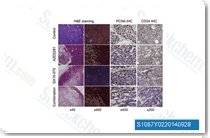
| S1057 | Obatoclax Mesylate (GX15-070) | Obatoclax Mesylate (GX15-070) ist ein Antagonist von Bcl-2 mit einem Ki von 0,22 μM in einem zellfreien Assay und kann dazu beitragen, MCL-1-vermittelte Apoptosis-Resistenz zu überwinden. |
|
|
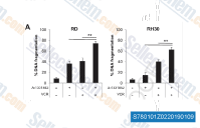
| S7801 | A-1331852 | A-1331852 ist ein potenter und selektiverBCL-XL-Inhibitor mit einem Ki-Wert von weniger als 0,01 nM für BCL-XL und 6 nM, 4 nM, 142 nM für Bcl-2, Bcl-W bzw. MCL-1. Er könnte bei der Behandlung von Krebs, Immun- und Autoimmunerkrankungen nützlich sein. |
|
|
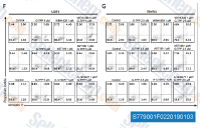
| S7790 | A-1210477 | A-1210477 ist ein potenter und selektiver MCL-1-Inhibitor mit einer Ki und IC50 von 0,454 nM bzw. 26,2 nM, mit einer >100-fachen Selektivität gegenüber anderen Bcl-2-Familienmitgliedern. |
|
|
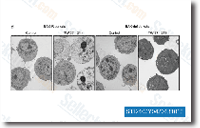
| S1121 | TW-37 | TW-37 ist ein neuartiger Nicht-Peptid-Inhibitor für rekombinantes Bcl-2, Bcl-xL und Mcl-1 mit Ki-Werten von 0,29 μM, 1,11 μM bzw. 0,26 μM in zellfreien Assays. |
|
|
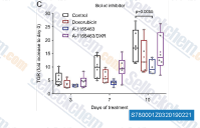
| S7800 | A-1155463 Dihydrochloride | A-1155463 Dihydrochloride, ein hochpotenter und selektiver BCL-XL-Inhibitor, zeigt eine pikomolare Bindungsaffinität zu BCL-XL und eine >1000-fach schwächere Bindung zu BCL-2 und verwandten Proteinen BCL-W (Ki=19 nM) und MCL-1 (Ki>440 nM). |
|
|
Bcl-2 (B-cell lymphoma 2) is encoded by the Bcl-2 gene and is the first identified member of a large family of apoptosis regulatory proteins (Bcl-2 family) that derives its name from the B-cell lymphoma 2, as it is the second member of a variety of proteins initially described in the t(14;18) chromosomal translocation in human follicular B-cell lymphomas. Bcl-2 contains four Bcl-2 homology domains (BH1-BH4) that mediate the formation of homodimer and heterodimer with relative proteins such as Bax, Bad, Bak and Bcl-xL, and a trans-membrane (TM) domain that mediates insertion into the outer membrane of the mitochondria and the endoplasmic reticulum. Bcl-2 proteins are generally integrated within the outer mitochondrial membrane (OMM), and may also be in the cytosol or ER membrane. The Bcl-2 and other antiapoptotic members of the Bcl-2 family preserve the outer mitochondrial membrane (OMM) integrity, thus inhibiting the mitochondrial signaling pathway of apoptosis, by complex interactions with the proapoptotic Bcl-2 proteins such as Bax, Bak, Bim, Puma and tBid. [1][2]
Bcl-2 suppresses apoptosis in response to a broad range of stress stimuli, including those frequently encountered during tumor development, such as oncogene activation, DNA damage, hypoxia (oxygen deprivation), loss of appropriate growth signals and anoikis (loss of cell attachment). In healthy cells, Bax and Bak are kept in check by the pro-survival Bcl-2 family members and the binding of BH3-only proteins unleashes Bax/Bak. Bcl-2 is also critical for the survival of renal epithelial stem cells during embryogenesis, melanocyte progenitors and mature B and T lymphocytes. Bcl-2 over-expression accelerates Eu-myc-induced lymphomagenesis, but loss of endogenous Bcl-2 does not prevent or delay Eu-myc-induced B lymphoma development. Bcl-2 proteins also constitutively binds to Beclin-1, and its dissociation through post-translational modification of Beclin-1 and/or Bcl-2 proteins such as phosphorylation by JNK1, or direct competition for the Bcl-2 BC groove by another BH3-only protein such as Bad, may be sufficient to induce autophagy, leading to the suggestion that autophagy and apoptosis are mechanistically linked. Single-site phosphorylation at Serine 70 (S70) is required for the antiapoptotic function of Bcl-2, and multisite phosphorylation at Threonine 69, S70, and S87 has been reported to inactivate Bcl-2. Phosphorylation of Bcl-2 has been shown to enhance activity to allow response to extracellular growth-factor-mediated signals. [1][2][3]
In addition, Bcl-2 is over-expressed in human follicular centre B-cell lymphoma; high levels of Bcl-2 are also detected in significant numbers of chronic lymphocytic leukaemia (CLL), DLBCL and mantle cell lymphoma, as well as in certain solid tumours(brain, breast and lung). The upregulation of Bcl-2 in CLL and other cancers has been attributed to the hypo-methylation of the Bcl-2 promoter or, possibly more importantly due to hemizygous or homozygous loss of the micro RNAs (miRs) 15a and 16-1 that negatively regulate Bcl-2. The dysregulated Bcl-2 proteins in cancer can lead to increased survival of abnormal cells, which are thought to be involved in resistance to conventional cancer treatment. Mice that constitutively express both Myc and Bcl-2 transgenes develop lymphoblastic leukaemia with high incidence, while shut-down of the inducible Bcl-2 transgene in lymphoma-burdened bi-transgenic mice results in tumor regression and significantly prolonged animal survival in many cases, indicating that inactivation of Bcl-2 constitutes a promising new approach to cancer therapy. Small molecule mimetics of BH3-only proteins that can directly target pro-survival Bcl-2 family members are being developed as a novel therapeutic approach. ABT-737 and the closely related orally bioavailable ABT-263, belong to the BH3 mimetic small molecule inhibitors, targeting Bcl-2 and Bcl-2-related proteins such as Bcl-xL and Bcl-w, therefore promoting tumor regression in murine xeno-transplanation models of certain human lymphomas or small cell lung carcinomas and in primary patient-derived follicular lymphoma cells. [1][4]

Produkte sind nur für Forschungszwecke bestimmt. Nicht für den menschlichen Gebrauch. Wir verkaufen nicht an Patienten.
©Copyright 2013 Selleck Chemicals. Alle Rechte vorbehalten.