
nur für Forschungszwecke
Ramipril RAAS Inhibitor
Kat.-Nr.S1793
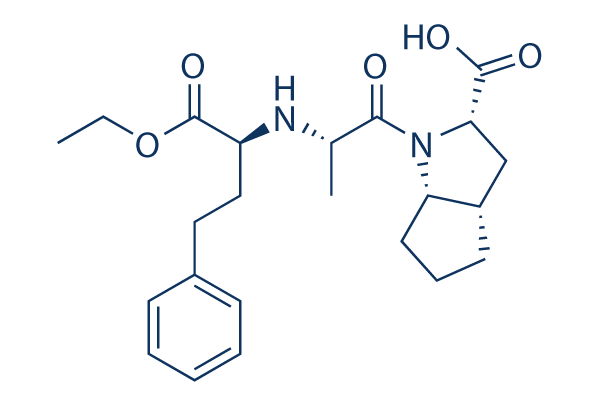
Chemische Struktur
Molekulargewicht: 416.51
Qualitätskontrolle
Chemische Informationen, Lagerung & Stabilität
| Molekulargewicht | 416.51 | Formel | C23H32N2O5 |
Lagerung (Ab dem Eingangsdatum) | |
|---|---|---|---|---|---|
| CAS-Nr. | 87333-19-5 | SDF herunterladen | Lagerung von Stammlösungen |
|
|
| Synonyme | HOE-498 | Smiles | CCOC(=O)C(CCC1=CC=CC=C1)NC(C)C(=O)N2C3CCCC3CC2C(=O)O | ||
Löslichkeit
|
In vitro |
DMSO
: 83 mg/mL
(199.27 mM)
Ethanol : 83 mg/mL Water : Insoluble |
Molaritätsrechner
|
In vivo |
|||||
In-vivo-Formulierungsrechner (Klare Lösung)
Schritt 1: Geben Sie die untenstehenden Informationen ein (Empfohlen: Ein zusätzliches Tier zur Berücksichtigung von Verlusten während des Experiments)
Schritt 2: Geben Sie die In-vivo-Formulierung ein (Dies ist nur der Rechner, keine Formulierung. Bitte kontaktieren Sie uns zuerst, wenn es im Abschnitt "Löslichkeit" keine In-vivo-Formulierung gibt.)
Berechnungsergebnisse:
Arbeitskonzentration: mg/ml;
Methode zur Herstellung der DMSO-Stammlösung: mg Wirkstoff vorgelöst in μL DMSO ( Konzentration der Stammlösung mg/mL, Bitte kontaktieren Sie uns zuerst, wenn die Konzentration die DMSO-Löslichkeit der Wirkstoffcharge überschreitet. )
Methode zur Herstellung der In-vivo-Formulierung: Nehmen Sie μL DMSO Stammlösung, dann hinzufügenμL PEG300, mischen und klären, dann hinzufügenμL Tween 80, mischen und klären, dann hinzufügen μL ddH2O, mischen und klären.
Methode zur Herstellung der In-vivo-Formulierung: Nehmen Sie μL DMSO Stammlösung, dann hinzufügen μL Maisöl, mischen und klären.
Hinweis: 1. Bitte stellen Sie sicher, dass die Flüssigkeit klar ist, bevor Sie das nächste Lösungsmittel hinzufügen.
2. Achten Sie darauf, das/die Lösungsmittel der Reihe nach hinzuzufügen. Sie müssen sicherstellen, dass die bei der vorherigen Zugabe erhaltene Lösung eine klare Lösung ist, bevor Sie mit der Zugabe des nächsten Lösungsmittels fortfahren. Physikalische Methoden wie Vortex, Ultraschall oder ein heißes Wasserbad können zur Unterstützung des Lösens verwendet werden.
Wirkmechanismus
| Merkmale |
A pro-drug converted to its active metabolite, ramiprilat, by liver esterase enzymes.
|
|---|---|
| Targets/IC50/Ki |
ACE
5 nM
|
| In vitro |
Ramipril ist ein Angiotensin-Converting-Enzym (ACE)-Hemmer mit einer IC50 von 5 nM. Diese Verbindung verstärkt die Aktivität von ACE-assoziierter CK2 und die Phosphorylierung von ACE Ser1270 in kultivierten Endothelzellen, ist jedoch nicht in der Lage, JNK zu aktivieren oder die nukleare Akkumulation von c-Jun in Endothelzellen zu stimulieren, die eine S1270A-ACE-Mutante exprimieren oder in ACE-defizienten Zellen. Eine längere Behandlung mit dieser Chemikalie erhöht die ACE-Expression in Primärkulturen menschlicher Endothelzellen und in vivo (Mauslunge), was durch eine Vorbehandlung mit dem JNK-Inhibitor SP600125 verhindert werden kann. Es zeigt wenig verstärkte Wirkung auf die Rate der In-vitro-Endothelapoptose, die durch die Serumentzugsmethode induziert wird. |
| In vivo |
Die chronische In-vivo-Verabreichung von Ramipril an Ratten in einer Dosierung, die ähnliche hypotensive Wirkungen in vitro HUVECs aufweist, reduziert die Rate der LPS-induzierten Apoptose im Vergleich zu den anderen ACE-Hemmern signifikant, was im Gegensatz zum Apoptoseeffekt in vitro steht. Diese Verbindung hemmt den systolischen Blutdruck (SBP) mit einer IC50 von 1,97 mg/kg bei spontan hypertensiven Ratten (SHR). In Kombination mit der AT1-Rezeptorblockade durch Candesartan-Cilexetil erhöht sich die SBP-Reduktion synergistisch und nicht additiv. Die Verabreichung dieser Chemikalie an spontan hypertensive Ratten (SHR) führt zu einer signifikanten Hemmung von Aorta ACE und Lunge ACE mit einer IC50 von ~5 mg/kg, zeigt jedoch ex vivo wenig Wirkung auf Gehirn ACE. Dieser Wirkstoff verhindert die Beta-Zell-Dysfunktion bei Osteoprotegerin-behandelten Mäusen durch die Verringerung der Infiltration von Monozyten/Makrophagen in den Inselzellen, Fibrose und Apoptose unter Beteiligung der Verringerung von RAS, Wachstumsfaktor-Genen und Entzündungsmolekül-Expressionen. |
Literatur |
|
Klinische Studieninformationen
(Daten von https://clinicaltrials.gov, aktualisiert am 2024-05-22)
| NCT-Nummer | Rekrutierung | Erkrankungen | Sponsor/Kooperationspartner | Startdatum | Phasen |
|---|---|---|---|---|---|
| NCT05438316 | Completed | Bioequivalence |
Pharmtechnology LLC|Ligand Research LLC |
June 17 2022 | Phase 1 |
| NCT03475186 | Active not recruiting | Glioblastoma|Radiotherapy; Complications|Cognitive Decline|Chemoradiation |
Wake Forest University Health Sciences|National Cancer Institute (NCI) |
March 25 2019 | Phase 2 |
| NCT03440177 | Recruiting | Obesity Morbid |
Norwegian University of Science and Technology|St. Olavs Hospital|Volvat Medisinsk Senter Stokkan|Namsos Hospital|Alesund Hospital |
January 2 2018 | -- |
| NCT01743014 | Unknown status | Diabetes Type 2|Diabetic Nephropathy|Vascular Disease |
AHEPA University Hospital|Aristotle University Of Thessaloniki |
July 2012 | Phase 4 |
Technischer Support
Tel: +1-832-582-8158 Ext:3
Wenn Sie weitere Fragen haben, hinterlassen Sie bitte eine Nachricht.

Produkte sind nur für Forschungszwecke bestimmt. Nicht für den menschlichen Gebrauch. Wir verkaufen nicht an Patienten.
©Copyright 2013 Selleck Chemicals. Alle Rechte vorbehalten.