
nur für Forschungszwecke
Copanlisib (BAY 80-6946) PI3K Inhibitor
Kat.-Nr.S2802
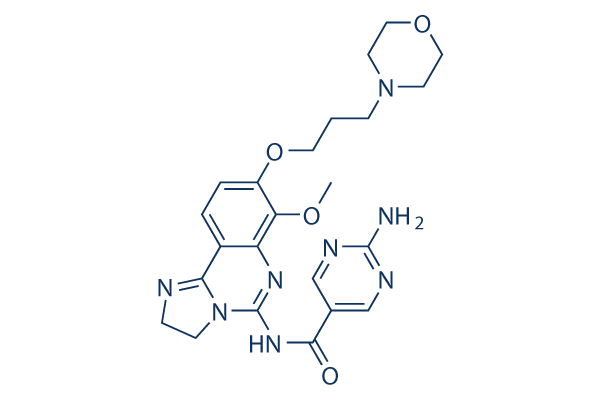
Chemische Struktur
Molekulargewicht: 480.52
Qualitätskontrolle
Produkte, die oft zusammen verwendet werden mit Copanlisib (BAY 80-6946)
| Verwandte Ziele | Akt mTOR GSK-3 ATM/ATR DNA-PK AMPK PDPK1 PTEN PP2A PDK |
|---|---|
| Weitere PI3K Inhibitoren | GDC-0077 (Inavolisib) SAR405 Quercetin (Sophoretin) LY294002 XL147 analogue Tersolisib (STX-478) Buparlisib (BKM120) 740 Y-P (PDGFR 740Y-P) GO-203 TFA Eganelisib (IPI-549) |
Zellkultur, Behandlung & Arbeitskonzentration
| Zelllinien | Assay-Typ | Konzentration | Inkubationszeit | Formulierung | Aktivitätsbeschreibung | PMID |
|---|---|---|---|---|---|---|
| Huh7 | Growth inhibiton assay | 100 nM | Copanlisib dose-dependently inhibited cell growth in vitro. IC50=47.9 nM. | 30962952 | ||
| HepG2 | Growth inhibiton assay | 100 nM | Copanlisib dose-dependently inhibited cell growth in vitro. IC50=31.6 nM. | 30962952 | ||
| Hep3B | Growth inhibiton assay | IC50=72.4 nM | 30962952 | |||
| PLCPRF5 | Growth inhibiton assay | IC50=283 nM | 30962952 | |||
| Chang | Growth inhibiton assay | IC50=442 nM | 30962952 | |||
| JVM-3 | Function assay | 48 h | inhibits metabolic activity with an IC50 of 2 μM in the XTT assay | 25912635 | ||
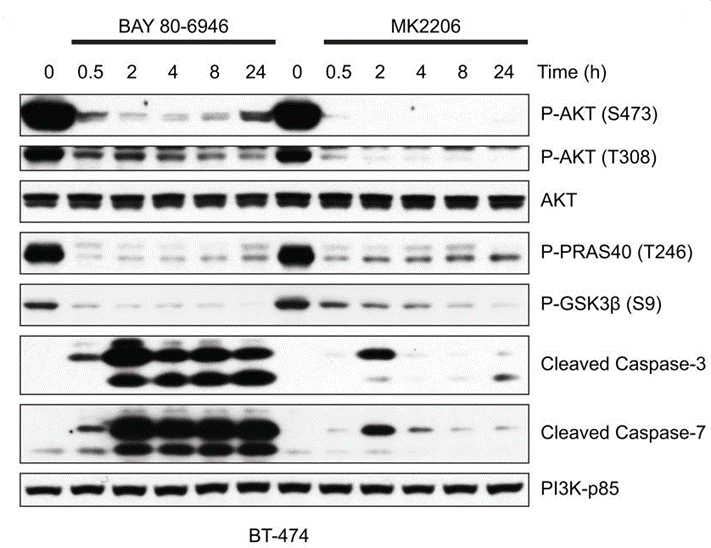
| BT-474 | Function assay | 50 nM | 0.5, 2, 4, 8, 24 h | rapidly inhibits the phosphorylation of AKT (S473, T308) as well as its direct substrates PRAS40 (T246) and GSK3β (S9), and inhibition was sustained for up to 24 hours | 24436048 | |
| SK-BR-3 | Function assay | 0, 1, 2, 4 h | downregulation of P-AKT | 24436048 | ||
| UACC-893 | Function assay | 0, 1, 2, 4 h | downregulation of P-AKT | 24436048 | ||
| HCC-1954 | Function assay | 0, 1, 2, 4 h | downregulation of P-AKT | 24436048 | ||
| MDA-MB-453 | Function assay | 0, 1, 2, 4 h | downregulation of P-AKT | 24436048 | ||
| MDA-MB-361 | Function assay | 0, 1, 2, 4 h | downregulation of P-AKT | 24436048 | ||
| BT-20 | Function assay | 0, 1, 2, 4 h | downregulation of P-AKT | 24436048 | ||
| MCF-7 | Function assay | 0, 1, 2, 4 h | downregulation of P-AKT | 24436048 | ||
| T-47D | Function assay | 0, 1, 2, 4 h | downregulation of P-AKT | 24436048 | ||
| HCC1806 | Function assay | 0, 1, 2, 4 h | downregulation of P-AKT | 24436048 | ||
| NCI-H292 | Function assay | 0, 1, 2, 4 h | downregulation of P-AKT | 24436048 | ||
| NCI-H1650 | Function assay | 0, 1, 2, 4 h | downregulation of P-AKT | 24436048 | ||
| CCRF-SB | Function assay | 0, 1, 2, 4 h | downregulation of P-AKT | 24436048 | ||
| U937 | Function assay | 0, 1, 2, 4 h | downregulation of P-AKT | 24436048 | ||
| SU-DHL-4 | Function assay | 0, 1, 2, 4 h | downregulation of P-AKT | 24436048 | ||
| SU-DHL-5 | Function assay | 0, 1, 2, 4 h | downregulation of P-AKT | 24436048 | ||
| HCT116 | Function assay | 0, 1, 2, 4 h | downregulation of P-AKT | 24436048 | ||
| A549 cells | Function assay | 0, 1, 2, 4 h | downregulation of P-AKT | 24436048 | ||
| SK-MEL-30 | Function assay | 0, 1, 2, 4 h | downregulation of P-AKT | 24436048 | ||
| SK-MEL-2 cells | Function assay | 0, 1, 2, 4 h | downregulation of P-AKT | 24436048 | ||
| NCI-H1703 | Function assay | 0, 1, 2, 4 h | downregulation of P-AKT | 24436048 | ||
| NCI-H661 | Function assay | 0, 1, 2, 4 h | downregulation of P-AKT | 24436048 | ||
| PC9 | Function assay | 0, 1, 2, 4 h | downregulation of P-AKT | 24436048 | ||
| TC32 | qHTS assay | qHTS of pediatric cancer cell lines to identify multiple opportunities for drug repurposing: Primary screen for TC32 cells | 29435139 | |||
| A673 | qHTS assay | qHTS of pediatric cancer cell lines to identify multiple opportunities for drug repurposing: Primary screen for A673 cells | 29435139 | |||
| Saos-2 | qHTS assay | qHTS of pediatric cancer cell lines to identify multiple opportunities for drug repurposing: Primary screen for Saos-2 cells | 29435139 | |||
| RD | qHTS assay | qHTS of pediatric cancer cell lines to identify multiple opportunities for drug repurposing: Primary screen for RD cells | 29435139 | |||
| MG 63 (6-TG R) | qHTS assay | qHTS of pediatric cancer cell lines to identify multiple opportunities for drug repurposing: Primary screen for MG 63 (6-TG R) cells | 29435139 | |||
| OHS-50 | qHTS assay | qHTS of pediatric cancer cell lines to identify multiple opportunities for drug repurposing: Primary screen for OHS-50 cells | 29435139 | |||
| LAN-5 | qHTS assay | qHTS of pediatric cancer cell lines to identify multiple opportunities for drug repurposing: Confirmatory screen for LAN-5 cells | 29435139 | |||
| NB-EBc1 | qHTS assay | qHTS of pediatric cancer cell lines to identify multiple opportunities for drug repurposing: Confirmatory screen for NB-EBc1 cells | 29435139 | |||
| SK-N-SH | qHTS assay | qHTS of pediatric cancer cell lines to identify multiple opportunities for drug repurposing: Confirmatory screen for SK-N-SH cells | 29435139 | |||
| Rh41 | qHTS assay | qHTS of pediatric cancer cell lines to identify multiple opportunities for drug repurposing: Primary screen for Rh41 cells | 29435139 | |||
| A673 | qHTS assay | qHTS of pediatric cancer cell lines to identify multiple opportunities for drug repurposing: Confirmatory screen for A673 cells) | 29435139 | |||
| BT-37 | qHTS assay | qHTS of pediatric cancer cell lines to identify multiple opportunities for drug repurposing: Confirmatory screen for BT-37 cells | 29435139 | |||
| MG 63 (6-TG R) | qHTS assay | qHTS of pediatric cancer cell lines to identify multiple opportunities for drug repurposing: Confirmatory screen for MG 63 (6-TG R) cells | 29435139 | |||
| Rh30 | qHTS assay | qHTS of pediatric cancer cell lines to identify multiple opportunities for drug repurposing: Confirmatory screen for Rh30 cells | 29435139 | |||
| OHS-50 | qHTS assay | qHTS of pediatric cancer cell lines to identify multiple opportunities for drug repurposing: Confirmatory screen for OHS-50 cells | 29435139 | |||
| SJ-GBM2 | qHTS assay | qHTS of pediatric cancer cell lines to identify multiple opportunities for drug repurposing: Primary screen for SJ-GBM2 cells | 29435139 | |||
| SK-N-MC | qHTS assay | qHTS of pediatric cancer cell lines to identify multiple opportunities for drug repurposing: Primary screen for SK-N-MC cells | 29435139 | |||
| NB-EBc1 | qHTS assay | qHTS of pediatric cancer cell lines to identify multiple opportunities for drug repurposing: Primary screen for NB-EBc1 cells | 29435139 | |||
| LAN-5 | qHTS assay | qHTS of pediatric cancer cell lines to identify multiple opportunities for drug repurposing: Primary screen for LAN-5 cells | 29435139 | |||
| Rh18 | qHTS assay | qHTS of pediatric cancer cell lines to identify multiple opportunities for drug repurposing: Primary screen for Rh18 cells | 29435139 | |||
| NB1643 | qHTS assay | qHTS of pediatric cancer cell lines to identify multiple opportunities for drug repurposing: Confirmatory screen for NB1643 cells | 29435139 | |||
| SK-N-MC | qHTS assay | qHTS of pediatric cancer cell lines to identify multiple opportunities for drug repurposing: Confirmatory screen for SK-N-MC cells | 29435139 | |||
| SJ-GBM2 | qHTS assay | qHTS of pediatric cancer cell lines to identify multiple opportunities for drug repurposing: Confirmatory screen for SJ-GBM2 cells | 29435139 | |||
| TC32 | qHTS assay | qHTS of pediatric cancer cell lines to identify multiple opportunities for drug repurposing: Confirmatory screen for TC32 cells | 29435139 | |||
| Rh18 | qHTS assay | qHTS of pediatric cancer cell lines to identify multiple opportunities for drug repurposing: Confirmatory screen for Rh18 cells | 29435139 | |||
| Saos-2 | qHTS assay | qHTS of pediatric cancer cell lines to identify multiple opportunities for drug repurposing: Confirmatory screen for Saos-2 cells | 29435139 | |||
| Klicken Sie hier, um weitere experimentelle Daten zu Zelllinien anzuzeigen | ||||||
Chemische Informationen, Lagerung & Stabilität
| Molekulargewicht | 480.52 | Formel | C23H28N8O4 |
Lagerung (Ab dem Eingangsdatum) | |
|---|---|---|---|---|---|
| CAS-Nr. | 1032568-63-0 | SDF herunterladen | Lagerung von Stammlösungen |
|
|
| Synonyme | BAY 80-6946 | Smiles | COC1=C(C=CC2=C3NCCN3C(=NC(=O)C4=CN=C(N=C4)N)N=C21)OCCCN5CCOCC5 | ||
Löslichkeit
|
In vitro |
5%TFA : 8 mg/mL
DMSO
: Insoluble
Water : Insoluble |
Molaritätsrechner
|
In vivo |
|||||
In-vivo-Formulierungsrechner (Klare Lösung)
Schritt 1: Geben Sie die untenstehenden Informationen ein (Empfohlen: Ein zusätzliches Tier zur Berücksichtigung von Verlusten während des Experiments)
Schritt 2: Geben Sie die In-vivo-Formulierung ein (Dies ist nur der Rechner, keine Formulierung. Bitte kontaktieren Sie uns zuerst, wenn es im Abschnitt "Löslichkeit" keine In-vivo-Formulierung gibt.)
Berechnungsergebnisse:
Arbeitskonzentration: mg/ml;
Methode zur Herstellung der DMSO-Stammlösung: mg Wirkstoff vorgelöst in μL DMSO ( Konzentration der Stammlösung mg/mL, Bitte kontaktieren Sie uns zuerst, wenn die Konzentration die DMSO-Löslichkeit der Wirkstoffcharge überschreitet. )
Methode zur Herstellung der In-vivo-Formulierung: Nehmen Sie μL DMSO Stammlösung, dann hinzufügenμL PEG300, mischen und klären, dann hinzufügenμL Tween 80, mischen und klären, dann hinzufügen μL ddH2O, mischen und klären.
Methode zur Herstellung der In-vivo-Formulierung: Nehmen Sie μL DMSO Stammlösung, dann hinzufügen μL Maisöl, mischen und klären.
Hinweis: 1. Bitte stellen Sie sicher, dass die Flüssigkeit klar ist, bevor Sie das nächste Lösungsmittel hinzufügen.
2. Achten Sie darauf, das/die Lösungsmittel der Reihe nach hinzuzufügen. Sie müssen sicherstellen, dass die bei der vorherigen Zugabe erhaltene Lösung eine klare Lösung ist, bevor Sie mit der Zugabe des nächsten Lösungsmittels fortfahren. Physikalische Methoden wie Vortex, Ultraschall oder ein heißes Wasserbad können zur Unterstützung des Lösens verwendet werden.
Wirkmechanismus
| Targets/IC50/Ki |
PI3Kα
(Cell-free assay) 0.5 nM
PI3Kδ
(Cell-free assay) 0.7 nM
PI3Kβ
(Cell-free assay) 3.7 nM
PI3Kγ
(Cell-free assay) 6.4 nM
|
|---|---|
| In vitro |
Sowohl in KPL4-Zellen als auch in LPA-stimulierten PC3-Zellen reduziert BAY 80-6946 die pAKT-Spiegel. In einer Untergruppe menschlicher Krebszelllinien mit PIK3CA-Mutationen und/oder Überexpression von HER2 zeigt BAY 80-6946 antiproliferative Aktivität und induziert Apoptose. [1] Die Kombination von HER2-gerichteten Therapien und BAY 80-6946 hemmt das Wachstum effektiver als jede Therapie allein und kann die Empfindlichkeit gegenüber Trastuzumab und Lapatinib in Zellen wiederherstellen. [2] |
| Kinase-Assay |
Biochemische Lipidkinase-Assays
|
|
Die Wirkung von BAY 80-6946 auf die PI3Kα-, PI3Kβ- und PI3Kγ-Aktivität wird durch die Hemmung des 33P-Einbaus in Phosphatidylinositol (PI) in 384-Well-MaxiSorp®-Platten gemessen, die mit 2 µg/Well PI und Phosphatidylserin (PS) (1:1 molares Verhältnis) beschichtet sind. In jedem PI3K-Isoform-Assay werden 9 µL Reaktionspuffer (50 mM MOPSO, pH 7,0, 100 mM NaCl, 4 mM MgCl2, 0,1 % BSA) verwendet, der 7,5 ng His-getaggtes N-terminal trunkiertes p110α- oder p110β-Protein oder 25 ng gereinigtes humanes p110γ-Protein enthält. Die Reaktion wird durch Zugabe von 5 µL einer 40-µM-ATP-Lösung gestartet, die 20 µCi/mL [33P]-ATP enthält. Nach 2 Stunden Inkubation bei Raumtemperatur wird die Reaktion durch Zugabe von 5 µL einer 25-mM-EDTA-Lösung beendet. Die Platten werden gewaschen und anschließend 25 µL Ultima Gold™ Szintillationscocktail hinzugefügt. Die in das immobilisierte PI-Substrat eingebaute Radioaktivität wird mit einem BetaPlate Liquid Scintillation Counter bestimmt.
|
|
| In vivo |
In einem Ratten-KPL4- oder HCT116-Tumor-Xenotransplantatmodell induziert BAY 80-6946 (6 mg/kg, i.v.) eine 100%ige vollständige Tumorrückbildung. Bei Nacktmäusen mit Erlotinib-resistentem, patientenabgeleitetem NSCLC (Lu7860) und patientenabgeleiteten luminalen Brusttumormodellen (MAXF1398) verursacht BAY 80-6946 (14 mg/kg, i.v.) ebenfalls eine Tumorwachstumshemmung. [1] |
Literatur |
|
Anwendungen
| Methoden | Biomarker | Bilder | PMID |
|---|---|---|---|
| Western blot | p-AKT / AKT / p-PRAS40(T246) / p-GSK3β(S9) / cleaved caspase-3 / cleaved caspase-7 / PI3K-p85 p-FoxO4(T28) / p-S6(S235/236) / p-4E-BP1(S65) / p-4E-BP1(T37/46) / p-HER3(Y1197) / HER3 / p-IGF1Rβ/ IGF1R / p-HER2 / p-EGFR / p-STAT3 / p-ERK |
|
24436048 |
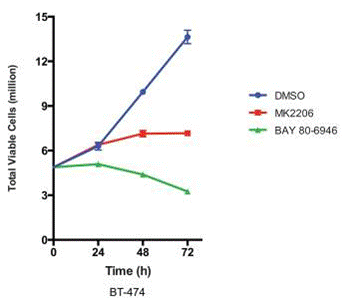
| Growth inhibition assay | Cell viability |
|
24436048 |
Klinische Studieninformationen
(Daten von https://clinicaltrials.gov, aktualisiert am 2024-05-22)
| NCT-Nummer | Rekrutierung | Erkrankungen | Sponsor/Kooperationspartner | Startdatum | Phasen |
|---|---|---|---|---|---|
| NCT05082025 | Active not recruiting | Endometrial Cancer|Ovarian Cancer |
M.D. Anderson Cancer Center|Bayer |
September 27 2022 | Phase 2 |
| NCT05217914 | Active not recruiting | Relapsed or Refractory Indolent Non-Hodgkin Lymphoma |
Bayer |
July 1 2022 | -- |
| NCT04939272 | Suspended | Recurrent Mantle Cell Lymphoma|Refractory Mantle Cell Lymphoma |
City of Hope Medical Center|National Cancer Institute (NCI) |
June 29 2022 | Phase 1|Phase 2 |
| NCT04572763 | Active not recruiting | Diffuse Large B Cell Lymphoma|Relapsed Diffuse Large B-Cell Lymphoma|Refractory Diffuse Large B-Cell Lymphoma |
Dana-Farber Cancer Institute|AbbVie|Bayer |
September 8 2021 | Phase 1|Phase 2 |
| NCT04803123 | Terminated | Leukemia Acute Lymphocytic |
Dorothy Sipkins MD PhD|Bayer|Duke University |
June 21 2021 | Early Phase 1 |
Technischer Support
Tel: +1-832-582-8158 Ext:3
Wenn Sie weitere Fragen haben, hinterlassen Sie bitte eine Nachricht.

Produkte sind nur für Forschungszwecke bestimmt. Nicht für den menschlichen Gebrauch. Wir verkaufen nicht an Patienten.
©Copyright 2013 Selleck Chemicals. Alle Rechte vorbehalten.