
nur für Forschungszwecke
C188-9 (TTI-101) STAT3-Inhibitor
Kat.-Nr.S8605
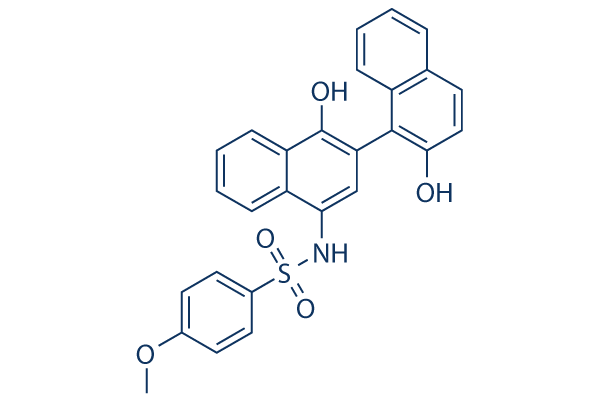
Chemische Struktur
Molekulargewicht: 471.52
Qualitätskontrolle
| Verwandte Ziele | EGFR JAK Pim |
|---|---|
| Weitere STAT Inhibitoren | Napabucasin (BBI608) Stattic NSC 74859 (S3I-201) Cryptotanshinone (Tanshinone C) SH-4-54 BP-1-102 AS1517499 Nifuroxazide HO-3867 Homoharringtonine (HHT) |
Zellkultur, Behandlung & Arbeitskonzentration
| Zelllinien | Assay-Typ | Konzentration | Inkubationszeit | Formulierung | Aktivitätsbeschreibung | PMID |
|---|---|---|---|---|---|---|
| Y79 | Function assay | 10 μM | 28684419 | |||
| SK-N-DZ | Function assay | 10 μM | 28684419 | |||
| Huh7 | Cell viability assay | 48 h | IC50=11.27 μM | 28533225 | ||
| PLC/PRF/5 | Cell viability assay | 48 h | IC50=11.83 μM | 28533225 | ||
| HepG2 | Cell viability assay | 48 h | IC50=10.19 μM | 28533225 | ||
| SCC-35 | Cell growth assay | 0/0.1/0.3/1/3/10/100 μM | 36 h | IC50=10.8 ± 0.0 μM | 27027445 | |
| SCC-61 | Cell growth assay | 0/0.1/0.3/1/3/10/100 μM | 36 h | IC50=14.8 ±2.9 μM | 27027445 | |
| UM-SCC-17B | Cell growth assay | 0/0.1/0.3/1/3/10/100 μM | 36 h | IC50=0.7 ± 0.6 μM | 27027445 | |
| HN30 | Cell growth assay | 0/0.1/0.3/1/3/10/100 μM | 36 h | IC50=4.4 ± 0.1 μM | 27027445 | |
| A549 | Function assay | 2.5 h | decreased pSTAT3 levels in a concentration-dependent manner starting at concentrations as low as 3 nM | 26410177 | ||
| Kasumi-1 | Function assay | IC50=4.5 μM | 21447830 | |||
| THP-1 | Function assay | IC50=4.8 μM | 21447830 | |||
| GDM-1 | Function assay | IC50=5.0 μM | 21447830 | |||
| NB-1 | Function assay | IC50=8.3 μM | 21447830 | |||
| HL-60 | Function assay | IC50=5.3 μM | 21447830 | |||
| KG-1 | Function assay | IC50=4.1 μM | 21447830 | |||
| K562 | Apoptosis assay | induction of apoptosis with an EC50 of 43.6 μM | 21447830 | |||
| A673 | qHTS assay | qHTS of pediatric cancer cell lines to identify multiple opportunities for drug repurposing: Primary screen for A673 cells | 29435139 | |||
| Saos-2 | qHTS assay | qHTS of pediatric cancer cell lines to identify multiple opportunities for drug repurposing: Primary screen for Saos-2 cells | 29435139 | |||
| BT-37 | qHTS assay | qHTS of pediatric cancer cell lines to identify multiple opportunities for drug repurposing: Primary screen for BT-37 cells | 29435139 | |||
| RD | qHTS assay | qHTS of pediatric cancer cell lines to identify multiple opportunities for drug repurposing: Primary screen for RD cells | 29435139 | |||
| BT-12 | qHTS assay | qHTS of pediatric cancer cell lines to identify multiple opportunities for drug repurposing: Primary screen for BT-12 cells | 29435139 | |||
| NB1643 | qHTS assay | qHTS of pediatric cancer cell lines to identify multiple opportunities for drug repurposing: Primary screen for NB1643 cells | 29435139 | |||
| OHS-50 | qHTS assay | qHTS of pediatric cancer cell lines to identify multiple opportunities for drug repurposing: Primary screen for OHS-50 cells | 29435139 | |||
| MG 63 (6-TG R) | qHTS assay | qHTS of pediatric cancer cell lines to identify multiple opportunities for drug repurposing: Primary screen for MG 63 (6-TG R) cells | 29435139 | |||
| Rh41 | qHTS assay | qHTS of pediatric cancer cell lines to identify multiple opportunities for drug repurposing: Primary screen for Rh41 cells | 29435139 | |||
| SJ-GBM2 | qHTS assay | qHTS of pediatric cancer cell lines to identify multiple opportunities for drug repurposing: Primary screen for SJ-GBM2 cells | 29435139 | |||
| SK-N-MC | qHTS assay | qHTS of pediatric cancer cell lines to identify multiple opportunities for drug repurposing: Primary screen for SK-N-MC cells | 29435139 | |||
| NB-EBc1 | qHTS assay | qHTS of pediatric cancer cell lines to identify multiple opportunities for drug repurposing: Primary screen for NB-EBc1 cells | 29435139 | |||
| LAN-5 | qHTS assay | qHTS of pediatric cancer cell lines to identify multiple opportunities for drug repurposing: Primary screen for LAN-5 cells | 29435139 | |||
| Klicken Sie hier, um weitere experimentelle Daten zu Zelllinien anzuzeigen | ||||||
Chemische Informationen, Lagerung & Stabilität
| Molekulargewicht | 471.52 | Formel | C27H21NO5S |
Lagerung (Ab dem Eingangsdatum) | |
|---|---|---|---|---|---|
| CAS-Nr. | 432001-19-9 | SDF herunterladen | Lagerung von Stammlösungen |
|
|
| Synonyme | TTI 101 | Smiles | COC1=CC=C(C=C1)S(=O)(=O)NC2=CC(=C(C3=CC=CC=C32)O)C4=C(C=CC5=CC=CC=C54)O | ||
Löslichkeit
|
In vitro |
DMSO
: 94 mg/mL
(199.35 mM)
Ethanol : 2 mg/mL Water : Insoluble |
Molaritätsrechner
|
In vivo |
|||||
In-vivo-Formulierungsrechner (Klare Lösung)
Schritt 1: Geben Sie die untenstehenden Informationen ein (Empfohlen: Ein zusätzliches Tier zur Berücksichtigung von Verlusten während des Experiments)
Schritt 2: Geben Sie die In-vivo-Formulierung ein (Dies ist nur der Rechner, keine Formulierung. Bitte kontaktieren Sie uns zuerst, wenn es im Abschnitt "Löslichkeit" keine In-vivo-Formulierung gibt.)
Berechnungsergebnisse:
Arbeitskonzentration: mg/ml;
Methode zur Herstellung der DMSO-Stammlösung: mg Wirkstoff vorgelöst in μL DMSO ( Konzentration der Stammlösung mg/mL, Bitte kontaktieren Sie uns zuerst, wenn die Konzentration die DMSO-Löslichkeit der Wirkstoffcharge überschreitet. )
Methode zur Herstellung der In-vivo-Formulierung: Nehmen Sie μL DMSO Stammlösung, dann hinzufügenμL PEG300, mischen und klären, dann hinzufügenμL Tween 80, mischen und klären, dann hinzufügen μL ddH2O, mischen und klären.
Methode zur Herstellung der In-vivo-Formulierung: Nehmen Sie μL DMSO Stammlösung, dann hinzufügen μL Maisöl, mischen und klären.
Hinweis: 1. Bitte stellen Sie sicher, dass die Flüssigkeit klar ist, bevor Sie das nächste Lösungsmittel hinzufügen.
2. Achten Sie darauf, das/die Lösungsmittel der Reihe nach hinzuzufügen. Sie müssen sicherstellen, dass die bei der vorherigen Zugabe erhaltene Lösung eine klare Lösung ist, bevor Sie mit der Zugabe des nächsten Lösungsmittels fortfahren. Physikalische Methoden wie Vortex, Ultraschall oder ein heißes Wasserbad können zur Unterstützung des Lösens verwendet werden.
Wirkmechanismus
| Targets/IC50/Ki |
STAT3
(Cell-free) 4.7 nM(Kd)
|
|---|---|
| In vitro |
C188-9 ist ein niedermolekularer Inhibitor von Stat3, der die Phosphotyrosylpeptid-Bindungsstelle innerhalb der Stat3 Src-Homologie 2 (SH2)-Domäne mit Ki 136 nM angreift. Es hemmt nicht die vorgeschalteten Jak- oder Src-Kinasen.
|
| In vivo |
Die Behandlung von Nacktmäusen mit Xenotransplantaten von UM-SCC-17B, einer radioresistenten HNSCC-Linie, mit C188-9, aber nicht mit C188, verhinderte das Wachstum der Tumorxenotransplantate. Diese Verbindung wurde in Mäusen gut vertragen, zeigte eine gute orale Bioverfügbarkeit und reicherte sich in Tumoren an.
|
Literatur |
|
Anwendungen
| Methoden | Biomarker | Bilder | PMID |
|---|---|---|---|
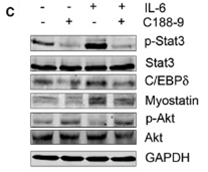
| Western blot | p-STAT3 / STAT3 / CEBPδ / Myostatin / p-Akt / Akt |
|
24011072 |
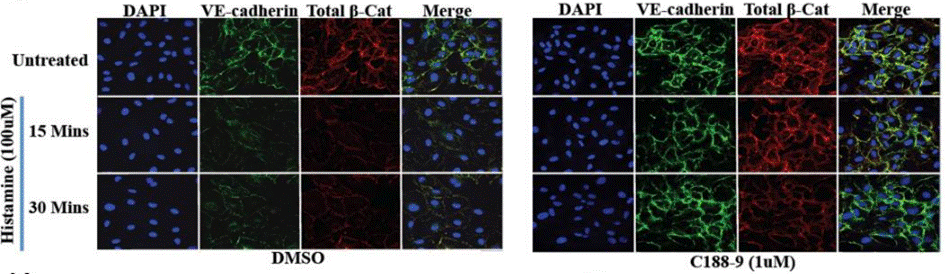
| Immunofluorescence | VE-cadherin / β-catenin non-phosphorylated β-Catenin |
|
26948077 |
Technischer Support
Tel: +1-832-582-8158 Ext:3
Wenn Sie weitere Fragen haben, hinterlassen Sie bitte eine Nachricht.

Produkte sind nur für Forschungszwecke bestimmt. Nicht für den menschlichen Gebrauch. Wir verkaufen nicht an Patienten.
©Copyright 2013 Selleck Chemicals. Alle Rechte vorbehalten.