
nur für Forschungszwecke
Eltanexor (KPT-8602) XPO1-Inhibitor
Kat.-Nr.: S8397
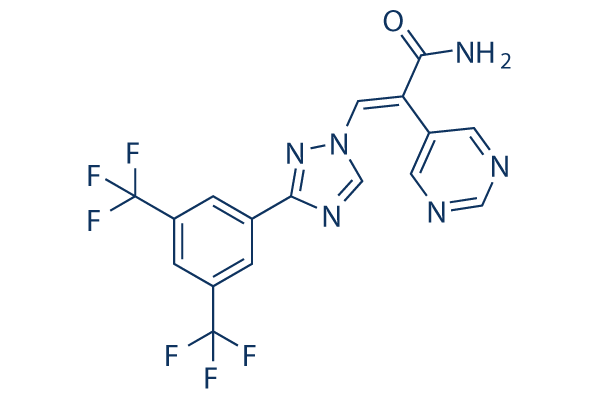
Chemische Struktur
Molekulargewicht: 428.29
Qualitätskontrolle (Quality Control)
| Verwandte Ziele | CFTR CD markers AChR Calcium Channel Sodium Channel Potassium Channel GABA Receptor TRP Channel ATPase GluR |
|---|---|
| Weitere CRM1 Inhibitoren | Leptomycin B (LMB) KPT-185 Verdinexor (KPT-335) KPT-276 |
Chemische Informationen, Lagerung & Stabilität (Chemical Information, Storage & Stability)
| Molekulargewicht | 428.29 | Formel | C17H10F6N6O |
Lagerung (Ab dem Eingangsdatum) | |
|---|---|---|---|---|---|
| CAS-Nr. | 1642300-52-4 | SDF herunterladen | Lagerung von Stammlösungen |
|
|
| Synonyme | ONO-7706,ATG-016 | Smiles | C1=C(C=C(C=C1C(F)(F)F)C(F)(F)F)C2=NN(C=N2)C=C(C3=CN=CN=C3)C(=O)N | ||
Löslichkeit (Solubility)
|
In vitro |
DMSO
: 85 mg/mL
(198.46 mM)
Ethanol : 1 mg/mL Water : Insoluble |
Molaritätsrechner
|
In vivo |
|||||
In-vivo-Formulierungsrechner (Klare Lösung)
Schritt 1: Geben Sie die untenstehenden Informationen ein (Empfohlen: Ein zusätzliches Tier zur Berücksichtigung von Verlusten während des Experiments)
Schritt 2: Geben Sie die In-vivo-Formulierung ein (Dies ist nur der Rechner, keine Formulierung. Bitte kontaktieren Sie uns zuerst, wenn es im Abschnitt "Löslichkeit" keine In-vivo-Formulierung gibt.)
Berechnungsergebnisse:
Arbeitskonzentration: mg/ml;
Methode zur Herstellung der DMSO-Stammlösung: mg Wirkstoff vorgelöst in μL DMSO ( Konzentration der Stammlösung mg/mL, Bitte kontaktieren Sie uns zuerst, wenn die Konzentration die DMSO-Löslichkeit der Wirkstoffcharge überschreitet. )
Methode zur Herstellung der In-vivo-Formulierung: Nehmen Sie μL DMSO Stammlösung, dann hinzufügenμL PEG300, mischen und klären, dann hinzufügenμL Tween 80, mischen und klären, dann hinzufügen μL ddH2O, mischen und klären.
Methode zur Herstellung der In-vivo-Formulierung: Nehmen Sie μL DMSO Stammlösung, dann hinzufügen μL Maisöl, mischen und klären.
Hinweis: 1. Bitte stellen Sie sicher, dass die Flüssigkeit klar ist, bevor Sie das nächste Lösungsmittel hinzufügen.
2. Achten Sie darauf, das/die Lösungsmittel der Reihe nach hinzuzufügen. Sie müssen sicherstellen, dass die bei der vorherigen Zugabe erhaltene Lösung eine klare Lösung ist, bevor Sie mit der Zugabe des nächsten Lösungsmittels fortfahren. Physikalische Methoden wie Vortex, Ultraschall oder ein heißes Wasserbad können zur Unterstützung des Lösens verwendet werden.
Wirkmechanismus (Mechanism of Action)
| Targets/IC50/Ki |
XPO1
|
|---|---|
| In vitro |
Eltanexor (KPT-8602) is a potent inhibitor of AML cells in cell-based viability assays. It inhibits XPO1/cargo interactions and nuclear export, induces apoptosis of primary CLL cells and significantly inhibits proliferation of diffuse large B-cell lymphoma cell lines
|
| In vivo |
Eltanexor (KPT-8602) is orally bioavailable and has similar pharmacokinetic properties to selinexor, but exhibits markedly reduced (approximately 30-fold less) penetration across the blood−brain barrier. Toxicology studies in rats and monkeys indicate that this compound has a substantially better tolerability profile, probably due to its inability to penetrate into the CNS, with reduced anorexia, malaise and weight loss compared to selinexor. It also shows superior anti-leukemic activity and better tolerability in the AML PDX models tested, with nearly complete elimination of human AML cells in the AML-CN model. It is minimally toxic to normal hematopoietic stem and progenitor cells. Furthermore, it does not accumulate in plasma after repetitive dosing and prolongs survival in a human leukemia xenograft model of AML.
|
Literatur |
|
Anwendungen (Applications)
| Methoden | Biomarker | Bilder | PMID |
|---|---|---|---|
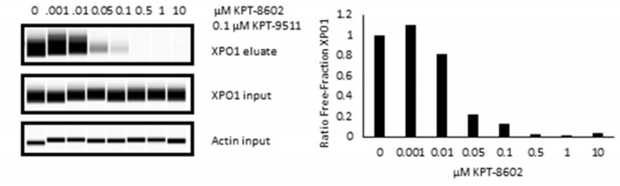
| Western blot | XPO1 |
|
26654943 |
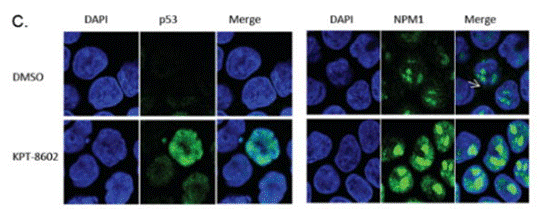
| Immunofluorescence | p53 / NPM1 p62 / p53 |
|
27323910 |
Klinische Studieninformationen (Clinical Trial Information)
(Daten von https://clinicaltrials.gov, aktualisiert am 2026-08-19)
| NCT-Nummer | Rekrutierung | Erkrankungen | Sponsor/Kooperationspartner | Startdatum | Phasen |
|---|---|---|---|---|---|
| NCT06399640 | RECRUITING | Relapsed Myelodysplastic Syndrome; Refractory Myelodysplastic Syndrome; Acute Myeloid Leukemia; Recurrent Acute Myeloid Leukemia; Refractory Acute Myeloid Leukemia |
Vanderbilt-Ingram Cancer Center |
2024-08-14 | PHASE1 |
| NCT05918055 | TERMINATED | Myelodysplastic Syndromes |
National Cancer Institute (NCI) |
2023-11-14 | PHASE1; PHASE2 |
| NCT02649790 | COMPLETED | Relapsed/Refractory Multiple Myeloma (RRMM); Metastatic Colorectal Cancer (mCRC); Metastatic Castration-Resistant Prostate Cancer (mCRPC); Higher-Risk Myelodysplastic Syndrome (HR-MDS); Acute Myeloid Leukemia (AML); Newly Diagnosed Intermediate/High-Risk MDS |
Karyopharm Therapeutics Inc |
2016-01 | PHASE1; PHASE2 |
| NCT05918055 | Recruiting | Myelodysplastic Syndromes |
National Cancer Institute (NCI)|National Institutes of Health Clinical Center (CC) |
2023-11-14 | Phase 1|Phase 2 |
| NCT02649790 | Active not recruiting | Relapsed/Refractory Multiple Myeloma (RRMM)|Metastatic Colorectal Cancer (mCRC)|Metastatic Castration-Resistant Prostate Cancer (mCRPC)|Higher-Risk Myelodysplastic Syndrome (HR-MDS)|Acute Myeloid Leukemia (AML)|Newly Diagnosed Intermediate/High-Risk MDS |
Karyopharm Therapeutics Inc |
2016-01 | Phase 1|Phase 2 |

Produkte sind nur für Forschungszwecke bestimmt. Nicht für den menschlichen Gebrauch. Wir verkaufen nicht an Patienten.
©Copyright 2013 Selleck Chemicals. Alle Rechte vorbehalten.