
nur für Forschungszwecke
V-9302 ASCT2 Antagonist
Kat.-Nr.S8818
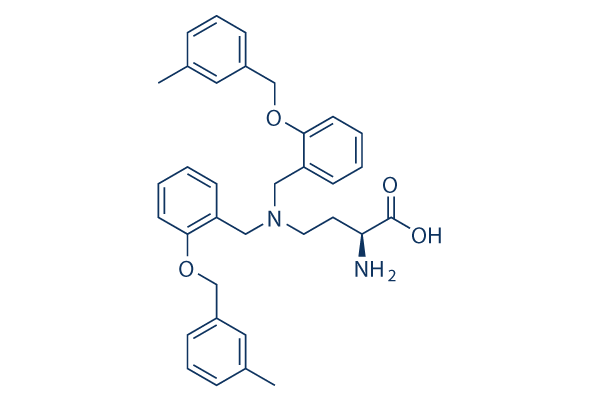
Chemische Struktur
Molekulargewicht: 538.68
Qualitätskontrolle
| Verwandte Ziele | CFTR CRM1 CD markers AChR Calcium Channel Sodium Channel Potassium Channel GABA Receptor TRP Channel ATPase |
|---|---|
| Weitere Amino acid transporter Inhibitoren | JPH203 (Nanvuranlat) GPNA hydrochloride BCH |
Zellkultur, Behandlung & Arbeitskonzentration
| Zelllinien | Assay-Typ | Konzentration | Inkubationszeit | Formulierung | Aktivitätsbeschreibung | PMID |
|---|---|---|---|---|---|---|
| C6 | Function assay | Inhibition of ASCT2-mediated glutamine transport in rat C6 cells using [3H]-glutamine after 15 mins by scintillation counting, IC50 = 9 μM. | 26750251 | |||
| HEK293 | Function assay | Inhibition of ASCT2-mediated glutamine transport in human HEK293 cells using [3H]-glutamine after 15 mins by scintillation counting, IC50 = 9.6 μM. | 26750251 | |||
| Klicken Sie hier, um weitere experimentelle Daten zu Zelllinien anzuzeigen | ||||||
Chemische Informationen, Lagerung & Stabilität
| Molekulargewicht | 538.68 | Formel | C34H38N2O4 |
Lagerung (Ab dem Eingangsdatum) | 3 years -20°C powder |
|---|---|---|---|---|---|
| CAS-Nr. | 1855871-76-9 | -- | Lagerung von Stammlösungen |
|
|
| Synonyme | N/A | Smiles | CC1=CC(=CC=C1)COC2=CC=CC=C2CN(CCC(C(=O)O)N)CC3=CC=CC=C3OCC4=CC=CC(=C4)C | ||
Löslichkeit
|
In vitro |
DMSO
: 100 mg/mL
(185.63 mM)
Water : 100 mg/mL Ethanol : 100 mg/mL |
Molaritätsrechner
|
In vivo |
|||||
In-vivo-Formulierungsrechner (Klare Lösung)
Schritt 1: Geben Sie die untenstehenden Informationen ein (Empfohlen: Ein zusätzliches Tier zur Berücksichtigung von Verlusten während des Experiments)
Schritt 2: Geben Sie die In-vivo-Formulierung ein (Dies ist nur der Rechner, keine Formulierung. Bitte kontaktieren Sie uns zuerst, wenn es im Abschnitt "Löslichkeit" keine In-vivo-Formulierung gibt.)
Berechnungsergebnisse:
Arbeitskonzentration: mg/ml;
Methode zur Herstellung der DMSO-Stammlösung: mg Wirkstoff vorgelöst in μL DMSO ( Konzentration der Stammlösung mg/mL, Bitte kontaktieren Sie uns zuerst, wenn die Konzentration die DMSO-Löslichkeit der Wirkstoffcharge überschreitet. )
Methode zur Herstellung der In-vivo-Formulierung: Nehmen Sie μL DMSO Stammlösung, dann hinzufügenμL PEG300, mischen und klären, dann hinzufügenμL Tween 80, mischen und klären, dann hinzufügen μL ddH2O, mischen und klären.
Methode zur Herstellung der In-vivo-Formulierung: Nehmen Sie μL DMSO Stammlösung, dann hinzufügen μL Maisöl, mischen und klären.
Hinweis: 1. Bitte stellen Sie sicher, dass die Flüssigkeit klar ist, bevor Sie das nächste Lösungsmittel hinzufügen.
2. Achten Sie darauf, das/die Lösungsmittel der Reihe nach hinzuzufügen. Sie müssen sicherstellen, dass die bei der vorherigen Zugabe erhaltene Lösung eine klare Lösung ist, bevor Sie mit der Zugabe des nächsten Lösungsmittels fortfahren. Physikalische Methoden wie Vortex, Ultraschall oder ein heißes Wasserbad können zur Unterstützung des Lösens verwendet werden.
Wirkmechanismus
| Targets/IC50/Ki |
ASCT2
(HEK293 cells) 9.6 μM
|
|---|---|
| In vitro |
V-9302 hemmt die ASCT2-vermittelte Glutaminaufnahme in menschlichen Zellen konzentrationsabhängig und weist eine 100-fache Verbesserung der Potenz (IC50 dieser Verbindung = 9,6 µM) gegenüber Gamma-L-Glutamyl-p-Nitroanilid (GPNA; IC50 = 1000 µM) auf. |
| In vivo |
Die pharmakologische Blockade von ASCT2 mit V-9302 führt zu einer abgeschwächten Krebszellwachstum und -proliferation, erhöht den Zelltod und den oxidativen Stress, was zusammen zu Anti-Tumor-Reaktionen in vitro und in murinen Modellen in vivo beiträgt. Die Steady-State-Plasmakonzentrationen werden 4 Stunden nach der Verabreichung erreicht, mit einer Halbwertszeit von etwa 6 Stunden bei gesunden Mäusen. Nach einer einzelnen akuten Exposition gegenüber dieser Verbindung (4 Stunden) unterscheiden sich die Plasmaglukosespiegel nicht signifikant von den Vehikelkontrollen, während die Plasmaglutaminspiegel bei behandelten Mäusen im Vergleich zu den Vehikelkontrollen um etwa 50 % erhöht sind, wahrscheinlich ein pharmakodynamischer Effekt. Die Plasmaglukosespiegel bei Mäusen, die chronisch diesem chemischen Stoff oder Vehikel über ein 21-Tage-Regime ausgesetzt waren, unterscheiden sich nicht signifikant, während die Plasmaglutaminspiegel leicht gesenkt sind. |
Literatur |
|
Anwendungen
| Methoden | Biomarker | Bilder | PMID |
|---|---|---|---|
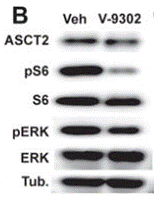
| Western blot | ASCT2 / pS6 / S6 / pERK / ERK |
|
29334372 |
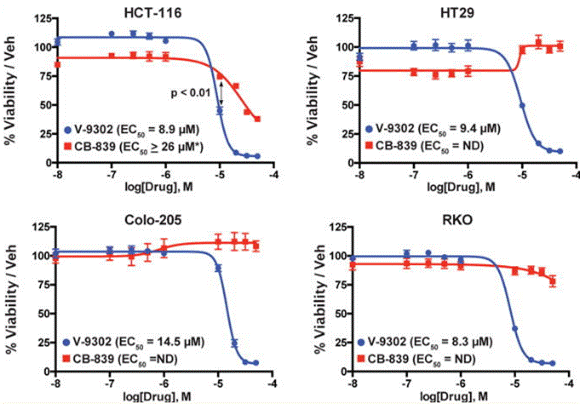
| Growth inhibition assay | Cell viability |
|
29334372 |
Technischer Support
Tel: +1-832-582-8158 Ext:3
Wenn Sie weitere Fragen haben, hinterlassen Sie bitte eine Nachricht.
Häufig gestellte Fragen
Frage 1:
What should be done if the water soluble mother liquor of it becomes cloudy when diluted into cell medium or PBS solution?
Antwort:
During cell experiments, the mother liquor prepared with pure water may temporarily become turbid after adding PBS. It can be clarified again by standing at room temperature for half an hour. For animal experiments, please directly use PBS to prepare it.

Produkte sind nur für Forschungszwecke bestimmt. Nicht für den menschlichen Gebrauch. Wir verkaufen nicht an Patienten.
©Copyright 2013 Selleck Chemicals. Alle Rechte vorbehalten.