
LPA Receptor
Weitere GPCR & G Protein Inhibitoren
| Kat.-Nr. | Produktname | Informationen | Publikationen | Validierung |
|---|---|---|---|---|
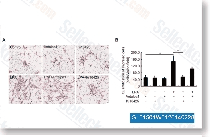
| S1315 | Ki16425 | Ki16425 ist ein kompetitiver, potenter und reversibler Antagonist von LPA1, LPA2 und LPA3 mit Ki-Werten von 0,34 μM, 6,5 μM und 0,93 μM in RH7777-Zelllinien und zeigt keine Aktivität bei LPA4, LPA5, LPA6. |
|
|
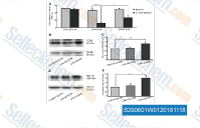
| S2906 | Ki16198 | Ki16198 ist der Methylester von Ki16425, einem LPA-Antagonisten, der die LPA1- und LPA3-induzierte Inositolphosphatproduktion mit Ki von 0,34 μM bzw. 0,93 μM hemmt, eine schwächere Hemmung für LPA2 zeigt und keine Aktivität bei LPA4, LPA5, LPA6 aufweist. |
|
|
| S8345 | ONO-7300243 | ONO-7300243 ist ein neuartiger, potenter LPA1(Lysophosphatidic Acid Receptor)-Antagonist mit einer IC50 von 160 nM. |
|
|
| S6633 | AM 095 | AM095 ist ein Antagonist des LPA-Rezeptors Typ 1 mit IC50-Werten von 0,98 bzw. 0,73 M f human rekombinante und murine LPA1. |
|
|
| E1036 | BMS-986278 | BMS-986278 ist ein potenter und oral aktiver Antagonist des Lysophosphatidsäure-Rezeptors 1 (LPA1). Diese Verbindung weist Kbs von 6,9 nM bzw. 4,0 nM für menschliches und Maus-LPA1 auf und wird in der Forschung zu pulmonalen fibrotischen Erkrankungen широко eingesetzt. | ||
| S3534 | AM966 | AM966 ist ein hochaffiner, selektiver, oraler Lysophosphatidic acid receptor 1 (LPA1)-Antagonist, der die LPA-stimulierte intrazelluläre Kalziumfreisetzung (IC50=17 nM, mittels Ca-Flux-Assay) hemmen kann. | ||
| S3572 | BMS-986020 | BMS-986020 (AM152, AP-3152 freie Säure) ist ein potenter und selektiver Antagonist des lysophosphatidic acid receptor 1 (LPA1). Diese Verbindung hemmt Gallensäure- und Phospholipidtransporter mit IC50-Werten von 4,8 μM, 6,2 μM bzw. 7,5 μM für BSEP, MRP4 und MDR3. Sie hat Potenzial für die Behandlung der idiopathischen Lungenfibrose (IPF). | ||
| E1941 | ACT-1016-0707 | ACT-1016-0707 (LPA1-Rezeptorantagonist 2) ist ein oral wirksamer und selektiver Antagonist des LPA1 Receptor mit einer IC50 von 3,1 nM für hLPAR1 im Tango-Assay. Es hat das Potenzial, fibrotische Krankheiten zu behandeln. | ||
| E2992 | Oleoyl-L-alpha-lysophosphatidic acid sodium salt | Oleoyl-L-alpha-Lysophosphatidsäure-Natriumsalz ist ein essentieller Metabolit für die Membranbiosynthese. LPA interagiert mit den G-Protein-gekoppelten Rezeptoren (GPCRs), die als LPA-Rezeptoren bezeichnet werden, und vermittelt die Signalübertragung. Es fungiert als endogener Agonist für LPA1- und LPA2-Rezeptoren. |

Produkte sind nur für Forschungszwecke bestimmt. Nicht für den menschlichen Gebrauch. Wir verkaufen nicht an Patienten.
©Copyright 2013 Selleck Chemicals. Alle Rechte vorbehalten.