
nur für Forschungszwecke
3PO PFKFB inhibitor
Kat.-Nr.S7639
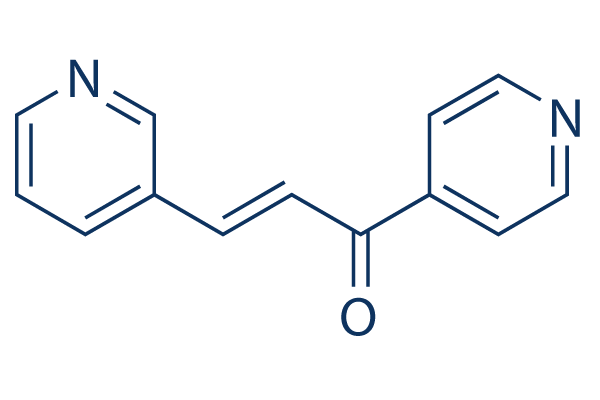
Chemische Struktur
Molekulargewicht: 210.23
Qualitätskontrolle
| Verwandte Ziele | CDK HSP PD-1/PD-L1 ROCK Wee1 DNA/RNA Synthesis Microtubule Associated Ras KRas Aurora Kinase |
|---|---|
| Weitere PFKFB Inhibitoren | PFK15 PFK158 KAN0438757 |
Zellkultur, Behandlung & Arbeitskonzentration
| Zelllinien | Assay-Typ | Konzentration | Inkubationszeit | Formulierung | Aktivitätsbeschreibung | PMID |
|---|---|---|---|---|---|---|
| Jurkat | Growth inhibition assay | 48 hrs | Growth inhibition of human Jurkat cells expressing inducible FLAG-tagged PFKFB incubated for 48 hrs by trypan blue dye exclusion assay, IC50=1.4μM | ChEMBL | ||
| NHBE | Growth inhibition assay | 48 to 72 hrs | Growth inhibition of human NHBE cells immortalized with human telomerase and large-T antigen and transformed with mutated Ras protein incubated for 48 to 72 hrs by trypan blue dye exclusion assay, IC50=1.5μM | ChEMBL | ||
| K562 | Growth inhibition assay | 48 hrs | Growth inhibition of human K562 cells incubated for 48 hrs by trypan blue dye exclusion assay, IC50=3.2μM | ChEMBL | ||
| HL60 | Growth inhibition assay | 48 hrs | Growth inhibition of human HL60 cells incubated for 48 hrs by trypan blue dye exclusion assay, IC50=4.5μM | ChEMBL | ||
| MDA-MB-231 | Growth inhibition assay | 48 hrs | Growth inhibition of human MDA-MB-231 cells incubated for 48 hrs by trypan blue dye exclusion assay, IC50=4.7μM | ChEMBL | ||
| Jurkat | Growth inhibition assay | 48 hrs | Growth inhibition of human Jurkat cells expressing un-altered PFKFB expression incubated for 48 hrs by trypan blue dye exclusion assay, IC50=8.9μM | ChEMBL | ||
| CRL11174 | Growth inhibition assay | 48 hrs | Growth inhibition of human CRL11174 cells incubated for 48 hrs by trypan blue dye exclusion assay, IC50=15μM | ChEMBL | ||
| LLC | Growth inhibition assay | 48 hrs | Growth inhibition of mouse LLC cells incubated for 48 hrs by trypan blue dye exclusion assay, IC50=19μM | ChEMBL | ||
| Jurkat | Growth inhibition assay | 48 hrs | Growth inhibition of human Jurkat cells expressing inducible FLAG-tagged PFKFB in presence of doxycycline incubated for 48 hrs by trypan blue dye exclusion assay, IC50=19.3μM | ChEMBL | ||
| HeLa | Growth inhibition assay | 48 hrs | Growth inhibition of human HeLa cells incubated for 48 hrs by trypan blue dye exclusion assay, IC50=24μM | ChEMBL | ||
| Jurkat | Growth inhibition assay | 48 hrs | Growth inhibition of PFKFB3+/-ht/LT/Ras human Jurkat cells and incubated for 48 hrs by trypan blue dye exclusion assay, IC50=26μM | ChEMBL | ||
| A549 | Growth inhibition assay | 48 hrs | Growth inhibition of human A549 cells incubated for 48 hrs by trypan blue dye exclusion assay, IC50=48μM | ChEMBL | ||
| Jurkat | Growth inhibition assay | 48 hrs | Growth inhibition of PFKFB3+/+ht/LT/Ras human Jurkat cells and incubated for 48 hrs by trypan blue dye exclusion assay, IC50=49μM | ChEMBL | ||
| Jurkat | Cell proliferation assay | 10 uM | 36 hrs | Inhibition of cell proliferation of human Jurkat cells expressing inducible FLAG-tagged PFKFB at 10 uM incubated for 36 hrs by trypan blue dye exclusion assay | ChEMBL | |
| Jurkat | Cell cycle assay | Inhibition of cell cycle arrest in human Jurkat cells expressing inducible FLAG-tagged PFKFB assessed as accumulation at G2/M phase by propidium iodide staining based flow cytometry | ChEMBL | |||
| Jurkat | Function assay | 10 uM | Reduction in 2-deoxy-glucose uptake in human Jurkat cells expressing inducible FLAG-tagged PFKFB at 10 uM measured within 4 hrs using [14C]-2-deoxy-glucose by scintillation counting method | ChEMBL | ||
| Jurkat | Function assay | 10 uM | 4 hrs | Reduction in Fru-2,6-BP production in human Jurkat cells expressing inducible FLAG-tagged PFKFB at 10 uM measured within 4 hrs | ChEMBL | |
| Jurkat | Function assay | 10 uM | 8 hrs | Reduction in lactate secretion in human Jurkat cells expressing inducible FLAG-tagged PFKFB at 10 uM after 8 hrs by lactate oxidase based colorimetric assay | ChEMBL | |
| Jurkat | Function assay | 10 uM | 16 hrs | Reduction in NADH level in human Jurkat cells expressing inducible FLAG-tagged PFKFB at 10 uM after 16 hrs | ChEMBL | |
| Jurkat | Function assay | 10 uM | 24 hrs | Reduction in NAD+ level in human Jurkat cells expressing inducible FLAG-tagged PFKFB at 10 uM after 24 hrs | ChEMBL | |
| Jurkat | Function assay | 10 uM | 24 hrs | Reduction in ATP level in human Jurkat cells expressing inducible FLAG-tagged PFKFB at 10 uM after 24 hrs | ChEMBL | |
| Jurkat | Function assay | 10 uM | 36 hrs | Suppression of glycolytic flux into lactate in human Jurkat cells expressing inducible FLAG-tagged PFKFB at 10 uM after 36 hrs by NMR spectroscopy | ChEMBL | |
| NHBE | Growth inhibition assay | 1 uM | 48 to 72 hrs | Growth inhibition of human NHBE cells immortalized with human telomerase and large-T antigen and transformed with mutated Ras protein at 1 uM incubated for 48 to 72 hrs by trypan blue dye exclusion assay | ChEMBL | |
| NHBE | Growth inhibition assay | 10 uM | 48 to 72 hrs | Growth inhibition of human NHBE cells immortalized with human telomerase and large-T antigen and transformed with mutated Ras protein at 10 uM incubated for 48 to 72 hrs by trypan blue dye exclusion assay | ChEMBL | |
| Klicken Sie hier, um weitere experimentelle Daten zu Zelllinien anzuzeigen | ||||||
Chemische Informationen, Lagerung & Stabilität
| Molekulargewicht | 210.23 | Formel | C13H10N2O |
Lagerung (Ab dem Eingangsdatum) | |
|---|---|---|---|---|---|
| CAS-Nr. | 18550-98-6 | SDF herunterladen | Lagerung von Stammlösungen |
|
|
| Synonyme | 3-(3-pyridinyl)-1-(4-pyridinyl)-2-propen-1-one | Smiles | C1=CC(=CN=C1)C=CC(=O)C2=CC=NC=C2 | ||
Löslichkeit
|
In vitro |
DMSO
: 42 mg/mL
(199.78 mM)
Ethanol : 11 mg/mL Water : Insoluble |
Molaritätsrechner
|
In vivo |
|||||
In-vivo-Formulierungsrechner (Klare Lösung)
Schritt 1: Geben Sie die untenstehenden Informationen ein (Empfohlen: Ein zusätzliches Tier zur Berücksichtigung von Verlusten während des Experiments)
Schritt 2: Geben Sie die In-vivo-Formulierung ein (Dies ist nur der Rechner, keine Formulierung. Bitte kontaktieren Sie uns zuerst, wenn es im Abschnitt "Löslichkeit" keine In-vivo-Formulierung gibt.)
Berechnungsergebnisse:
Arbeitskonzentration: mg/ml;
Methode zur Herstellung der DMSO-Stammlösung: mg Wirkstoff vorgelöst in μL DMSO ( Konzentration der Stammlösung mg/mL, Bitte kontaktieren Sie uns zuerst, wenn die Konzentration die DMSO-Löslichkeit der Wirkstoffcharge überschreitet. )
Methode zur Herstellung der In-vivo-Formulierung: Nehmen Sie μL DMSO Stammlösung, dann hinzufügenμL PEG300, mischen und klären, dann hinzufügenμL Tween 80, mischen und klären, dann hinzufügen μL ddH2O, mischen und klären.
Methode zur Herstellung der In-vivo-Formulierung: Nehmen Sie μL DMSO Stammlösung, dann hinzufügen μL Maisöl, mischen und klären.
Hinweis: 1. Bitte stellen Sie sicher, dass die Flüssigkeit klar ist, bevor Sie das nächste Lösungsmittel hinzufügen.
2. Achten Sie darauf, das/die Lösungsmittel der Reihe nach hinzuzufügen. Sie müssen sicherstellen, dass die bei der vorherigen Zugabe erhaltene Lösung eine klare Lösung ist, bevor Sie mit der Zugabe des nächsten Lösungsmittels fortfahren. Physikalische Methoden wie Vortex, Ultraschall oder ein heißes Wasserbad können zur Unterstützung des Lösens verwendet werden.
Wirkmechanismus
| Targets/IC50/Ki |
PFKFB3
22.9 μM
|
|---|---|
| In vitro |
3PO ist ein Inhibitor des PFKFB3-Isoenzyms, hauptsächlich durch Konkurrenz mit Fru-6-P und hemmt die Aktivität der gereinigten PFK-1 nicht. Diese Verbindung dämpft die Proliferation mehrerer menschlicher maligner hämatopoetischer und Adenokarzinom-Zelllinien (IC50, 1,4-24 μmol/L) deutlich und ist selektiv zytostatisch gegenüber ras-transformierten menschlichen bronchialen Epithelzellen im Vergleich zu normalen menschlichen bronchialen Epithelzellen. Es kann einen G2-M phase arrest verursachen.
|
| In vivo |
Die i.p.-Verabreichung von 3PO (0,07 mg/g) an Tumortragende Mäuse reduziert die intrazelluläre Konzentration von Fru-2,6-BP, die Glukoseaufnahme und das Wachstum etablierter Tumoren in vivo deutlich. Es unterdrückt das tumorigenische Wachstum von Brustadenokarzinom-, Leukämie- und Lungenadenokarzinomzellen in vivo. Die PK-Eigenschaften dieser Verbindung werden in C57Bl/6-Mäusen untersucht, denen diese Chemikalie intravenös verabreicht wurde: Clearance CL=2312 mL/min/kg, T1/2=0,3 Std., Cmax=113 ng/ml, AUC0-inf=36 ng/Std./ml. Es wird berichtet, dass es eine potente Aktivität gegen ein hochrelevantes Mausmodell der Leukämie aufweist.
|
Literatur |
|
Technischer Support
Tel: +1-832-582-8158 Ext:3
Wenn Sie weitere Fragen haben, hinterlassen Sie bitte eine Nachricht.

Produkte sind nur für Forschungszwecke bestimmt. Nicht für den menschlichen Gebrauch. Wir verkaufen nicht an Patienten.
©Copyright 2013 Selleck Chemicals. Alle Rechte vorbehalten.