
nur für Forschungszwecke
Rosuvastatin calcium HMG-CoA Reductase Inhibitor
Kat.-Nr.: S2169
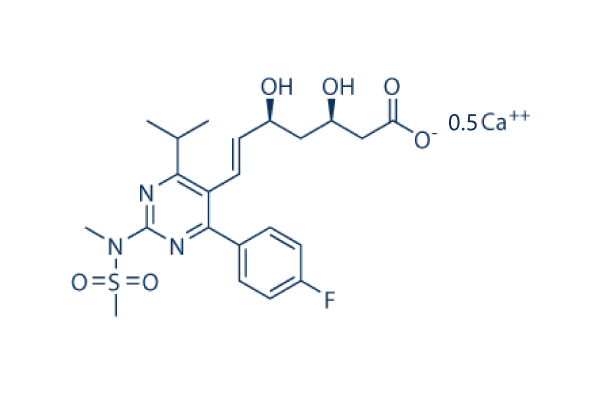
Chemische Struktur
Molekulargewicht: 500.57
Qualitätskontrolle (Quality Control)
| Verwandte Ziele | Dehydrogenase HSP Transferase P450 (e.g. CYP17) PDE phosphatase PPAR Vitamin Carbohydrate Metabolism Mitochondrial Metabolism |
|---|---|
| Weitere HMG-CoA Reductase Inhibitoren | Mevastatin SR-12813 Clinofibrate Dihydrolanosterol 7-ketocholesterol Cerivastatin sodium |
Chemische Informationen, Lagerung & Stabilität (Chemical Information, Storage & Stability)
| Molekulargewicht | 500.57 | Formel | C22H27FN3O6S.0.5Ca |
Lagerung (Ab dem Eingangsdatum) | |
|---|---|---|---|---|---|
| CAS-Nr. | 147098-20-2 | SDF herunterladen | Lagerung von Stammlösungen |
|
|
| Synonyme | ZD4522 calcium | Smiles | CC(C)C1=NC(=NC(=C1C=CC(CC(CC(=O)[O-])O)O)C2=CC=C(C=C2)F)N(C)S(=O)(=O)C.CC(C)C1=NC(=NC(=C1C=CC(CC(CC(=O)[O-])O)O)C2=CC=C(C=C2)F)N(C)S(=O)(=O)C.[Ca+2] | ||
Löslichkeit (Solubility)
|
In vitro |
DMSO
: 100 mg/mL
(199.77 mM)
Water : Insoluble Ethanol : Insoluble |
Molaritätsrechner
|
In vivo |
|||||
In-vivo-Formulierungsrechner (Klare Lösung)
Schritt 1: Geben Sie die untenstehenden Informationen ein (Empfohlen: Ein zusätzliches Tier zur Berücksichtigung von Verlusten während des Experiments)
Schritt 2: Geben Sie die In-vivo-Formulierung ein (Dies ist nur der Rechner, keine Formulierung. Bitte kontaktieren Sie uns zuerst, wenn es im Abschnitt "Löslichkeit" keine In-vivo-Formulierung gibt.)
Berechnungsergebnisse:
Arbeitskonzentration: mg/ml;
Methode zur Herstellung der DMSO-Stammlösung: mg Wirkstoff vorgelöst in μL DMSO ( Konzentration der Stammlösung mg/mL, Bitte kontaktieren Sie uns zuerst, wenn die Konzentration die DMSO-Löslichkeit der Wirkstoffcharge überschreitet. )
Methode zur Herstellung der In-vivo-Formulierung: Nehmen Sie μL DMSO Stammlösung, dann hinzufügenμL PEG300, mischen und klären, dann hinzufügenμL Tween 80, mischen und klären, dann hinzufügen μL ddH2O, mischen und klären.
Methode zur Herstellung der In-vivo-Formulierung: Nehmen Sie μL DMSO Stammlösung, dann hinzufügen μL Maisöl, mischen und klären.
Hinweis: 1. Bitte stellen Sie sicher, dass die Flüssigkeit klar ist, bevor Sie das nächste Lösungsmittel hinzufügen.
2. Achten Sie darauf, das/die Lösungsmittel der Reihe nach hinzuzufügen. Sie müssen sicherstellen, dass die bei der vorherigen Zugabe erhaltene Lösung eine klare Lösung ist, bevor Sie mit der Zugabe des nächsten Lösungsmittels fortfahren. Physikalische Methoden wie Vortex, Ultraschall oder ein heißes Wasserbad können zur Unterstützung des Lösens verwendet werden.
Wirkmechanismus (Mechanism of Action)
| Targets/IC50/Ki |
HMG-CoA reductase
(Cell-free assay) 11 nM
|
|---|---|
| In vitro |
Rosuvastatin is relatively hydrophilic and is highly selective for hepatic cells; its uptake is mediated by the liver-specific organic anion transporter OATP-C. Rosuvastatin is a high-affinity substrate for OATP-C with apparent association constant of 8.5 μM. Rosuvastatin inhibits cholesterol biosynthesis in rat liver isolated hepatocytes with IC50 of 1.12 nM. Rosuvastatin causes approximately 10 times greater increase of mRNA of LDL receptors than pravastatin. Rosuvastatin (100 μM) decreases the extent of U937 adhesion to TNF-α-stimulated HUVEC. Rosuvastatin inhibits the expressions of ICAM-1, MCP-1, IL-8, IL-6, and COX-2 mRNA and protein levels through inhibition of c-Jun N-terminal kinase and nuclear factor-kB in endothelial cells. |
| Kinase-Assay |
HMG-CoA reductase Aktivitätstest
|
|
Das Gesamtvolumen jedes Assays beträgt 95 μL und die Reaktionsmischung enthielt 10 μL der zu testenden Inhibitorverbindung und 85 μL des Inkubationspuffers, der 2 mg/mL Lebermikrosomen, 0,1 M KH2P04, pH 7,2, 5,7 mM Dithiothreit, 10 mM Glucose-6-phosphat, 2 U/mL Glucose-6-phosphat-Dehydrogenase, 1 mM NADP, 10 μM Miconazol enthielt. Kontrollexperimente werden ohne NADPH-generierendes System durchgeführt. Alle Proben werden 10 Minuten bei 37℃ inkubiert, bevor 5μL Substrat (unmarkiertes und 14C-HMG-3-hydroxy-3-methylglutaryl CoA, Endkonzentration 50 μM, 2,5 nCi/nmole) hinzugefügt werden. Nach 30 Minuten bei 37℃ wird die Reaktion durch Zugabe von 27 μL 1N HCl und 20 μL unmarkiertem Mevalonolacton (200 μg/Assay) gestoppt. Die Umwandlung von Mevalonsäure zu Lacton wird bei Raumtemperatur für 60 Minuten durchgeführt.
|
|
| In vivo |
Rosuvastatin is efficient on reducing plasma liquids. Rosuvastatin (3 mg/kg) daily administration for 14 days decreases plasma cholesterol levels by 26% in male beagle dogs with normal cholesterol levels. In cynomolgus monkeys, Rosuvastatin decreases plasma cholesterol levels by 22% Rosuvastatin (20 mg/kg/day) administration for 2 weeks, significantly reduces very low-density lipoproteins (VLDL) in diabetes mellitus rats induced by Streptozocin. Rosuvastatin shows antiatherothromhotic effects in vivo. Rosuvastatin (1.25 mg/kg) significantly inhibits thrombin-induced transmigration of monocvtes across mesenteric venules via inhibition of the endothelial cell surface expression of P-selectin, and increases the basal rate of nitric oxide in aortic segments by 2-fold times. Rosuvastatin (20 mg/kg) inhibits ROS production, normalizes NO-dependent endothelial function and reduces platelet activation in diabetic rats induced by Streptozocin. Rosuvastatin displays cardioprotective effects in vivo. Rosuvastatin (80 mg) is shows to decrease infarct size and improve cardiac mechanical function after ischemia/reperfusion in animal model. The cardioprotective properties of Rosuvastatin may be due to the improvement of coronary blood flow, decrease in resistance of coronary arteries mediated by enhanced eNOS expression, and the subsequent increase in the production of vascular endothelial NO. Rosuvastatin (2.0 mg/kg) attenuates left ventricular hypertrophy produced by transaortic constriction in mice through regulation of Racl protein and NADPH oxidase activities. |
Literatur |
|
Klinische Studieninformationen (Clinical Trial Information)
(Daten von https://clinicaltrials.gov, aktualisiert am 2026-09-01)
| NCT-Nummer | Rekrutierung | Erkrankungen | Sponsor/Kooperationspartner | Startdatum | Phasen |
|---|---|---|---|---|---|
| NCT07232069 | RECRUITING | Coronary Artery Disease Risk Factors Multiple; Coronary Artery Disease Progression; Prevention & Control; Premature Atherosclerosis |
Duke University |
2026-07-21 | PHASE3 |
| NCT05155137 | RECRUITING | Stroke; Cognitive Decline |
Hospital Moinhos de Vento |
2021-12-20 | PHASE3 |
| NCT07799779 | NOT_YET_RECRUITING | Acute Coronary Syndromes (ACS) |
Seoul National University Bundang Hospital |
2026-09 | PHASE4 |
| NCT05832229 | RECRUITING | Cirrhosis; Cirrhosis, Liver; Cirrhosis Early; Cirrhosis Due to Hepatitis B; Cirrhosis Advanced; Cirrhosis Infectious; Cirrhosis Alcoholic; Cirrhosis Due to Hepatitis C |
National Institute of Diabetes and Digestive and Kidney Diseases (NIDDK) |
2023-12-07 | PHASE2 |
| NCT07307989 | RECRUITING | Ischemic Stroke; Hypercholesteremia |
Chang Gung Memorial Hospital |
2025-08-01 | PHASE2 |
| NCT06186037 | RECRUITING | Coronary Artery Disease; Dyslipidemias; Primary Prevention |
Saint Vincent's Hospital, Korea |
2024-02-01 | PHASE4 |

Produkte sind nur für Forschungszwecke bestimmt. Nicht für den menschlichen Gebrauch. Wir verkaufen nicht an Patienten.
©Copyright 2013 Selleck Chemicals. Alle Rechte vorbehalten.