
nur für Forschungszwecke
Tigecycline Antineoplastic and Immunosuppressive Antibiotics Inhibitor
Kat.-Nr.S1403
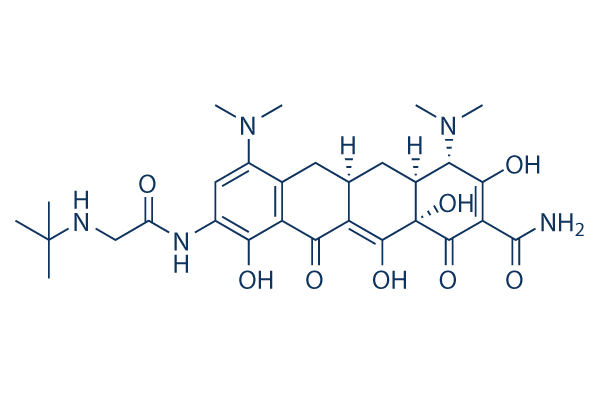
Chemische Struktur
Molekulargewicht: 585.65
Qualitätskontrolle
| Verwandte Ziele | Integrase Bacterial Antibiotics Anti-infection Fungal Antiviral COVID-19 Parasite Reverse Transcriptase HIV |
|---|---|
| Weitere Antineoplastic and Immunosuppressive Antibiotics Inhibitoren | Staurosporine (STS) Cyclosporin A Oligomycin A (MCH 32) Puromycin Dihydrochloride Nigericin sodium salt Geldanamycin (NSC 122750) Honokiol Streptozotocin (STZ) Sodium Monensin (NSC 343257) Cephalomannine |
Zellkultur, Behandlung & Arbeitskonzentration
| Zelllinien | Assay-Typ | Konzentration | Inkubationszeit | Formulierung | Aktivitätsbeschreibung | PMID |
|---|---|---|---|---|---|---|
| THP-1 | Antibacterial assay | 24 hrs | Antibacterial activity against Staphylococcus aureus SCV isolated from cystic fibrosis patient infected in human THP-1 cells assessed as log reduction of intracellular CFU level after 24 hrs in presence of thymidine | 19188393 | ||
| Klicken Sie hier, um weitere experimentelle Daten zu Zelllinien anzuzeigen | ||||||
Chemische Informationen, Lagerung & Stabilität
| Molekulargewicht | 585.65 | Formel | C29H39N5O8 |
Lagerung (Ab dem Eingangsdatum) | |
|---|---|---|---|---|---|
| CAS-Nr. | 220620-09-7 | SDF herunterladen | Lagerung von Stammlösungen |
|
|
| Synonyme | GAR-936, WAY-GAR-936, TBG-MINO | Smiles | CC(C)(C)NCC(=O)NC1=CC(=C2CC3CC4C(C(=O)C(=C(C4(C(=O)C3=C(C2=C1O)O)O)O)C(=O)N)N(C)C)N(C)C | ||
Löslichkeit
|
In vitro |
DMSO
: 100 mg/mL
(170.75 mM)
Water : 100 mg/mL Ethanol : Insoluble |
Molaritätsrechner
|
In vivo |
|||||
In-vivo-Formulierungsrechner (Klare Lösung)
Schritt 1: Geben Sie die untenstehenden Informationen ein (Empfohlen: Ein zusätzliches Tier zur Berücksichtigung von Verlusten während des Experiments)
Schritt 2: Geben Sie die In-vivo-Formulierung ein (Dies ist nur der Rechner, keine Formulierung. Bitte kontaktieren Sie uns zuerst, wenn es im Abschnitt "Löslichkeit" keine In-vivo-Formulierung gibt.)
Berechnungsergebnisse:
Arbeitskonzentration: mg/ml;
Methode zur Herstellung der DMSO-Stammlösung: mg Wirkstoff vorgelöst in μL DMSO ( Konzentration der Stammlösung mg/mL, Bitte kontaktieren Sie uns zuerst, wenn die Konzentration die DMSO-Löslichkeit der Wirkstoffcharge überschreitet. )
Methode zur Herstellung der In-vivo-Formulierung: Nehmen Sie μL DMSO Stammlösung, dann hinzufügenμL PEG300, mischen und klären, dann hinzufügenμL Tween 80, mischen und klären, dann hinzufügen μL ddH2O, mischen und klären.
Methode zur Herstellung der In-vivo-Formulierung: Nehmen Sie μL DMSO Stammlösung, dann hinzufügen μL Maisöl, mischen und klären.
Hinweis: 1. Bitte stellen Sie sicher, dass die Flüssigkeit klar ist, bevor Sie das nächste Lösungsmittel hinzufügen.
2. Achten Sie darauf, das/die Lösungsmittel der Reihe nach hinzuzufügen. Sie müssen sicherstellen, dass die bei der vorherigen Zugabe erhaltene Lösung eine klare Lösung ist, bevor Sie mit der Zugabe des nächsten Lösungsmittels fortfahren. Physikalische Methoden wie Vortex, Ultraschall oder ein heißes Wasserbad können zur Unterstützung des Lösens verwendet werden.
Wirkmechanismus
| In vitro |
Tigecycline umgeht die Tet(A-E)-Effluxpumpen, die für den Großteil der erworbenen Resistenzen gegen Tetracyclin und Minocyclin bei Enterobacteriaceae und Acinetobacter spp. verantwortlich sind. Diese Verbindung bindet an Bacterial ribosome, die durch das Tet(M)-Protein modifiziert wurden, einen Mechanismus, der alle verfügbaren Tetracycline beeinträchtigt und der bei Gram-positiven Kokken und Neisseria spp. häufig ist. Es bleibt anfällig für die chromosomal kodierten Multidrug-Effluxpumpen von Proteeae und Pseudomonas aeruginosa und für Tet(X), eine Tetracyclin-abbauende Monooxygenase, die, wenn auch selten, in Bacteroides spp. gefunden wird. Die MHK-Werte für Enterokokken, Staphylokokken und Streptokokken liegen meistens bei 0,06–0,25 mg/L, wiederum mit geringer oder keiner Verschiebung der Verteilung. Dieses Mittel ist anfällig für Oxidation, und die MHK-Werte, insbesondere für die empfindlichsten Isolate, können erhöht sein, wenn das Medikament zu einer Brühe hinzugefügt wird, die während der Lagerung mit Sauerstoff angereichert wurde, oder wenn medikamentenhaltige Medien vor der Inokulation gelagert werden. Es ist ein schlechtes Substrat für Tetracyclin-spezifische Effluxpumpen und bindet immer noch an ribosome, die durch das Tet(M)-Protein modifiziert wurden. Dieses Antibakterium hat Aktivität gegen eine Vielzahl von grampositiven und gramnegativen Erregern gezeigt, einschließlich multiresistenter Stämme. Es ist aktiv gegen viele grampositive und -negative Organismen, einschließlich Methicillin-resistenter Staphylococcus aureus, Vancomycin-intermediärer und -resistenter Enterokokken sowie Extended-Spectrum-β-Lactamase-produzierender Escherichia coli und Klebsiella pneumoniae. Diese Verbindung zeigt antibakterielle Aktivität gegen ein breites Spektrum aerober und anaerober Bakterien. Es ist ein Breitband-, Protein-inhibierendes, antibakterielles Mittel, das Aktivität gegen Stämme besitzt, die gegen andere Chemotherapeutika resistent sind. Diese Chemikalie zeigt In-vitro-Aktivitäten gegen die GISA und die Methicillin-resistenten und Methicillin-empfindlichen Staphylokokkenstämme (MHK-Werte, bei denen 90 % der getesteten Isolate gehemmt werden [MHK90s], 0,5 bis 1 μg/ml). Es hat MHK90s von 0,25 μg/ml für alle S. pneumoniae-Stämme und zeigt ähnliche Aktivitäten gegen alle getesteten S. pneumoniae-Stämme. |
|---|---|
| In vivo |
Tigecycline wirkt bakterizid gegen Methicillin-empfindlichen S. aureus (MSSA) im Kaninchen-Osteomyelitis-Modell und zeigt eine gute, aber nicht hervorragende Aktivität bei Legionellapneumophila-Pneumonie bei Meerschweinchen. Diese Verbindung in einer Dosis von 50 mg/kg zweimal täglich war für Mäuse nicht toxisch. Es ist wirksam bei der Hemmung des NSCLC-Wachstums in vivo durch Verringerung der Proliferation und Erhöhung der Apoptose von Tumorzellen. |
Literatur |
|
Anwendungen
| Methoden | Biomarker | Bilder | PMID |
|---|---|---|---|
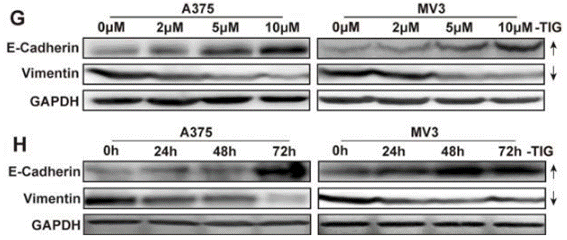
| Western blot | E-cadherin / Vimentin CDK2 / Cyclin E Cox-1 / Cox-2 / Cox-4 p-AMPKα / AMPKα / p-mTOR / mTOR / p-p70S6K / p70S6K / p-4E-BP-1 / 4E-BP1 p62 / LC3-I / LC3-II Cyclin D1 / CDK2 / p21 |
|
26621850 |
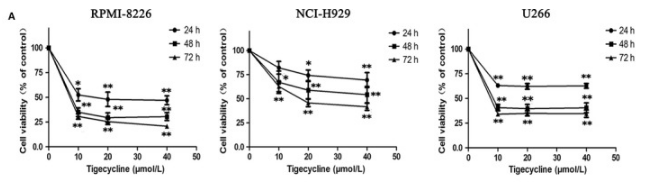
| Growth inhibition assay | Cell viability |
|
30247801 |
Klinische Studieninformationen
(Daten von https://clinicaltrials.gov, aktualisiert am 2024-05-22)
| NCT-Nummer | Rekrutierung | Erkrankungen | Sponsor/Kooperationspartner | Startdatum | Phasen |
|---|---|---|---|---|---|
| NCT06049771 | Recruiting | Carbapenem-resistant Enterobacteriaceae |
Phramongkutklao College of Medicine and Hospital|Silpakorn University |
September 17 2023 | Not Applicable |
| NCT05698160 | Not yet recruiting | Blood Coagulation Disorder |
The Affiliated Nanjing Drum Tower Hospital of Nanjing University Medical School |
May 1 2023 | -- |
| NCT04937894 | Recruiting | Infectious Disease |
Shandong University|Shandong Provincial Hospital |
June 1 2021 | -- |
| NCT04724798 | Unknown status | Extracorporeal Membrane Oxygenation|Pharmacokinetics|Tigecycline |
Nanfang Hospital Southern Medical University |
January 20 2020 | -- |
| NCT04489459 | Unknown status | Treatment of Blood Stream Infections Due to Multidrug-Resistant Klebsiella Pneumoniae |
Al-Azhar University |
September 21 2019 | Phase 4 |
Technischer Support
Tel: +1-832-582-8158 Ext:3
Wenn Sie weitere Fragen haben, hinterlassen Sie bitte eine Nachricht.

Produkte sind nur für Forschungszwecke bestimmt. Nicht für den menschlichen Gebrauch. Wir verkaufen nicht an Patienten.
©Copyright 2013 Selleck Chemicals. Alle Rechte vorbehalten.