
nur für Forschungszwecke
ARN-509 (Apalutamide) AR-Antagonist
Kat.-Nr.S2840
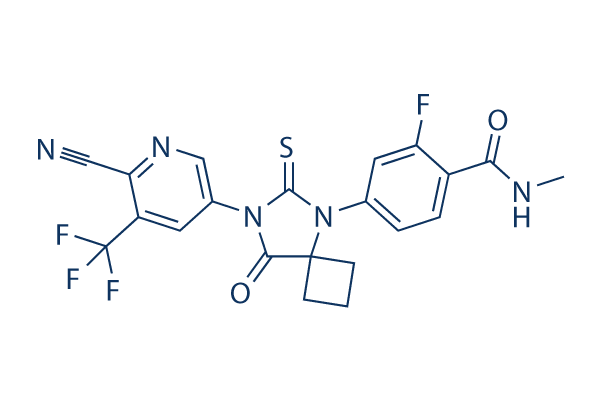
Chemische Struktur
Molekulargewicht: 477.43
Qualitätskontrolle
| Verwandte Ziele | Adrenergic Receptor Estrogen/progestogen Receptor GPR Glucocorticoid Receptor ACE RAAS Progesterone Receptor Opioid Receptor PGES THR |
|---|---|
| Weitere Androgen Receptor Inhibitoren | Bavdegalutamide (ARV-110) RU58841 EPI-001 Galeterone Cyproterone Acetate 3,3'-Diindolylmethane Ailanthone Proxalutamide (GT0918) AZD3514 Chlormadinone acetate |
Zellkultur, Behandlung & Arbeitskonzentration
| Zelllinien | Assay-Typ | Konzentration | Inkubationszeit | Formulierung | Aktivitätsbeschreibung | PMID |
|---|---|---|---|---|---|---|
| LNCAP cells | Proliferation assay | 3 days | Antiproliferative activity against human LNCAP cells after 3 days, IC50=0.174 μM | 26046313 | ||
| PSN1 cells | Cytotoxicity assay | 96 h | Cytotoxicity against human PSN1 cells after 96 hrs by ATP-lite luminescence assay, IC50=0.06 μM | 22247788 | ||
| PSN1 cells | Function assay | 30 nM | 24 h | Induction of cell cycle arrest in human PSN1 cells assessed as accumulation at G2/M phase cells at 30 nM after 24 hrs by flow cytometry | 22247788 | |
| LNCaP | Function assay | 30 mins | Displacement of [3H]-R1881 from AR in human LNCaP cells preincubated for 30 mins followed by [3H]-R1881 addition measured after 30 mins by microbeta scintillation counter method, IC50 = 0.01625 μM. | 28478926 | ||
| U-2 OS | qHTS assay | qHTS of pediatric cancer cell lines to identify multiple opportunities for drug repurposing: Primary screen for U-2 OS cells | 29435139 | |||
| A673 | qHTS assay | qHTS of pediatric cancer cell lines to identify multiple opportunities for drug repurposing: Primary screen for A673 cells | 29435139 | |||
| DAOY | qHTS assay | qHTS of pediatric cancer cell lines to identify multiple opportunities for drug repurposing: Primary screen for DAOY cells | 29435139 | |||
| BT-37 | qHTS assay | qHTS of pediatric cancer cell lines to identify multiple opportunities for drug repurposing: Primary screen for BT-37 cells | 29435139 | |||
| RD | qHTS assay | qHTS of pediatric cancer cell lines to identify multiple opportunities for drug repurposing: Primary screen for RD cells | 29435139 | |||
| SK-N-SH | qHTS assay | qHTS of pediatric cancer cell lines to identify multiple opportunities for drug repurposing: Primary screen for SK-N-SH cells | 29435139 | |||
| BT-12 | qHTS assay | qHTS of pediatric cancer cell lines to identify multiple opportunities for drug repurposing: Primary screen for BT-12 cells | 29435139 | |||
| MG 63 (6-TG R) | qHTS assay | qHTS of pediatric cancer cell lines to identify multiple opportunities for drug repurposing: Primary screen for MG 63 (6-TG R) cells | 29435139 | |||
| NB1643 | qHTS assay | qHTS of pediatric cancer cell lines to identify multiple opportunities for drug repurposing: Primary screen for NB1643 cells | 29435139 | |||
| Fibroblast cells | qHTS assay | qHTS of pediatric cancer cell lines to identify multiple opportunities for drug repurposing: Primary screen for control Hh wild type fibroblast cells | 29435139 | |||
| Rh41 | qHTS assay | qHTS of pediatric cancer cell lines to identify multiple opportunities for drug repurposing: Primary screen for Rh41 cells | 29435139 | |||
| Rh30 | qHTS assay | qHTS of pediatric cancer cell lines to identify multiple opportunities for drug repurposing: Primary screen for Rh30 cells | 29435139 | |||
| SJ-GBM2 | qHTS assay | qHTS of pediatric cancer cell lines to identify multiple opportunities for drug repurposing: Primary screen for SJ-GBM2 cells | 29435139 | |||
| SK-N-MC | qHTS assay | qHTS of pediatric cancer cell lines to identify multiple opportunities for drug repurposing: Primary screen for SK-N-MC cells | 29435139 | |||
| NB-EBc1 | qHTS assay | qHTS of pediatric cancer cell lines to identify multiple opportunities for drug repurposing: Primary screen for NB-EBc1 cells | 29435139 | |||
| LAN-5 | qHTS assay | qHTS of pediatric cancer cell lines to identify multiple opportunities for drug repurposing: Primary screen for LAN-5 cells | 29435139 | |||
| Rh18 | qHTS assay | qHTS of pediatric cancer cell lines to identify multiple opportunities for drug repurposing: Primary screen for Rh18 cells | 29435139 | |||
| Klicken Sie hier, um weitere experimentelle Daten zu Zelllinien anzuzeigen | ||||||
Chemische Informationen, Lagerung & Stabilität
| Molekulargewicht | 477.43 | Formel | C21H15F4N5O2S |
Lagerung (Ab dem Eingangsdatum) | |
|---|---|---|---|---|---|
| CAS-Nr. | 956104-40-8 | SDF herunterladen | Lagerung von Stammlösungen |
|
|
| Synonyme | N/A | Smiles | CNC(=O)C1=C(C=C(C=C1)N2C(=S)N(C(=O)C23CCC3)C4=CC(=C(N=C4)C#N)C(F)(F)F)F | ||
Löslichkeit
|
In vitro |
DMSO
: 95 mg/mL
(198.98 mM)
Ethanol : 7 mg/mL Water : Insoluble |
Molaritätsrechner
|
In vivo |
|||||
In-vivo-Formulierungsrechner (Klare Lösung)
Schritt 1: Geben Sie die untenstehenden Informationen ein (Empfohlen: Ein zusätzliches Tier zur Berücksichtigung von Verlusten während des Experiments)
Schritt 2: Geben Sie die In-vivo-Formulierung ein (Dies ist nur der Rechner, keine Formulierung. Bitte kontaktieren Sie uns zuerst, wenn es im Abschnitt "Löslichkeit" keine In-vivo-Formulierung gibt.)
Berechnungsergebnisse:
Arbeitskonzentration: mg/ml;
Methode zur Herstellung der DMSO-Stammlösung: mg Wirkstoff vorgelöst in μL DMSO ( Konzentration der Stammlösung mg/mL, Bitte kontaktieren Sie uns zuerst, wenn die Konzentration die DMSO-Löslichkeit der Wirkstoffcharge überschreitet. )
Methode zur Herstellung der In-vivo-Formulierung: Nehmen Sie μL DMSO Stammlösung, dann hinzufügenμL PEG300, mischen und klären, dann hinzufügenμL Tween 80, mischen und klären, dann hinzufügen μL ddH2O, mischen und klären.
Methode zur Herstellung der In-vivo-Formulierung: Nehmen Sie μL DMSO Stammlösung, dann hinzufügen μL Maisöl, mischen und klären.
Hinweis: 1. Bitte stellen Sie sicher, dass die Flüssigkeit klar ist, bevor Sie das nächste Lösungsmittel hinzufügen.
2. Achten Sie darauf, das/die Lösungsmittel der Reihe nach hinzuzufügen. Sie müssen sicherstellen, dass die bei der vorherigen Zugabe erhaltene Lösung eine klare Lösung ist, bevor Sie mit der Zugabe des nächsten Lösungsmittels fortfahren. Physikalische Methoden wie Vortex, Ultraschall oder ein heißes Wasserbad können zur Unterstützung des Lösens verwendet werden.
Wirkmechanismus
| Targets/IC50/Ki |
Androgen Receptor
(Cell-free assay) 16 nM
|
|---|---|
| In vitro |
Apalutamide (ARN-509) (< 10 μM) hemmt die Androgen-vermittelte Induktion oder Repression der mRNA-Expressionsspiegel für 13 endogene Gene, einschließlich PSA und TMPRSS2, in der Prostatakrebszelllinie LNCaP/AR. Es hemmt auch die proliferative Wirkung von R1881 (30 pM) in derselben Zelllinie. Bei 10 μM beeinträchtigt diese Verbindung die nukleäre Lokalisation des Androgen Receptor und reduziert somit die Konzentration des Androgen Receptor, die zur Bindung an Androgen-Antwortelemente (ARE) in LNCaP-Zellen mit AR-EYFP-Expression zur Verfügung steht. Es ist in der Lage, effektiv mit R1881 (1 nM) zu konkurrieren und den Androgen Receptor an der Bindung an Promotorregionen zu hindern. Zusätzlich hemmt es die R1881-induzierte VP16-AR-vermittelte Transkription mit einer IC50 von 0,2 μM in Hep-G2-Zellen, die ein VP16-AR-Fusionsprotein und einen ARE-gesteuerten Luciferase-Reporter exprimieren. |
| In vivo |
Apalutamide (ARN-509) (10 mg/kg/Tag, oral) hemmt das Tumorwachstum mit einem verminderten Proliferationsindex und einer erhöhten apoptotischen Rate bei kastrierten männlichen immundefizienten Mäusen, die LNCaP/AR-luc-Xenograft-Tumoren beherbergen. Diese Verbindung hemmt das Tumorwachstum dosisabhängig mit der höchsten Wirksamkeit bei einer Dosis von 30 mg/kg/Tag bei kastrierten männlichen immundefizienten Mäusen, die LNCaP/AR-luc-Xenograft-Tumoren beherbergen. Es führte bei einer Dosis von 10 mg/kg/Tag über 28 Tage zu einer dreifachen Reduktion des Prostatagewichts, verbunden mit fehlender Drüsensekretionsaktivität, und einer 1,7-fachen Reduktion des Nebenhodengewichts bei erwachsenen männlichen Hunden. Die Verbindung (10 mg/kg/Tag, oral) hemmt die Zellproliferation von Prostatagewebe bei erwachsenen männlichen Hunden. Es ist sicher und gut verträglich bei 24 Patienten mit metastasiertem CRPC, die unter früheren Behandlungen fortgeschritten sind, und die maximalen Plasmakonzentrationen traten 2 bis 3 Stunden nach der Verabreichung auf. Dieses Mittel führt zu anhaltenden PSA-Abnahmen bei Dosen von 30 bis 300 mg bei Patienten mit metastasiertem CRPC. Es zeigt eine starke Anti-Krebs-Aktivität und induziert dauerhafte Remissionen lange nach Abschluss der Therapie in Mausmodellen für kastrationsresistenten Prostatakrebs. |
Literatur |
|
Technischer Support
Tel: +1-832-582-8158 Ext:3
Wenn Sie weitere Fragen haben, hinterlassen Sie bitte eine Nachricht.

Produkte sind nur für Forschungszwecke bestimmt. Nicht für den menschlichen Gebrauch. Wir verkaufen nicht an Patienten.
©Copyright 2013 Selleck Chemicals. Alle Rechte vorbehalten.