
nur für Forschungszwecke
Atorvastatin Calcium (CI-981) HMG-CoA Reductase Inhibitor
Kat.-Nr.S2077
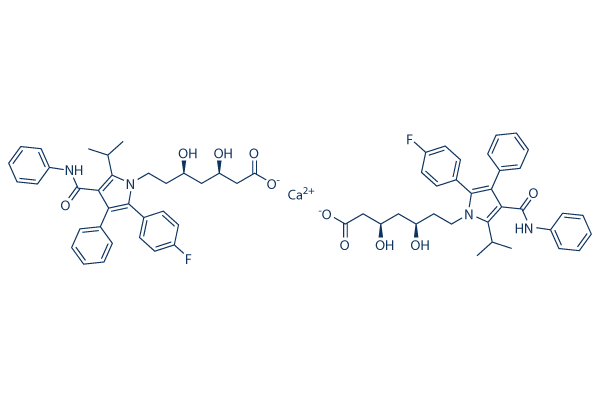
Chemische Struktur
Molekulargewicht: 1155.34
Qualitätskontrolle
| Verwandte Ziele | Dehydrogenase HSP Transferase P450 (e.g. CYP17) PDE phosphatase PPAR Vitamin Carbohydrate Metabolism Mitochondrial Metabolism |
|---|---|
| Weitere HMG-CoA Reductase Inhibitoren | Mevastatin SR-12813 Clinofibrate Dihydrolanosterol 7-ketocholesterol Cerivastatin sodium |
Zellkultur, Behandlung & Arbeitskonzentration
| Zelllinien | Assay-Typ | Konzentration | Inkubationszeit | Formulierung | Aktivitätsbeschreibung | PMID |
|---|---|---|---|---|---|---|
| CHO | Function assay | Ki values for sodium fluorescein (10 uM) uptake in OATP1B1-transfected CHO cells, Ki=0.45μM. | 23571415 | |||
| CHO | Function assay | pIC50 values for sodium fluorescein (10 uM) uptake in OATP1B1-transfected CHO cells, IC50=0.81283μM. | 23571415 | |||
| Me300 | Cytotoxicity assay | 72 hrs | Cytotoxicity against human Me300 cells after 72 hrs by MTT assay, IC50=1.2μM. | 22533316 | ||
| KB | Cytotoxicity assay | 72 hrs | Cytotoxicity against human KB cells after 72 hrs by MTT assay, IC50=1.97μM. | 22533316 | ||
| CHO | Function assay | Ki values for sodium fluorescein (10 uM) uptake in OATP1B3-transfected CHO cells, Ki=2.58μM. | 23571415 | |||
| CHO | Function assay | pIC50 values for sodium fluorescein (10 uM) uptake in OATP1B3-transfected CHO cells, IC50=3.38844μM. | 23571415 | |||
| HeLa | Cytotoxicity assay | 72 hrs | Cytotoxicity against human HeLa cells after 72 hrs by MTT assay, IC50=4.22μM. | 22533316 | ||
| LN18 | Cytotoxicity assay | 72 hrs | Cytotoxicity against human LN18 cells assessed as reduction in cell survival after 72 hrs by MTT assay, IC50=6.9μM. | 22533316 | ||
| LNZ308 | Cytotoxicity assay | 72 hrs | Cytotoxicity against human LNZ308 cells after 72 hrs by MTT assay, IC50=7.44μM. | 22533316 | ||
| LN229 | Cytotoxicity assay | 72 hrs | Cytotoxicity against human LN229 cells assessed as reduction in cell survival after 72 hrs by MTT assay, IC50=8.1μM. | 22533316 | ||
| Caco2 | Cytotoxicity assay | 72 hrs | Cytotoxicity against human Caco2 cells after 72 hrs by MTT assay, IC50=18.7μM. | 22533316 | ||
| HCEC | Cytotoxicity assay | 72 hrs | Cytotoxicity against human HCEC cells assessed as reduction in cell survival after 72 hrs by MTT assay, IC50=20.3μM. | 22533316 | ||
| LN18 | Function assay | 1 to 3 uM | 24 hrs | Inhibition of DNA synthesis in human LN18 cells assessed as inhibition of tritiated thymidine incorporation at 1 to 3 uM after 24 hrs by beta counting | 22533316 | |
| LN229 | Function assay | 1 to 3 uM | 24 hrs | Inhibition of DNA synthesis in human LN229 cells assessed as inhibition of tritiated thymidine incorporation at 1 to 3 uM after 24 hrs by beta counting | 22533316 | |
| DAOY | qHTS assay | qHTS of pediatric cancer cell lines to identify multiple opportunities for drug repurposing: Primary screen for DAOY cells | 29435139 | |||
| SJ-GBM2 | qHTS assay | qHTS of pediatric cancer cell lines to identify multiple opportunities for drug repurposing: Primary screen for SJ-GBM2 cells | 29435139 | |||
| A673 | qHTS assay | qHTS of pediatric cancer cell lines to identify multiple opportunities for drug repurposing: Primary screen for A673 cells | 29435139 | |||
| BT-37 | qHTS assay | qHTS of pediatric cancer cell lines to identify multiple opportunities for drug repurposing: Primary screen for BT-37 cells | 29435139 | |||
| U-2 OS | qHTS assay | qHTS of pediatric cancer cell lines to identify multiple opportunities for drug repurposing: Primary screen for U-2 OS cells | 29435139 | |||
| Saos-2 | qHTS assay | qHTS of pediatric cancer cell lines to identify multiple opportunities for drug repurposing: Primary screen for Saos-2 cells | 29435139 | |||
| SK-N-SH | qHTS assay | qHTS of pediatric cancer cell lines to identify multiple opportunities for drug repurposing: Primary screen for SK-N-SH cells | 29435139 | |||
| BT-12 | qHTS assay | qHTS of pediatric cancer cell lines to identify multiple opportunities for drug repurposing: Primary screen for BT-12 cells | 29435139 | |||
| OHS-50 | qHTS assay | qHTS of pediatric cancer cell lines to identify multiple opportunities for drug repurposing: Primary screen for OHS-50 cells | 29435139 | |||
| MG 63 (6-TG R) | qHTS assay | qHTS of pediatric cancer cell lines to identify multiple opportunities for drug repurposing: Primary screen for MG 63 (6-TG R) cells | 29435139 | |||
| Klicken Sie hier, um weitere experimentelle Daten zu Zelllinien anzuzeigen | ||||||
Chemische Informationen, Lagerung & Stabilität
| Molekulargewicht | 1155.34 | Formel | 2(C33H34FN2O5).Ca |
Lagerung (Ab dem Eingangsdatum) | |
|---|---|---|---|---|---|
| CAS-Nr. | 134523-03-8 | SDF herunterladen | Lagerung von Stammlösungen |
|
|
| Synonyme | N/A | Smiles | CC(C)C1=C(C(=C(N1CCC(CC(CC(=O)[O-])O)O)C2=CC=C(C=C2)F)C3=CC=CC=C3)C(=O)NC4=CC=CC=C4.CC(C)C1=C(C(=C(N1CCC(CC(CC(=O)[O-])O)O)C2=CC=C(C=C2)F)C3=CC=CC=C3)C(=O)NC4=CC=CC=C4.[Ca+2] | ||
Löslichkeit
|
In vitro |
DMSO
: 100 mg/mL
(86.55 mM)
Water : Insoluble Ethanol : Insoluble |
Molaritätsrechner
|
In vivo |
|||||
In-vivo-Formulierungsrechner (Klare Lösung)
Schritt 1: Geben Sie die untenstehenden Informationen ein (Empfohlen: Ein zusätzliches Tier zur Berücksichtigung von Verlusten während des Experiments)
Schritt 2: Geben Sie die In-vivo-Formulierung ein (Dies ist nur der Rechner, keine Formulierung. Bitte kontaktieren Sie uns zuerst, wenn es im Abschnitt "Löslichkeit" keine In-vivo-Formulierung gibt.)
Berechnungsergebnisse:
Arbeitskonzentration: mg/ml;
Methode zur Herstellung der DMSO-Stammlösung: mg Wirkstoff vorgelöst in μL DMSO ( Konzentration der Stammlösung mg/mL, Bitte kontaktieren Sie uns zuerst, wenn die Konzentration die DMSO-Löslichkeit der Wirkstoffcharge überschreitet. )
Methode zur Herstellung der In-vivo-Formulierung: Nehmen Sie μL DMSO Stammlösung, dann hinzufügenμL PEG300, mischen und klären, dann hinzufügenμL Tween 80, mischen und klären, dann hinzufügen μL ddH2O, mischen und klären.
Methode zur Herstellung der In-vivo-Formulierung: Nehmen Sie μL DMSO Stammlösung, dann hinzufügen μL Maisöl, mischen und klären.
Hinweis: 1. Bitte stellen Sie sicher, dass die Flüssigkeit klar ist, bevor Sie das nächste Lösungsmittel hinzufügen.
2. Achten Sie darauf, das/die Lösungsmittel der Reihe nach hinzuzufügen. Sie müssen sicherstellen, dass die bei der vorherigen Zugabe erhaltene Lösung eine klare Lösung ist, bevor Sie mit der Zugabe des nächsten Lösungsmittels fortfahren. Physikalische Methoden wie Vortex, Ultraschall oder ein heißes Wasserbad können zur Unterstützung des Lösens verwendet werden.
Wirkmechanismus
| Targets/IC50/Ki |
HMG-CoA reductase
(Cell-free assay) |
|---|---|
| In vitro |
Atorvastatin Calcium hemmt die prä-proET-1 mRNA-Expression konzentrations- und zeitabhängig (60-70 % maximale Hemmung) und reduziert die immunreaktiven ET-1-Spiegel (25-50 %), dieser Hemmeffekt bleibt in Gegenwart von oxidiertem LDL (1-50 mg/mL) erhalten. Diese Verbindung reduziert signifikant die Angiotensin II-induzierte und Epidermal Growth Factor-induzierte ROS-Produktion in VSMCs. Es reguliert die mRNA-Expression der NAD(P)H-Oxidase-Untereinheit nox1 in VSMCs herunter, während die p22phox-mRNA-Expression nicht signifikant verändert wird. Die Chemikalie hemmt die Membrantranslokation der rac1 GTPase, die für die Aktivierung der NAD(P)H-Oxidase erforderlich ist. Atorvastatin (0,1 μM) vermindert signifikant die durch Ang II und TNF-α induzierte NF-κB-Aktivierung in mononukleären Zellen und VSMC. Diese Verbindung (1 μM) vermindert die durch Ang II und TNF-α induzierte MCP-1-Expression und wird durch Mevalonat nur in Ang II-stimulierten Zellen umgekehrt. Es (1 μM) vermindert die durch Ang II und durch TNF-α in VSMC induzierte IP-10-Expression, und diese Reduktion wird teilweise durch Mevalonat umgekehrt. Atorvastatin- und Gemfibrozil-Metaboliten, nicht aber die Ausgangssubstanzen, sind potente Antioxidantien gegen die Lipoproteinoxidation. |
| In vivo |
Atorvastatin Calcium reduziert die vaskuläre mRNA-Expression von p22phox und nox1 und erhöht die Expression der aortalen Katalase bei statinbehandelten Ratten. Diese Verbindung hemmt den Anstieg der hsCRP-Serumspiegel bei den cholesteringefütterten Kaninchen. Es hemmt den Anstieg der Osteopontin-Expression im gesamten Klappensegel bei den hypercholesterinämischen Aortenklappen. |
Literatur |
|
Anwendungen
| Methoden | Biomarker | Bilder | PMID |
|---|---|---|---|
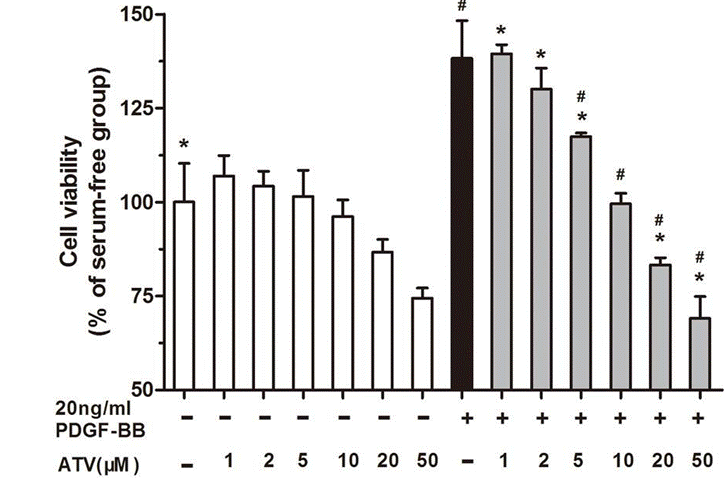
| Growth inhibition assay | Cell viability |
|
25874930 |
Klinische Studieninformationen
(Daten von https://clinicaltrials.gov, aktualisiert am 2024-05-22)
| NCT-Nummer | Rekrutierung | Erkrankungen | Sponsor/Kooperationspartner | Startdatum | Phasen |
|---|---|---|---|---|---|
| NCT01555632 | Withdrawn | Recurrent Prostate Cancer|Stage I Prostate Cancer|Stage IIA Prostate Cancer|Stage IIB Prostate Cancer|Stage III Prostate Cancer|Stage IV Prostate Cancer |
University of Nebraska|National Cancer Institute (NCI) |
March 2012 | Not Applicable |
Technischer Support
Tel: +1-832-582-8158 Ext:3
Wenn Sie weitere Fragen haben, hinterlassen Sie bitte eine Nachricht.

Produkte sind nur für Forschungszwecke bestimmt. Nicht für den menschlichen Gebrauch. Wir verkaufen nicht an Patienten.
©Copyright 2013 Selleck Chemicals. Alle Rechte vorbehalten.