
nur für Forschungszwecke
CTEP (RO4956371) GluR Antagonist
Kat.-Nr.S2861
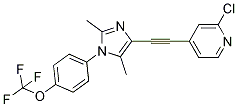
Chemische Struktur
Molekulargewicht: 391.77
Qualitätskontrolle
Chemische Informationen, Lagerung & Stabilität
| Molekulargewicht | 391.77 | Formel | C19H13ClF3N3O |
Lagerung (Ab dem Eingangsdatum) | |
|---|---|---|---|---|---|
| CAS-Nr. | 871362-31-1 | SDF herunterladen | Lagerung von Stammlösungen |
|
|
| Synonyme | N/A | Smiles | CC1=C(N=C(N1C2=CC=C(C=C2)OC(F)(F)F)C)C#CC3=CC(=NC=C3)Cl | ||
Löslichkeit
|
In vitro |
DMSO
: 78 mg/mL
(199.09 mM)
Ethanol : 10 mg/mL Water : Insoluble |
Molaritätsrechner
|
In vivo |
|||||
In-vivo-Formulierungsrechner (Klare Lösung)
Schritt 1: Geben Sie die untenstehenden Informationen ein (Empfohlen: Ein zusätzliches Tier zur Berücksichtigung von Verlusten während des Experiments)
Schritt 2: Geben Sie die In-vivo-Formulierung ein (Dies ist nur der Rechner, keine Formulierung. Bitte kontaktieren Sie uns zuerst, wenn es im Abschnitt "Löslichkeit" keine In-vivo-Formulierung gibt.)
Berechnungsergebnisse:
Arbeitskonzentration: mg/ml;
Methode zur Herstellung der DMSO-Stammlösung: mg Wirkstoff vorgelöst in μL DMSO ( Konzentration der Stammlösung mg/mL, Bitte kontaktieren Sie uns zuerst, wenn die Konzentration die DMSO-Löslichkeit der Wirkstoffcharge überschreitet. )
Methode zur Herstellung der In-vivo-Formulierung: Nehmen Sie μL DMSO Stammlösung, dann hinzufügenμL PEG300, mischen und klären, dann hinzufügenμL Tween 80, mischen und klären, dann hinzufügen μL ddH2O, mischen und klären.
Methode zur Herstellung der In-vivo-Formulierung: Nehmen Sie μL DMSO Stammlösung, dann hinzufügen μL Maisöl, mischen und klären.
Hinweis: 1. Bitte stellen Sie sicher, dass die Flüssigkeit klar ist, bevor Sie das nächste Lösungsmittel hinzufügen.
2. Achten Sie darauf, das/die Lösungsmittel der Reihe nach hinzuzufügen. Sie müssen sicherstellen, dass die bei der vorherigen Zugabe erhaltene Lösung eine klare Lösung ist, bevor Sie mit der Zugabe des nächsten Lösungsmittels fortfahren. Physikalische Methoden wie Vortex, Ultraschall oder ein heißes Wasserbad können zur Unterstützung des Lösens verwendet werden.
Wirkmechanismus
| Targets/IC50/Ki |
mGlu5
2.2 nM
|
|---|---|
| In vitro |
In HEK293-Zellen, die humanes mGlu5 stabil exprimieren, hemmt CTEP (RO4956371) die Quisqualat-induzierte Ca2+-Mobilisierung mit einer IC50 von 11,4 nM und die [3H]IP-Akkumulation mit einer IC50 von 6,4 nM. Es hemmt auch die konstitutive Aktivität des humanen mGlu5 um etwa 50% mit einer IC50 von 40,1 nM.
|
| In vivo |
CTEP (RO4956371) ist bei Dosen von 0,1 mg/kg und 0,3 mg/kg bei der Behandlung von Angstzuständen bei Mäusen signifikant aktiv. Es erhöht die Trinkzeit bei Dosen von 0,3 mg/kg und 1,0 mg/kg im Vogel-Konflikttrinktest bei Ratten signifikant, während es bei niedrigeren Dosen keine Wirkung zeigt. Die Halbwertszeit dieser Verbindung (oral) beträgt 18 h, und das B/P-Verhältnis basierend auf den Gesamtkonzentrationen des Arzneimittels im Plasma und in Homogenaten des gesamten Gehirns beträgt 2,6 bei Mäusen. Nach einzelnen oralen Dosen von 4,5 und 8,7 mg/kg, formuliert als Mikrosuspension in einem Salz-/Tween-Vehikel, die erwachsenen C57BL/6-Mäusen verabreicht wurden, wird es schnell resorbiert und erreicht nach etwa 30 min eine annähernd maximale Exposition. Chronische Verabreichung an erwachsenen Mäusen mit einer Dosis von 2 mg/kg p.o. alle 48 h über 2 Monate erreicht eine minimale Gehirnexposition von 240 ng/g. Es verdrängt [3H]ABP688 in Mausgehirnbereichen, die bekanntermaßen mGlu5 exprimieren, vollständig, und eine 50%ige Verdrängung wird mit Dosen erreicht, die eine durchschnittliche Verbindungskonzentration von 77,5 ng/g im Homogenat des gesamten Gehirns erzeugen. Bei 2 mg/kg p.o. bid erreicht es eine ununterbrochene mGlu5-Besetzung über 48 Stunden bei Mäusen. Die Behandlung mit dieser Verbindung (2 mg/kg p.o.) korrigiert erhöhte hippocampale Langzeitdepression, übermäßige Proteinsynthese und audiogene Anfälle bei der Fmr1-Knockout-Maus.
|
Literatur |
|
Klinische Studieninformationen
(Daten von https://clinicaltrials.gov, aktualisiert am 2024-05-22)
| NCT-Nummer | Rekrutierung | Erkrankungen | Sponsor/Kooperationspartner | Startdatum | Phasen |
|---|---|---|---|---|---|
| NCT05915208 | Recruiting | Histiocytosis|Langerhans Cell Histiocytosis|Erdheim-Chester Disease|Rosai Dorfman Disease|Xanthogranuloma|Malignant Histiocytoses |
University of Alabama at Birmingham |
September 1 2022 | -- |
| NCT02424916 | Completed | Metastatic Melanoma |
Nantes University Hospital|UMR892 |
May 26 2015 | Phase 1|Phase 2 |
Technischer Support
Tel: +1-832-582-8158 Ext:3
Wenn Sie weitere Fragen haben, hinterlassen Sie bitte eine Nachricht.
Häufig gestellte Fragen
Frage 1:
Do you have advice for its administration in mouse via injection?
Antwort:
The IP formula for S2861 is 2% DMSO+40% PEG300+2% Tween-80 +H2O.

Produkte sind nur für Forschungszwecke bestimmt. Nicht für den menschlichen Gebrauch. Wir verkaufen nicht an Patienten.
©Copyright 2013 Selleck Chemicals. Alle Rechte vorbehalten.