
nur für Forschungszwecke
MPEP GluR Antagonist
Kat.-Nr.S2809
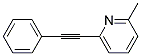
Chemische Struktur
Molekulargewicht: 193.24
Qualitätskontrolle
- In Nature Medicine für seine erstklassige Qualität zitiert
- COA
- NMR
- HPLC
- SDS
- Datenblatt
Chemische Informationen, Lagerung & Stabilität
| Molekulargewicht | 193.24 | Formel | C14H11N |
Lagerung (Ab dem Eingangsdatum) | |
|---|---|---|---|---|---|
| CAS-Nr. | 96206-92-7 | SDF herunterladen | Lagerung von Stammlösungen |
|
|
| Synonyme | N/A | Smiles | CC1=NC(=CC=C1)C#CC2=CC=CC=C2 | ||
Löslichkeit
|
In vitro |
DMSO
: 39 mg/mL
(201.82 mM)
Ethanol : 39 mg/mL Water : Insoluble |
Molaritätsrechner
|
In vivo |
|||||
In-vivo-Formulierungsrechner (Klare Lösung)
Schritt 1: Geben Sie die untenstehenden Informationen ein (Empfohlen: Ein zusätzliches Tier zur Berücksichtigung von Verlusten während des Experiments)
Schritt 2: Geben Sie die In-vivo-Formulierung ein (Dies ist nur der Rechner, keine Formulierung. Bitte kontaktieren Sie uns zuerst, wenn es im Abschnitt "Löslichkeit" keine In-vivo-Formulierung gibt.)
Berechnungsergebnisse:
Arbeitskonzentration: mg/ml;
Methode zur Herstellung der DMSO-Stammlösung: mg Wirkstoff vorgelöst in μL DMSO ( Konzentration der Stammlösung mg/mL, Bitte kontaktieren Sie uns zuerst, wenn die Konzentration die DMSO-Löslichkeit der Wirkstoffcharge überschreitet. )
Methode zur Herstellung der In-vivo-Formulierung: Nehmen Sie μL DMSO Stammlösung, dann hinzufügenμL PEG300, mischen und klären, dann hinzufügenμL Tween 80, mischen und klären, dann hinzufügen μL ddH2O, mischen und klären.
Methode zur Herstellung der In-vivo-Formulierung: Nehmen Sie μL DMSO Stammlösung, dann hinzufügen μL Maisöl, mischen und klären.
Hinweis: 1. Bitte stellen Sie sicher, dass die Flüssigkeit klar ist, bevor Sie das nächste Lösungsmittel hinzufügen.
2. Achten Sie darauf, das/die Lösungsmittel der Reihe nach hinzuzufügen. Sie müssen sicherstellen, dass die bei der vorherigen Zugabe erhaltene Lösung eine klare Lösung ist, bevor Sie mit der Zugabe des nächsten Lösungsmittels fortfahren. Physikalische Methoden wie Vortex, Ultraschall oder ein heißes Wasserbad können zur Unterstützung des Lösens verwendet werden.
Wirkmechanismus
| Merkmale |
Inactive against other group I/II/III metabotropic glutamate receptors.
|
|---|---|
| Targets/IC50/Ki |
mGluR5
36 nM
|
| In vitro |
MPEP hat keine nennenswerte agonistische oder antagonistische Aktivität am eng verwandten rekombinanten humanen mGlu1b-Rezeptor, der in CHO-K1-Zellen exprimiert wird, oder an einem purinorezeptor, der endogen in L(tk-)-Zellen exprimiert wird, bis zu Konzentrationen von 100 μM. Darüber hinaus zeigt diese Verbindung keine nennenswerte agonistische oder antagonistische Aktivität in cAMP-Akkumulations- oder [35S]-GTPγS-Bindungsassays an den rekombinanten humanen metabotropen Rezeptoren der Gruppe II und III (human mGlu2, -3, -4a, -6, -7b, -8a) sowie den humanen NMDA- (NMDAR1A/2A, -1A/2B), Ratten-AMPA- (GluR3) und humanen Kainat- (GluR6) Rezeptor-Subtypen. In Schnitten des neonatalen Hippocampus, Striatums und Kortex von Ratten, aber nicht des Kleinhirns, hemmt es die DHPG-stimulierte PI-Hydrolyse mit IC50-Werten von 8,0 nM, 20,5 nM bzw. 17,9 nM. Diese Chemikalie moduliert positiv den hmGluR4 in einem rekombinanten Expressionssystem, und der Effekt ist vollständig von der Aktivierung des orthosterischen Agonisten L-AP4 abhängig.
|
| In vivo |
Bei mikroiontophoretischer Anwendung in das Gehirn von Ratten reduziert MPEP DHPG-induzierte Erregungen, aber nicht die durch AMPA induzierten Erregungen. Nach intravenöser Verabreichung führt diese Verbindung zu einer dosisabhängigen Hemmung von DHPG-induzierten, aber nicht AMPA-induzierten Erregungen mit einem schnellen Wirkungseintritt. Die orale Verabreichung dieser Chemikalie zeigt auch eine ausgezeichnete anti-hyperalgesische Aktivität in den Complete Freund's Adjuvant- und Terpentin-Modellen für entzündliche Schmerzen. Es (1-30 mg/kg) induziert anxiolytisch-ähnliche Effekte im Konflikttrinktest und im erhöhten Plus-Labyrinth-Test bei Ratten sowie im Vier-Platten-Test bei Mäusen. Diese Verbindung (1-20 mg/kg) verkürzt die Immobilitätszeit in einem Schwanzaufhängungstest bei Mäusen, ist aber im Verzweiflungstest bei Ratten inaktiv. Es hat keine Auswirkung auf die lokomotorische Aktivität oder die motorische Koordination. Diese Chemikalie reduziert signifikant die fmr1-, aber nicht die Wildtyp-Zentrumquadrateinträge und -dauer. In Open-Field-Tests reduziert es das fmr1tm1Cgr-Zentrumfeldeverhalten auf ein von Wildtyp nicht unterscheidbares. Es führt zu einer signifikanten Reduzierung der gesamten lokomotorischen Aktivität in drei von vier getesteten Gruppen, sowohl bei 10 mg/kg als auch bei 30 mg/kg.
|
Literatur |
|
Technischer Support
Tel: +1-832-582-8158 Ext:3
Wenn Sie weitere Fragen haben, hinterlassen Sie bitte eine Nachricht.

Produkte sind nur für Forschungszwecke bestimmt. Nicht für den menschlichen Gebrauch. Wir verkaufen nicht an Patienten.
©Copyright 2013 Selleck Chemicals. Alle Rechte vorbehalten.