
nur für Forschungszwecke
Doxycycline MMP Inhibitor
Kat.-Nr.S5159
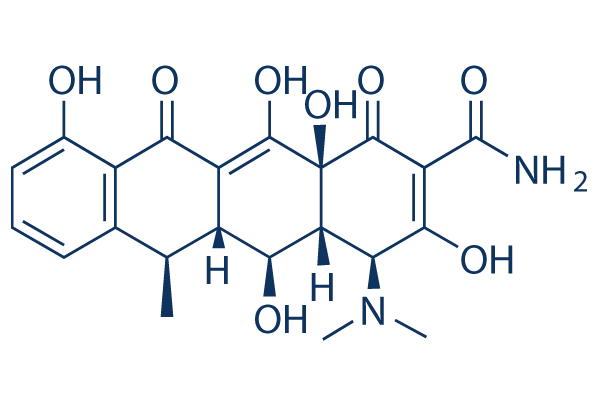
Chemische Struktur
Molekulargewicht: 444.43
Qualitätskontrolle
- Zitiert in Nature Medicine für seine erstklassige Qualität
- COA
- Datenblatt
- SDS
- Zitiert in Nature Medicine für seine erstklassige Qualität
- COA
- Datenblatt
- SDS
- Zitiert in Nature Medicine für seine erstklassige Qualität
- COA
- Datenblatt
- SDS
- Zitiert in Nature Medicine für seine erstklassige Qualität
- COA
- Datenblatt
- SDS
- Zitiert in Nature Medicine für seine erstklassige Qualität
- COA
- Datenblatt
- SDS
| Verwandte Ziele | Integrase Bacterial Antibiotics Anti-infection Fungal Antiviral COVID-19 Parasite Reverse Transcriptase HIV |
|---|---|
| Weitere Antineoplastic and Immunosuppressive Antibiotics Inhibitoren | Staurosporine (STS) Cyclosporin A Oligomycin A (MCH 32) Puromycin Dihydrochloride Nigericin sodium salt Geldanamycin (NSC 122750) Honokiol Streptozotocin (STZ) Sodium Monensin (NSC 343257) Cephalomannine |
Zellkultur, Behandlung & Arbeitskonzentration
| Zelllinien | Assay-Typ | Konzentration | Inkubationszeit | Formulierung | Aktivitätsbeschreibung | PMID |
|---|---|---|---|---|---|---|
| Staphylococcus aureus 2 planktonic cells | Bactericidal assay | 24 hrs | Bactericidal activity against methicillin-resistant Staphylococcus aureus 2 planktonic cells after 24 hrs by calgary biofilm device method, MBC=2μM. | 29638121 | ||
| THP1 | Function assay | Selectivity index, ratio of IC50 for human THP1 cells to IC50 for Plasmodium falciparum, IC50=3.1μM. | 19748781 | |||
| K562 | Cytotoxicity assay | 72 hrs | Cytotoxicity against human K562 cells after 72 hrs by flow cytometry, IC50=15μM. | 19482476 | ||
| K562 | Cytotoxicity assay | 72 hrs | Cytotoxicity against human K562 cells after 72 hrs by flow cytometry, IC50=15μM. | 19926173 | ||
| HepG2 | Cytotoxicity assay | 72 hrs | Cytotoxicity against human HepG2 cells after 72 hrs by MTT assay, IC50=20μM. | 19482476 | ||
| HepG2 | Cytotoxicity assay | 72 hrs | Cytotoxicity against human HepG2 cells after 72 hrs by MTT assay, IC50=20μM. | 19926173 | ||
| THP1 | Cytotoxicity assay | 72 hrs | Cytotoxicity against human THP1 cells after 72 hrs by propidium iodide staining-based flow cytometry, IC50=20μM. | 19748781 | ||
| HepG2 | Cytotoxicity assay | 72 hrs | Cytotoxicity against human HepG2 cells after 72 hrs by MTT assay, CC50=20μM. | 21741131 | ||
| HepG2 | Cytotoxicity assay | 72 hrs | Cytotoxicity against human HepG2 cells after 72 hrs by MTT assay, CC50=20μM. | 22889559 | ||
| HepG2 | Cytotoxicity assay | 72 hrs | Cytotoxicity against human HepG2 cells after 72 hrs by MTT assay, CC50=20μM. | 21852132 | ||
| HepG2 | Cytotoxicity assay | 72 hrs | Cytotoxicity against human HepG2 cells after 72 hrs by MTT assay, CC50=20μM. | 24946216 | ||
| HepG2 | Cytotoxicity assay | 72 hrs | Cytotoxicity against human HepG2 cells assessed as cell viability after 72 hrs by MTT assay, CC50=20μM. | 25791675 | ||
| HepG2 | Cytotoxicity assay | 72 hrs | Cytotoxicity against human HepG2 cells incubated for 72 hrs by MTT assay, CC50=20μM. | 25282267 | ||
| HepG2 | Cytotoxicity assay | 72 hrs | Cytotoxicity against human HepG2 cells measured after 72 hrs by MTT assay, CC50=20μM. | 27155463 | ||
| HepG2 | Cytotoxicity assay | 72 hrs | Cytotoxicity against human HepG2 cells assessed as reduction in cell viability after 72 hrs by MTT assay, CC50=20μM. | 27654395 | ||
| SW1353 | Function assay | 50 uM | Inhibition of IL-1-beta-induced MMP13 production in human SW1353 cells at 50 uM | 17267227 | ||
| K-12 BW25113 | Bactericidal assay | 24 hrs | Bactericidal activity against yafQ gene-deficient Escherichia coli K-12 BW25113 biofilm assessed as log reduction of viable cells after 24 hrs | 19307375 | ||
| K-12 BW25113 | Bactericidal assay | 24 hrs | Bactericidal activity against Escherichia coli K-12 BW25113 biofilm harboring pCA24N ptac::yafQ plasmid assessed as log reduction of viable cells after 24 hrs pretreated with 5 uM of IPTG for 4 hrs | 19307375 | ||
| Neuro2a | Function assay | 1 uM | Decrease in 7-DHC levels in Dhcr7-deficient mouse Neuro2a cells at 1 uM by LC-MS/GC-MS analysis | 26789657 | ||
| vascular endothelial cells | Antibacterial assay | 25 ug/ml | 72 hrs | Antibacterial activity against Rickettsia prowazekii str. Breinl infected in CD rat primary pulmonary vascular endothelial cells assessed as bacterial shape change at 25 ug/ml measured 72 hrs post infection by Hoechst 33258/phalloidin staining based fluor | 28089350 | |
| A673 | qHTS assay | qHTS of pediatric cancer cell lines to identify multiple opportunities for drug repurposing: Primary screen for A673 cells | 29435139 | |||
| BT-12 | qHTS assay | qHTS of pediatric cancer cell lines to identify multiple opportunities for drug repurposing: Primary screen for BT-12 cells | 29435139 | |||
| Hep2 | Anti-Chlamydial assay | 1 ug/ml | 8 hrs | Anti-Chlamydial activity against Chlamydia trachomatis Serovar LGV-L2 infected in Hep2 cells assessed as reduction in size and number of chlamydial inclusion at 1 ug/ml treated at 8 hrs post-infection and 24 hrs later re-infecting fresh Hep2 cells monolay | 32227948 | |
| skeletal myoblast cells | Cytotoxicity assay | DNDI: Cytotoxicity in Vitro, 72 hour, in rat skeletal myoblast cells, IC50=14.49μM. | ChEMBL | |||
| Klicken Sie hier, um weitere experimentelle Daten zu Zelllinien anzuzeigen | ||||||
Chemische Informationen, Lagerung & Stabilität
| Molekulargewicht | 444.43 | Formel | C22H24N2O8 |
Lagerung (Ab dem Eingangsdatum) | |
|---|---|---|---|---|---|
| CAS-Nr. | 564-25-0 | SDF herunterladen | Lagerung von Stammlösungen |
|
|
| Synonyme | Vibramycin, Doxytetracycline, Doxiciclina, Doxycyclinum | Smiles | CC1C2C(C3C(C(=O)C(=C(C3(C(=O)C2=C(C4=C1C=CC=C4O)O)O)O)C(=O)N)N(C)C)O | ||
Löslichkeit
|
In vitro |
DMSO
: 89 mg/mL
(200.25 mM)
Water : Insoluble Ethanol : Insoluble |
Molaritätsrechner
|
In vivo |
|||||
In-vivo-Formulierungsrechner (Klare Lösung)
Schritt 1: Geben Sie die untenstehenden Informationen ein (Empfohlen: Ein zusätzliches Tier zur Berücksichtigung von Verlusten während des Experiments)
Schritt 2: Geben Sie die In-vivo-Formulierung ein (Dies ist nur der Rechner, keine Formulierung. Bitte kontaktieren Sie uns zuerst, wenn es im Abschnitt "Löslichkeit" keine In-vivo-Formulierung gibt.)
Berechnungsergebnisse:
Arbeitskonzentration: mg/ml;
Methode zur Herstellung der DMSO-Stammlösung: mg Wirkstoff vorgelöst in μL DMSO ( Konzentration der Stammlösung mg/mL, Bitte kontaktieren Sie uns zuerst, wenn die Konzentration die DMSO-Löslichkeit der Wirkstoffcharge überschreitet. )
Methode zur Herstellung der In-vivo-Formulierung: Nehmen Sie μL DMSO Stammlösung, dann hinzufügenμL PEG300, mischen und klären, dann hinzufügenμL Tween 80, mischen und klären, dann hinzufügen μL ddH2O, mischen und klären.
Methode zur Herstellung der In-vivo-Formulierung: Nehmen Sie μL DMSO Stammlösung, dann hinzufügen μL Maisöl, mischen und klären.
Hinweis: 1. Bitte stellen Sie sicher, dass die Flüssigkeit klar ist, bevor Sie das nächste Lösungsmittel hinzufügen.
2. Achten Sie darauf, das/die Lösungsmittel der Reihe nach hinzuzufügen. Sie müssen sicherstellen, dass die bei der vorherigen Zugabe erhaltene Lösung eine klare Lösung ist, bevor Sie mit der Zugabe des nächsten Lösungsmittels fortfahren. Physikalische Methoden wie Vortex, Ultraschall oder ein heißes Wasserbad können zur Unterstützung des Lösens verwendet werden.
Wirkmechanismus
| In vitro |
100 ng/mL-5 µg/mL Doxycycline kann das Stoffwechselprofil der Zelle signifikant verändern und die Proliferationsrate reduzieren, wobei die Effektgröße von der verwendeten Zelllinie abhängt. Diese Verbindung arretiert Zellen in der G1-S-Phase des Zellzyklus in PANC-1-Zellen und induziert die Expression von p53 und seinem nachgeschalteten Ziel p21. Sie reguliert antiapoptotische Gene herunter und induziert proapoptotische Gene. Diese Chemikalie induziert auch Apoptose über einen Fas/Fas-Ligand-abhängigen Signalweg in Jurkat-T-Lymphozyten. |
|---|---|
| In vivo |
Doxycycline reduziert erfolgreich das Tumorwachstum in vivo (hemmte das Wachstum von Pankreaskrebszellen). |
Literatur |
|
Anwendungen
| Methoden | Biomarker | Bilder | PMID |
|---|---|---|---|
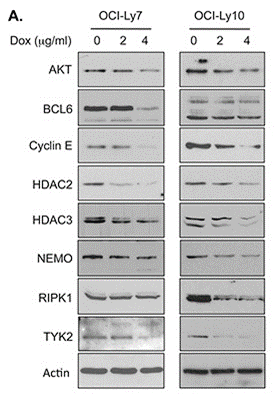
| Western blot | AKT / BCL6 / Cyclin E / HDAC2 / HDAC3 / NEMO / TYK2 / RIPK1 HSP70 / HSP90 pATM / ATM |
|
26142707 |
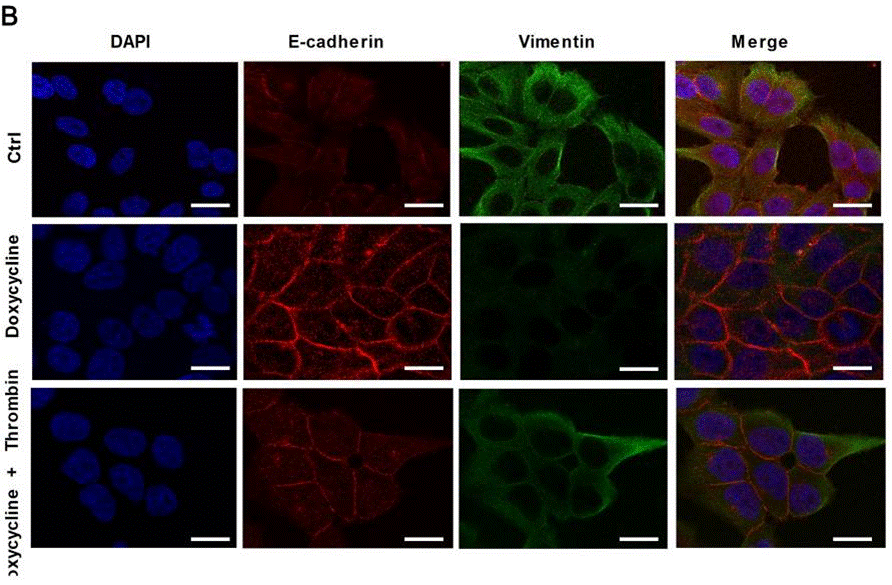
| Immunofluorescence | E-cadherin / Vimentin |
|
29285218 |
Klinische Studieninformationen
(Daten von https://clinicaltrials.gov, aktualisiert am 2024-05-22)
| NCT-Nummer | Rekrutierung | Erkrankungen | Sponsor/Kooperationspartner | Startdatum | Phasen |
|---|---|---|---|---|---|
| NCT05972772 | Not yet recruiting | Infectious Disease|Therapeutics |
Lao-Oxford-Mahosot Hospital Wellcome Trust Research Unit|Mahidol Oxford Tropical Medicine Research Unit |
March 20 2024 | Phase 2|Phase 3 |
| NCT06007534 | Recruiting | Post-exposure Prophylaxis|Sexually Transmitted Diseases|Doxycycline |
Assistance Publique - Hôpitaux de Paris |
October 25 2023 | Not Applicable |
| NCT04762134 | Recruiting | Bacterial Sexually Transmitted Diseases |
Jonathan Troy Grennan|Canadian Institutes of Health Research (CIHR)|British Columbia Centre for Disease Control |
June 2 2023 | Phase 4 |
| NCT05853120 | Recruiting | Sexually Transmitted Diseases |
Emory University|Centers for Disease Control and Prevention |
May 31 2023 | Phase 4 |
| NCT05382208 | Recruiting | Emphysema|HIV |
Weill Medical College of Cornell University|National Heart Lung and Blood Institute (NHLBI)|University of California Los Angeles|University of Iowa|University of Michigan |
August 22 2022 | Phase 2 |
| NCT05492019 | Recruiting | Parkinson Disease |
Bangabandhu Sheikh Mujib Medical University Dhaka Bangladesh |
July 1 2022 | Phase 2 |
Technischer Support
Tel: +1-832-582-8158 Ext:3
Wenn Sie weitere Fragen haben, hinterlassen Sie bitte eine Nachricht.

Produkte sind nur für Forschungszwecke bestimmt. Nicht für den menschlichen Gebrauch. Wir verkaufen nicht an Patienten.
©Copyright 2013 Selleck Chemicals. Alle Rechte vorbehalten.