
nur für Forschungszwecke
Lonafarnib (SCH66336) Farnesyltransferase Inhibitor
Kat.-Nr.S2797
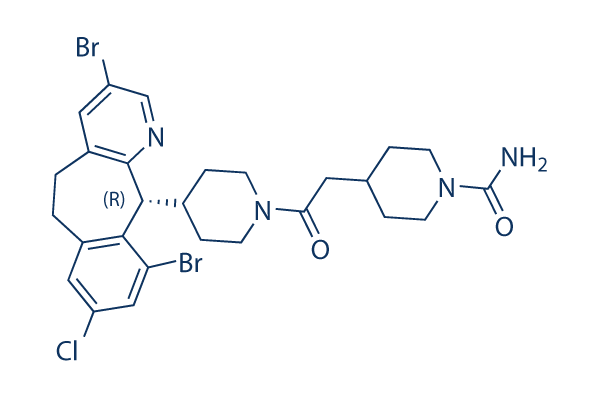
Chemische Struktur
Molekulargewicht: 638.82
Qualitätskontrolle
| Verwandte Ziele | Dehydrogenase HSP Transferase P450 (e.g. CYP17) PDE phosphatase PPAR Vitamin Carbohydrate Metabolism Mitochondrial Metabolism |
|---|---|
| Weitere FTase Inhibitoren | FTI 277 HCl Tipifarnib (IND 58359) LB42708 |
Zellkultur, Behandlung & Arbeitskonzentration
| Zelllinien | Assay-Typ | Konzentration | Inkubationszeit | Formulierung | Aktivitätsbeschreibung | PMID |
|---|---|---|---|---|---|---|
| Cos-1 monkey kidney cells | Function assay | Inhibition of Protein farnesyltransferase in Cos-1 monkey kidney cells expressing H-Ras-val, IC50=0.0019 μM | 12190309 | |||
| COS-7 monkey cells | Function assay | Inhibiting the farnesylation of H-ras proteins in COS-7 monkey cells transiently expressing H-ras[Val12]-CVLS in the whole cell assay, IC50=0.01 μM | 9822558 | |||
| MCF-7 tumor cell line | Growth inhibition assay | Compound was measured for inhibition of MCF-7 tumor cell line in breast under soft agar assay, IC50=0.05 μM | 9822558 | |||
| HCT116 | Growth inhibition assay | Compound was measured for inhibition of HCT116 tumor cell line in colon under soft agar assay, IC50=0.07 μM | 9822558 | |||
| NIH-H tumor cell lines | Growth inhibition assay | Compound ability to inhibit anchorage-independent growth of NIH-H tumor cell lines in soft agar, IC50=0.072 μM | 9822558 | |||
| NIH3T3 cells | Function assay | Inhibition of Ras farnesylation in H-Ras transformed NIH3T3 cells, EC50=0.1 μM | 15454228 | |||
| NIH-K tumor cell lines | Growth inhibition assay | Compound ability to inhibit anchorage-independent growth of NIH-K tumor cell lines in soft agar, IC50=0.5 μM | 9822558 | |||
| Cos-1 | Function assay | Inhibition of Protein farnesyltransferase in Cos-1 monkey kidney cells expressing H-Ras-val, IC50 = 0.0019 μM. | 12190309 | |||
| Cos-1 | Function assay | Effect on Ras processing in Cos-1 monkey kidney cells expressing either H-Ras-Val 12-CVLS or H-Ras-Val12, IC50 = 0.01 μM. | 10411485 | |||
| COS7 | Function assay | Inhibition of FTase in human COS7 cells, IC50 = 0.01 μM. | 20925433 | |||
| H-Ras transformed cells | Function assay | Inhibition of soft agar colony formation in H-Ras transformed cells, IC50 = 0.07 μM. | 15501065 | |||
| NIH3T3 | Function assay | Effective concentration against Ha-RAS processing in NIH3T3 ras-transformed cells, EC50 = 0.16 μM. | 12657284 | |||
| NIH3T3 | Function assay | TP_TRANSPORTER: inhibition of DNR efflux (DNR: ? uM) in MDR1-expressing NIH3T3 cells, IC50 = 2.7 μM. | 11606389 | |||
| A673 | qHTS assay | qHTS of pediatric cancer cell lines to identify multiple opportunities for drug repurposing: Primary screen for A673 cells | 29435139 | |||
| DAOY | qHTS assay | qHTS of pediatric cancer cell lines to identify multiple opportunities for drug repurposing: Primary screen for DAOY cells | 29435139 | |||
| Saos-2 | qHTS assay | qHTS of pediatric cancer cell lines to identify multiple opportunities for drug repurposing: Primary screen for Saos-2 cells | 29435139 | |||
| BT-37 | qHTS assay | qHTS of pediatric cancer cell lines to identify multiple opportunities for drug repurposing: Primary screen for BT-37 cells | 29435139 | |||
| RD | qHTS assay | qHTS of pediatric cancer cell lines to identify multiple opportunities for drug repurposing: Primary screen for RD cells | 29435139 | |||
| BT-12 | qHTS assay | qHTS of pediatric cancer cell lines to identify multiple opportunities for drug repurposing: Primary screen for BT-12 cells | 29435139 | |||
| MG 63 (6-TG R) | qHTS assay | qHTS of pediatric cancer cell lines to identify multiple opportunities for drug repurposing: Primary screen for MG 63 (6-TG R) cells | 29435139 | |||
| NB1643 | qHTS assay | qHTS of pediatric cancer cell lines to identify multiple opportunities for drug repurposing: Primary screen for NB1643 cells | 29435139 | |||
| OHS-50 | qHTS assay | qHTS of pediatric cancer cell lines to identify multiple opportunities for drug repurposing: Primary screen for OHS-50 cells | 29435139 | |||
| Rh41 | qHTS assay | qHTS of pediatric cancer cell lines to identify multiple opportunities for drug repurposing: Primary screen for Rh41 cells | 29435139 | |||
| SJ-GBM2 | qHTS assay | qHTS of pediatric cancer cell lines to identify multiple opportunities for drug repurposing: Primary screen for SJ-GBM2 cells | 29435139 | |||
| SK-N-MC | qHTS assay | qHTS of pediatric cancer cell lines to identify multiple opportunities for drug repurposing: Primary screen for SK-N-MC cells | 29435139 | |||
| NB-EBc1 | qHTS assay | qHTS of pediatric cancer cell lines to identify multiple opportunities for drug repurposing: Primary screen for NB-EBc1 cells | 29435139 | |||
| LAN-5 | qHTS assay | qHTS of pediatric cancer cell lines to identify multiple opportunities for drug repurposing: Primary screen for LAN-5 cells | 29435139 | |||
| Caco-2 | Cytotoxicity assay | 48 hours | Determination of IC50 values for inhibition of SARS-CoV-2 induced cytotoxicity of Caco-2 cells after 48 hours by high content imaging, IC50 = 5.68 μM. | ChEMBL | ||
| Caco-2 | Toxicity assay | 48 hours | Toxicity against Caco-2 cells determined at 48 hours by intracellular ATP concentration using the CellTiter-Glo Luminescent Cell Viability Assay, CC50 = 10.71 μM. | ChEMBL | ||
| Klicken Sie hier, um weitere experimentelle Daten zu Zelllinien anzuzeigen | ||||||
Chemische Informationen, Lagerung & Stabilität
| Molekulargewicht | 638.82 | Formel | C27H31Br2ClN4O2 |
Lagerung (Ab dem Eingangsdatum) | |
|---|---|---|---|---|---|
| CAS-Nr. | 193275-84-2 | SDF herunterladen | Lagerung von Stammlösungen |
|
|
| Synonyme | N/A | Smiles | C1CN(CCC1CC(=O)N2CCC(CC2)C3C4=C(CCC5=C3N=CC(=C5)Br)C=C(C=C4Br)Cl)C(=O)N | ||
Löslichkeit
|
In vitro |
DMSO
: 127 mg/mL
(198.8 mM)
Ethanol : 127 mg/mL Water : Insoluble |
Molaritätsrechner
|
In vivo |
|||||
In-vivo-Formulierungsrechner (Klare Lösung)
Schritt 1: Geben Sie die untenstehenden Informationen ein (Empfohlen: Ein zusätzliches Tier zur Berücksichtigung von Verlusten während des Experiments)
Schritt 2: Geben Sie die In-vivo-Formulierung ein (Dies ist nur der Rechner, keine Formulierung. Bitte kontaktieren Sie uns zuerst, wenn es im Abschnitt "Löslichkeit" keine In-vivo-Formulierung gibt.)
Berechnungsergebnisse:
Arbeitskonzentration: mg/ml;
Methode zur Herstellung der DMSO-Stammlösung: mg Wirkstoff vorgelöst in μL DMSO ( Konzentration der Stammlösung mg/mL, Bitte kontaktieren Sie uns zuerst, wenn die Konzentration die DMSO-Löslichkeit der Wirkstoffcharge überschreitet. )
Methode zur Herstellung der In-vivo-Formulierung: Nehmen Sie μL DMSO Stammlösung, dann hinzufügenμL PEG300, mischen und klären, dann hinzufügenμL Tween 80, mischen und klären, dann hinzufügen μL ddH2O, mischen und klären.
Methode zur Herstellung der In-vivo-Formulierung: Nehmen Sie μL DMSO Stammlösung, dann hinzufügen μL Maisöl, mischen und klären.
Hinweis: 1. Bitte stellen Sie sicher, dass die Flüssigkeit klar ist, bevor Sie das nächste Lösungsmittel hinzufügen.
2. Achten Sie darauf, das/die Lösungsmittel der Reihe nach hinzuzufügen. Sie müssen sicherstellen, dass die bei der vorherigen Zugabe erhaltene Lösung eine klare Lösung ist, bevor Sie mit der Zugabe des nächsten Lösungsmittels fortfahren. Physikalische Methoden wie Vortex, Ultraschall oder ein heißes Wasserbad können zur Unterstützung des Lösens verwendet werden.
Wirkmechanismus
| Targets/IC50/Ki |
H-ras
(Cell-free assay) 1.9 nM
N-ras
(Cell-free assay) 2.8 nM
K-ras-4B
(Cell-free assay) 5.2 nM
|
|---|---|
| In vitro |
Lonafarnib (SCH66336) in Konzentrationen von 0,1 µM bis 8 µM unterdrückt das Wachstum und induziert die Apoptose von menschlichen Plattenepithelkarzinomzellen des Kopfes und Halses (HNSCC) dosis- und zeitabhängig. Bei 8 µM unterdrückt es die Aktivität der Proteinkinase B/Akt sowie die Phosphorylierung der Akt-Substrate Glykogen-Synthase-Kinase (GSK)-3β, Forkhead-Transkriptionsfaktor und BAD in SqCC/Y1-Zellen. Diese Verbindung zeigt variable antiproliferative Effekte gegen die Zelllinien, mit IC50-Werten von 0,6 µM bis 32,3 µM. Es induziert eine CCAAT/Enhancer-Binding Protein Homologous Protein (CHOP)-abhängige Transaktivierung des DR5-Promotors, wodurch eine CHOP-abhängige DR5-Hochregulierung verursacht wird. In Konzentrationen unter 10 µM aktiviert es Caspase-8 und seine nachgeschalteten Caspasen, wodurch eine Caspase-8-abhängige Apoptose in H1792-Zellen induziert wird. Bei 5 µM reguliert es die DR5-Expression hoch, erhöht die DR5-Verteilung an der Zelloberfläche und verstärkt die Tumornekrosefaktor-bezogene Apoptose-induzierende Ligand-induzierte Apoptose in H1792-Zellen.
|
| In vivo |
Lonafarnib (SCH66336) hemmt das Wachstum von HTBI77-Xenografts menschlicher Lungenkarzinome in Nacktmäusen dosisabhängig. Bei einer Dosierung von 50 mg/kg p.o. bid durch orale Sondenernährung hemmt es das Tumorwachstum mit bis zu 69 % Wachstumshemmung nach 21 Behandlungstagen in NOD/SCID-Mäusen, die s.c. Flanken-XEN01, XEN05 oder XEN08 GBM-Xenografts tragen.
|
Literatur |
|
Anwendungen
| Methoden | Biomarker | Bilder | PMID |
|---|---|---|---|
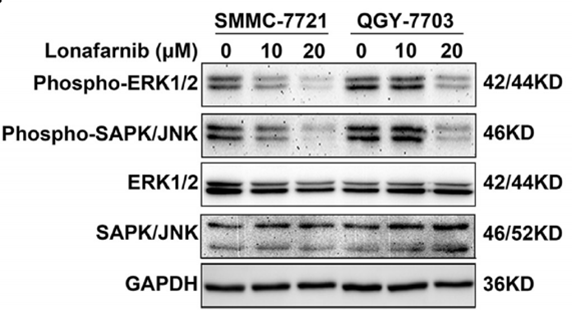
| Western blot | p-ERK / p-SAPK / p-JNK PARP / cleaved-PARP / pro-caspase3 / cleaved-caspase3 / Bcl-2 Cyclin D / CDK6 / CDK4 / SKP2 LC3A / LC3B |
|
29285232 |
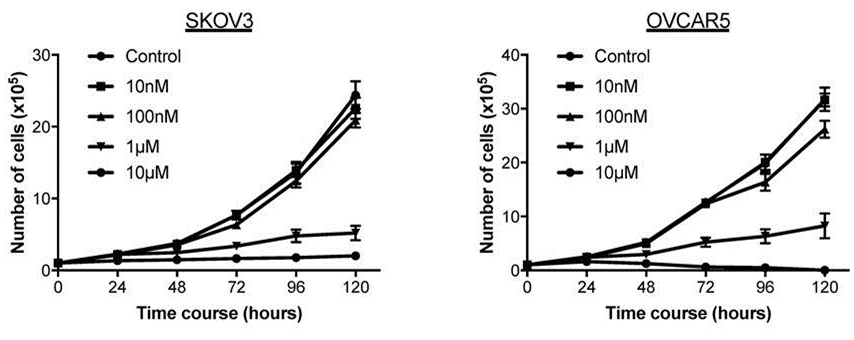
| Growth inhibition assay | Cell number Cell viability |
|
29069775 |
Klinische Studieninformationen
(Daten von https://clinicaltrials.gov, aktualisiert am 2024-05-22)
| NCT-Nummer | Rekrutierung | Erkrankungen | Sponsor/Kooperationspartner | Startdatum | Phasen |
|---|---|---|---|---|---|
| NCT05953545 | Not yet recruiting | Chronic Hepatitis Delta |
National Institute of Diabetes and Digestive and Kidney Diseases (NIDDK)|National Institutes of Health Clinical Center (CC) |
May 15 2024 | Phase 2 |
| NCT02579044 | Enrolling by invitation | Progeria |
Boston Children''s Hospital |
December 2015 | Phase 1|Phase 2 |
| NCT02430181 | Completed | Chronic Hepatitis D Infection |
Eiger BioPharmaceuticals |
November 2014 | Phase 2 |
| NCT01495585 | Completed | Hepatitis D |
National Institute of Diabetes and Digestive and Kidney Diseases (NIDDK)|National Institutes of Health Clinical Center (CC) |
December 2011 | Phase 2 |
| NCT01232881 | Terminated | Breast Cancer |
Hoosier Cancer Research Network|United States Department of Defense|Indiana University School of Medicine|Emory University |
August 2009 | -- |
| NCT00916747 | Active not recruiting | Progeria |
Boston Children''s Hospital|Schering-Plough|Merck Sharp & Dohme LLC|Eiger BioPharmaceuticals |
August 2009 | Phase 2 |
Technischer Support
Tel: +1-832-582-8158 Ext:3
Wenn Sie weitere Fragen haben, hinterlassen Sie bitte eine Nachricht.

Produkte sind nur für Forschungszwecke bestimmt. Nicht für den menschlichen Gebrauch. Wir verkaufen nicht an Patienten.
©Copyright 2013 Selleck Chemicals. Alle Rechte vorbehalten.