
nur für Forschungszwecke
SB505124 TGF-beta/Smad Inhibitor
Kat.-Nr.S2186
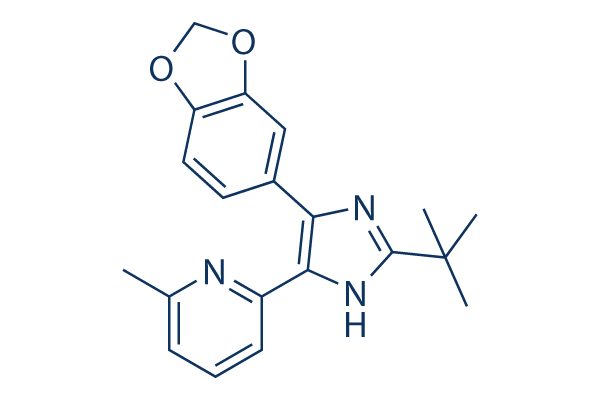
Chemische Struktur
Molekulargewicht: 335.4
Qualitätskontrolle
| Verwandte Ziele | PKC ROCK Bcr-Abl |
|---|---|
| Weitere TGF-beta/Smad Inhibitoren | SB431542 RepSox (E-616452) Vactosertib (TEW-7197) LDN-193189 A-83-01 LDN-193189 Dihydrochloride Galunisertib (LY2157299) SRI-011381 (C381) LY2109761 SIS3 Hydrochloride |
Zellkultur, Behandlung & Arbeitskonzentration
| Zelllinien | Assay-Typ | Konzentration | Inkubationszeit | Formulierung | Aktivitätsbeschreibung | PMID |
|---|---|---|---|---|---|---|
| Sf9 | Function assay | Inhibition of human recombinant GST-fused ALK5 expressed in Sf9 insect cells using casein as substrate by proprietary radioisotopic protein kinase assay, IC50=0.0349μM | 26483198 | |||
| HaCaT | Function assay | 24 hrs | Inhibition of ALK5 in human HaCaT cells assessed as inhibition of TGFbeta1-induced luciferase activity after 24 hrs by luciferase reporter gene assay, IC50=0.0438μM | 24786585 | ||
| Sf9 | Function assay | Inhibition of human recombinant GST-fused ALK5 expressed in Sf9 cells, IC50=0.054μM | 21435890 | |||
| Sf9 | Function assay | Inhibition of GST-fused recombinant human ALK5 expressed in baculovirus-infected insect Sf9 cells using casein as substrate by radioisotope-based assay, IC50=0.054μM | 24704197 | |||
| Sf9 | Function assay | Inhibition of human recombinant ALK5 expressed in insect Sf9 cells using casein as substrate by radioisotopic assay, IC50=0.054μM | 24786585 | |||
| Sf9 | Function assay | Inhibition of human recombinant GST-fused ALK5 expressed in Sf9 cells using casein as a substrate by radioisotopic protein kinase assay, IC50=0.0544μM | 23047226 | |||
| 4T1 | Function assay | 24 hrs | Inhibition of ALK5 in mouse 4T1 cells assessed as inhibition of TGFbeta1-induced luciferase activity after 24 hrs by luciferase reporter gene assay, IC50=0.0766μM | 24786585 | ||
| Sf9 | Function assay | Inhibition of human recombinant GST-fused ALK5 expressed in Sf9 cells, IC50=0.169μM | 20472445 | |||
| NMuMG | Function assay | 0.1 to 0.5 uM | 1 hr | Inhibition of ALK5 activity in mouse NMuMG cells assessed as TGFbeta-induced phosphorylation of Smad2 at 0.1 to 0.5 uM after 1 hr by Western blot analysis | 23047226 | |
| TC32 | qHTS assay | qHTS of pediatric cancer cell lines to identify multiple opportunities for drug repurposing: Primary screen for TC32 cells | 29435139 | |||
| SJ-GBM2 | qHTS assay | qHTS of pediatric cancer cell lines to identify multiple opportunities for drug repurposing: Primary screen for SJ-GBM2 cells | 29435139 | |||
| A673 | qHTS assay | qHTS of pediatric cancer cell lines to identify multiple opportunities for drug repurposing: Primary screen for A673 cells | 29435139 | |||
| SK-N-MC | qHTS assay | qHTS of pediatric cancer cell lines to identify multiple opportunities for drug repurposing: Primary screen for SK-N-MC cells | 29435139 | |||
| BT-37 | qHTS assay | qHTS of pediatric cancer cell lines to identify multiple opportunities for drug repurposing: Primary screen for BT-37 cells | 29435139 | |||
| Saos-2 | qHTS assay | qHTS of pediatric cancer cell lines to identify multiple opportunities for drug repurposing: Primary screen for Saos-2 cells | 29435139 | |||
| SK-N-SH | qHTS assay | qHTS of pediatric cancer cell lines to identify multiple opportunities for drug repurposing: Primary screen for SK-N-SH cells | 29435139 | |||
| NB1643 | qHTS assay | qHTS of pediatric cancer cell lines to identify multiple opportunities for drug repurposing: Primary screen for NB1643 cells | 29435139 | |||
| LAN-5 | qHTS assay | qHTS of pediatric cancer cell lines to identify multiple opportunities for drug repurposing: Primary screen for LAN-5 cells | 29435139 | |||
| BT-12 | qHTS assay | qHTS of pediatric cancer cell lines to identify multiple opportunities for drug repurposing: Primary screen for BT-12 cells | 29435139 | |||
| OHS-50 | qHTS assay | qHTS of pediatric cancer cell lines to identify multiple opportunities for drug repurposing: Primary screen for OHS-50 cells | 29435139 | |||
| RD | qHTS assay | qHTS of pediatric cancer cell lines to identify multiple opportunities for drug repurposing: Primary screen for RD cells | 29435139 | |||
| Rh41 | qHTS assay | qHTS of pediatric cancer cell lines to identify multiple opportunities for drug repurposing: Primary screen for Rh41 cells | 29435139 | |||
| A673 | qHTS assay | qHTS of pediatric cancer cell lines to identify multiple opportunities for drug repurposing: Confirmatory screen for A673 cells) | 29435139 | |||
| SK-N-MC | qHTS assay | qHTS of pediatric cancer cell lines to identify multiple opportunities for drug repurposing: Confirmatory screen for SK-N-MC cells | 29435139 | |||
| BT-12 | qHTS assay | qHTS of pediatric cancer cell lines to identify multiple opportunities for drug repurposing: Confirmatory screen for BT-12 cells | 29435139 | |||
| LAN-5 | qHTS assay | qHTS of pediatric cancer cell lines to identify multiple opportunities for drug repurposing: Confirmatory screen for LAN-5 cells | 29435139 | |||
| BT-37 | qHTS assay | qHTS of pediatric cancer cell lines to identify multiple opportunities for drug repurposing: Confirmatory screen for BT-37 cells | 29435139 | |||
| TC32 | qHTS assay | qHTS of pediatric cancer cell lines to identify multiple opportunities for drug repurposing: Confirmatory screen for TC32 cells | 29435139 | |||
| fibroblast cells | qHTS assay | qHTS of pediatric cancer cell lines to identify multiple opportunities for drug repurposing: Confirmatory screen for control Hh wild type fibroblast cells | 29435139 | |||
| Klicken Sie hier, um weitere experimentelle Daten zu Zelllinien anzuzeigen | ||||||
Chemische Informationen, Lagerung & Stabilität
| Molekulargewicht | 335.4 | Formel | C20H21N3O2 |
Lagerung (Ab dem Eingangsdatum) | |
|---|---|---|---|---|---|
| CAS-Nr. | 694433-59-5 | SDF herunterladen | Lagerung von Stammlösungen |
|
|
| Synonyme | N/A | Smiles | CC1=NC(=CC=C1)C2=C(N=C(N2)C(C)(C)C)C3=CC4=C(C=C3)OCO4 | ||
Löslichkeit
|
In vitro |
DMSO
: 67 mg/mL
(199.76 mM)
Ethanol : 67 mg/mL Water : Insoluble |
Molaritätsrechner
|
In vivo |
|||||
In-vivo-Formulierungsrechner (Klare Lösung)
Schritt 1: Geben Sie die untenstehenden Informationen ein (Empfohlen: Ein zusätzliches Tier zur Berücksichtigung von Verlusten während des Experiments)
Schritt 2: Geben Sie die In-vivo-Formulierung ein (Dies ist nur der Rechner, keine Formulierung. Bitte kontaktieren Sie uns zuerst, wenn es im Abschnitt "Löslichkeit" keine In-vivo-Formulierung gibt.)
Berechnungsergebnisse:
Arbeitskonzentration: mg/ml;
Methode zur Herstellung der DMSO-Stammlösung: mg Wirkstoff vorgelöst in μL DMSO ( Konzentration der Stammlösung mg/mL, Bitte kontaktieren Sie uns zuerst, wenn die Konzentration die DMSO-Löslichkeit der Wirkstoffcharge überschreitet. )
Methode zur Herstellung der In-vivo-Formulierung: Nehmen Sie μL DMSO Stammlösung, dann hinzufügenμL PEG300, mischen und klären, dann hinzufügenμL Tween 80, mischen und klären, dann hinzufügen μL ddH2O, mischen und klären.
Methode zur Herstellung der In-vivo-Formulierung: Nehmen Sie μL DMSO Stammlösung, dann hinzufügen μL Maisöl, mischen und klären.
Hinweis: 1. Bitte stellen Sie sicher, dass die Flüssigkeit klar ist, bevor Sie das nächste Lösungsmittel hinzufügen.
2. Achten Sie darauf, das/die Lösungsmittel der Reihe nach hinzuzufügen. Sie müssen sicherstellen, dass die bei der vorherigen Zugabe erhaltene Lösung eine klare Lösung ist, bevor Sie mit der Zugabe des nächsten Lösungsmittels fortfahren. Physikalische Methoden wie Vortex, Ultraschall oder ein heißes Wasserbad können zur Unterstützung des Lösens verwendet werden.
Wirkmechanismus
| Targets/IC50/Ki |
ALK5
(Cell-free assay) 47 nM
ALK4
(Cell-free assay) 129 nM
|
|---|---|
| In vitro |
SB505124 wird als reversibler ATP-kompetitiver und selektiver ALK-Inhibitor von ALK4 und ALK5 identifiziert. Diese Verbindung zeigt bei Konzentrationen von bis zu 100 μM über 48 Stunden keine Toxizität für renale epitheliale A498-Zellen und blockiert die TGF-β-induzierte Apoptose von FaO-Zellen und NRP 154-Zellen auf konzentrationsabhängige Weise. In humanen Nabelschnurvenenendothelzellen (HUVEC) blockiert diese Chemikalie (500 nM) die Veränderungen von TGF-β1 auf die F-Aktin-Assemblierung und verhindert die durch TGF-β induzierte ROS-Produktion. Durch die Hemmung der TGF-beta1-Signalübertragung führt dies zu einer verringerten (DFO)-induzierten Neurogenese. Eine aktuelle Studie zeigt, dass dieser Inhibitor die Migration und Invasion von Brustkrebs-MCF-7-M5-Zellen unterdrückt. |
| Kinase-Assay |
In-vitro-Proteinkinase-Assay
|
|
Kinase-Assays werden, wie von Laping et al., 2002 beschrieben, unter Verwendung der Kinasedomäne von ALK5 und des vollen N-terminal fusionierten GST-Smad3 durchgeführt. Kinase-Assays werden mit 65 nM GST-ALK5 und 184 nM GST-Smad3 in 50 mM HEPES, 5 mM MgCl2, 1 mM CaCl2, 1 mM Dithiothreitol und 3 μM ATP durchgeführt. Die Reaktionen werden 3 Stunden bei 30 °C mit 0,5 μCi [33P]γATP inkubiert. Phosphoryliertes Protein wird auf P-81-Papier eingefangen, mit 0,5 %iger Phosphorsäure gewaschen und durch Flüssigkeitsszintillation gezählt. Alternativ wird Smad3- oder Smad1-Protein auch auf FlashPlate Sterile Basic Microplates beschichtet. Kinase-Assays werden dann in FlashPlates mit denselben Assay-Bedingungen unter Verwendung entweder der Kinasedomäne von ALK5 mit Smad3 als Substrat oder der Kinasedomäne von ALK6 (BMP-Rezeptor) mit Smad1 als Substrat durchgeführt. Die Platten werden dreimal mit Phosphatpuffer gewaschen und mit TopCount gezählt.
|
|
| In vivo |
In einem Kaninchen-GFS-Modell senkte SB505124 den intraokularen Druck (IOP) und reduzierte die subkonjunktivale Zellinfiltration und Narbenbildung an der Operationsstelle im GFS. In (TAC)-behandelten Mäusen und FK12EC-KO-Mäusen verhindert diese Verbindung die Aktivierung endothelialer TGF-β-Rezeptoren und die Induktion renaler arteriolarer Hyalinose. |
Literatur |
|
Anwendungen
| Methoden | Biomarker | Bilder | PMID |
|---|---|---|---|
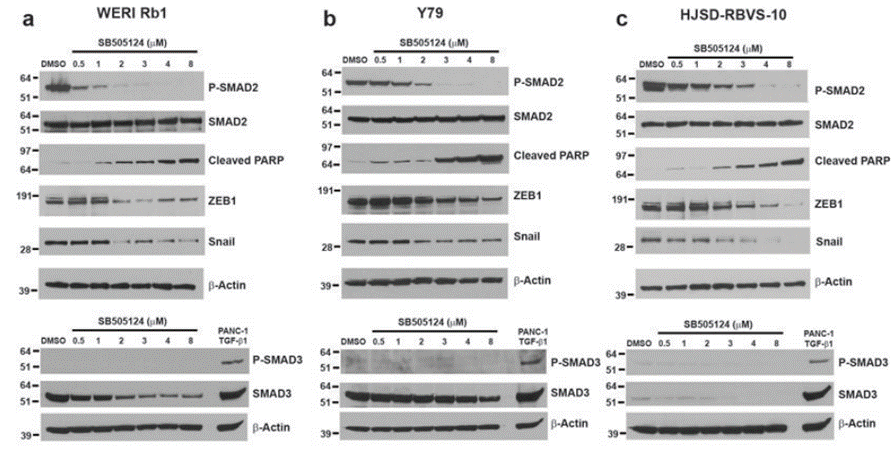
| Western blot | p-SMAD2 / SMAD2 / Cleaved PARP / ZEB1 / Snail |
|
30401983 |
Technischer Support
Tel: +1-832-582-8158 Ext:3
Wenn Sie weitere Fragen haben, hinterlassen Sie bitte eine Nachricht.

Produkte sind nur für Forschungszwecke bestimmt. Nicht für den menschlichen Gebrauch. Wir verkaufen nicht an Patienten.
©Copyright 2013 Selleck Chemicals. Alle Rechte vorbehalten.