
nur für Forschungszwecke
AT9283 JAK Inhibitor
Kat.-Nr.S1134
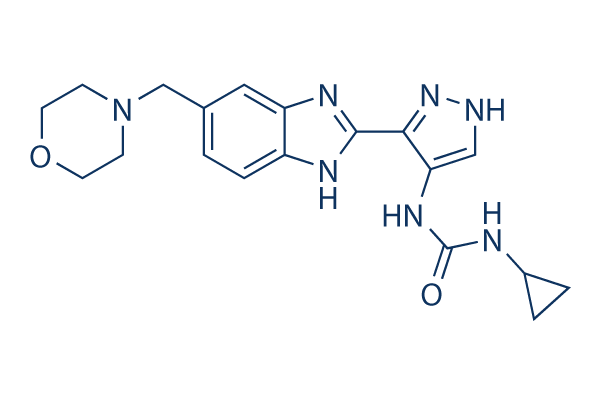
Chemische Struktur
Molekulargewicht: 381.43
Qualitätskontrolle
| Verwandte Ziele | EGFR STAT Pim |
|---|---|
| Weitere JAK Inhibitoren | BMS-986165 (Deucravacitinib) AZD1480 WP1066 Momelotinib (CYT387) Filgotinib (GLPG0634) Gandotinib (LY2784544) Pacritinib TG101209 Cerdulatinib (PRT062070) hydrochloride NVP-BSK805 2HCl |
Zellkultur, Behandlung & Arbeitskonzentration
| Zelllinien | Assay-Typ | Konzentration | Inkubationszeit | Formulierung | Aktivitätsbeschreibung | PMID |
|---|---|---|---|---|---|---|
| HCT116 | Cytotoxicity assay | 10 to 14 days | Cytotoxicity against human HCT116 cells assessed as number of colonies after 10 to 14 days by colony forming assay, IC50=0.012μM | 19143567 | ||
| HCT116 | Function assay | 10 mg/kg | Cmax in BALB/c mouse bearing human HCT116 cells at 10 mg/kg, po, Cmax=0.45μM | 19143567 | ||
| HCT116 | Function assay | 5 mg/kg | Cmax in BALB/c mouse bearing human HCT116 cells at 5 mg/kg, iv, Cmax=4.9μM | 19143567 | ||
| HCT116 | Function assay | 20 mg/kg | Cmax in BALB/c mouse bearing human HCT116 cells at 20 mg/kg, ip, Cmax=8.4μM | 19143567 | ||
| HT-29 | Antitumor assay | 72 hrs | Antitumor activity against human HT-29 cells after 72 hrs by MTT assay, IC50=0.383μM | 23664099 | ||
| A549 | Antitumor assay | 72 hrs | Antitumor activity against human A549 cells after 72 hrs by MTT assay, IC50=0.512μM | 23664099 | ||
| LoVo | Antitumor assay | 72 hrs | Antitumor activity against human LoVo cells after 72 hrs by MTT assay, IC50=0.553μM | 23664099 | ||
| K562 | Antitumor assay | 72 hrs | Antitumor activity against human K562 cells after 72 hrs by MTT assay, IC50=1.6μM | 23664099 | ||
| U937 | Antitumor assay | 72 hrs | Antitumor activity against human U937 cells after 72 hrs by MTT assay, IC50=6.7μM | 23664099 | ||
| BL21 (DE3) | Function assay | 30 mins | Inhibition of His6-tagged MELK catalytic domain (1 to 340 residues) (unknown origin) expressed in Escherichia coli BL21 (DE3) cells using Bcl-GL as substrate measured after 30 mins in presence of [gamma32P]ATP by liquid scintillation counting method, IC50=0.685μM | 28351607 | ||
| Sf9 | Function assay | Binding affinity to N-terminal TEV-cleavable hexa-histidine tagged human JAK2 JH1 domain (840 to 1132 residues) expressed in baculovirus-infected Sf9 cells by ITC assay, Kd=0.011μM | 28626521 | |||
| Sf9 | Function assay | Binding affinity to C-terminal thrombin-cleavable hexa-histidine tagged human JAK2 JH2 pseudokinase domain (536 to 812 residues) W659A/W777A/F794H mutant expressed in baculovirus-infected Sf9 cells by ITC assay, Kd=1.323μM | 28626521 | |||
| Sf9 | Function assay | 10 uM | 60 mins | Displacement of BODIPY-ATP from C-terminal thrombin-cleavable hexa-histidine tagged human JAK2 JH2 pseudokinase domain (536 to 812 residues) W659A/W777A/F794H mutant expressed in baculovirus-infected Sf9 cells at 10 uM after 60 mins by high-throughput flu | 28626521 | |
| HCT116 | Function assay | Inhibition of Aurora B kinase in human HCT116 cells assessed as reduction in polyploid phenotype, IC50=0.03μM | 28918096 | |||
| DAOY | qHTS assay | qHTS of pediatric cancer cell lines to identify multiple opportunities for drug repurposing: Primary screen for DAOY cells | 29435139 | |||
| SJ-GBM2 | qHTS assay | qHTS of pediatric cancer cell lines to identify multiple opportunities for drug repurposing: Primary screen for SJ-GBM2 cells | 29435139 | |||
| A673 | qHTS assay | qHTS of pediatric cancer cell lines to identify multiple opportunities for drug repurposing: Primary screen for A673 cells | 29435139 | |||
| SK-N-MC | qHTS assay | qHTS of pediatric cancer cell lines to identify multiple opportunities for drug repurposing: Primary screen for SK-N-MC cells | 29435139 | |||
| BT-37 | qHTS assay | qHTS of pediatric cancer cell lines to identify multiple opportunities for drug repurposing: Primary screen for BT-37 cells | 29435139 | |||
| NB-EBc1 | qHTS assay | qHTS of pediatric cancer cell lines to identify multiple opportunities for drug repurposing: Primary screen for NB-EBc1 cells | 29435139 | |||
| U-2 OS | qHTS assay | qHTS of pediatric cancer cell lines to identify multiple opportunities for drug repurposing: Primary screen for U-2 OS cells | 29435139 | |||
| Saos-2 | qHTS assay | qHTS of pediatric cancer cell lines to identify multiple opportunities for drug repurposing: Primary screen for Saos-2 cells | 29435139 | |||
| SK-N-SH | qHTS assay | qHTS of pediatric cancer cell lines to identify multiple opportunities for drug repurposing: Primary screen for SK-N-SH cells | 29435139 | |||
| NB1643 | qHTS assay | qHTS of pediatric cancer cell lines to identify multiple opportunities for drug repurposing: Primary screen for NB1643 cells | 29435139 | |||
| LAN-5 | qHTS assay | qHTS of pediatric cancer cell lines to identify multiple opportunities for drug repurposing: Primary screen for LAN-5 cells | 29435139 | |||
| BT-12 | qHTS assay | qHTS of pediatric cancer cell lines to identify multiple opportunities for drug repurposing: Primary screen for BT-12 cells | 29435139 | |||
| Rh18 | qHTS assay | qHTS of pediatric cancer cell lines to identify multiple opportunities for drug repurposing: Primary screen for Rh18 cells | 29435139 | |||
| OHS-50 | qHTS assay | qHTS of pediatric cancer cell lines to identify multiple opportunities for drug repurposing: Primary screen for OHS-50 cells | 29435139 | |||
| RD | qHTS assay | qHTS of pediatric cancer cell lines to identify multiple opportunities for drug repurposing: Primary screen for RD cells | 29435139 | |||
| MG 63 (6-TG R) | qHTS assay | qHTS of pediatric cancer cell lines to identify multiple opportunities for drug repurposing: Primary screen for MG 63 (6-TG R) cells | 29435139 | |||
| fibroblast cells | qHTS assay | qHTS of pediatric cancer cell lines to identify multiple opportunities for drug repurposing: Primary screen for control Hh wild type fibroblast cells | 29435139 | |||
| Rh41 | qHTS assay | qHTS of pediatric cancer cell lines to identify multiple opportunities for drug repurposing: Primary screen for Rh41 cells | 29435139 | |||
| SK-N-MC | qHTS assay | qHTS of pediatric cancer cell lines to identify multiple opportunities for drug repurposing: Confirmatory screen for SK-N-MC cells | 29435139 | |||
| Klicken Sie hier, um weitere experimentelle Daten zu Zelllinien anzuzeigen | ||||||
Chemische Informationen, Lagerung & Stabilität
| Molekulargewicht | 381.43 | Formel | C19H23N7O2 |
Lagerung (Ab dem Eingangsdatum) | |
|---|---|---|---|---|---|
| CAS-Nr. | 896466-04-9 | SDF herunterladen | Lagerung von Stammlösungen |
|
|
| Synonyme | N/A | Smiles | C1CC1NC(=O)NC2=C(NN=C2)C3=NC4=C(N3)C=C(C=C4)CN5CCOCC5 | ||
Löslichkeit
|
In vitro |
DMSO
: 76 mg/mL
(199.25 mM)
Ethanol : 25 mg/mL Water : Insoluble |
Molaritätsrechner
|
In vivo |
|||||
In-vivo-Formulierungsrechner (Klare Lösung)
Schritt 1: Geben Sie die untenstehenden Informationen ein (Empfohlen: Ein zusätzliches Tier zur Berücksichtigung von Verlusten während des Experiments)
Schritt 2: Geben Sie die In-vivo-Formulierung ein (Dies ist nur der Rechner, keine Formulierung. Bitte kontaktieren Sie uns zuerst, wenn es im Abschnitt "Löslichkeit" keine In-vivo-Formulierung gibt.)
Berechnungsergebnisse:
Arbeitskonzentration: mg/ml;
Methode zur Herstellung der DMSO-Stammlösung: mg Wirkstoff vorgelöst in μL DMSO ( Konzentration der Stammlösung mg/mL, Bitte kontaktieren Sie uns zuerst, wenn die Konzentration die DMSO-Löslichkeit der Wirkstoffcharge überschreitet. )
Methode zur Herstellung der In-vivo-Formulierung: Nehmen Sie μL DMSO Stammlösung, dann hinzufügenμL PEG300, mischen und klären, dann hinzufügenμL Tween 80, mischen und klären, dann hinzufügen μL ddH2O, mischen und klären.
Methode zur Herstellung der In-vivo-Formulierung: Nehmen Sie μL DMSO Stammlösung, dann hinzufügen μL Maisöl, mischen und klären.
Hinweis: 1. Bitte stellen Sie sicher, dass die Flüssigkeit klar ist, bevor Sie das nächste Lösungsmittel hinzufügen.
2. Achten Sie darauf, das/die Lösungsmittel der Reihe nach hinzuzufügen. Sie müssen sicherstellen, dass die bei der vorherigen Zugabe erhaltene Lösung eine klare Lösung ist, bevor Sie mit der Zugabe des nächsten Lösungsmittels fortfahren. Physikalische Methoden wie Vortex, Ultraschall oder ein heißes Wasserbad können zur Unterstützung des Lösens verwendet werden.
Wirkmechanismus
| Targets/IC50/Ki |
JAK3
(Cell-free assay) 1.1 nM
JAK2
(Cell-free assay) 1.2 nM
Aurora A
(Cell-free assay) ~3.0 nM
Aurora B
(Cell-free assay) ~3.0 nM
Abl1 (T315I)
(Cell-free assay) 4 nM
GSK-3β
(Cell-free assay) 1 nM-10 nM
FGFR2
(Cell-free assay) 1-10 nM
VEGFR3/FLT4
(Cell-free assay) 1 nM-10 nM
Mer
(Cell-free assay) 1 nM-10 nM
RET
(Cell-free assay) 1 nM-10 nM
RSK2
(Cell-free assay) 1 nM-10 nM
RSK3
(Cell-free assay) 1 nM-10 nM
TYK2
(Cell-free assay) 1 nM-10 nM
YES
(Cell-free assay) 1 nM-10 nM
Abl (Q252H)
(Cell-free assay) 10 nM-30 nM
DRAK1
(Cell-free assay) 10 nM-30 nM
FGFR1
(Cell-free assay) 10 nM-30 nM
FGFR1 (V561M)
(Cell-free assay) 10 nM-30 nM
FGFR2 (N549H)
(Cell-free assay) 10 nM-30 nM
FGFR3
(Cell-free assay) 10 nM-30 nM
VEGFR1/FLT1
(Cell-free assay) 10 nM-30 nM
FLT3
(Cell-free assay) 10 nM-30 nM
PDGFRα (D842V)
(Cell-free assay) 10 nM-30 nM
PDK-1
(Cell-free assay) 10 nM-30 nM
PKCμ
(Cell-free assay) 10 nM-30 nM
RSK4
(Cell-free assay) 10 nM-30 nM
Src (T341M)
(Cell-free assay) 10 nM-30 nM
VEGFR2
(Cell-free assay) 10 nM-30 nM
|
|---|---|
| In vitro |
AT9283 führt zu einem klaren polyploiden Phänotyp, indem es die Aktivität der Aurora B Kinase in HCT116-Zellen mit einer IC50 von 30 nM hemmt. Darüber hinaus hemmt diese Verbindung auch die Koloniebildung von HCT116. |
| Kinase-Assay |
Aurora A- und Aurora B Kinase-Assays
|
|
Assays für Aurora A und B werden im DELFIA-Format durchgeführt. Das Aurora A-Enzym wird mit AT9283 und 3 μM Cross-Tide-Substrat (Biotin-CGPKGPGRRGRRRTSSFAEG) in 10 mM MOPS, pH 7, 0,1 mg/mL BSA, 0,001 % Brij-35, 0,5 % Glycerin, 0,2 mM EDTA, 10 mM MgCl2, 0,01 % β-Mercaptoethanol, 15 μM ATP und 2,5 % DMSO inkubiert. Das Aurora B-Enzym wird mit dieser Verbindung, 3 μM des oben genannten Substrats in 25 mM Tris, pH 8,5, 5 mM MgCl2, 0,1 mg/mL BSA, 0,025 % Tween-20, 1 mM DTT, 15 μM ATP und 2,5 % DMSO inkubiert. Die Reaktionen werden 60 Minuten für Aurora A und 45-90 Minuten für Aurora B durchgeführt, bevor sie mit EDTA abgebrochen werden. Die Reaktionsgemische werden dann auf eine Neutravidin-beschichtete Platte übertragen, und das phosphorylierte Peptid wird mittels eines phospho-spezifischen Antikörpers und eines Europium-markierten sekundären Antikörpers unter Verwendung von zeitaufgelöster Fluoreszenz (Anregung, 337 nm; Emission, 620 nm) quantifiziert. Die IC50-Werte für die Kontrollverbindungen betragen 92 nM (Aurora A-Assay) und 17 nM (Aurora B).
|
|
| In vivo |
Bei HCT116-Mäusen mit menschlichem Kolonkarzinom-Xenotransplantat führt die AT9283-Behandlung (15 mg/kg und 20 mg/kg) über 16 Tage zu einer signifikanten Hemmung des Tumorwachstums von 67 % bzw. 76 %. Darüber hinaus weist diese Verbindung auch eine signifikant längere Halbwertszeit in Tumoren (2,5 Stunden) im Vergleich zum Plasma (0,5 Stunden) und eine moderate orale Bioverfügbarkeit bei Mäusen (Fp.o. = 24 %) auf. |
Literatur |
|
Anwendungen
| Methoden | Biomarker | Bilder | PMID |
|---|---|---|---|
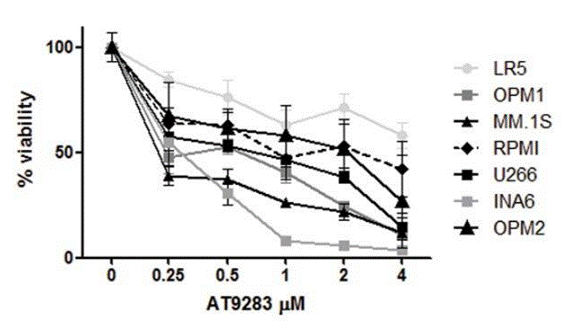
| Growth inhibition assay | Cell viability |
|
21430070 |
Klinische Studieninformationen
(Daten von https://clinicaltrials.gov, aktualisiert am 2024-05-22)
| NCT-Nummer | Rekrutierung | Erkrankungen | Sponsor/Kooperationspartner | Startdatum | Phasen |
|---|---|---|---|---|---|
| NCT01145989 | Completed | Multiple Myeloma |
NCIC Clinical Trials Group|Astex Pharmaceuticals Inc.|Canadian Cancer Trials Group |
February 15 2011 | Phase 2 |
| NCT00443976 | Completed | Non-Hodgkins Lymphoma|Unspecified Adult Solid Tumor Protocol Specific |
NCIC Clinical Trials Group|Astex Pharmaceuticals Inc.|Canadian Cancer Trials Group |
January 30 2007 | Phase 1 |
Technischer Support
Tel: +1-832-582-8158 Ext:3
Wenn Sie weitere Fragen haben, hinterlassen Sie bitte eine Nachricht.

Produkte sind nur für Forschungszwecke bestimmt. Nicht für den menschlichen Gebrauch. Wir verkaufen nicht an Patienten.
©Copyright 2013 Selleck Chemicals. Alle Rechte vorbehalten.