
nur für Forschungszwecke
Pacritinib JAK Inhibitor
Kat.-Nr.S8057
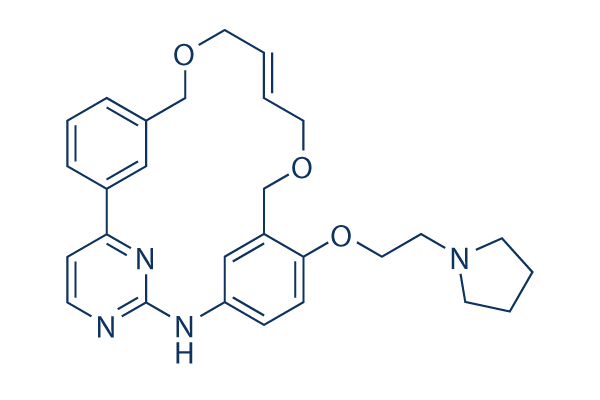
Chemische Struktur
Molekulargewicht: 472.58
Qualitätskontrolle
Produkte, die oft zusammen verwendet werden mit Pacritinib
| Verwandte Ziele | EGFR STAT Pim |
|---|---|
| Weitere JAK Inhibitoren | BMS-986165 (Deucravacitinib) AZD1480 WP1066 Momelotinib (CYT387) Filgotinib (GLPG0634) AT9283 Gandotinib (LY2784544) TG101209 Cerdulatinib (PRT062070) hydrochloride NVP-BSK805 2HCl |
Zellkultur, Behandlung & Arbeitskonzentration
| Zelllinien | Assay-Typ | Konzentration | Inkubationszeit | Formulierung | Aktivitätsbeschreibung | PMID |
|---|---|---|---|---|---|---|
| MOLM14 | Antiproliferative assay | 48 hrs | Antiproliferative activity against human MOLM14 cells harboring FLT3-ITD mutant after 48 hrs by CellTiter-Glo assay, IC50 = 0.079 μM. | 27541357 | ||
| MCF7 | Antiproliferative assay | 72 hrs | Antiproliferative activity against human MCF7 cells after 72 hrs by MTT assay, IC50 = 0.29 μM. | 27541357 | ||
| HL60 | Antiproliferative assay | 48 hrs | Antiproliferative activity against human HL60 cells after 48 hrs by CellTiter-Glo assay, IC50 = 0.52 μM. | 27541357 | ||
| KMS-12-BM | Antiproliferative assay | 48 hrs | Antiproliferative activity against human KMS-12-BM cells after 48 hrs by CellTiter-Glo assay, IC50 = 0.75 μM. | 27541357 | ||
| PC3 | Antiproliferative assay | 48 hrs | Antiproliferative activity against human PC3 cells after 48 hrs by CellTiter-Glo assay, IC50 = 0.77 μM. | 27541357 | ||
| Jurkat | Antiproliferative assay | 48 hrs | Antiproliferative activity against human Jurkat cells after 48 hrs by CellTiter-Glo assay, IC50 = 0.839 μM. | 27541357 | ||
| MCF7 | Antiproliferative assay | 48 hrs | Antiproliferative activity against human MCF7 cells after 48 hrs by CellTiter-Glo assay, IC50 = 0.85 μM. | 27541357 | ||
| HCT116 | Antiproliferative assay | 72 hrs | Antiproliferative activity against human HCT116 cells after 72 hrs by MTT assay, IC50 = 0.88 μM. | 27541357 | ||
| Jurkat | Antiproliferative assay | Antiproliferative activity against human Jurkat cells, IC50 = 1.09 μM. | 27541357 | |||
| HEL 92.1.7 | Antiproliferative assay | 36 hrs | Antiproliferative activity against HEL 92.1.7 cells harboring JAK2 V617F mutant after 36 hrs by PrestoBlue dye based assay, IC50 = 1.17 μM. | 27541357 | ||
| OPM2 | Antiproliferative assay | 48 hrs | Antiproliferative activity against human OPM2 cells after 48 hrs by CellTiter-Glo assay, IC50 = 1.21 μM. | 27541357 | ||
| KHYG | Antiproliferative assay | 48 hrs | Antiproliferative activity against human KHYG cells after 48 hrs by CellTiter-Glo assay, IC50 = 1.24 μM. | 27541357 | ||
| KG1 | Antiproliferative assay | 48 hrs | Antiproliferative activity against human KG1 cells after 48 hrs by CellTiter-Glo assay, IC50 = 1.48 μM. | 27541357 | ||
| NKYS | Antiproliferative assay | 48 hrs | Antiproliferative activity against human NKYS cells after 48 hrs by CellTiter-Glo assay, IC50 = 1.6 μM. | 27541357 | ||
| HCT116 | Antiproliferative assay | 48 hrs | Antiproliferative activity against human HCT116 cells after 48 hrs by CellTiter-Glo assay, IC50 = 1.69 μM. | 27541357 | ||
| HEL 92.1.7 | Antiproliferative assay | 48 hrs | Antiproliferative activity against HEL 92.1.7 cells harboring JAK2 V617F mutant after 48 hrs by CellTiter-Glo assay, IC50 = 1.726 μM. | 27541357 | ||
| HL60 | Antiproliferative assay | Antiproliferative activity against human HL60 cells, IC50 = 1.78 μM. | 27541357 | |||
| PC3 | Antiproliferative assay | 72 hrs | Antiproliferative activity against human PC3 cells after 72 hrs by MTT assay, IC50 = 2.41 μM. | 27541357 | ||
| MDA-MB-231 | Antiproliferative assay | 72 hrs | Antiproliferative activity against human MDA-MB-231 cells after 72 hrs by MTT assay, IC50 = 2.43 μM. | 27541357 | ||
| TAMH | Antiproliferative assay | 24 hrs | Antiproliferative activity against mouse TAMH cells after 24 hrs by CellTiter-Glo assay, IC50 = 3.68 μM. | 27541357 | ||
| MOLM14 | Antiproliferative assay | 48 hrs | Antiproliferative activity against human MOLM14 cells after 48 hrs by CellTiter-Glo luminescent assay, IC50 = 0.079 μM. | 28953386 | ||
| KMS-12-BM | Antiproliferative assay | 48 hrs | Antiproliferative activity against human KMS-12-BM cells after 48 hrs by CellTiter-Glo luminescent assay, IC50 = 0.75 μM. | 28953386 | ||
| Jurkat | Antiproliferative assay | Antiproliferative activity against human Jurkat cells, IC50 = 1.09 μM. | 28953386 | |||
| HEL 92.1.7 | Antiproliferative assay | 36 hrs | Antiproliferative activity against human HEL 92.1.7 cells after 36 hrs by PrestoBlue dye based assay, IC50 = 1.17 μM. | 28953386 | ||
| OPM2 | Antiproliferative assay | 48 hrs | Antiproliferative activity against human OPM2 cells after 48 hrs by CellTiter-Glo luminescent assay, IC50 = 1.21 μM. | 28953386 | ||
| KHYG | Antiproliferative assay | 48 hrs | Antiproliferative activity against human KHYG cells after 48 hrs by CellTiter-Glo luminescent assay, IC50 = 1.24 μM. | 28953386 | ||
| KG1 | Antiproliferative assay | 48 hrs | Antiproliferative activity against human KG1 cells after 48 hrs by CellTiter-Glo luminescent assay, IC50 = 1.48 μM. | 28953386 | ||
| NKYS | Antiproliferative assay | 48 hrs | Antiproliferative activity against human NKYS cells after 48 hrs by CellTiter-Glo luminescent assay, IC50 = 1.6 μM. | 28953386 | ||
| HL60 | Antiproliferative assay | Antiproliferative activity against human HL60 cells, IC50 = 1.78 μM. | 28953386 | |||
| AC10 | Cytotoxicity assay | 24 hrs | Cytotoxicity against human AC10 cells assessed as cell viability after 24 hrs by CellTiter-Glo assay, IC50 = 2.02 μM. | 28953386 | ||
| TAMH | Cytotoxicity assay | 24 hrs | Cytotoxicity against TAMH cells assessed as cell viability after 24 hrs by CellTiter-Glo assay, IC50 = 3.68 μM. | 28953386 | ||
| KMS-12-BM | Function assay | 2 uM | 3 hrs | Inhibition of JAK2 in IL-6-stimulated human KMS-12-BM cells assessed as suppression of STAT3 phosphorylation at TY705 residue at 2 uM pretreated for 3 hrs followed by IL-6 stimulation by immunoblot method | 27541357 | |
| MOLM14 | Function assay | 0.1 uM | 3 hrs | Inhibition of JAK2 in IL-6-stimulated human MOLM14 cells assessed as suppression of STAT3 phosphorylation at TY705 residue at 0.1 uM pretreated for 3 hrs followed by IL-6 stimulation by immunoblot method | 27541357 | |
| HEL 92.1.7 | Function assay | 1 hr | Induction of JAK2 V617F mutant phosphorylation at Y1007/8 residues in HEL 92.1.7 cells after 1 hr by immunoblot method | 27541357 | ||
| Klicken Sie hier, um weitere experimentelle Daten zu Zelllinien anzuzeigen | ||||||
Chemische Informationen, Lagerung & Stabilität
| Molekulargewicht | 472.58 | Formel | C28H32N4O3 |
Lagerung (Ab dem Eingangsdatum) | |
|---|---|---|---|---|---|
| CAS-Nr. | 937272-79-2 | SDF herunterladen | Lagerung von Stammlösungen |
|
|
| Synonyme | SB1518 | Smiles | C1CCN(C1)CCOC2=C3COCC=CCOCC4=CC(=CC=C4)C5=NC(=NC=C5)NC(=C3)C=C2 | ||
Löslichkeit
|
In vitro |
DMSO
: 11 mg/mL
(23.27 mM)
Water : Insoluble Ethanol : Insoluble |
Molaritätsrechner
|
In vivo |
|||||
In-vivo-Formulierungsrechner (Klare Lösung)
Schritt 1: Geben Sie die untenstehenden Informationen ein (Empfohlen: Ein zusätzliches Tier zur Berücksichtigung von Verlusten während des Experiments)
Schritt 2: Geben Sie die In-vivo-Formulierung ein (Dies ist nur der Rechner, keine Formulierung. Bitte kontaktieren Sie uns zuerst, wenn es im Abschnitt "Löslichkeit" keine In-vivo-Formulierung gibt.)
Berechnungsergebnisse:
Arbeitskonzentration: mg/ml;
Methode zur Herstellung der DMSO-Stammlösung: mg Wirkstoff vorgelöst in μL DMSO ( Konzentration der Stammlösung mg/mL, Bitte kontaktieren Sie uns zuerst, wenn die Konzentration die DMSO-Löslichkeit der Wirkstoffcharge überschreitet. )
Methode zur Herstellung der In-vivo-Formulierung: Nehmen Sie μL DMSO Stammlösung, dann hinzufügenμL PEG300, mischen und klären, dann hinzufügenμL Tween 80, mischen und klären, dann hinzufügen μL ddH2O, mischen und klären.
Methode zur Herstellung der In-vivo-Formulierung: Nehmen Sie μL DMSO Stammlösung, dann hinzufügen μL Maisöl, mischen und klären.
Hinweis: 1. Bitte stellen Sie sicher, dass die Flüssigkeit klar ist, bevor Sie das nächste Lösungsmittel hinzufügen.
2. Achten Sie darauf, das/die Lösungsmittel der Reihe nach hinzuzufügen. Sie müssen sicherstellen, dass die bei der vorherigen Zugabe erhaltene Lösung eine klare Lösung ist, bevor Sie mit der Zugabe des nächsten Lösungsmittels fortfahren. Physikalische Methoden wie Vortex, Ultraschall oder ein heißes Wasserbad können zur Unterstützung des Lösens verwendet werden.
Wirkmechanismus
| Merkmale |
Dual JAK2/FLT3 inhibitor that has progressed to Phase III clinical trials for treatment of Myelofibrosis.
|
|---|---|
| Targets/IC50/Ki |
FLT3 (D835Y)
(Cell-free assay) 6 nM
JAK2 (V617F)
(Cell-free assay) 19 nM
FLT3
(Cell-free assay) 22 nM
JAK2
(Cell-free assay) 23 nM
TYK2
(Cell-free assay) 50 nM
JAK3
(Cell-free assay) 520 nM
|
| In vitro |
Pacritinib ist ein potenter Inhibitor sowohl des Wildtyp-JAK2 als auch des JAK2V617F-Mutanten (IC50 = 19 nM), der bei Patienten mit MPD häufig vorkommt. Im Vergleich zu JAK2 ist diese Verbindung zwei-fach weniger potent gegen TYK2 (IC50 = 50 nM), 23-fach weniger potent gegen JAK3 (IC50 = 520 nM) und 56-fach weniger potent gegen JAK1 (IC50 = 1280 nM). Es durchdringt Zellen effektiv, um Signalwege stromabwärts von JAK2 zu modulieren, egal ob Agonisten-aktiviert oder mutationsaktiviert. Diese Chemikalie induziert Apoptose, Zellzyklusarrest und antiproliferative Effekte in JAK2WT- und JAK2V617F-abhängigen Zellen. Es hemmt die Zellproliferation von Karpas 1106P und Ba/F3-JAK2V617F mit IC50 von 348 bzw. 160 nM. Es hemmt das endogene Koloniewachstum, das aus erythroiden und myeloischen Vorläuferzellen stammt, mit IC50 von 63 bzw. 53 nM.
SB1518 hemmt auch FLT3 und seinen Mutanten FLT3-D835Y (IC50 = 6 nM). Diese Verbindung hemmt die FLT3-Phosphorylierung und die nachgeschaltete STAT-, MAPK- und PI3K-Signalübertragung in FLT3-internal-tandem duplication (ITD), FLT3-wt-Zellen und primären AML-Blasten. Ihre Behandlung führt zu einer dosisabhängigen Abnahme von pFLT3, pSTAT5, pERK1/2 und pAkt in FLT3-ITD-tragenden MV4-11-Zellen mit IC50 von 80, 40, 33 bzw. 29 nM. Die Behandlung der primären AML-Blasten mit dieser Chemikalie über 3 h führt zu einer dosisabhängigen Abnahme von pFLT3, pSTAT3 und pSTAT5 mit einer IC50 unter 0,5 μM. Es induziert Apoptose, Zellzyklusarrest und antiproliferative Effekte in FLT3-Mutanten- und FLT3-wt-Zellen. Es hemmt die Zellproliferation von FLT3-ITD-tragenden Zellen MV4-11 und primären AML-Blasten mit IC50s von 47 nM bzw. 0,19-1,3 μM.
|
| Kinase-Assay |
Kinaseaktivitätsassays
|
|
Alle Assays werden in weißen 384-Well-Mikrotiterplatten durchgeführt. Die Verbindungen werden in 8 Schritten 4-fach seriell verdünnt, beginnend bei 10 μM. Die Reaktionsmischung bestand aus 25 μL Assay-Puffer (50 mM HEPES pH 7,5, 10 mM MgCl2, 5 mM MnCl2, 1 mM DTT, 0,1 mM Na3VO4, 5 mM β-Glycerolphosphat). Für FLT3-Assays enthielt die Reaktion 2,0 μg/mL FLT3-Enzym, 5 μM Poly(Glu,Tyr)-Substrat und 4 μM ATP. Für JAK1-Assays enthielt die Reaktion 2,5 μg/mL JAK1-Enzym, 10 μM Poly(Glu,Ala,Tyr)-Substrat und 1,0 μM ATP. Für JAK2-Assays enthielt die Reaktion 0,35 μg/mL JAK2-Enzym, 10 μM Poly(Glu,Ala,Tyr)-Substrat und 0,15 μM ATP. Für JAK3-Assays enthielt die Reaktion 3,5 μg/mL JAK3-Enzym, 10 μM Poly(Glu,Ala,Tyr)-Substrat und 6,0 μM ATP. Für TYK2-Assays enthielt die Reaktion 2,5 μg/mL TYK2-Enzym, 10 μM Poly(Glu,Ala,Tyr)-Substrat und 0,15 μM ATP. Die Reaktion wird 2 Stunden bei Raumtemperatur inkubiert, bevor 13 μL PKLight®-Detektionsreagenz hinzugefügt werden. Nach 10 Minuten Inkubation werden die lumineszenten Signale auf einem Multi-Label-Plattenleser abgelesen.
|
|
| In vivo |
Pacritinib, verabreicht mit 150 mg/kg p.o. q.d. an ein JAK2V617F-abhängiges Xenograft-Modell, verbessert signifikant die Symptome von Splenomegalie und Hepatomegalie, mit 60% Normalisierung des Milzgewichts und 92% Normalisierung des Lebergewichts und wird gut vertragen ohne signifikanten Gewichtsverlust oder hämatologische Toxizitäten, einschließlich Thrombozytopenie und Anämie. Diese Verbindung induziert eine dosisabhängige Hemmung des Tumorwachstums des JAK2V617F-abhängigen SET-2-Xenograft-Modells (40% für 75 mg/kg und 61% für 150 mg/kg).
Diese Chemikalie ist wirksam in FLT3-ITD-tragenden MV4-11-Xenograft-Modellen. Einmal täglich über 21 aufeinanderfolgende Tage behandelt, induziert sie eine dosisabhängige Hemmung des Tumorwachstums (38% für 25 mg/kg, 92% für 50 mg/kg und 121% für 100 mg/kg). Eine vollständige Regression wird bei 3/10 und 8/8 Mäusen für die Gruppen von 50 bzw. 100 mg/kg/Tag beobachtet.
|
Literatur |
|
Anwendungen
| Methoden | Biomarker | Bilder | PMID |
|---|---|---|---|
| Western blot | pFLT3 / FLT3 / pSTAT5 / STAT5 / GAPDH p-STAT3Y705 / STAT3 / ACTIN / PARP pSTAT3 Y705 / STAT3 / β-Tubulin pSTAT3 Y705 / STAT3 / Actin / MAPK / p-AKT S473 / AKT pFLT3(Y591) / pSTAT5(Y694) / pERK1、2 / pAkt(T308) / β-Actin pFLT3(Y591) / pSTAT5(Y694) / pERK1、2 / pAkt(T308) / β-Actin |

|
31102119 |
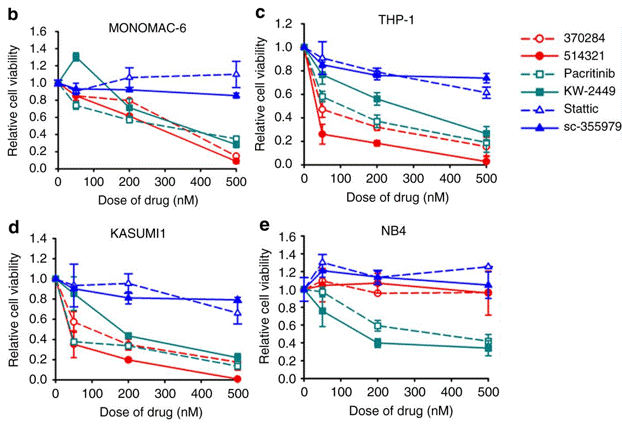
| Growth inhibition assay | Cell viability |
|
29235481 |
| IHC | HE staining of liver sections HE staining of skin grafts p-STAT3 / Ki-67 / mCD31 / VEGF-A / Bcl-2 |

|
29785143 |
| Immunofluorescence | Phalloidin TUNEL |

|
27334834 |
Klinische Studieninformationen
(Daten von https://clinicaltrials.gov, aktualisiert am 2024-05-22)
| NCT-Nummer | Rekrutierung | Erkrankungen | Sponsor/Kooperationspartner | Startdatum | Phasen |
|---|---|---|---|---|---|
| NCT06303193 | Not yet recruiting | Myelodysplastic Syndromes |
National Cancer Institute (NCI)|National Institutes of Health Clinical Center (CC) |
May 15 2024 | Phase 1|Phase 2 |
| NCT06052618 | Not yet recruiting | KSHV Inflammatory Cytokine Syndrome (KICS)|Kaposi Sarcoma Herpesvirus -Associated Multicentric Castleman Disease |
National Cancer Institute (NCI)|National Institutes of Health Clinical Center (CC) |
May 15 2024 | Phase 2 |
| NCT06159491 | Not yet recruiting | Chronic Myelomonocytic Leukemia |
Douglas Tremblay|Sobi Inc.|Icahn School of Medicine at Mount Sinai |
January 2 2024 | Phase 1|Phase 2 |
| NCT05531786 | Recruiting | Graft vs Host Disease |
National Cancer Institute (NCI)|National Institutes of Health Clinical Center (CC) |
March 6 2023 | Phase 1|Phase 2 |
Technischer Support
Tel: +1-832-582-8158 Ext:3
Wenn Sie weitere Fragen haben, hinterlassen Sie bitte eine Nachricht.

Produkte sind nur für Forschungszwecke bestimmt. Nicht für den menschlichen Gebrauch. Wir verkaufen nicht an Patienten.
©Copyright 2013 Selleck Chemicals. Alle Rechte vorbehalten.