
nur für Forschungszwecke
BIBR 1532 Telomerase Inhibitor
Kat.-Nr.S1186
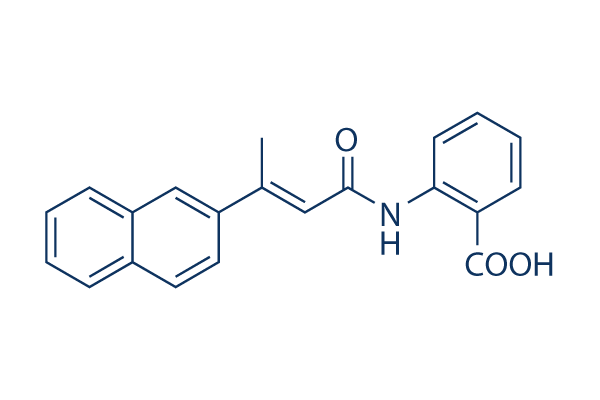
Chemische Struktur
Molekulargewicht: 331.36
Qualitätskontrolle
| Verwandte Ziele | HDAC PARP ATM/ATR DNA-PK WRN DNA/RNA Synthesis Topoisomerase PPAR Sirtuin Casein Kinase |
|---|---|
| Weitere Telomerase Inhibitoren | EGCG ((-)-Epigallocatechin Gallate) Costunolide RHPS 4 methosulfate Cycloastragenol Cyclogalegenol Epitalon MST-312 L-778123 hydrochloride TAC (TERT Activator-1) Braco-19 trihydrochloride |
Zellkultur, Behandlung & Arbeitskonzentration
| Zelllinien | Assay-Typ | Konzentration | Inkubationszeit | Formulierung | Aktivitätsbeschreibung | PMID |
|---|---|---|---|---|---|---|
| human HeLa cells | Function assay | 2 h | Inhibition of telomerase in human HeLa cells after 2 hrs by [alpha-32P]dGTP incorporation assay, IC50=93 nM | 22413845 | ||
| human MDA-MB-231 cells | Function assay | 24 h | Inhibition of telomerase in human MDA-MB-231 cells after 24 hrs by TRAP-PCR-ELISA, IC50=0.17 μM | 25965778 | ||
| human MGC803 cells | Function assay | 24 h | Inhibition of telomerase in human MGC803 cells after 24 hrs by TRAP-PCR-ELISA, IC50=0.28 μM | 25554922 | ||
| HeLa | Function assay | 15 mins | Inhibition of telomerase in human HeLa cells using 5'-AAT CCG TCG AGC AGA GTT-3' as substrate incubated for 15 mins prior to extension reaction by telomeric repeat amplification protocol, IC50=3.6μM | 22413845 | ||
| HeLa | Function assay | 15 mins | Inhibition of telomerase in human HeLa cells using 5'-AAT CCG TCG AGC AGA GTT-3' as substrate incubated for 15 mins prior to extension reaction followed by compound washout by spin-telomeric repeat amplification protocol, IC50=4.6μM | 22413845 | ||
| HeLa | Function assay | 30 mins | Inhibition of human telomerase isolated from human HeLa cells nuclear extracts expressed in insect cells assessed as [33P]dCMP incorporation after 30 mins by liquid scintillation counting analysis, IC50=0.093μM | 24053596 | ||
| HEK293 | Function assay | Inhibition of human telomerase activity isolated from HEK293 cells assessed as reduction in dNTP incorporation using 5'-biotinylated AATCCGTCGAGCAGAGTT primer by flash plate assay, IC50=3.6μM | 27657809 | |||
| Klicken Sie hier, um weitere experimentelle Daten zu Zelllinien anzuzeigen | ||||||
Chemische Informationen, Lagerung & Stabilität
| Molekulargewicht | 331.36 | Formel | C21H17NO3 |
Lagerung (Ab dem Eingangsdatum) | |
|---|---|---|---|---|---|
| CAS-Nr. | 321674-73-1 | SDF herunterladen | Lagerung von Stammlösungen |
|
|
| Synonyme | N/A | Smiles | CC(=CC(=O)NC1=CC=CC=C1C(=O)O)C2=CC3=CC=CC=C3C=C2 | ||
Löslichkeit
|
In vitro |
DMSO
: 66 mg/mL
(199.17 mM)
Ethanol : 16 mg/mL Water : Insoluble |
Molaritätsrechner
|
In vivo |
|||||
In-vivo-Formulierungsrechner (Klare Lösung)
Schritt 1: Geben Sie die untenstehenden Informationen ein (Empfohlen: Ein zusätzliches Tier zur Berücksichtigung von Verlusten während des Experiments)
Schritt 2: Geben Sie die In-vivo-Formulierung ein (Dies ist nur der Rechner, keine Formulierung. Bitte kontaktieren Sie uns zuerst, wenn es im Abschnitt "Löslichkeit" keine In-vivo-Formulierung gibt.)
Berechnungsergebnisse:
Arbeitskonzentration: mg/ml;
Methode zur Herstellung der DMSO-Stammlösung: mg Wirkstoff vorgelöst in μL DMSO ( Konzentration der Stammlösung mg/mL, Bitte kontaktieren Sie uns zuerst, wenn die Konzentration die DMSO-Löslichkeit der Wirkstoffcharge überschreitet. )
Methode zur Herstellung der In-vivo-Formulierung: Nehmen Sie μL DMSO Stammlösung, dann hinzufügenμL PEG300, mischen und klären, dann hinzufügenμL Tween 80, mischen und klären, dann hinzufügen μL ddH2O, mischen und klären.
Methode zur Herstellung der In-vivo-Formulierung: Nehmen Sie μL DMSO Stammlösung, dann hinzufügen μL Maisöl, mischen und klären.
Hinweis: 1. Bitte stellen Sie sicher, dass die Flüssigkeit klar ist, bevor Sie das nächste Lösungsmittel hinzufügen.
2. Achten Sie darauf, das/die Lösungsmittel der Reihe nach hinzuzufügen. Sie müssen sicherstellen, dass die bei der vorherigen Zugabe erhaltene Lösung eine klare Lösung ist, bevor Sie mit der Zugabe des nächsten Lösungsmittels fortfahren. Physikalische Methoden wie Vortex, Ultraschall oder ein heißes Wasserbad können zur Unterstützung des Lösens verwendet werden.
Wirkmechanismus
| Targets/IC50/Ki |
Telomerase
(Cell-free assay) 100 nM
|
|---|---|
| In vitro |
BIBR 1532 zeigt eine nicht-kompetitive hemmende Wirkung auf die Telomerase-Aktivität. In der Leukämiezelllinie JVM13 zeigt diese Verbindung eine antiproliferative Wirkung in einem dosisabhängigen Bereich mit einer IC50 von 52 μM, und ähnliche Ergebnisse werden auch in anderen Leukämiezelllinien wie Nalm-1, HL-60 und Jurkat beobachtet. Darüber hinaus führt es zu einer direkten antiproliferativen Wirkung auf die akute myeloische Leukämie (AML) mit einer IC50 von 56 μM, ohne die Proliferationskapazität normaler hämatopoetischer Vorläuferzellen zu beeinflussen. Diese Chemikalie (2,5 μM) reduziert die Koloniebildungsfähigkeit und induziert eine Telomerlängenverkürzung sowie eine chemotherapeutische Sensibilisierung durch Hemmung der Telomerase-Aktivität in MCF-7/WT- und Melphalan-resistenten MCF-7/MlnR-Zelllinien. Bei der T-Zell-Prolymphozytenleukämie (T-PLL) zeigt sie selektive zytotoxische Effekte dosisabhängig, und die mit dieser Verbindung behandelten Zellen zeigen auch eine Kernkondensation und Bildung apoptotischer Körper, die morphologisch mit Apoptose vereinbar sind. Eine aktuelle Studie zeigt, dass die Kombinationstherapie dieser Verbindung und der Chemotherapeutika Carboplatin zu einer potenziellen Synergie zur Eliminierung von Ovarialkarzinom-Sphäroid-bildenden Zellen in den Zelllinien ES2, SKOV3 und TOV112D führt.
|
| Kinase-Assay |
Konventioneller Telomerase-Assay
|
|
Für den direkten Telomerase-Assay mit der endogenen Telomerase werden 10 μL des Telomerase-angereicherten Extrakts mit verschiedenen Konzentrationen von BIBR 1532 in einem Endvolumen von 20 μL gemischt. Nach 15-minütiger Präinkubation auf Eis werden 20 μL des Reaktionsgemisches hinzugefügt, und die Reaktion wird durch Überführen der Röhrchen auf 37 °C initiiert. Die Endkonzentrationen im Reaktionsgemisch betragen 25 mM Tris-Cl (pH 8,3), 1 mM MgCl2, 1 mM EGTA, 1 mM dATP, 1 mM dTTP, 6,3 μM kaltes dGTP, 15 μCi [α-32P]dGTP (3000 Ci/mmol; NEN), 1,25 mM Spermidin, 10 Einheiten RNasin, 5 mM 2-Mercaptoethanol und 2,5 μM TS-Primer (5
|
Literatur |
|
Technischer Support
Tel: +1-832-582-8158 Ext:3
Wenn Sie weitere Fragen haben, hinterlassen Sie bitte eine Nachricht.
Häufig gestellte Fragen
Frage 1:
Does it diffuse through the plasma membrane and nuclear membrane?
Antwort:
It is a cell permeable molecule.

Produkte sind nur für Forschungszwecke bestimmt. Nicht für den menschlichen Gebrauch. Wir verkaufen nicht an Patienten.
©Copyright 2013 Selleck Chemicals. Alle Rechte vorbehalten.