
nur für Forschungszwecke
Amuvatinib (MP-470) c-Kit Inhibitor
Kat.-Nr.S1244
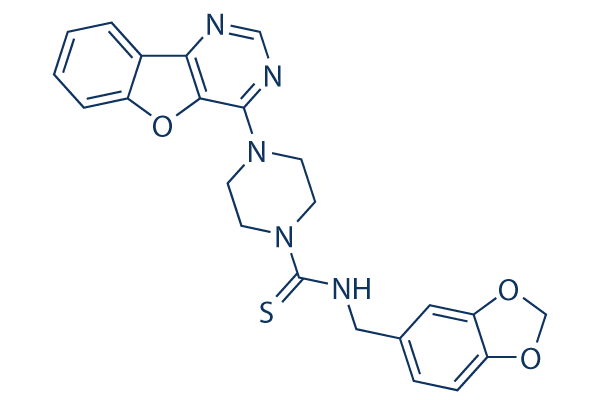
Chemische Struktur
Molekulargewicht: 447.51
Qualitätskontrolle
| Verwandte Ziele | EGFR VEGFR PDGFR FGFR c-Met Src MEK CSF-1R FLT3 HER2 |
|---|---|
| Weitere c-Kit Inhibitoren | Masitinib OSI-930 Sitravatinib (MGCD516) PDGFR inhibitor 1 ISCK03 AZD3229 Masitinib mesylate Bezuclastinib Elenestinib phosphate M4205(IDRX-42) |
Zellkultur, Behandlung & Arbeitskonzentration
| Zelllinien | Assay-Typ | Konzentration | Inkubationszeit | Formulierung | Aktivitätsbeschreibung | PMID |
|---|---|---|---|---|---|---|
| GIST | Function assay | Inhibition of AXL in human GIST cells, IC50<1μM | 26555154 | |||
| DAOY | qHTS assay | qHTS of pediatric cancer cell lines to identify multiple opportunities for drug repurposing: Primary screen for DAOY cells | 29435139 | |||
| A673 | qHTS assay | qHTS of pediatric cancer cell lines to identify multiple opportunities for drug repurposing: Primary screen for A673 cells | 29435139 | |||
| SK-N-MC | qHTS assay | qHTS of pediatric cancer cell lines to identify multiple opportunities for drug repurposing: Primary screen for SK-N-MC cells | 29435139 | |||
| NB1643 | qHTS assay | qHTS of pediatric cancer cell lines to identify multiple opportunities for drug repurposing: Primary screen for NB1643 cells | 29435139 | |||
| LAN-5 | qHTS assay | qHTS of pediatric cancer cell lines to identify multiple opportunities for drug repurposing: Primary screen for LAN-5 cells | 29435139 | |||
| OHS-50 | qHTS assay | qHTS of pediatric cancer cell lines to identify multiple opportunities for drug repurposing: Primary screen for OHS-50 cells | 29435139 | |||
| Caco-2 | Function assay | 48 hrs | Determination of IC50 values for inhibition of SARS-CoV-2 induced cytotoxicity of Caco-2 cells after 48 hours by high content imaging, IC50=0.02μM | ChEMBL | ||
| Caco-2 | Function assay | 48 hrs | Toxicity against Caco-2 cells determined at 48 hours by intracellular ATP concentration using the CellTiter-Glo Luminescent Cell Viability Assay, CC50=0.06μM | ChEMBL | ||
| GIST882 | Function assay | 4 days | Inhibition of c-kit gain of function mutant in human GIST882 cells measured after 4 days by sulforhodamine B assay, IC50=1.6μM | ChEMBL | ||
| GIST882 | Function assay | 96 hrs | Inhibition of c-kit gain of function mutant in human GIST882 cells after 96 hrs by Cell-Titer Glo luciferase assay, IC50=1.6μM | ChEMBL | ||
| MIAPaCa2 | Function assay | 4 days | Inhibition of PDGFRA in human MIAPaCa2 cells measured after 4 days by sulforhodamine B assay, IC50=2.1μM | ChEMBL | ||
| PANC1 | Function assay | 4 days | Inhibition of PDGFRA in human PANC1 cells measured after 4 days by sulforhodamine B assay, IC50=3μM | ChEMBL | ||
| SF-767 | Cytotoxicity assay | 1 uM | 24 hrs | Cytotoxicity against human SF-767 cells assessed as cell death at 1 uM after 24 hrs by MTS assay | ChEMBL | |
| SF-767 | Cytotoxicity assay | 1 uM | 24 hrs | Cytotoxicity against human SF-767 cells assessed as cell death at 1 uM in presence of 800Gy ionizing radiation after 24 hrs by MTS assay | ChEMBL | |
| SBcl2 | Antitumor assay | 5 days | Antitumor activity against human SBcl2 cells xenografted in ip dosed athymic nude mouse assessed as reduction in tumor growth administered as qd for 5 days | ChEMBL | ||
| HT-29 | Function assay | Suppression of ionizing radiation-induced Rad51 expression in human HT-29 cells pretreated with compound followed by ionizing radiation by Western blot analysis | ChEMBL | |||
| Klicken Sie hier, um weitere experimentelle Daten zu Zelllinien anzuzeigen | ||||||
Chemische Informationen, Lagerung & Stabilität
| Molekulargewicht | 447.51 | Formel | C23H21N5O3S |
Lagerung (Ab dem Eingangsdatum) | |
|---|---|---|---|---|---|
| CAS-Nr. | 850879-09-3 | SDF herunterladen | Lagerung von Stammlösungen |
|
|
| Synonyme | HPK 56 | Smiles | C1CN(CCN1C2=NC=NC3=C2OC4=CC=CC=C43)C(=S)NCC5=CC6=C(C=C5)OCO6 | ||
Löslichkeit
|
In vitro |
DMSO
: 32 mg/mL
(71.5 mM)
Water : Insoluble Ethanol : Insoluble |
Molaritätsrechner
|
In vivo |
|||||
In-vivo-Formulierungsrechner (Klare Lösung)
Schritt 1: Geben Sie die untenstehenden Informationen ein (Empfohlen: Ein zusätzliches Tier zur Berücksichtigung von Verlusten während des Experiments)
Schritt 2: Geben Sie die In-vivo-Formulierung ein (Dies ist nur der Rechner, keine Formulierung. Bitte kontaktieren Sie uns zuerst, wenn es im Abschnitt "Löslichkeit" keine In-vivo-Formulierung gibt.)
Berechnungsergebnisse:
Arbeitskonzentration: mg/ml;
Methode zur Herstellung der DMSO-Stammlösung: mg Wirkstoff vorgelöst in μL DMSO ( Konzentration der Stammlösung mg/mL, Bitte kontaktieren Sie uns zuerst, wenn die Konzentration die DMSO-Löslichkeit der Wirkstoffcharge überschreitet. )
Methode zur Herstellung der In-vivo-Formulierung: Nehmen Sie μL DMSO Stammlösung, dann hinzufügenμL PEG300, mischen und klären, dann hinzufügenμL Tween 80, mischen und klären, dann hinzufügen μL ddH2O, mischen und klären.
Methode zur Herstellung der In-vivo-Formulierung: Nehmen Sie μL DMSO Stammlösung, dann hinzufügen μL Maisöl, mischen und klären.
Hinweis: 1. Bitte stellen Sie sicher, dass die Flüssigkeit klar ist, bevor Sie das nächste Lösungsmittel hinzufügen.
2. Achten Sie darauf, das/die Lösungsmittel der Reihe nach hinzuzufügen. Sie müssen sicherstellen, dass die bei der vorherigen Zugabe erhaltene Lösung eine klare Lösung ist, bevor Sie mit der Zugabe des nächsten Lösungsmittels fortfahren. Physikalische Methoden wie Vortex, Ultraschall oder ein heißes Wasserbad können zur Unterstützung des Lösens verwendet werden.
Wirkmechanismus
| Targets/IC50/Ki |
c-Met
RAD51
c-RET
c-Kit (D816H)
10 nM
PDGFRα (V561D)
40 nM
FLT3 (D835Y)
81 nM
|
|---|---|
| In vitro |
Das Hydrochloridsalz von Amuvatinib (MP-470) hemmt mehrere Mutanten von c-Kit, einschließlich c-KitD816V, c-KitD816H, c-KitV560G und c-KitV654A, sowie eine Flt3-Mutante (Flt3D835Y) und zwei PDGFRα-Mutanten (PDGFRαV561D und PDGFRαD842V), mit einer IC50 von 10 nM bis 8,4 μM. Es bindet auch an mehrere c-Kit-Mutanten, einschließlich c-KitK642E, c-KitD816V und c-KitK642E/D816V, und hemmt diese. Diese Verbindung hemmt potent die Proliferation von OVCAR-3-, A549-, NCI-H647-, DMS-153- und DMS-114-Zellen mit einer IC50 von 0,9 μM bis 7,86 μM. Es hemmt auch c-Kit und PDGFRα mit IC50-Werten von 31 μM bzw. 27 μM. Es zeigt eine potente Zytotoxizität gegen MiaPaCa-2-, PANC-1- und GIST882-Zellen mit einer IC50 von 1,6 μM bis 3,0 μM. In MDA-MB-231-Zellen hemmt es (1 μM) die Tyrosinphosphorylierung von AXL. In LNCaP- und PC-3-, aber nicht DU145-Zellen, zeigt es Zytotoxizität mit einer IC50 von 4 μM bzw. 8 μM und induziert Apoptose bei 10 μM. In LNCaP-Zellen induziert es (10 μM) einen G1-Arrest und verringert die Phosphorylierung von Akt und ERK1/2. In SF767-Zellen hemmt es (10 μM) die c-Met-Phosphorylierung und sensibilisiert Zellen für Strahlung. In Kombination mit Strahlung hemmt es (10 μM) die Glykogensynthasekinase (GSK)3β-Aktivität, induziert Apoptose und stört die Reparatur von dsDNA-Brüchen, wahrscheinlich durch die Unterdrückung von Rad51. |
| Kinase-Assay |
Kinase-Hemmtest von c-Kit und PDGFRα
|
|
Zur Bestimmung der hemmenden Aktivität gegen c-Kit und PDGFRα werden Enzyme mit verschiedenen Konzentrationen von Amuvatinib (MP-470) und radiomarkiertem γ-32P-ATP inkubiert. Nach 30 Minuten werden die Reaktionsgemische auf einem Acrylamidgel elektrophoretisch getrennt und die Autophosphorylierung, quantifiziert durch die Menge an radioaktiver Substanz, die in das Enzym eingebaut wurde, bestimmt.
|
|
| In vivo |
In Maus-Xenograft-Modellen von HT-29-, A549- und SB-CL2-Zellen hemmt Amuvatinib (MP-470) (10 mg/kg–75 mg/kg i.p. oder 50 mg/kg–200 mg/kg p.o.) das Tumorwachstum. In Mäusen mit LNCaP-Xenograft induziert diese Verbindung (20 mg/kg) in Kombination mit Erlotinib signifikant eine Hemmung des Tumorwachstums (TGI). |
Literatur |
|
Anwendungen
| Methoden | Biomarker | Bilder | PMID |
|---|---|---|---|
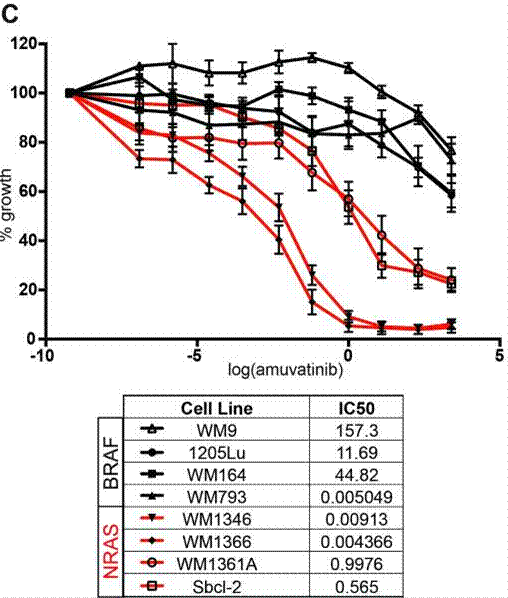
| Growth inhibition assay | Cell viability |
|
24950457 |
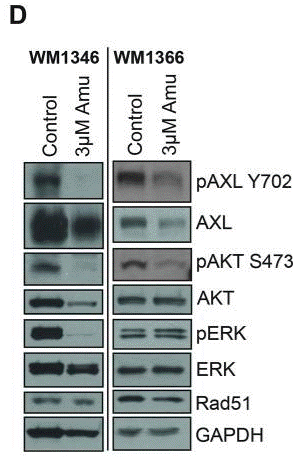
| Western blot | p-AXL / AXL / p-AKT / AKT / ERK / Rad51 |
|
24950457 |
Klinische Studieninformationen
(Daten von https://clinicaltrials.gov, aktualisiert am 2024-05-22)
| NCT-Nummer | Rekrutierung | Erkrankungen | Sponsor/Kooperationspartner | Startdatum | Phasen |
|---|---|---|---|---|---|
| NCT01357395 | Completed | Small Cell Lung Carcinoma |
Astex Pharmaceuticals Inc. |
May 2011 | Phase 2 |
Technischer Support
Tel: +1-832-582-8158 Ext:3
Wenn Sie weitere Fragen haben, hinterlassen Sie bitte eine Nachricht.

Produkte sind nur für Forschungszwecke bestimmt. Nicht für den menschlichen Gebrauch. Wir verkaufen nicht an Patienten.
©Copyright 2013 Selleck Chemicals. Alle Rechte vorbehalten.