
nur für Forschungszwecke
Adavosertib (AZD1775, MK-1775) Wee1 Inhibitor
Kat.-Nr.S1525
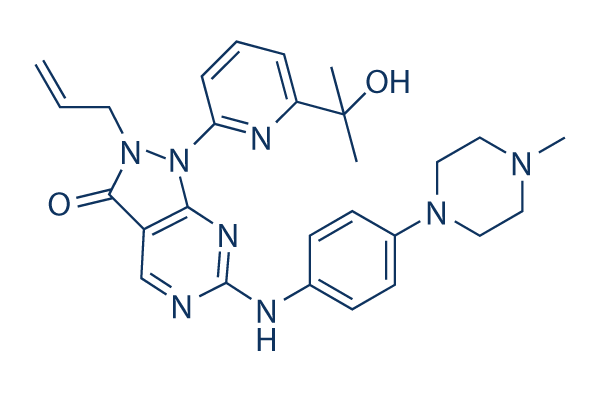
Chemische Struktur
Molekulargewicht: 500.6
Qualitätskontrolle
| Verwandte Ziele | CDK HSP PD-1/PD-L1 ROCK DNA/RNA Synthesis Microtubule Associated Ras KRas Aurora Kinase Casein Kinase |
|---|---|
| Weitere Wee1 Inhibitoren | PD0166285 Zedoresertib (Debio-0123, WEE1-IN-5) Azenosertib (Zn-C3) Potrasertib |
Zellkultur, Behandlung & Arbeitskonzentration
| Zelllinien | Assay-Typ | Konzentration | Inkubationszeit | Formulierung | Aktivitätsbeschreibung | PMID |
|---|---|---|---|---|---|---|
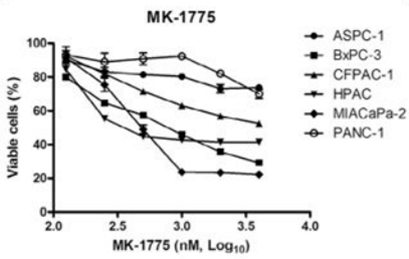
| ASPC-1 | Growth Inhibition Assay | IC50=13.2 ± 1.1 μM | 25458954 | |||
| BxPC-3 | Growth Inhibition Assay | IC50=0.8 ± 0.03 μM | 25458954 | |||
| CFPAC-1 | Growth Inhibition Assay | IC50=3.3 ± 0.2 μM | 25458954 | |||
| HPAC | Growth Inhibition Assay | IC50=0.5 ± 0.01 μM | 25458954 | |||
| MIAPaCa-2 | Growth Inhibition Assay | IC50=0.5 ± 0.05 μM | 25458954 | |||
| PANC-1 | Growth Inhibition Assay | IC50=10.6 ± 1.1 μM | 25458954 | |||
| SK-N-BE (2) | Growth Inhibition Assay | IC50=2.4 ± 0.3 μM | 25308916 | |||
| SK-N-BE (2), PAN→MK | Growth Inhibition Assay | IC50=26.6 ± 9.6 μM | 25308916 | |||
| SK-N-BE (2), MK→PAN | Growth Inhibition Assay | IC50=2.4 ± 0.3 μM | 25308916 | |||
| SK-N-AS | Growth Inhibition Assay | IC50=0.50 ± 0.02 μM | 25308916 | |||
| SK-N-DZ | Growth Inhibition Assay | IC50=0.36 ± 0.01 μM | 25308916 | |||
| SK-N-AS | Apoptosis Assay | 500 nM | 48 h | induces cell apoptosis | 25308916 | |
| SK-N-DZ | Apoptosis Assay | 500 nM | 48 h | induces cell apoptosis | 25308916 | |
| THP-1 | Growth Inhibition Assay | 125/250/500 nM | 48 h | increases cell death in a concentration-dependent manner | 25084614 | |
| MV4-11 | Growth Inhibition Assay | 125/250/500 nM | 48 h | increases cell death in a concentration-dependent manner | 25084614 | |
| U937 | Growth Inhibition Assay | 125/250/500 nM | 48 h | increases cell death in a concentration-dependent manner | 25084614 | |
| HL-60 | Growth Inhibition Assay | 125/250/500 nM | 48 h | increases cell death in a concentration-dependent manner | 25084614 | |
| OCI-AML3 | Growth Inhibition Assay | 125/250/500 nM | 48 h | increases cell death in a concentration-dependent manner | 25084614 | |
| MOLM-13 | Growth Inhibition Assay | 125/250/500 nM | 48 h | increases cell death in a concentration-dependent manner | 25084614 | |
| CMK | Cell Viability Assay | 10-10000 nM | 72 h | reduces cell vialibity in a concentration-dependent manner | 24962331 | |
| CMY | Cell Viability Assay | 10-10000 nM | 72 h | reduces cell vialibity in a concentration-dependent manner | 24962331 | |
| Dayo | Growth Inhibition Assay | IC50=150 nM | 24661910 | |||
| UW228 | Growth Inhibition Assay | IC50=232 nM | 24661910 | |||
| IST-MES1 | Cell Viability Assay | 150/250 nM | 72 h | enhances the cisplatin cytotoxic effect in a concentration-dependent manner | 24365782 | |
| IST-MES2 | Cell Viability Assay | 150/250 nM | 72 h | enhances the cisplatin cytotoxic effect in a concentration-dependent manner | 24365782 | |
| REN | Cell Viability Assay | 150/250 nM | 72 h | enhances the cisplatin cytotoxic effect in a concentration-dependent manner | 24365782 | |
| NCI-H2452 | Cell Viability Assay | 150/250 nM | 72 h | enhances the cisplatin cytotoxic effect in a concentration-dependent manner | 24365782 | |
| MSTO-211H | Cell Viability Assay | 150/250 nM | 72 h | enhances the cisplatin cytotoxic effect in a concentration-dependent manner | 24365782 | |
| NCI-H2052 | Cell Viability Assay | 150/250 nM | 72 h | enhances the cisplatin cytotoxic effect in a concentration-dependent manner | 24365782 | |
| WEE1 | Growth Inhibition Assay | IC50=5.2 nM | 23699655 | |||
| CDC2 | Growth Inhibition Assay | IC50>1000 nM | 23699655 | |||
| CDK7 | Growth Inhibition Assay | IC50>1000 nM | 23699655 | |||
| MYT1 | Growth Inhibition Assay | IC50=530 nM | 23699655 | |||
| T98G | Apoptosis Assay | 100/250 nM | 6 h | enhances radiation-induced cell killing | 21992793 | |
| A549 | Apoptosis Assay | 200 nM | 1 h | radiosensitizes NSCLC cells in a p53-dependent manner | 21799033 | |
| H460 | Apoptosis Assay | 200 nM | 1 h | radiosensitizes NSCLC cells in a p53-dependent manner | 21799033 | |
| H1299 | Apoptosis Assay | 200 nM | 1 h | radiosensitizes NSCLC cells in a p53-dependent manner | 21799033 | |
| Calu-6 | Apoptosis Assay | 200 nM | 1 h | radiosensitizes NSCLC cells in a p53-dependent manner | 21799033 | |
| WiDr | Kinase Assays | 10-10000 nM | 8 h | inhibits phosphorylation of CDC2 at Tyr15 with an EC50 value of 85 nmol/L pretreated with gemcitabine | 19887545 | |
| Function assay | Expi293F | Binding affinity to recombinant human full-length N-terminal His8-tagged Wee1 (1 to 646 residues) expressed in human Expi293F cells assessed as dessociation constant by quantitative real-time PCR method, Kd = 0.0032 μM. | 28792760 | |||
| Function assay | Expi293F | Binding affinity to recombinant human full-length N-terminal His8-tagged Wee2 (1 to 567 residues) expressed in human Expi293F cells assessed as dessociation constant by quantitative real-time PCR method, Kd = 0.0039 μM. | 28792760 | |||
| Antiproliferative assay | MDA-MB-231 | 72 hrs | Antiproliferative activity against human MDA-MB-231 cells measured after 72 hrs by CellTiter-Blue assay, IC50 = 0.26 μM. | 28792760 | ||
| Antiproliferative assay | HEK293T | 72 hrs | Antiproliferative activity against HEK293T cells measured after 72 hrs by CellTiter-Blue assay, IC50 = 0.29 μM. | 28792760 | ||
| Antiproliferative assay | MM1S | 72 hrs | Antiproliferative activity against human MM1S cells measured after 72 hrs by CellTiter-Blue assay, IC50 = 0.31 μM. | 28792760 | ||
| Function assay | HEK293 | 1 hr | Inhibition of human full length PKMYT1 expressed in HEK293 cells using EFS (247 to 259 residues) as substrate after 1 hr by fluorescence polarization immunoasay, Ki = 0.47 μM. | 29941193 | ||
| Function assay | HEK293 | 1 hr | Inhibition of human full length PKMYT1 expressed in HEK293 cells using EFS (247 to 259 residues) as substrate after 1 hr by fluorescence polarization immunoasay, IC50 = 4.94 μM. | 29941193 | ||
| Function assay | MDA-MB-231 | 0.1 to 10 uM | 6 hrs | Inhibition of Wee1 in human MDA-MB-231 cells assessed as decrease in CDK1 phosphorylation at Tyr 15 at 0.1 to 10 uM after 6 hrs by Western blot method | 28792760 | |
| Function assay | HEK293T | 0.1 to 10 uM | 6 hrs | Inhibition of Wee1 in HEK293T cells assessed as decrease in CDK1 phosphorylation at Tyr15 at 0.1 to 10 uM after 6 hrs by Western blot method | 28792760 | |
| Function assay | HEK293T | 0.1 to 10 uM | 6 hrs | Inhibition of PLK1 in HEK293T cells assessed as decrease in TCTP phosphorylation at 0.1 to 10 uM after 6 hrs by Western blot method | 28792760 | |
| Function assay | MDA-MB-23 | 0.1 to 10 uM | 6 hrs | Inhibition of PLK1 in human MDA-MB-23 cells assessed as decrease in TCTP phosphorylation at 0.1 to 10 uM after 6 hrs by Western blot method | 28792760 | |
| qHTS assay | TC32 | qHTS of pediatric cancer cell lines to identify multiple opportunities for drug repurposing: Primary screen for TC32 cells | 29435139 | |||
| qHTS assay | U-2 OS | qHTS of pediatric cancer cell lines to identify multiple opportunities for drug repurposing: Primary screen for U-2 OS cells | 29435139 | |||
| qHTS assay | A673 | qHTS of pediatric cancer cell lines to identify multiple opportunities for drug repurposing: Primary screen for A673 cells | 29435139 | |||
| qHTS assay | DAOY | qHTS of pediatric cancer cell lines to identify multiple opportunities for drug repurposing: Primary screen for DAOY cells | 29435139 | |||
| qHTS assay | Saos-2 | qHTS of pediatric cancer cell lines to identify multiple opportunities for drug repurposing: Primary screen for Saos-2 cells | 29435139 | |||
| qHTS assay | BT-37 | qHTS of pediatric cancer cell lines to identify multiple opportunities for drug repurposing: Primary screen for BT-37 cells | 29435139 | |||
| qHTS assay | RD | qHTS of pediatric cancer cell lines to identify multiple opportunities for drug repurposing: Primary screen for RD cells | 29435139 | |||
| qHTS assay | SK-N-SH | qHTS of pediatric cancer cell lines to identify multiple opportunities for drug repurposing: Primary screen for SK-N-SH cells | 29435139 | |||
| qHTS assay | BT-12 | qHTS of pediatric cancer cell lines to identify multiple opportunities for drug repurposing: Primary screen for BT-12 cells | 29435139 | |||
| qHTS assay | NB1643 | qHTS of pediatric cancer cell lines to identify multiple opportunities for drug repurposing: Primary screen for NB1643 cells | 29435139 | |||
| qHTS assay | OHS-50 | qHTS of pediatric cancer cell lines to identify multiple opportunities for drug repurposing: Primary screen for OHS-50 cells | 29435139 | |||
| qHTS assay | BT-12 | qHTS of pediatric cancer cell lines to identify multiple opportunities for drug repurposing: Confirmatory screen for BT-12 cells | 29435139 | |||
| qHTS assay | DAOY | qHTS of pediatric cancer cell lines to identify multiple opportunities for drug repurposing: Confirmatory screen for DAOY cells | 29435139 | |||
| qHTS assay | SK-N-SH | qHTS of pediatric cancer cell lines to identify multiple opportunities for drug repurposing: Confirmatory screen for SK-N-SH cells | 29435139 | |||
| qHTS assay | Rh41 | qHTS of pediatric cancer cell lines to identify multiple opportunities for drug repurposing: Primary screen for Rh41 cells | 29435139 | |||
| qHTS assay | A673 | qHTS of pediatric cancer cell lines to identify multiple opportunities for drug repurposing: Confirmatory screen for A673 cells) | 29435139 | |||
| qHTS assay | MG 63 (6-TG R) | qHTS of pediatric cancer cell lines to identify multiple opportunities for drug repurposing: Confirmatory screen for MG 63 (6-TG R) cells | 29435139 | |||
| qHTS assay | U-2 OS | qHTS of pediatric cancer cell lines to identify multiple opportunities for drug repurposing: Confirmatory screen for U-2 OS cells | 29435139 | |||
| qHTS assay | OHS-50 | qHTS of pediatric cancer cell lines to identify multiple opportunities for drug repurposing: Confirmatory screen for OHS-50 cells | 29435139 | |||
| qHTS assay | Rh41 | qHTS of pediatric cancer cell lines to identify multiple opportunities for drug repurposing: Confirmatory screen for Rh41 cells | 29435139 | |||
| qHTS assay | RD | qHTS of pediatric cancer cell lines to identify multiple opportunities for drug repurposing: Confirmatory screen for RD cells | 29435139 | |||
| qHTS assay | SJ-GBM2 | qHTS of pediatric cancer cell lines to identify multiple opportunities for drug repurposing: Primary screen for SJ-GBM2 cells | 29435139 | |||
| qHTS assay | SK-N-MC | qHTS of pediatric cancer cell lines to identify multiple opportunities for drug repurposing: Primary screen for SK-N-MC cells | 29435139 | |||
| qHTS assay | NB-EBc1 | qHTS of pediatric cancer cell lines to identify multiple opportunities for drug repurposing: Primary screen for NB-EBc1 cells | 29435139 | |||
| qHTS assay | LAN-5 | qHTS of pediatric cancer cell lines to identify multiple opportunities for drug repurposing: Primary screen for LAN-5 cells | 29435139 | |||
| qHTS assay | Rh18 | qHTS of pediatric cancer cell lines to identify multiple opportunities for drug repurposing: Primary screen for Rh18 cells | 29435139 | |||
| qHTS assay | SJ-GBM2 | qHTS of pediatric cancer cell lines to identify multiple opportunities for drug repurposing: Confirmatory screen for SJ-GBM2 cells | 29435139 | |||
| qHTS assay | Saos-2 | qHTS of pediatric cancer cell lines to identify multiple opportunities for drug repurposing: Confirmatory screen for Saos-2 cells | 29435139 | |||
| Klicken Sie hier, um weitere experimentelle Daten zu Zelllinien anzuzeigen | ||||||
Chemische Informationen, Lagerung & Stabilität
| Molekulargewicht | 500.6 | Formel | C27H32N8O2 |
Lagerung (Ab dem Eingangsdatum) | |
|---|---|---|---|---|---|
| CAS-Nr. | 955365-80-7 | SDF herunterladen | Lagerung von Stammlösungen |
|
|
| Synonyme | AZD1775 | Smiles | CC(C)(C1=NC(=CC=C1)N2C3=NC(=NC=C3C(=O)N2CC=C)NC4=CC=C(C=C4)N5CCN(CC5)C)O | ||
Löslichkeit
|
In vitro |
DMSO
: 100 mg/mL
(199.76 mM)
Water : Insoluble Ethanol : Insoluble |
Molaritätsrechner
|
In vivo |
|||||
In-vivo-Formulierungsrechner (Klare Lösung)
Schritt 1: Geben Sie die untenstehenden Informationen ein (Empfohlen: Ein zusätzliches Tier zur Berücksichtigung von Verlusten während des Experiments)
Schritt 2: Geben Sie die In-vivo-Formulierung ein (Dies ist nur der Rechner, keine Formulierung. Bitte kontaktieren Sie uns zuerst, wenn es im Abschnitt "Löslichkeit" keine In-vivo-Formulierung gibt.)
Berechnungsergebnisse:
Arbeitskonzentration: mg/ml;
Methode zur Herstellung der DMSO-Stammlösung: mg Wirkstoff vorgelöst in μL DMSO ( Konzentration der Stammlösung mg/mL, Bitte kontaktieren Sie uns zuerst, wenn die Konzentration die DMSO-Löslichkeit der Wirkstoffcharge überschreitet. )
Methode zur Herstellung der In-vivo-Formulierung: Nehmen Sie μL DMSO Stammlösung, dann hinzufügenμL PEG300, mischen und klären, dann hinzufügenμL Tween 80, mischen und klären, dann hinzufügen μL ddH2O, mischen und klären.
Methode zur Herstellung der In-vivo-Formulierung: Nehmen Sie μL DMSO Stammlösung, dann hinzufügen μL Maisöl, mischen und klären.
Hinweis: 1. Bitte stellen Sie sicher, dass die Flüssigkeit klar ist, bevor Sie das nächste Lösungsmittel hinzufügen.
2. Achten Sie darauf, das/die Lösungsmittel der Reihe nach hinzuzufügen. Sie müssen sicherstellen, dass die bei der vorherigen Zugabe erhaltene Lösung eine klare Lösung ist, bevor Sie mit der Zugabe des nächsten Lösungsmittels fortfahren. Physikalische Methoden wie Vortex, Ultraschall oder ein heißes Wasserbad können zur Unterstützung des Lösens verwendet werden.
Wirkmechanismus
| Merkmale |
The first reported Wee1 inhibitor.
|
|---|---|
| Targets/IC50/Ki |
Wee1
(Cell-free assay) 5.2 nM
|
| In vitro |
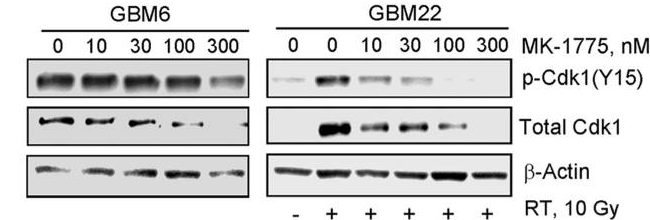
Adavosertib (MK-1775) hemmt die Wee1-Kinase ATP-kompetitiv. Im Vergleich zu Wee1 zeigt es eine 2- bis 3-fach geringere Potenz gegen Yes mit einer IC50 von 14 nM, eine 10-fach geringere Potenz gegen sieben andere Kinasen mit >80%iger Hemmung bei 1 µM und eine >100-fache Selektivität gegenüber humanem Myt 1, einer weiteren Kinase, die die Cyclin-abhängige Kinase 1 (CDC2) durch Phosphorylierung an einer alternativen Stelle (Thr14) hemmt. Durch die Aufhebung des DNA-Schadens-Checkpoints durch Blockade der Wee1-Aktivität in WiDr-Zellen mit mutiertem p53 hemmt diese Verbindung die basale Phosphorylierung von CDC2 an Tyr15 (CDC2Y15) mit einer EC50 von 49 nM und unterdrückt die induzierte Phosphorylierung von CDC2 und den Zellzyklusarrest dosisabhängig mit einer EC50 von 82 nM und 81 nM, 180 nM und 163 nM sowie 159 nM und 160 nM. Eine alleinige Behandlung mit 30-100 nM hat keine signifikante antiproliferative Wirkung in WiDr- und H1299-Zellen, während bei 300 nM, ausreichend zur Hemmung von Wee1 um >80 %, moderate, aber signifikante antiproliferative Wirkungen von 34,1 % in WiDr-Zellen und 28,4 % in H1299-Zellen zeigt. |
| Kinase-Assay |
In-vitro-Kinaseassays
|
|
Rekombinantes humanes Wee1 wird verwendet. Die Kinase-Reaktion wird mit 10 μM ATP, 1,0 μCi [γ-33P]ATP und 2,5 μg Poly(Lys, Tyr) als Substrat in Gegenwart steigender Konzentrationen von Adavosertib (MK-1775) bei 30 °C für 30 Minuten durchgeführt. Die in das Substrat eingebaute Radioaktivität wird auf MultiScreen-PH-Platten eingefangen und in einem Flüssigszintillationszähler gezählt.
|
|
| In vivo |
Eine alleinige Adavosertib (MK-1775)-Behandlung mit ~20 mg/kg zeigt minimale Antitumorwirkungen gegen WiDr-Xenografts in Ratten mit einem T/C von 69 % an Tag 3. Ihre Antitumorwirksamkeit in den Nacktratten-Xenograftmodellen HeLa-luc und TOV21G-shp53 ist ebenfalls moderat. |
Literatur |
Anwendungen
| Methoden | Biomarker | Bilder | PMID |
|---|---|---|---|
| Western blot | p-Cdk1(Y15) / Cdk1 p-KAP1(S824) / p-Chk2(T68) / p-Chk1(S345) PARP / CF-PARP / pH3(S10) / p-CDC25c(S216) / p-CDK2(Y15) WEE1 |
|
25609063 |
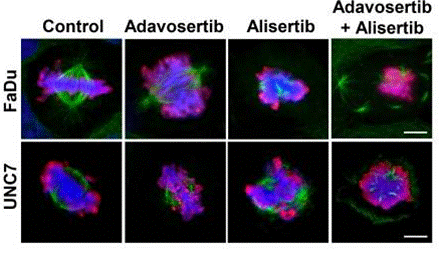
| Immunofluorescence | tubulin / p-HH3(S10) γH2AX Cleaved caspase-3 / pH3 |
|
30755439 |
| Growth inhibition assay | Cell viability IC50 |
|
25458954 |
Klinische Studieninformationen
(Daten von https://clinicaltrials.gov, aktualisiert am 2024-05-22)
| NCT-Nummer | Rekrutierung | Erkrankungen | Sponsor/Kooperationspartner | Startdatum | Phasen |
|---|---|---|---|---|---|
| NCT03253679 | Completed | Advanced Malignant Solid Neoplasm|Refractory Malignant Solid Neoplasm |
National Cancer Institute (NCI) |
January 16 2019 | Phase 2 |
| NCT03668340 | Active not recruiting | Uterine Cancer |
Dana-Farber Cancer Institute|AstraZeneca |
October 22 2018 | Phase 2 |
| NCT03028766 | Completed | Hypopharynx Squamous Cell Carcinoma|Oral Cavity Squamous Cell Carcinoma|Larynx Cancer |
University of Birmingham|AstraZeneca|Cancer Research UK |
June 22 2017 | Phase 1 |
Technischer Support
Tel: +1-832-582-8158 Ext:3
Wenn Sie weitere Fragen haben, hinterlassen Sie bitte eine Nachricht.
Häufig gestellte Fragen
Frage 1:
How to prepare its methylcellulose solution? and how to prepare methylcellulose itself? Once make the solution, how should i keep it?
Antwort:
It is a suspension or emulsion in 0.5% methylcellulose, and it is ok to treat mice orally. It is recommended to dissolve methylcellulose in saline. It will take some time to dissolve methylcellulose, and you can vortex it for a while. The methylcellulose solution of this compound can be stored at 4°C for a week.

Produkte sind nur für Forschungszwecke bestimmt. Nicht für den menschlichen Gebrauch. Wir verkaufen nicht an Patienten.
©Copyright 2013 Selleck Chemicals. Alle Rechte vorbehalten.