
nur für Forschungszwecke
PD0166285 Wee1 Inhibitor
Kat.-Nr.S8148
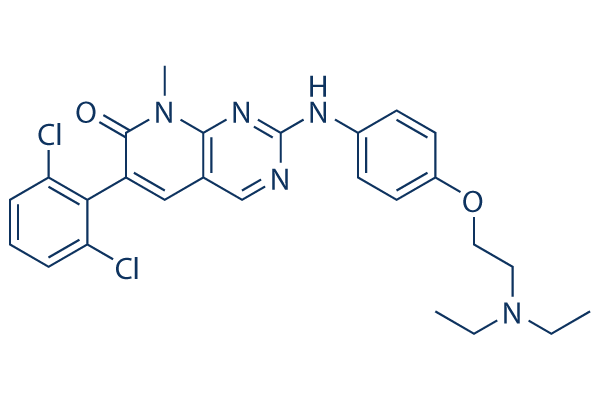
Chemische Struktur
Molekulargewicht: 512.43
Qualitätskontrolle
- In Nature Medicine für seine erstklassige Qualität zitiert
- COA
- NMR
- SDS
- Datenblatt
| Verwandte Ziele | CDK HSP PD-1/PD-L1 ROCK DNA/RNA Synthesis Microtubule Associated Ras KRas Aurora Kinase Casein Kinase |
|---|---|
| Weitere Wee1 Inhibitoren | Adavosertib (AZD1775, MK-1775) Zedoresertib (Debio-0123, WEE1-IN-5) Azenosertib (Zn-C3) Potrasertib |
Zellkultur, Behandlung & Arbeitskonzentration
| Zelllinien | Assay-Typ | Konzentration | Inkubationszeit | Formulierung | Aktivitätsbeschreibung | PMID |
|---|---|---|---|---|---|---|
| NIH3T3 | Function assay | Inhibition of PDGF-induced autophosphorylation of PDGF-R in NIH3T3 cells, IC50=0.0018μM | 9703473 | |||
| C6 | Function assay | Inhibition of PDGF-induced autophosphorylation of PDGF-R in C6 cells, IC50=0.005μM | 9703473 | |||
| MCF-7 | Function assay | 12 mg/kg | Weight change of MCF-7 tumor cells in mice at 12 mg/kg peroral dose, days 1-15 administration | 9703473 | ||
| C6 | Function assay | 2 hr | Inhibition of PDGF-stimulated Platelet-derived growth factor receptor autophosphorylation in C6 rat glioma cells after 2 hr, IC50=0.005μM | 9784112 | ||
| RAVSMCs | Function assay | 2 hr | Inhibition of PDGF-stimulated Platelet-derived growth factor receptor autophosphorylation in rat aortic vascular smooth muscle cells (RAVSMCs) after 2 hr, IC50=0.0065μM | 9784112 | ||
| SW-620 | Function assay | Inhibitory activity against SW-620 human colon adenocarcinoma cells was determined, IC50=0.27μM | 10956222 | |||
| HT-29 | Function assay | Inhibitory activity against HT-29 human colon adenocarcinoma cells was determined, IC50=0.28μM | 10956222 | |||
| HCT-8 | Function assay | Inhibitory activity against HCT-8 human colon adenocarcinoma cells was determined, IC50=0.42μM | 10956222 | |||
| HEK293 | Function assay | Binding affinity to human full-length His-tagged Myt1 kinase expressed in HEK293 cells by TR-FRET based binding assay, IC50=0.0072μM | 22770610 | |||
| MDA-MB-231 | Antiproliferative assay | 72 hrs | Antiproliferative activity against human MDA-MB-231 cells measured after 72 hrs by CellTiter-Blue assay, IC50=0.16μM | 28792760 | ||
| HEK293T | Antiproliferative assay | 72 hrs | Antiproliferative activity against HEK293T cells measured after 72 hrs by CellTiter-Blue assay, IC50=0.29μM | 28792760 | ||
| MM1S | Antiproliferative assay | 72 hrs | Antiproliferative activity against human MM1S cells measured after 72 hrs by CellTiter-Blue assay, IC50=0.52μM | 28792760 | ||
| TC32 | qHTS assay | qHTS of pediatric cancer cell lines to identify multiple opportunities for drug repurposing: Primary screen for TC32 cells | 29435139 | |||
| DAOY | qHTS assay | qHTS of pediatric cancer cell lines to identify multiple opportunities for drug repurposing: Primary screen for DAOY cells | 29435139 | |||
| SJ-GBM2 | qHTS assay | qHTS of pediatric cancer cell lines to identify multiple opportunities for drug repurposing: Primary screen for SJ-GBM2 cells | 29435139 | |||
| A673 | qHTS assay | qHTS of pediatric cancer cell lines to identify multiple opportunities for drug repurposing: Primary screen for A673 cells | 29435139 | |||
| SK-N-MC | qHTS assay | qHTS of pediatric cancer cell lines to identify multiple opportunities for drug repurposing: Primary screen for SK-N-MC cells | 29435139 | |||
| BT-37 | qHTS assay | qHTS of pediatric cancer cell lines to identify multiple opportunities for drug repurposing: Primary screen for BT-37 cells | 29435139 | |||
| NB-EBc1 | qHTS assay | qHTS of pediatric cancer cell lines to identify multiple opportunities for drug repurposing: Primary screen for NB-EBc1 cells | 29435139 | |||
| U-2 OS | qHTS assay | qHTS of pediatric cancer cell lines to identify multiple opportunities for drug repurposing: Primary screen for U-2 OS cells | 29435139 | |||
| Saos-2 | qHTS assay | qHTS of pediatric cancer cell lines to identify multiple opportunities for drug repurposing: Primary screen for Saos-2 cells | 29435139 | |||
| SK-N-SH | qHTS assay | qHTS of pediatric cancer cell lines to identify multiple opportunities for drug repurposing: Primary screen for SK-N-SH cells | 29435139 | |||
| NB1643 | qHTS assay | qHTS of pediatric cancer cell lines to identify multiple opportunities for drug repurposing: Primary screen for NB1643 cells | 29435139 | |||
| LAN-5 | qHTS assay | qHTS of pediatric cancer cell lines to identify multiple opportunities for drug repurposing: Primary screen for LAN-5 cells | 29435139 | |||
| BT-12 | qHTS assay | qHTS of pediatric cancer cell lines to identify multiple opportunities for drug repurposing: Primary screen for BT-12 cells | 29435139 | |||
| Rh18 | qHTS assay | qHTS of pediatric cancer cell lines to identify multiple opportunities for drug repurposing: Primary screen for Rh18 cells | 29435139 | |||
| OHS-50 | qHTS assay | qHTS of pediatric cancer cell lines to identify multiple opportunities for drug repurposing: Primary screen for OHS-50 cells | 29435139 | |||
| RD | qHTS assay | qHTS of pediatric cancer cell lines to identify multiple opportunities for drug repurposing: Primary screen for RD cells | 29435139 | |||
| MG 63 (6-TG R) | qHTS assay | qHTS of pediatric cancer cell lines to identify multiple opportunities for drug repurposing: Primary screen for MG 63 (6-TG R) cells | 29435139 | |||
| Rh41 | qHTS assay | qHTS of pediatric cancer cell lines to identify multiple opportunities for drug repurposing: Primary screen for Rh41 cells | 29435139 | |||
| NB1643 | qHTS assay | qHTS of pediatric cancer cell lines to identify multiple opportunities for drug repurposing: Confirmatory screen for NB1643 cells | 29435139 | |||
| A673 | qHTS assay | qHTS of pediatric cancer cell lines to identify multiple opportunities for drug repurposing: Confirmatory screen for A673 cells) | 29435139 | |||
| SK-N-MC | qHTS assay | qHTS of pediatric cancer cell lines to identify multiple opportunities for drug repurposing: Confirmatory screen for SK-N-MC cells | 29435139 | |||
| BT-12 | qHTS assay | qHTS of pediatric cancer cell lines to identify multiple opportunities for drug repurposing: Confirmatory screen for BT-12 cells | 29435139 | |||
| DAOY | qHTS assay | qHTS of pediatric cancer cell lines to identify multiple opportunities for drug repurposing: Confirmatory screen for DAOY cells | 29435139 | |||
| NB-EBc1 | qHTS assay | qHTS of pediatric cancer cell lines to identify multiple opportunities for drug repurposing: Confirmatory screen for NB-EBc1 cells | 29435139 | |||
| SJ-GBM2 | qHTS assay | qHTS of pediatric cancer cell lines to identify multiple opportunities for drug repurposing: Confirmatory screen for SJ-GBM2 cells | 29435139 | |||
| BT-37 | qHTS assay | qHTS of pediatric cancer cell lines to identify multiple opportunities for drug repurposing: Confirmatory screen for BT-37 cells | 29435139 | |||
| TC32 | qHTS assay | qHTS of pediatric cancer cell lines to identify multiple opportunities for drug repurposing: Confirmatory screen for TC32 cells | 29435139 | |||
| MG 63 (6-TG R) | qHTS assay | qHTS of pediatric cancer cell lines to identify multiple opportunities for drug repurposing: Confirmatory screen for MG 63 (6-TG R) cells | 29435139 | |||
| U-2 OS | qHTS assay | qHTS of pediatric cancer cell lines to identify multiple opportunities for drug repurposing: Confirmatory screen for U-2 OS cells | 29435139 | |||
| Rh41 | qHTS assay | qHTS of pediatric cancer cell lines to identify multiple opportunities for drug repurposing: Confirmatory screen for Rh41 cells | 29435139 | |||
| RD | qHTS assay | qHTS of pediatric cancer cell lines to identify multiple opportunities for drug repurposing: Confirmatory screen for RD cells | 29435139 | |||
| Rh18 | qHTS assay | qHTS of pediatric cancer cell lines to identify multiple opportunities for drug repurposing: Confirmatory screen for Rh18 cells | 29435139 | |||
| Rh30 | qHTS assay | qHTS of pediatric cancer cell lines to identify multiple opportunities for drug repurposing: Confirmatory screen for Rh30 cells | 29435139 | |||
| Saos-2 | qHTS assay | qHTS of pediatric cancer cell lines to identify multiple opportunities for drug repurposing: Confirmatory screen for Saos-2 cells | 29435139 | |||
| OHS-50 | qHTS assay | qHTS of pediatric cancer cell lines to identify multiple opportunities for drug repurposing: Confirmatory screen for OHS-50 cells | 29435139 | |||
| SK-N-SH | qHTS assay | qHTS of pediatric cancer cell lines to identify multiple opportunities for drug repurposing: Confirmatory screen for SK-N-SH cells | 29435139 | |||
| HEK293 | qHTS assay | Inhibition of human full length PKMYT1 expressed in HEK293 cells using EFS (247 to 259 residues) as substrate after 1 hr by fluorescence polarization immunoasay, Ki=0.0008μM | 29941193 | |||
| HEK293 | qHTS assay | Inhibition of human full length PKMYT1 expressed in HEK293 cells using EFS (247 to 259 residues) as substrate after 1 hr by fluorescence polarization immunoasay, IC50=0.008μM | 29941193 | |||
| Klicken Sie hier, um weitere experimentelle Daten zu Zelllinien anzuzeigen | ||||||
Chemische Informationen, Lagerung & Stabilität
| Molekulargewicht | 512.43 | Formel | C26H27Cl2N5O2 |
Lagerung (Ab dem Eingangsdatum) | |
|---|---|---|---|---|---|
| CAS-Nr. | 185039-89-8 | SDF herunterladen | Lagerung von Stammlösungen |
|
|
| Synonyme | N/A | Smiles | CCN(CC)CCOC1=CC=C(C=C1)NC2=NC=C3C=C(C(=O)N(C3=N2)C)C4=C(C=CC=C4Cl)Cl | ||
Löslichkeit
|
In vitro |
DMSO
: 100 mg/mL
(195.14 mM)
Ethanol : 100 mg/mL Water : Insoluble |
Molaritätsrechner
|
In vivo |
|||||
In-vivo-Formulierungsrechner (Klare Lösung)
Schritt 1: Geben Sie die untenstehenden Informationen ein (Empfohlen: Ein zusätzliches Tier zur Berücksichtigung von Verlusten während des Experiments)
Schritt 2: Geben Sie die In-vivo-Formulierung ein (Dies ist nur der Rechner, keine Formulierung. Bitte kontaktieren Sie uns zuerst, wenn es im Abschnitt "Löslichkeit" keine In-vivo-Formulierung gibt.)
Berechnungsergebnisse:
Arbeitskonzentration: mg/ml;
Methode zur Herstellung der DMSO-Stammlösung: mg Wirkstoff vorgelöst in μL DMSO ( Konzentration der Stammlösung mg/mL, Bitte kontaktieren Sie uns zuerst, wenn die Konzentration die DMSO-Löslichkeit der Wirkstoffcharge überschreitet. )
Methode zur Herstellung der In-vivo-Formulierung: Nehmen Sie μL DMSO Stammlösung, dann hinzufügenμL PEG300, mischen und klären, dann hinzufügenμL Tween 80, mischen und klären, dann hinzufügen μL ddH2O, mischen und klären.
Methode zur Herstellung der In-vivo-Formulierung: Nehmen Sie μL DMSO Stammlösung, dann hinzufügen μL Maisöl, mischen und klären.
Hinweis: 1. Bitte stellen Sie sicher, dass die Flüssigkeit klar ist, bevor Sie das nächste Lösungsmittel hinzufügen.
2. Achten Sie darauf, das/die Lösungsmittel der Reihe nach hinzuzufügen. Sie müssen sicherstellen, dass die bei der vorherigen Zugabe erhaltene Lösung eine klare Lösung ist, bevor Sie mit der Zugabe des nächsten Lösungsmittels fortfahren. Physikalische Methoden wie Vortex, Ultraschall oder ein heißes Wasserbad können zur Unterstützung des Lösens verwendet werden.
Wirkmechanismus
| Targets/IC50/Ki |
Wee1
(Cell-free assay) 24 nM
Myt1
(Cell-free assay) 72 nM
Chk1
(Cell-free assay) 3.4 μM
|
|---|---|
| In vitro |
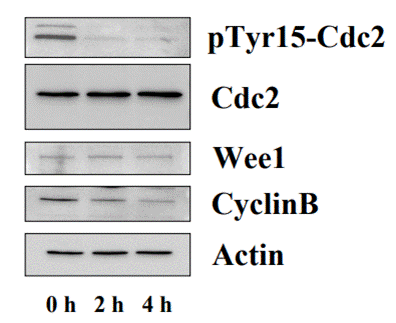
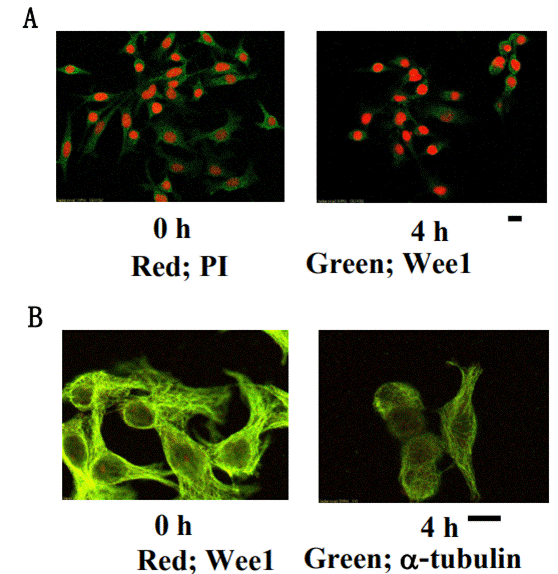
PD0166285 inhibiert nachweislich die Wee1-Aktivität in nanomolaren Konzentrationen. Der Inhibitor hebt den G2/M-Kontrollpunkt auf und induziert eine frühe Zellteilung. Auf zellulärer Ebene inhibiert 0,5 μM dieser Verbindung die strahleninduzierte Cdc2-Phosphorylierung an Tyr-15 und Thr-14 in sieben von sieben getesteten Krebszelllinien dramatisch. Diese Aufhebung des G2-Kontrollpunkts durch diese Chemikalie tötet nachweislich Krebszellen ab. Es inhibiert Cdc2/Cyclin B nicht, aber Chk1-Kinase bei einer viel höheren Konzentration (3433 nM). Die Behandlung von Zellen mit dem Inhibitor ist mit Mikrotubuli-Stabilisierung und einer Abnahme der Cyclin-D-Transkription verbunden. Daher kann diese Verbindung eine potenziell nützliche Anti-Krebs-Therapie sein.
|
| Kinase-Assay |
Wee1-Massenscreening
|
|
Das Wee1-Massenscreening wird mit dem p34cdc2-Kinase-SPA-Kit von Amersham mit einigen Modifikationen durchgeführt. Kurz gesagt, 45–60 nM vollständige Wee1-Kinase wird mit 25 μM dieser Verbindung, 20 μM ATP und 122–441 nM Cdc2/Cyclin B in einem Endvolumen von 50 μl Enzymverdünnungspuffer [50 mM Tris (pH 8,0), 10 mM NaCl, 10 mM MgCl2, 1 mM DTT und 0,1 mM Na3VO4] inkubiert. Nach 30 Minuten Inkubation bei 30 °C werden 30 μl [33P]ATP-haltiger Kinasepuffer [67 mM Tris (pH 8,0), 40 mM NaCl, 13 mM MgCl2, 1 mM DTT und 0,13 mM Na3VO4], der 1 μM biotinyliertes Peptid und 0,25 μCi [γ-33P]ATP enthält, zur Reaktion gegeben und weitere 30 Minuten bei 30 °C inkubiert. Die Reaktion wird durch Zugabe von 200 μl Stopppuffer [50 μM ATP, 5 mM EDTA, 0,1 % Triton X-100 und 1,25 mg/ml SPA-Beads in PBS] gestoppt. Nach Zentrifugation bei 2400 U/min für 15 Minuten wird die Platte mit Wallacs Microbeta-Zähler gezählt.
|
|
| In vivo |
PD0166285 in einer Konzentration von 0,5 μM kann die Cdc2Y15/T14-Phosphorylierung in allen getesteten Zelllinien hemmen, unabhängig von ihrem p53-Status, und die pharmakologische Hemmung von WEE1 durch diese Verbindung sensibilisiert U251-FM-GBM-Tumoren für IR in vivo.
|
Literatur |
|
Anwendungen
| Methoden | Biomarker | Bilder | PMID |
|---|---|---|---|
| Western blot | p-Cdc2 / Cdc2 / Wee1 / Cyclin B |
|
17177986 |
| Immunofluorescence | Wee1 / α-tubulin |
|
17177986 |
Technischer Support
Tel: +1-832-582-8158 Ext:3
Wenn Sie weitere Fragen haben, hinterlassen Sie bitte eine Nachricht.

Produkte sind nur für Forschungszwecke bestimmt. Nicht für den menschlichen Gebrauch. Wir verkaufen nicht an Patienten.
©Copyright 2013 Selleck Chemicals. Alle Rechte vorbehalten.