
nur für Forschungszwecke
Bexarotene Retinoid Receptor Agonist
Kat.-Nr.: S2098
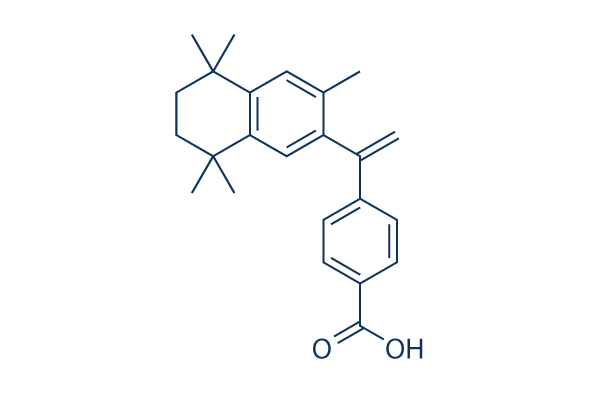
Chemische Struktur
Molekulargewicht: 348
Qualitätskontrolle (Quality Control)
| Verwandte Ziele | Dehydrogenase HSP Transferase P450 (e.g. CYP17) PDE phosphatase PPAR Vitamin Carbohydrate Metabolism Mitochondrial Metabolism |
|---|---|
| Weitere Retinoid Receptor Inhibitoren | TTNPB (Arotinoid acid) Tamibarotene AM580 Fenretinide UVI 3003 SR 11237 BMS493 AR7 All trans-Retinal AGN 193109 |
Chemische Informationen, Lagerung & Stabilität (Chemical Information, Storage & Stability)
| Molekulargewicht | 348 | Formel | C24H28O2 |
Lagerung (Ab dem Eingangsdatum) | |
|---|---|---|---|---|---|
| CAS-Nr. | 153559-49-0 | SDF herunterladen | Lagerung von Stammlösungen |
|
|
| Synonyme | LGD1069 | Smiles | CC1=CC2=C(C=C1C(=C)C3=CC=C(C=C3)C(=O)O)C(CCC2(C)C)(C)C | ||
Löslichkeit (Solubility)
|
In vitro |
DMSO
: 70 mg/mL
(201.14 mM)
Water : Insoluble Ethanol : Insoluble |
Molaritätsrechner
|
In vivo |
|||||
In-vivo-Formulierungsrechner (Klare Lösung)
Schritt 1: Geben Sie die untenstehenden Informationen ein (Empfohlen: Ein zusätzliches Tier zur Berücksichtigung von Verlusten während des Experiments)
Schritt 2: Geben Sie die In-vivo-Formulierung ein (Dies ist nur der Rechner, keine Formulierung. Bitte kontaktieren Sie uns zuerst, wenn es im Abschnitt "Löslichkeit" keine In-vivo-Formulierung gibt.)
Berechnungsergebnisse:
Arbeitskonzentration: mg/ml;
Methode zur Herstellung der DMSO-Stammlösung: mg Wirkstoff vorgelöst in μL DMSO ( Konzentration der Stammlösung mg/mL, Bitte kontaktieren Sie uns zuerst, wenn die Konzentration die DMSO-Löslichkeit der Wirkstoffcharge überschreitet. )
Methode zur Herstellung der In-vivo-Formulierung: Nehmen Sie μL DMSO Stammlösung, dann hinzufügenμL PEG300, mischen und klären, dann hinzufügenμL Tween 80, mischen und klären, dann hinzufügen μL ddH2O, mischen und klären.
Methode zur Herstellung der In-vivo-Formulierung: Nehmen Sie μL DMSO Stammlösung, dann hinzufügen μL Maisöl, mischen und klären.
Hinweis: 1. Bitte stellen Sie sicher, dass die Flüssigkeit klar ist, bevor Sie das nächste Lösungsmittel hinzufügen.
2. Achten Sie darauf, das/die Lösungsmittel der Reihe nach hinzuzufügen. Sie müssen sicherstellen, dass die bei der vorherigen Zugabe erhaltene Lösung eine klare Lösung ist, bevor Sie mit der Zugabe des nächsten Lösungsmittels fortfahren. Physikalische Methoden wie Vortex, Ultraschall oder ein heißes Wasserbad können zur Unterstützung des Lösens verwendet werden.
Wirkmechanismus (Mechanism of Action)
| Targets/IC50/Ki |
RXR
|
|---|---|
| In vitro |
Bexarotene treatment at 1 mM and 10 mM for 96 h increases the number of cells with sub-G1 populations and annexin V binding in a dose-dependent manner compared with vehicle controls (DMSO) in well-established CTCL cell lines (MJ, Hut78, and HH), respectively. This compound suppresses the expression of retinoid X receptor alpha and retinoic acid receptor alpha proteins in all three lines compared with untreated controls. It decreases the protein levels of survivin, activates caspase-3, and cleaved poly(ADP-Ribose) polymerase, but has no obvious effect on expression of Fas/Fas ligand and bcl-2 proteins in all three CTCL lines. It induces a loss of viability and more pronounced inhibition of clonogenic proliferation in HH and Hut-78 cells, whereas the MJ line exhibits resistance. The chemical upregulates and activates Bax in sensitive lines, although not enough to signal significant apoptosis. It signals both G(1) and G(2)/M arrest by the modulation of critical checkpoint proteins. It activates p53 by phosphorylation at Ser15, which influences the binding of p53 to promoters for cell cycle arrest, induces p73 upregulation, and, in concordance, also modulates some p53/p73 downstream target genes, such as p21, Bax, survivin and cdc2.
|
| In vivo |
Bexarotene significantly prevents ER-negative mammary tumorigenesis with less toxicity than naturally occurring retinoids in animal models. This compound inhibits the development of preinvasive mammary lesions such as hyperplasias and carcinoma-in-situ in MMTV-erbB2 mice.
|
Literatur |
|
Klinische Studieninformationen (Clinical Trial Information)
(Daten von https://clinicaltrials.gov, aktualisiert am 2026-02-04)
| NCT-Nummer | Rekrutierung | Erkrankungen | Sponsor/Kooperationspartner | Startdatum | Phasen |
|---|---|---|---|---|---|
| NCT05296304 | RECRUITING | Cutaneous T-cell Lymphoma |
Memorial Sloan Kettering Cancer Center |
2022-03-16 | PHASE1 |
| NCT04664829 | COMPLETED | Metastatic Triple-Negative Breast Carcinoma |
National Cancer Centre, Singapore |
2020-10-01 | PHASE1 |
| NCT05106192 | WITHDRAWN | Mycosis Fungoides of Skin (Diagnosis); Cutaneous T-cell Lymphoma; Non Hodgkin Lymphoma; Lymphomatoid Papulosis; Lymphoma, Large-Cell, Anaplastic; Lymphoma, Follicular |
Case Comprehensive Cancer Center |
2022-04-01 | |
| NCT03323658 | COMPLETED | Breast Atypical Ductal Hyperplasia; Breast Atypical Lobular Hyperplasia; Breast Ductal Carcinoma In Situ; Breast Lobular Carcinoma In Situ; Invasive Breast Carcinoma |
National Cancer Institute (NCI) |
2018-06-15 | PHASE1 |
| NCT03323658 | Completed | Breast Atypical Ductal Hyperplasia|Breast Atypical Lobular Hyperplasia|Breast Ductal Carcinoma In Situ|Breast Lobular Carcinoma In Situ|Invasive Breast Carcinoma |
National Cancer Institute (NCI) |
2018-06-15 | Phase 1 |
| NCT00411632 | COMPLETED | Lung Cancer |
M.D. Anderson Cancer Center |
2006-11-29 | PHASE2 |

Produkte sind nur für Forschungszwecke bestimmt. Nicht für den menschlichen Gebrauch. Wir verkaufen nicht an Patienten.
©Copyright 2013 Selleck Chemicals. Alle Rechte vorbehalten.