
nur für Forschungszwecke
Alectinib (CH5424802) ALK Inhibitor
Kat.-Nr.S2762
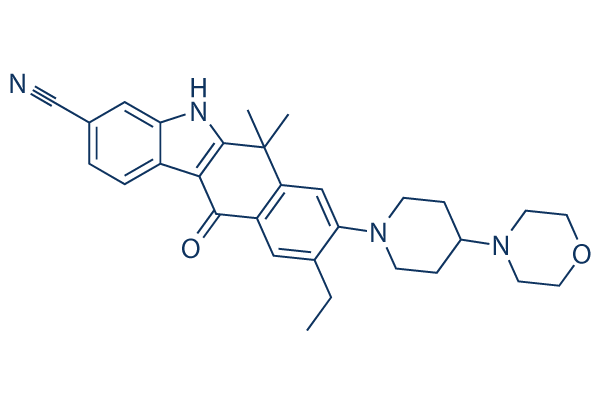
Chemische Struktur
Molekulargewicht: 482.62
Qualitätskontrolle
| Verwandte Ziele | EGFR VEGFR PDGFR FGFR c-Met Src MEK CSF-1R FLT3 HER2 |
|---|---|
| Weitere ALK Inhibitoren | TAE684 (NVP-TAE684) GSK1838705A Repotrectinib (TPX-0005) AZD3463 Ensartinib dihydrochloride AP26113-analog (ALK-IN-1) ASP3026 NVL-655 (Neladalkib) Envonalkib Belizatinib (TSR-011) |
Zellkultur, Behandlung & Arbeitskonzentration
| Zelllinien | Assay-Typ | Konzentration | Inkubationszeit | Formulierung | Aktivitätsbeschreibung | PMID |
|---|---|---|---|---|---|---|
| NCI-H2228 | Kinase assay | ~1 μM | prevents autophosphorylation of ALK | 21575866 | ||
| KARPAS-299 | Growth inhibitory assay | ~10 μM | IC50=3 nM | 21575866 | ||
| SR | Growth inhibitory assay | ~10 μM | IC50=6.9 nM | 21575866 | ||
| HDLM-2 | Growth inhibitory assay | ~10 μM | IC50>10,000 nM | 21575866 | ||
| NB-1 | Growth inhibitory assay | ~10 μM | IC50=4.5 nM | 21575866 | ||
| KELLY | Growth inhibitory assay | ~10 μM | IC50=62 nM | 21575866 | ||
| SK-N-FI | Growth inhibitory assay | ~10 μM | IC50>10,000 nM | 21575866 | ||
| NCI-H2228 | Growth inhibitory assay | ~10 μM | IC50=53 nM | 21575866 | ||
| Calu-3 | Growth inhibitory assay | ~10 μM | IC50=>10,000 nM | 21575866 | ||
| PC-1 | Growth inhibitory assay | ~10 μM | IC50>10,000 nM | 21575866 | ||
| NCI-H23 | Growth inhibitory assay | ~10 μM | IC50=3600 nM | 21575866 | ||
| Calu-1 | Growth inhibitory assay | ~10 μM | IC50>10,000 nM | 21575866 | ||
| NCI-H2009 | Growth inhibitory assay | ~10 μM | IC50>10,000 nM | 21575866 | ||
| NCI-H1993 | Growth inhibitory assay | ~10 μM | IC50>10,000 nM | 21575866 | ||
| MKN-45 | Growth inhibitory assay | ~10 μM | IC50>10,000 nM | 21575866 | ||
| SNU-5 | Growth inhibitory assay | ~10 μM | IC50=1800 nM | 21575866 | ||
| KATO-III | Growth inhibitory assay | ~10 μM | IC50=7900 nM | 21575866 | ||
| SK-BR-3 | Growth inhibitory assay | ~10 μM | IC50>10,000 nM | 21575866 | ||
| BT-483 | Growth inhibitory assay | ~10 μM | IC50>10,000 nM | 21575866 | ||
| PC-3 | Growth inhibitory assay | ~10 μM | IC50>10,000 nM | 21575866 | ||
| 22Rv1 | Growth inhibitory assay | ~10 μM | IC50>10,000 nM | 21575866 | ||
| U-87 MG | Growth inhibitory assay | ~10 μM | IC50>10,000 nM | 21575866 | ||
| H3122 | Growth inhibitory assay | ~10 μM | IC50=33 nM | 25096400 | ||
| LC-2/ad | Apoptosis assay | ~1 μM | DMSO | induces apoptosis | 25349307 | |
| LC-2/ad | Function assay | ~1 μM | DMSO | inhibits the MAPK signaling pathway | 25349307 | |
| Ba/F3 | Function assay | ~1 μM | DMSO | suppresses phosphorylation of ERK and increases the abundance of BIM | 25349307 | |
| SNU-2535 | Growth inhibitory assay | ~10 μM | IC50=33.1 nM | 26849637 | ||
| SNU-2535 | Kinase assay | ~1 μM | inhibits the phosphorylation of ALK and its downstream molecules ERK1/2 and AKT | 26849637 | ||
| Ba/F3 | Function assay | 72 hrs | Inhibition of EML4-ALK C1156Y mutant (unknown origin) expressed in mouse Ba/F3 cells assessed as cell viability after 72 hrs by MTS assay, IC50 = 0.002 μM. | 26568289 | ||
| Ba/F3 | Function assay | 72 hrs | Inhibition of EML4-ALK S1206Y mutant (unknown origin) expressed in mouse Ba/F3 cells assessed as cell viability after 72 hrs by MTS assay, IC50 = 0.002 μM. | 26568289 | ||
| Ba/F3 | Function assay | 72 hrs | Inhibition of wild type EML4-ALK (unknown origin) expressed in mouse Ba/F3 cells assessed as cell viability after 72 hrs by MTS assay, IC50 = 0.002 μM. | 26568289 | ||
| KARPAS299 | Antiproliferative assay | 96 hrs | Antiproliferative activity against human KARPAS299 cells after 96 hrs by cell counting assay, IC50 = 0.003 μM. | 22225917 | ||
| Ba/F3 | Function assay | 72 hrs | Inhibition of EML4-ALK F1174L mutant (unknown origin) expressed in mouse Ba/F3 cells assessed as cell viability after 72 hrs by MTS assay, IC50 = 0.003 μM. | 26568289 | ||
| Ba/F3 | Function assay | 72 hrs | Inhibition of EML4-ALK G1269A mutant (unknown origin) expressed in mouse Ba/F3 cells assessed as cell viability after 72 hrs by MTS assay, IC50 = 0.009 μM. | 26568289 | ||
| NCI-H3122 | Antiproliferative assay | 72 hrs | Antiproliferative activity against human NCI-H3122 cells after 72 hrs by CellTiter-Glo Luminescent Cell Viability Assay, EC50 = 0.009 μM. | 26568289 | ||
| KARPAS299 | Antiproliferative assay | 72 hrs | Antiproliferative activity against human KARPAS299 cells after 72 hrs by SRB/CCK-8 assay, IC50 = 0.015 μM. | 27131066 | ||
| NCI-H3122 | Antiproliferative assay | 72 hrs | Antiproliferative activity against human NCI-H3122 cells after 72 hrs by SRB/CCK-8 assay, IC50 = 0.0174 μM. | 27131066 | ||
| SUP-M2 | Antiproliferative assay | 72 hrs | Antiproliferative activity against human SUP-M2 cells after 72 hrs by SRB/CCK-8 assay, IC50 = 0.0179 μM. | 27131066 | ||
| NCI-H3122 | Function assay | 72 hrs | Inhibition of ALK expressed in human NCI-H3122 cells assessed as cell growth inhibition after 72 hrs by SRB/CCK-8 assay, IC50 = 0.019 μM. | 27131066 | ||
| NCI-H3122 | Antiproliferative assay | 72 hrs | Antiproliferative activity against ALK-dependent human NCI-H3122 cells after 72 hrs, IC50 = 0.019 μM. | 26476749 | ||
| SU-DHL1 | Antiproliferative assay | 72 hrs | Antiproliferative activity against human SU-DHL1 cells after 72 hrs by SRB/CCK-8 assay, IC50 = 0.0205 μM. | 27131066 | ||
| NIH/3T3 | Antiproliferative assay | 72 hrs | Antiproliferative activity against mouse NIH/3T3 cells expressing wild type EML4-ALK after 72 hrs by SRB/CCK-8 assay, IC50 = 0.0323 μM. | 27131066 | ||
| Ba/F3 | Function assay | 72 hrs | Inhibition of EML4-ALK 1151Tins mutant (unknown origin) expressed in mouse Ba/F3 cells assessed as cell viability after 72 hrs by MTS assay, IC50 = 0.072 μM. | 26568289 | ||
| Ba/F3 | Function assay | 72 hrs | Inhibition of EML4-ALK L1196M mutant (unknown origin) expressed in mouse Ba/F3 cells assessed as cell viability after 72 hrs by MTS assay, IC50 = 0.09 μM. | 26568289 | ||
| NIH/3T3 | Antiproliferative assay | 72 hrs | Antiproliferative activity against mouse NIH/3T3 cells expressing EML4-ALK L1196 mutant after 72 hrs by SRB/CCK-8 assay, IC50 = 0.132 μM. | 27131066 | ||
| Ba/F3 | Function assay | 72 hrs | Inhibition of EML4-ALK L1152R mutant (unknown origin) expressed in mouse Ba/F3 cells assessed as cell viability after 72 hrs by MTS assay, IC50 = 0.169 μM. | 26568289 | ||
| Ba/F3 | Function assay | 72 hrs | Inhibition of EML4-ALK G1202R mutant (unknown origin) expressed in mouse Ba/F3 cells assessed as cell viability after 72 hrs by MTS assay, IC50 = 0.207 μM. | 26568289 | ||
| DFCI114 | Antiproliferative assay | 72 hrs | Antiproliferative activity against human DFCI114 cells expressing EML4-ALK G1269A mutant after 72 hrs by CellTiter-Glo Luminescent Cell Viability Assay, EC50 = 0.207 μM. | 26568289 | ||
| CHLA20 | Antiproliferative assay | 72 hrs | Antiproliferative activity against human CHLA20 cells expressing EML4-ALK R1275Q mutant after 72 hrs by CellTiter-Glo Luminescent Cell Viability Assay, EC50 = 0.43 μM. | 26568289 | ||
| Kelly | Antiproliferative assay | 72 hrs | Antiproliferative activity against human Kelly cells expressing EML4-ALK F1174L mutant after 72 hrs by CellTiter-Glo Luminescent Cell Viability Assay, EC50 = 0.434 μM. | 26568289 | ||
| DFCI76 | Antiproliferative assay | 72 hrs | Antiproliferative activity against human DFCI76 cells expressing EML4-ALK L1152R mutant after 72 hrs by CellTiter-Glo Luminescent Cell Viability Assay, EC50 = 0.511 μM. | 26568289 | ||
| LAN5 | Antiproliferative assay | 72 hrs | Antiproliferative activity against human LAN5 cells expressing EML4-ALK R1275Q mutant after 72 hrs by CellTiter-Glo Luminescent Cell Viability Assay, EC50 = 0.617 μM. | 26568289 | ||
| SMS-KCNR | Antiproliferative assay | 72 hrs | Antiproliferative activity against human SMS-KCNR cells expressing EML4-ALK R1275Q mutant after 72 hrs by CellTiter-Glo Luminescent Cell Viability Assay, EC50 = 0.765 μM. | 26568289 | ||
| SK-N-SH | Antiproliferative assay | 72 hrs | Antiproliferative activity against human SK-N-SH cells expressing EML4-ALK F1174L mutant after 72 hrs by CellTiter-Glo Luminescent Cell Viability Assay, EC50 = 0.872 μM. | 26568289 | ||
| SH-SY5Y | Antiproliferative assay | 72 hrs | Antiproliferative activity against human SH-SY5Y cells expressing EML4-ALK F1174L mutant after 72 hrs by CellTiter-Glo Luminescent Cell Viability Assay, EC50 = 1.15 μM. | 26568289 | ||
| SK-N-BE(2) | Antiproliferative assay | 72 hrs | Antiproliferative activity against human SK-N-BE(2) cells expressing wild type EML4-ALK after 72 hrs by CellTiter-Glo Luminescent Cell Viability Assay, EC50 = 1.554 μM. | 26568289 | ||
| LAN1 | Antiproliferative assay | 72 hrs | Antiproliferative activity against human LAN1 cells expressing EML4-ALK F1174L mutant after 72 hrs by CellTiter-Glo Luminescent Cell Viability Assay, EC50 = 2.004 μM. | 26568289 | ||
| SK-N-AS | Antiproliferative assay | 72 hrs | Antiproliferative activity against human SK-N-AS cells expressing wild type EML4-ALK after 72 hrs by CellTiter-Glo Luminescent Cell Viability Assay, EC50 = 2.139 μM. | 26568289 | ||
| SK-N-FI | Antiproliferative assay | 72 hrs | Antiproliferative activity against human SK-N-FI cells expressing wild type EML4-ALK after 72 hrs by CellTiter-Glo Luminescent Cell Viability Assay, EC50 = 2.401 μM. | 26568289 | ||
| NIH/3T3 | Antitumor assay | 50 mg/kg | 10 days | Antitumor activity against mouse NIH/3T3 cells expressing EML4-ALK L1196M mutant xenografted in nude mouse assessed as tumor stasis at 50 mg/kg, po qd administered for 10 days | 27131066 | |
| NIH/3T3 | Antitumor assay | 50 mg/kg | 10 days | Antitumor activity against mouse NIH/3T3 cells expressing EML4-ALK L1196M mutant xenografted in nude mouse assessed as partial tumor regression at 50 mg/kg, po qd administered for 10 days | 27131066 | |
| Klicken Sie hier, um weitere experimentelle Daten zu Zelllinien anzuzeigen | ||||||
Chemische Informationen, Lagerung & Stabilität
| Molekulargewicht | 482.62 | Formel | C30H34N4O2 |
Lagerung (Ab dem Eingangsdatum) | |
|---|---|---|---|---|---|
| CAS-Nr. | 1256580-46-7 | SDF herunterladen | Lagerung von Stammlösungen |
|
|
| Synonyme | AF-802, RG-7853,CH5424802 | Smiles | CCC1=CC2=C(C=C1N3CCC(CC3)N4CCOCC4)C(C5=C(C2=O)C6=C(N5)C=C(C=C6)C#N)(C)C | ||
Löslichkeit
|
In vitro |
DMSO
: 7 mg/mL
(14.5 mM)
Water : Insoluble Ethanol : Insoluble |
Molaritätsrechner
|
In vivo |
|||||
In-vivo-Formulierungsrechner (Klare Lösung)
Schritt 1: Geben Sie die untenstehenden Informationen ein (Empfohlen: Ein zusätzliches Tier zur Berücksichtigung von Verlusten während des Experiments)
Schritt 2: Geben Sie die In-vivo-Formulierung ein (Dies ist nur der Rechner, keine Formulierung. Bitte kontaktieren Sie uns zuerst, wenn es im Abschnitt "Löslichkeit" keine In-vivo-Formulierung gibt.)
Berechnungsergebnisse:
Arbeitskonzentration: mg/ml;
Methode zur Herstellung der DMSO-Stammlösung: mg Wirkstoff vorgelöst in μL DMSO ( Konzentration der Stammlösung mg/mL, Bitte kontaktieren Sie uns zuerst, wenn die Konzentration die DMSO-Löslichkeit der Wirkstoffcharge überschreitet. )
Methode zur Herstellung der In-vivo-Formulierung: Nehmen Sie μL DMSO Stammlösung, dann hinzufügenμL PEG300, mischen und klären, dann hinzufügenμL Tween 80, mischen und klären, dann hinzufügen μL ddH2O, mischen und klären.
Methode zur Herstellung der In-vivo-Formulierung: Nehmen Sie μL DMSO Stammlösung, dann hinzufügen μL Maisöl, mischen und klären.
Hinweis: 1. Bitte stellen Sie sicher, dass die Flüssigkeit klar ist, bevor Sie das nächste Lösungsmittel hinzufügen.
2. Achten Sie darauf, das/die Lösungsmittel der Reihe nach hinzuzufügen. Sie müssen sicherstellen, dass die bei der vorherigen Zugabe erhaltene Lösung eine klare Lösung ist, bevor Sie mit der Zugabe des nächsten Lösungsmittels fortfahren. Physikalische Methoden wie Vortex, Ultraschall oder ein heißes Wasserbad können zur Unterstützung des Lösens verwendet werden.
Wirkmechanismus
| Targets/IC50/Ki |
ALK (F1174L)
(Cell-free assay) 1 nM
ALK
(Cell-free assay) 1.9 nM
ALK (R1275Q)
(Cell-free assay) 3.5 nM
|
|---|---|
| In vitro |
Der Dissoziationskonstanten (KD)-Wert von CH5424802 für ALK im ATP-kompetitiven Modus beträgt 2,4 nM. CH5424802 hat eine erhebliche Hemmwirkung sowohl gegen natives ALK als auch gegen L1196M mit Ki von 0,83 nM bzw. 1,56 nM. CH5424802 verhindert die Autophosphorylierung von ALK in NCI-H2228 NSCLC-Zellen, die EML4-ALK exprimieren. CH5424802 unterdrückt auch die Phosphorylierung von STAT3 und AKT, aber nicht die von ERK1/2. CH5424802 hemmt die Phosphorylierung von STAT3 an Tyr705 vollständig. CH5424802 ist vorzugsweise wirksam gegen NCI-H2228-Zellen, die EML4-ALK exprimieren, aber nicht gegen ALK-Fusions-negative NSCLC-Zelllinien, einschließlich HCC827-Zellen (EGFR-Exon-19-Deletion), A549-Zellen (KRAS-Mutante) oder NCI-H522-Zellen (EGFR-Wildtyp, KRAS-Wildtyp und ALK-Wildtyp) in Monolayer-Kultur. CH5424802 löst einen apoptotischen Marker – Caspase-3/7-ähnliche Aktivierung – in NCI-H2228-Sphäroidzellen aus. CH5424802 blockiert das Wachstum von zwei Lymphomlinien, KARPAS-299 und SR, mit NPM-ALK-Fusionsprotein, beeinflusst aber nicht das Wachstum einer HDLM-2-Lymphomlinie ohne ALK-Fusion. CH5424802 zeigt eine hohe Zielselektivität und die stärkere antiproliferative Aktivität gegen KARPAS-299. CH5424802 hemmt KAPRAS-299 mit einer IC50 von 3 nM und KDR mit einer IC50 von 1,4 μM. Die metabolische Stabilität von CH5424802 ist sehr hoch.
|
| Kinase-Assay |
Kinase-Inhibitions-Assays in vitro
|
|
Die Hemmfähigkeit gegen jede Kinase außer MEK1 und Raf-1 wird durch die Untersuchung ihrer Fähigkeit, verschiedene Substratpeptide in Gegenwart von CH5424802 zu phosphorylieren, unter Verwendung des zeitaufgelösten Fluoreszenzresonanzenergietransfer-Assays (TR-FRET) oder des Fluoreszenzpolarisations-Assays (FP) bewertet. Die Hemmwirkung gegen MEK1 wird durch die quantitative Analyse der Phosphorylierung eines Substratpeptids durch ein rekombinantes ERK2-Protein in Gegenwart von CH5424802 bewertet. Die Hemmwirkung gegen Raf-1 wird durch die Untersuchung der Fähigkeit der Kinasen, MEK1 in Gegenwart von CH5424802 zu phosphorylieren, bewertet.
|
|
| In vivo |
Die orale Verabreichung von CH5424802 hemmt das Tumorwachstum dosisabhängig mit einer ED50 von 0,46 mg/kg und führt zu einer Tumorregression. Die Behandlung mit 20 mg/kg CH5424802 zeigt eine schnelle Tumorregression um 168 %, das Tumorvolumen in jeder Maus beträgt nach 11 Tagen Behandlung (an Tag 28) <30 mm3, ein potenter Antitumoreffekt wird aufrechterhalten und ein erneutes Tumorwachstum tritt während der 4-wöchigen medikamentenfreien Periode nicht auf. Die Halbwertszeit und die orale Bioverfügbarkeit von CH5424802 bei Mäusen betragen 8,6 Stunden bzw. 70,8 %. Bei einer wiederholten Dosis von 6 mg/kg erreichten die mittleren Plasmaspiegel 1,7, 1,5 und 0,3 nM 2, 7 und 24 Stunden nach der Dosis. Die Verabreichung von CH5424802 führt zur Verhinderung des Tumorwachstums und zur Tumorregression. Die Tumorwachstumshemmung bei 20 mg/kg beträgt 119 % für KARPAS-299 und 104 % für NB-1 an Tag 20. CH5424802 hemmt die Phosphorylierung von STAT3 dosisabhängig (2–20 mg/kg). Eine teilweise Abnahme der AKT-Phosphorylierung wird auch in CH5424802-behandelten Xenograft-Tumoren beobachtet.
|
Literatur |
|
Anwendungen
| Methoden | Biomarker | Bilder | PMID |
|---|---|---|---|
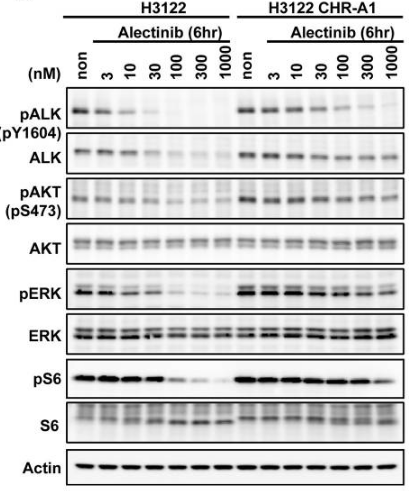
| Western blot | pALK / ALK / pAKT / AKT / pERK / ERK / pS6 / S6 PARP / cleaved PARP / Akt / caspase 3 / Cleaved caspase 3 pROS1 / ROS1 / pSTAT3 / STAT3 p-EGFR Tyr1068 / EGFR / p-HER3 Tyr1222 / HER3 / p-IGF-1R Tyr1135 / IGF-1R |
|
25228534 |
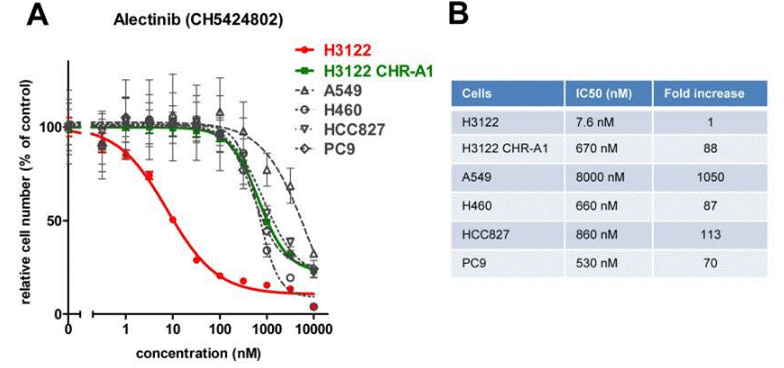
| Growth inhibition assay | Cell viability |
|
25228534 |
Klinische Studieninformationen
(Daten von https://clinicaltrials.gov, aktualisiert am 2024-05-22)
| NCT-Nummer | Rekrutierung | Erkrankungen | Sponsor/Kooperationspartner | Startdatum | Phasen |
|---|---|---|---|---|---|
| NCT05987956 | Not yet recruiting | Non-small Cell Lung Cancer |
Han Xu M.D. Ph.D. FAPCR Sponsor-Investigator IRB Chair|Medicine Invention Design Inc |
March 8 2024 | Phase 2|Phase 3 |
| NCT05987644 | Recruiting | Lung Cancer|NSCLC|Brain Metastases |
Joshua Palmer|Genentech Inc.|Hoosier Cancer Research Network |
March 7 2024 | Phase 1|Phase 2 |
| NCT05710133 | Enrolling by invitation | NSCLC |
The Netherlands Cancer Institute |
February 1 2024 | Not Applicable |
| NCT05770037 | Recruiting | Solid Tumor|Haematological Malignancy|Malignant Neoplasm|Lymphoproliferative Disorders|Neoplasms by Histologic Type|Neoplasms by Site|Cancer|Anaplastic Large Cell Lymphoma|Lymphoma|Renal Cell Carcinoma|Neuroblastoma |
Cancer Research UK|University of Manchester|University of Birmingham|Royal Marsden NHS Foundation Trust|Hoffmann-La Roche |
December 18 2023 | Phase 2|Phase 3 |
| NCT05525338 | Recruiting | Drug Monitoring|Carcinoma Non-Small-Cell Lung|Lung Cancer|Anaplastic Lymphoma Kinase Gene Mutation|Anaplastic Lymphoma Kinase Gene Translocation |
University Medical Center Groningen|Academisch Medisch Centrum - Universiteit van Amsterdam (AMC-UvA)|Erasmus Medical Center|Maastricht University Medical Center|Radboud University Medical Center|The Netherlands Cancer Institute|Leiden University Medical Center |
March 23 2022 | Phase 4 |
| NCT04774718 | Recruiting | ALK Fusion-positive Solid or CNS Tumors |
Hoffmann-La Roche |
September 14 2021 | Phase 1|Phase 2 |
Technischer Support
Tel: +1-832-582-8158 Ext:3
Wenn Sie weitere Fragen haben, hinterlassen Sie bitte eine Nachricht.

Produkte sind nur für Forschungszwecke bestimmt. Nicht für den menschlichen Gebrauch. Wir verkaufen nicht an Patienten.
©Copyright 2013 Selleck Chemicals. Alle Rechte vorbehalten.