
nur für Forschungszwecke
GMX1778 NAMPT Inhibitor
Kat.-Nr.S8117
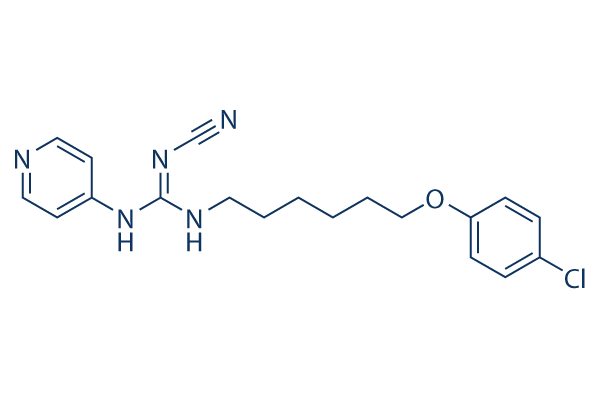
Chemische Struktur
Molekulargewicht: 371.86
Qualitätskontrolle
- In Nature Medicine für seine erstklassige Qualität zitiert
- COA
- NMR
- HPLC
- SDS
- Datenblatt
| Verwandte Ziele | Dehydrogenase HSP Transferase P450 (e.g. CYP17) PDE phosphatase PPAR Vitamin Carbohydrate Metabolism Mitochondrial Metabolism |
|---|---|
| Weitere NAMPT Inhibitoren | OT-82 Padnarsertib (KPT-9274, ATG-019) STF-118804 P7C3 GNE-617 SBI-797812 |
Zellkultur, Behandlung & Arbeitskonzentration
| Zelllinien | Assay-Typ | Konzentration | Inkubationszeit | Formulierung | Aktivitätsbeschreibung | PMID |
|---|---|---|---|---|---|---|
| A2780 | Cytotoxicity assay | 72 hrs | Cytotoxicity against human A2780 cells after 72 hrs by SRB assay, IC50=0.005μM | 23617784 | ||
| NYH | Cytotoxicity assay | 3 weeks | Cytotoxicity against human NYH cells after 3 weeks by clonogenic survival assay, LD50=0.0017μM | 23679915 | ||
| A2780 | Antiproliferative assay | 72 hrs | Antiproliferative activity against human A2780 cells assessed as growth inhibition after 72 hrs by SRB-based microplate reader analysis, IC50=0.005μM | 23859118 | ||
| A2780 | Cytotoxicity assay | 72 hrs | Cytotoxicity against human A2780 cells assessed as growth inhibition after 72 hrs by WST-1 assay, IC50=0.00056μM | 24164086 | ||
| MCF-7 | Cytotoxicity assay | 72 hrs | Cytotoxicity against human MCF-7 cells assessed as growth inhibition after 72 hrs by WST-1 assay, IC50=0.0016μM | 24164086 | ||
| HepG2 | Function assay | 1 hr | Inhibition of NAMPT in human HepG2 cells using [14C]-nicotinamide/PRPP as substrate assessed as formation of [14C]-nicotinamide mononucleotide after 1 hr by liquid scintillation counting analysis, IC50=0.0183μM | 24164086 | ||
| A2780 | Antiproliferative assay | 72 hrs | Antiproliferative activity against human A2780 cells after 72 hrs by sulforhodamine B assay, IC50=0.005μM | 24405419 | ||
| HONE1 | Cytotoxicity assay | 24 hrs | Cytotoxicity against human HONE1 cells after 24 hrs by SRB assay, IC50=0.015μM | 25147148 | ||
| MCF | Cytotoxicity assay | 24 hrs | Cytotoxicity against human MCF cells after 24 hrs by SRB assay, IC50=0.018μM | 25147148 | ||
| NUGC | Cytotoxicity assay | 24 hrs | Cytotoxicity against human NUGC cells after 24 hrs by SRB assay, IC50=0.025μM | 25147148 | ||
| HepG2 | Cytotoxicity assay | 24 hrs | Cytotoxicity against human HepG2 cells after 24 hrs by SRB assay, IC50=1.245μM | 25147148 | ||
| HA22T | Cytotoxicity assay | 24 hrs | Cytotoxicity against human HA22T cells after 24 hrs by SRB assay, IC50=2.067μM | 25147148 | ||
| DLD1 | Cytotoxicity assay | 24 hrs | Cytotoxicity against human DLD1 cells after 24 hrs by SRB assay, IC50=2.315μM | 25147148 | ||
| A2780 | Function assay | 72 hrs | Inhibition of NAMPT in human A2780 cells assessed as decrease in cell viability after 72 hrs by SRB assay, IC50=0.001μM | 27541271 | ||
| Rosetta (DE3) | Function assay | 15 mins | Inhibition of human full length C-terminal His6-tagged NAMPT expressed in Escherichia coli Rosetta (DE3) cells using nicotinamide as substrate incubated for 15 mins prior to substrate addition measured after 30 mins in presence of PRPP, IC50=0.002μM | 27541271 | ||
| PC3 | Antiproliferative assay | 5 days | Antiproliferative activity against human PC3 cells assessed as reduction in cell viability incubated for 5 days by Cell-titer Glo reagent based assay, IC50=0.0044μM | 28610984 | ||
| TC32 | qHTS assay | qHTS of pediatric cancer cell lines to identify multiple opportunities for drug repurposing: Primary screen for TC32 cells | 29435139 | |||
| DAOY | qHTS assay | qHTS of pediatric cancer cell lines to identify multiple opportunities for drug repurposing: Primary screen for DAOY cells | 29435139 | |||
| SJ-GBM2 | qHTS assay | qHTS of pediatric cancer cell lines to identify multiple opportunities for drug repurposing: Primary screen for SJ-GBM2 cells | 29435139 | |||
| A673 | qHTS assay | qHTS of pediatric cancer cell lines to identify multiple opportunities for drug repurposing: Primary screen for A673 cells | 29435139 | |||
| SK-N-MC | qHTS assay | qHTS of pediatric cancer cell lines to identify multiple opportunities for drug repurposing: Primary screen for SK-N-MC cells | 29435139 | |||
| BT-37 | qHTS assay | qHTS of pediatric cancer cell lines to identify multiple opportunities for drug repurposing: Primary screen for BT-37 cells | 29435139 | |||
| NB-EBc1 | qHTS assay | qHTS of pediatric cancer cell lines to identify multiple opportunities for drug repurposing: Primary screen for NB-EBc1 cells | 29435139 | |||
| U-2 OS | qHTS assay | qHTS of pediatric cancer cell lines to identify multiple opportunities for drug repurposing: Primary screen for U-2 OS cells | 29435139 | |||
| SK-N-SH | qHTS assay | qHTS of pediatric cancer cell lines to identify multiple opportunities for drug repurposing: Primary screen for SK-N-SH cells | 29435139 | |||
| NB1643 | qHTS assay | qHTS of pediatric cancer cell lines to identify multiple opportunities for drug repurposing: Primary screen for NB1643 cells | 29435139 | |||
| LAN-5 | qHTS assay | qHTS of pediatric cancer cell lines to identify multiple opportunities for drug repurposing: Primary screen for LAN-5 cells | 29435139 | |||
| BT-12 | qHTS assay | qHTS of pediatric cancer cell lines to identify multiple opportunities for drug repurposing: Primary screen for BT-12 cells | 29435139 | |||
| Rh18 | qHTS assay | qHTS of pediatric cancer cell lines to identify multiple opportunities for drug repurposing: Primary screen for Rh18 cells | 29435139 | |||
| OHS-50 | qHTS assay | qHTS of pediatric cancer cell lines to identify multiple opportunities for drug repurposing: Primary screen for OHS-50 cells | 29435139 | |||
| RD | qHTS assay | qHTS of pediatric cancer cell lines to identify multiple opportunities for drug repurposing: Primary screen for RD cells | 29435139 | |||
| MG 63 (6-TG R) | qHTS assay | qHTS of pediatric cancer cell lines to identify multiple opportunities for drug repurposing: Primary screen for MG 63 (6-TG R) cells | 29435139 | |||
| Rh30 | qHTS assay | qHTS of pediatric cancer cell lines to identify multiple opportunities for drug repurposing: Primary screen for Rh30 cells | 29435139 | |||
| Rh41 | qHTS assay | qHTS of pediatric cancer cell lines to identify multiple opportunities for drug repurposing: Primary screen for Rh41 cells | 29435139 | |||
| NB1643 | qHTS assay | qHTS of pediatric cancer cell lines to identify multiple opportunities for drug repurposing: Confirmatory screen for NB1643 cells | 29435139 | |||
| A673 | qHTS assay | qHTS of pediatric cancer cell lines to identify multiple opportunities for drug repurposing: Confirmatory screen for A673 cells) | 29435139 | |||
| SK-N-MC | qHTS assay | qHTS of pediatric cancer cell lines to identify multiple opportunities for drug repurposing: Confirmatory screen for SK-N-MC cells | 29435139 | |||
| LAN-5 | qHTS assay | qHTS of pediatric cancer cell lines to identify multiple opportunities for drug repurposing: Confirmatory screen for LAN-5 cells | 29435139 | |||
| DAOY | qHTS assay | qHTS of pediatric cancer cell lines to identify multiple opportunities for drug repurposing: Confirmatory screen for DAOY cells | 29435139 | |||
| NB-EBc1 | qHTS assay | qHTS of pediatric cancer cell lines to identify multiple opportunities for drug repurposing: Confirmatory screen for NB-EBc1 cells | 29435139 | |||
| SJ-GBM2 | qHTS assay | qHTS of pediatric cancer cell lines to identify multiple opportunities for drug repurposing: Confirmatory screen for SJ-GBM2 cells | 29435139 | |||
| BT-37 | qHTS assay | qHTS of pediatric cancer cell lines to identify multiple opportunities for drug repurposing: Confirmatory screen for BT-37 cells | 29435139 | |||
| TC32 | qHTS assay | qHTS of pediatric cancer cell lines to identify multiple opportunities for drug repurposing: Confirmatory screen for TC32 cells | 29435139 | |||
| U-2 OS | qHTS assay | qHTS of pediatric cancer cell lines to identify multiple opportunities for drug repurposing: Confirmatory screen for U-2 OS cells | 29435139 | |||
| Rh41 | qHTS assay | qHTS of pediatric cancer cell lines to identify multiple opportunities for drug repurposing: Confirmatory screen for Rh41 cells | 29435139 | |||
| RD | qHTS assay | qHTS of pediatric cancer cell lines to identify multiple opportunities for drug repurposing: Confirmatory screen for RD cells | 29435139 | |||
| Rh18 | qHTS assay | qHTS of pediatric cancer cell lines to identify multiple opportunities for drug repurposing: Confirmatory screen for Rh18 cells | 29435139 | |||
| Rh30 | qHTS assay | qHTS of pediatric cancer cell lines to identify multiple opportunities for drug repurposing: Confirmatory screen for Rh30 cells | 29435139 | |||
| Saos-2 | qHTS assay | qHTS of pediatric cancer cell lines to identify multiple opportunities for drug repurposing: Confirmatory screen for Saos-2 cells | 29435139 | |||
| 4T1 | Antitumor assay | 10 mg/kg | 12 days | Antitumor activity against mouse 4T1 cells implanted in BALB/c mouse assessed as reduction in tumour volume at 10 mg/kg, ip bid for 12 days by vernier caliper method | 31400709 | |
| 4T1 | Antitumor assay | 10 mg/kg | 12 days | Antitumor activity against mouse 4T1 cells implanted in BALB/c mouse assessed as reduction in tumor weight at 10 mg/kg, ip bid for 12 days | 31400709 | |
| 4T1 | Antitumor assay | 10 mg/kg | 12 days | Antitumor activity against mouse 4T1 cells implanted in Balb/c mouse mouse assessed as inhibition of tumor metastasis at 10 mg/kg, ip bid for 12 days measured post last dose by crystal violet staining based thioguanine clonogenic assay | 31400709 | |
| Klicken Sie hier, um weitere experimentelle Daten zu Zelllinien anzuzeigen | ||||||
Chemische Informationen, Lagerung & Stabilität
| Molekulargewicht | 371.86 | Formel | C19H22ClN5O |
Lagerung (Ab dem Eingangsdatum) | |
|---|---|---|---|---|---|
| CAS-Nr. | 200484-11-3 | SDF herunterladen | Lagerung von Stammlösungen |
|
|
| Synonyme | CHS828 | Smiles | C1=CC(=CC=C1OCCCCCCN=C(NC#N)NC2=CC=NC=C2)Cl | ||
Löslichkeit
|
In vitro |
DMSO
: 74 mg/mL
(198.99 mM)
Water : Insoluble Ethanol : Insoluble |
Molaritätsrechner
|
In vivo |
|||||
In-vivo-Formulierungsrechner (Klare Lösung)
Schritt 1: Geben Sie die untenstehenden Informationen ein (Empfohlen: Ein zusätzliches Tier zur Berücksichtigung von Verlusten während des Experiments)
Schritt 2: Geben Sie die In-vivo-Formulierung ein (Dies ist nur der Rechner, keine Formulierung. Bitte kontaktieren Sie uns zuerst, wenn es im Abschnitt "Löslichkeit" keine In-vivo-Formulierung gibt.)
Berechnungsergebnisse:
Arbeitskonzentration: mg/ml;
Methode zur Herstellung der DMSO-Stammlösung: mg Wirkstoff vorgelöst in μL DMSO ( Konzentration der Stammlösung mg/mL, Bitte kontaktieren Sie uns zuerst, wenn die Konzentration die DMSO-Löslichkeit der Wirkstoffcharge überschreitet. )
Methode zur Herstellung der In-vivo-Formulierung: Nehmen Sie μL DMSO Stammlösung, dann hinzufügenμL PEG300, mischen und klären, dann hinzufügenμL Tween 80, mischen und klären, dann hinzufügen μL ddH2O, mischen und klären.
Methode zur Herstellung der In-vivo-Formulierung: Nehmen Sie μL DMSO Stammlösung, dann hinzufügen μL Maisöl, mischen und klären.
Hinweis: 1. Bitte stellen Sie sicher, dass die Flüssigkeit klar ist, bevor Sie das nächste Lösungsmittel hinzufügen.
2. Achten Sie darauf, das/die Lösungsmittel der Reihe nach hinzuzufügen. Sie müssen sicherstellen, dass die bei der vorherigen Zugabe erhaltene Lösung eine klare Lösung ist, bevor Sie mit der Zugabe des nächsten Lösungsmittels fortfahren. Physikalische Methoden wie Vortex, Ultraschall oder ein heißes Wasserbad können zur Unterstützung des Lösens verwendet werden.
Wirkmechanismus
| Targets/IC50/Ki |
NAMPT
<25 nM
NAMPT
120 nM(Kd)
|
|---|---|
| In vitro |
GMX1778 induziert die NAD+-Depletion durch Hemmung der NAD+-Biosynthese, gefolgt von einer ATP-Depletion und führte letztendlich zum Zelltod. Diese Verbindung induziert den programmierten Zelltod mit apoptotischen Merkmalen. Es unterdrückt die Aktivität des nukleären Faktor-kappa B in Krebszellen durch Herunterregulierung der IKK-Aktivität (IC50=8 nM). |
| Kinase-Assay |
In-vitro-gekoppelter-Enzym-NAMPT-Assay
|
|
Die Aktivität der rekombinanten NAMPT wird unter Verwendung eines gekoppelten Enzymassays bestimmt, der auf der Quantifizierung von NAD+ basiert. Die Reaktionen werden bei Raumtemperatur für 180 Minuten unter Verwendung von Mischungen durchgeführt, die aus 50 mM HEPES (pH 7,4), 50 mM KCl, 5 mM MgCl2, 0,5 mM β-Mercaptoethanol, 0,005 % Rinderalbumin, 1 % DMSO, 2,0 U/ml Laktatdehydrogenase, 4 mM Natrium-L-Laktat, 0,4 U/ml Diaphorase, 6 μM Resazurin-Natriumsalz, 0,4 mM PRPP, 3,0 nM NMNAT1, 125 μM ATP, 50 μM NM und 2 bis 5 μM rekombinanter NAMPT bestehen. Die Fluoreszenz wird mit einem Tecan Safire Plattenlesegerät gemessen (Anregungswellenlänge, 560 nm; Emissionswellenlänge, 590 nm). Die Ki-Werte werden mit der Software Graphpad Prism 4.0 und der Cheng-Prusoff-Gleichung berechnet.
|
|
| In vivo |
GMX1778 (250 mg/kg, p.o.) zeigt eine ausgeprägte Antitumoraktivität gegen drei verschiedene menschliche neuroendokrine Tumoren, Mitteldarmkarzinoid (GOT1), Pankreaskarzinoid (BON) und medulläres Schilddrüsenkarzinom (GOT2), die in Nacktmäuse transplantiert wurden. |
Literatur |
|
Technischer Support
Tel: +1-832-582-8158 Ext:3
Wenn Sie weitere Fragen haben, hinterlassen Sie bitte eine Nachricht.
Häufig gestellte Fragen
Frage 1:
Could you please suggest me the suitable formulation of it for in vivo study?
Antwort:
It can be dissolved in 1%CMC-Na (suspension) for oral administration.

Produkte sind nur für Forschungszwecke bestimmt. Nicht für den menschlichen Gebrauch. Wir verkaufen nicht an Patienten.
©Copyright 2013 Selleck Chemicals. Alle Rechte vorbehalten.