
nur für Forschungszwecke
GW3965 Hydrochloride LXR Agonist
Kat.-Nr.S2630
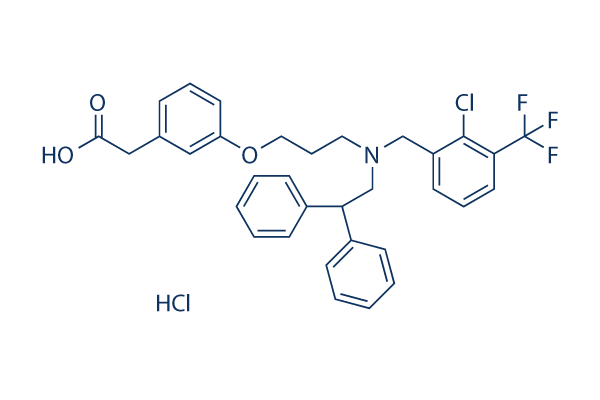
Chemische Struktur
Molekulargewicht: 618.51
Qualitätskontrolle
Produkte, die oft zusammen verwendet werden mit GW3965 Hydrochloride
| Verwandte Ziele | Dehydrogenase HSP Transferase P450 (e.g. CYP17) PDE phosphatase PPAR Vitamin Carbohydrate Metabolism Mitochondrial Metabolism |
|---|---|
| Weitere Liver X Receptor Inhibitoren | T0901317 LXR-623 (WAY-252623) GSK2033 SR9243 Abequolixron (RGX-104) AZ876 GSK3987 Desmosterol |
Zellkultur, Behandlung & Arbeitskonzentration
| Zelllinien | Assay-Typ | Konzentration | Inkubationszeit | Formulierung | Aktivitätsbeschreibung | PMID |
|---|---|---|---|---|---|---|
| HEK293 | 10 uM | 20 hrs | Activation of human LXRalpha expressed in HEK293 cells co-expressing human RXRalpha at 10 uM after 20 hrs by luciferase reporter gene assay | 28006909 | ||
| HEK293 | 10 uM | 20 hrs | Activation of rat LXRbeta expressed in HEK293 cells co-expressing human RXRalpha at 10 uM after 20 hrs by luciferase reporter gene assay | 28006909 | ||
| THP1 | Function assay | Induction of cholesterol efflux in THP1 cells, EC50 = 0.01 μM. | 17587573 | |||
| THP1 | Function assay | 18 hrs | Induction of cholesterol efflux in THP1 cells after 18 hrs, EC50 = 0.01 μM. | 17416521 | ||
| COS7 | Function assay | 16 hrs | Agonist activity at human LXRbeta receptor transfected in COS7 cells after 16 hrs by reporter transactivation assay, EC50 = 0.015 μM. | 17587573 | ||
| COS7 | Function assay | Activation of LXRbeta co-transfected in COS7 cells with RXRalpha by reporter transactivation assay, EC50 = 0.015 μM. | 17416521 | |||
| THP1 | Antiinflammatory assay | 6 hrs | Antiinflammatory activity against human THP1 cells assessed as inhibition of LPS-stimulated IL6 production after 6 hrs by ELISA, IC50 = 0.02 μM. | 18800767 | ||
| THP1 | Function assay | Agonist activity at GAL-linked human LXRbeta expressed in THP1 cells assessed as stimulation of co-activator recruitment by FRET assay, EC50 = 0.027 μM. | 17665897 | |||
| RAW264.7 | Function assay | 24 hrs | Induction of [3H]cholesterol efflux in mouse RAW264.7 cells loaded with acetylated-LDL after 24 hrs, EC50 = 0.029 μM. | 19717304 | ||
| THP1 | Function assay | Stimulation of [3H]cholesterol efflux in human THP1 foam cells loaded with ac-LDL, EC50 = 0.031 μM. | 18973288 | |||
| CV1 | Function assay | Antagonist activity at LXRbeta ligand binding domain assessed as inhibition of T1317-induced transcriptional activity in african green monkey CV1 cells co-transfected with Gal4-SRC1 by luciferase reporter assay, IC50 = 0.03981 μM. | 20345102 | |||
| THP1 | Function assay | Agonist activity at GAL-linked human LXRalpha expressed in THP1 cells assessed as stimulation of coactivator recruitment by FRET assay, EC50 = 0.097 μM. | 17665897 | |||
| CV1 | Function assay | Antagonist activity at LXRalpha ligand binding domain assessed as inhibition of T1317-induced transcriptional activity in african green monkey CV1 cells co-transfected with Gal4-SRC1 by luciferase reporter assay, IC50 = 0.1 μM. | 20345102 | |||
| SH-SY5Y | Function assay | 24 hrs | Agonist activity at human LXRbeta expressed in human SH-SY5Y cells co-transfected with Gal4-LBD after 24 hrs by luciferase reporter gene assay, EC50 = 0.13 μM. | 19264481 | ||
| HepG2 | Function assay | Effect on SREBP1c gene expression in human HepG2 cells, EC50 = 0.21 μM. | 18973288 | |||
| HuH7 | Function assay | Agonist activity at human recombinant LXRbeta ligand binding domain in human HuH7 cells co-transfected with fused Gal4-DBD by transactivation assay, EC50 = 0.31 μM. | 18973288 | |||
| SH-SY5Y | Function assay | 24 hrs | Agonist activity at human LXRalpha expressed in human SH-SY5Y cells co-transfected with Gal4-LBD after 24 hrs by luciferase reporter gene assay, EC50 = 0.31 μM. | 19264481 | ||
| CHO | Function assay | Agonist activity at human LXR beta receptor expressed in CHO cells by reporter assay, EC50 = 0.41 μM. | 17034119 | |||
| CHOK1 | Function assay | 24 hrs | Agonist activity at Gal4-tagged LXRbeta (unknown origin) expressed in CHOK1 cells after 24 hrs by luciferase reporter gene assay, EC50 = 0.42 μM. | 25677664 | ||
| THP1 | Function assay | Effect on ABCA1 gene expression in human differentiated THP1 cells, EC50 = 0.434 μM. | 18973288 | |||
| CV1 | Function assay | Agonist activity at LXRbeta ligand binding domain-mediated transcriptional activity in african green monkey CV1 cells co-transfected with Gal4-SRC1 by luciferase reporter assay, EC50 = 0.50119 μM. | 20345102 | |||
| HuH7 | Function assay | Agonist activity at human recombinant LXRalpha ligand binding domain in human HuH7 cells co-transfected with fused Gal4-DBD by transactivation assay, EC50 = 0.66 μM. | 18973288 | |||
| CV1 | Function assay | Agonist activity at LXRalpha ligand binding domain-mediated transcriptional activity in african green monkey CV1 cells co-transfected with Gal4-SRC1 by luciferase reporter assay, EC50 = 0.79433 μM. | 20345102 | |||
| CHOK1 | Function assay | 24 hrs | Agonist activity at Gal4-tagged LXRalpha (unknown origin) expressed in CHOK1 cells after 24 hrs by luciferase reporter gene assay, EC50 = 1.3 μM. | 25677664 | ||
| HepG2 | Function assay | Effect on triglyceride accumulation in human HepG2 cells, EC50 = 2.002 μM. | 18973288 | |||
| HepG2 | Function assay | 500 nM | Inhibition of 2-(3-(3-((2-chloro-3-(trifluoromethyl)benzyl)(2,2-diphenylethyl)amino)propoxy)phenyl)acetic acid-induced srebp1c mRNA expression in human HepG2 cells at 500 nM | 18800767 | ||
| HepG2 | Function assay | 500 nM | Inhibition of 2-(3-(3-((2-chloro-3-(trifluoromethyl)benzyl)(2,2-diphenylethyl)amino)propoxy)phenyl)acetic acid-induced fas mRNA expression in human HepG2 cells at 500 nM | 18800767 | ||
| RAW264.7 | Function assay | 1 uM | Reduction of LPS-stimulated iNOS gene expression in mouse RAW264.7 cells expressing LXRalpha at 1 uM by luciferase reporter gene assay | 18800767 | ||
| RAW264.7 | Function assay | 1 uM | Inhibition of LPS-stimulated nuclear co-repressor release from iNOS promoter in mouse RAW264.7 cells at 1 uM by RT-PCR | 18800767 | ||
| HeLa | Function assay | 1 uM | Induction of LXRbeta SUMOylation by SUMO2 in human HeLa cells at 1 uM by Western blot analysis | 18800767 | ||
| HeLa | Function assay | 1 uM | Induction of LXRbeta SUMOylation by SUMO3 in human HeLa cells at 1 uM by Western blot analysis | 18800767 | ||
| HeLa | Function assay | 1 uM | Induction of LXRalpha SUMOylation by SUMO3 in human HeLa cells at 1 uM by Western blot analysis | 18800767 | ||
| DAOY | qHTS assay | qHTS of pediatric cancer cell lines to identify multiple opportunities for drug repurposing: Primary screen for DAOY cells | 29435139 | |||
| SJ-GBM2 | qHTS assay | qHTS of pediatric cancer cell lines to identify multiple opportunities for drug repurposing: Primary screen for SJ-GBM2 cells | 29435139 | |||
| A673 | qHTS assay | qHTS of pediatric cancer cell lines to identify multiple opportunities for drug repurposing: Primary screen for A673 cells | 29435139 | |||
| SK-N-MC | qHTS assay | qHTS of pediatric cancer cell lines to identify multiple opportunities for drug repurposing: Primary screen for SK-N-MC cells | 29435139 | |||
| BT-37 | qHTS assay | qHTS of pediatric cancer cell lines to identify multiple opportunities for drug repurposing: Primary screen for BT-37 cells | 29435139 | |||
| NB-EBc1 | qHTS assay | qHTS of pediatric cancer cell lines to identify multiple opportunities for drug repurposing: Primary screen for NB-EBc1 cells | 29435139 | |||
| SK-N-SH | qHTS assay | qHTS of pediatric cancer cell lines to identify multiple opportunities for drug repurposing: Primary screen for SK-N-SH cells | 29435139 | |||
| BT-12 | qHTS assay | qHTS of pediatric cancer cell lines to identify multiple opportunities for drug repurposing: Primary screen for BT-12 cells | 29435139 | |||
| OHS-50 | qHTS assay | qHTS of pediatric cancer cell lines to identify multiple opportunities for drug repurposing: Primary screen for OHS-50 cells | 29435139 | |||
| RD | qHTS assay | qHTS of pediatric cancer cell lines to identify multiple opportunities for drug repurposing: Primary screen for RD cells | 29435139 | |||
| MG 63 (6-TG R) | qHTS assay | qHTS of pediatric cancer cell lines to identify multiple opportunities for drug repurposing: Primary screen for MG 63 (6-TG R) cells | 29435139 | |||
| Rh30 | qHTS assay | qHTS of pediatric cancer cell lines to identify multiple opportunities for drug repurposing: Primary screen for Rh30 cells | 29435139 | |||
| Rh41 | qHTS assay | qHTS of pediatric cancer cell lines to identify multiple opportunities for drug repurposing: Primary screen for Rh41 cells | 29435139 | |||
| Klicken Sie hier, um weitere experimentelle Daten zu Zelllinien anzuzeigen | ||||||
Chemische Informationen, Lagerung & Stabilität
| Molekulargewicht | 618.51 | Formel | C33H31ClF3NO3.HCl |
Lagerung (Ab dem Eingangsdatum) | |
|---|---|---|---|---|---|
| CAS-Nr. | 405911-17-3 | SDF herunterladen | Lagerung von Stammlösungen |
|
|
| Synonyme | N/A | Smiles | C1=CC=C(C=C1)C(CN(CCCOC2=CC=CC(=C2)CC(=O)O)CC3=C(C(=CC=C3)C(F)(F)F)Cl)C4=CC=CC=C4.Cl | ||
Löslichkeit
|
In vitro |
DMSO
: 100 mg/mL
(161.67 mM)
Water : Insoluble Ethanol : Insoluble |
Molaritätsrechner
|
In vivo |
|||||
In-vivo-Formulierungsrechner (Klare Lösung)
Schritt 1: Geben Sie die untenstehenden Informationen ein (Empfohlen: Ein zusätzliches Tier zur Berücksichtigung von Verlusten während des Experiments)
Schritt 2: Geben Sie die In-vivo-Formulierung ein (Dies ist nur der Rechner, keine Formulierung. Bitte kontaktieren Sie uns zuerst, wenn es im Abschnitt "Löslichkeit" keine In-vivo-Formulierung gibt.)
Berechnungsergebnisse:
Arbeitskonzentration: mg/ml;
Methode zur Herstellung der DMSO-Stammlösung: mg Wirkstoff vorgelöst in μL DMSO ( Konzentration der Stammlösung mg/mL, Bitte kontaktieren Sie uns zuerst, wenn die Konzentration die DMSO-Löslichkeit der Wirkstoffcharge überschreitet. )
Methode zur Herstellung der In-vivo-Formulierung: Nehmen Sie μL DMSO Stammlösung, dann hinzufügenμL PEG300, mischen und klären, dann hinzufügenμL Tween 80, mischen und klären, dann hinzufügen μL ddH2O, mischen und klären.
Methode zur Herstellung der In-vivo-Formulierung: Nehmen Sie μL DMSO Stammlösung, dann hinzufügen μL Maisöl, mischen und klären.
Hinweis: 1. Bitte stellen Sie sicher, dass die Flüssigkeit klar ist, bevor Sie das nächste Lösungsmittel hinzufügen.
2. Achten Sie darauf, das/die Lösungsmittel der Reihe nach hinzuzufügen. Sie müssen sicherstellen, dass die bei der vorherigen Zugabe erhaltene Lösung eine klare Lösung ist, bevor Sie mit der Zugabe des nächsten Lösungsmittels fortfahren. Physikalische Methoden wie Vortex, Ultraschall oder ein heißes Wasserbad können zur Unterstützung des Lösens verwendet werden.
Wirkmechanismus
| Targets/IC50/Ki |
hLXRβ
(Cell-free assay) 30 nM(EC50)
LXRα/SRC1 LiSA
(Cell-free assay) 125 nM(EC50)
hLXRα
(Cell-free assay) 190 nM(EC50)
|
|---|---|
| In vitro |
GW3965 rekrutiert den Steroidrezeptor-Koaktivator 1 zu humanem LXRα mit einem EC50 von 125 nM in einem zellfreien Liganden-Sensing-Assay. GW3965 zeigt eine potente antagonistische Aktivität gegen hLXRα und hLXRβ in zellbasierten Assays mit EC50 von 190 nM bzw. 30 nM. Außerdem zeigt GW3965 auch eine ausgezeichnete Selektivität gegenüber anderen Kernrezeptoren. In menschlichen Inselzellen reduziert GW3965 (1 μM) die Expression ausgewählter proinflammatorischer Zytokine, einschließlich IL-8, Monozyten-Chemoattraktionsprotein-1 und Gewebefaktor. |
| In vivo |
Bei Mäusen erhöht GW3965 in einer Dosis von 10 mg/kg die ABCA1-Expression um das 8-fache und erhöht die zirkulierenden HDL-Spiegel um 30% mit einem Cmax von 12,7 μg/mL und einer t1/2 von 2 Stunden. GW3965 (10 mg/kg) induziert die Expression von ABCA1 und ABCG1 und zeigt eine potente antiatherogene Aktivität sowohl bei LDLR−/−- als auch bei apoE−/−-Mäusen. Bei männlichen Sprague-Dawley-Ratten reduziert GW3965 Ang II-vermittelte Blutdruckerhöhungen und verringert die vaskuläre Ang II-Rezeptorgenexpression. Im Glioblastom-Mausmodell führt GW3965 zu einem induzierbaren Abbau der LDLR-vermittelten LDLR-Degradation, einer erhöhten Expression des ABCA1-Cholesterin-Efflux-Transporters und fördert somit potent den Tumorzelltod. |
Literatur |
|
Anwendungen
| Methoden | Biomarker | Bilder | PMID |
|---|---|---|---|
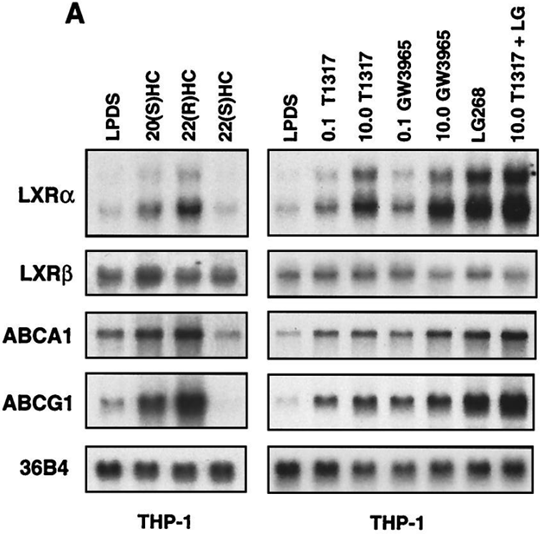
| Western blot | LXRα / LXRβ / ABCA1 / ABCG1 Skp2 / pEGFR / EGFR / pERK / ERK |
|
11604492 |
| Immunofluorescence | pRelA LAMP-1 / LDLR |
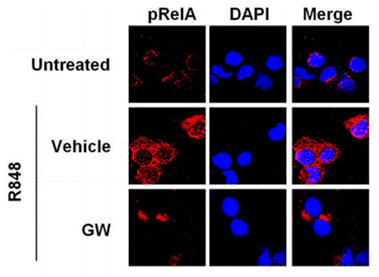
|
26635040 |
| Growth inhibition assay | Cell viability |
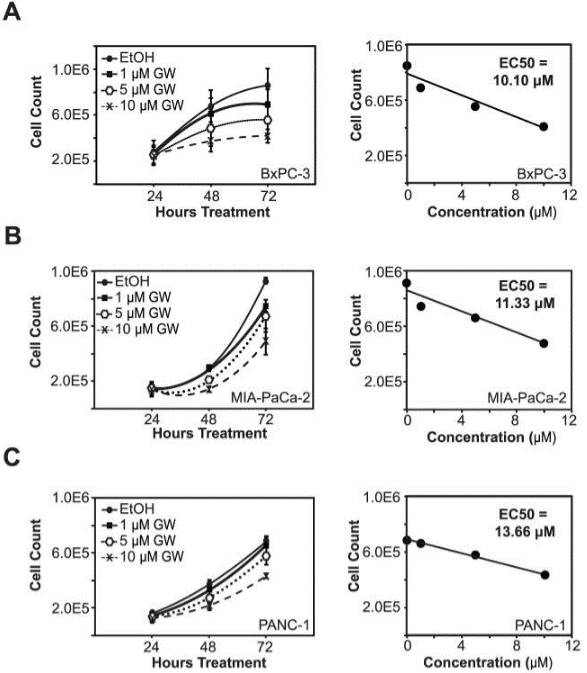
|
25184494 |
Technischer Support
Tel: +1-832-582-8158 Ext:3
Wenn Sie weitere Fragen haben, hinterlassen Sie bitte eine Nachricht.
Häufig gestellte Fragen
Frage 1:
How to formulate it for mouse in vivo experiment?
Antwort:
It can be dissolved in 2% DMSO/30% PEG 300/dd H2O at 10 mg/mL as a homogeneous suspension. This vehicle is suitable for oral gavage to mice.

Produkte sind nur für Forschungszwecke bestimmt. Nicht für den menschlichen Gebrauch. Wir verkaufen nicht an Patienten.
©Copyright 2013 Selleck Chemicals. Alle Rechte vorbehalten.