
nur für Forschungszwecke
Melphalan DNA alkylator chemisch
Kat.-Nr.S8266
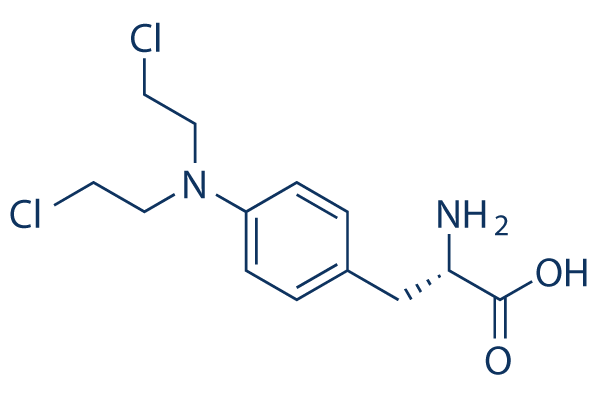
Chemische Struktur
Molekulargewicht: 305.20
Springe zu
Qualitätskontrolle
Charge:
Reinheit:
99.47%
99.47
| Verwandte Ziele | HDAC PARP ATM/ATR DNA-PK WRN DNA/RNA Synthesis Topoisomerase PPAR Sirtuin Casein Kinase |
|---|---|
| Weitere DNA alkylator Inhibitoren | Lomeguatrib Methyl methanesulfonate Lobaplatin (D-19466) Tretazicar (CB1954) Treosulfan Semustine |
Zellkultur, Behandlung & Arbeitskonzentration
| Zelllinien | Assay-Typ | Konzentration | Inkubationszeit | Formulierung | Aktivitätsbeschreibung | PMID |
|---|---|---|---|---|---|---|
| C6 (Rat) Glioma cell lines | Cytotoxicity assay | The compound was tested for cytotoxicity against C6 (Rat) Glioma cell lines, IC50=11 μM | ||||
| CEM T-lymphocytes | Cytotoxicity assay | Cytotoxicity against CEM T-lymphocytes, IC50=2.47 μM | ||||
| D283 MR (human) Glioma cell lines | Cytotoxicity assay | The compound was tested for cytotoxicity against D283 MR (human) Glioma cell lines, IC50=16.3 μM | ||||
| D283 (human) Glioma cell lines | Cytotoxicity assay | The compound was tested for cytotoxicity against D283 (human) Glioma cell lines, IC50=6.8 μM | ||||
| D341 (human) Glioma cell lines | Cytotoxicity assay | The compound was tested for cytotoxicity against D341 (human) Glioma cell lines, IC50=12.4 μM | ||||
| K562 | Cytotoxicity assay | 1 h | In vitro cytotoxic activity against human leukemic cell line K562 after incubation for 1 hour, IC50=30 μM | |||
| Jurkat T cells | Cytotoxicity assay | Inhibitory concentration against Human Jurkat T cells, IC50=2.2 μM | ||||
| L1210 cell | Cytotoxicity assay | 72 h | Tested in vitro for the cytotoxicity as number of viable cells against L1210 cell line after 72 hr treatment at conc. of 10E-6, ID50=1.7 μM | |||
| LoVo cell | Growth inhibition assay | 144 hr | Tested in vitro for inhibition after 144 hr exposure against human colon carcinoma LoVo cell line, IC50=4.09 μM | |||
| MCF-7 cells | Cytotoxicity assay | In vitro cytotoxicity activity against MCF-7, IC50=0.3 μM | ||||
| Molt 4/C8 cells | Cytotoxicity assay | Cytotoxicity against human Molt 4/C8 cells, IC50=3.24 μM | ||||
| P388 cells | Cytotoxicity assay | Cytotoxicity evaluated against P388 cells, IC50=0.22 μM | ||||
| MCF-7 | Proliferation assay | Antiproliferative activity in MCF-7 human breast cancer cells, IC50=5.7 μM | ||||
| C6 glioma cell line | Cytotoxicity assay | Cytotoxicity against rat C6 glioma cell line, IC50=12.6 μM | ||||
| HCT116 cells | Cytotoxicity assay | Cytotoxicity against human HCT116 cells, IC50=30.2 μM | ||||
| HCT15 cells | Cytotoxicity assay | Cytotoxicity against human HCT15 cells, IC50=36.3 μM | ||||
| KM12 cells | Cytotoxicity assay | Cytotoxicity against human KM12 cells, IC50=43.7 μM | ||||
| SW620 cells | Cytotoxicity assay | Cytotoxicity against human SW620 cells, IC50=38.9 Μm | ||||
| HCC2998 cells | Cytotoxicity assay | Cytotoxicity against human HCC2998 cells, IC50=41.7 μM | ||||
| SR cells | Cytotoxicity assay | Cytotoxicity against human SR cells, IC50=1.86 μM | ||||
| HSC2 cells | Cytotoxicity assay | Cytotoxicity against HSC2 cells, CC50=35 μM | ||||
| HL60 cells | Cytotoxicity assay | Cytotoxicity against human HL60 cells, CC50=6 μM | ||||
| MOLT3 cells | Function assay | 72 h | Antitumor activity against human MOLT3 cells in presence of Penicillin-G-amidase after 72 hrs by XTT assay, IC50=0.3 μM | |||
| HepG2 cells | Growth inhibition assay | Growth inhibition of human HepG2 cells, GI50=17 μM | ||||
| RT4 cells | Cytotoxicity assay | 96 h | Cytotoxicity against human RT4 cells after 96 hrs by microtiter assay, IC50=14.25 μM | |||
| RT112 cells | Cytotoxicity assay | 96 h | Cytotoxicity against human RT112 cells after 96 hrs by microtiter assay, IC50=4.69 μM | |||
| 5637 cells | Cytotoxicity assay | 96 h | Cytotoxicity against human 5637 cells after 96 hrs by microtiter assay, IC50=0.31 μM | |||
| KYSE70 cells | Cytotoxicity assay | 96 h | Cytotoxicity against human KYSE70 cells after 96 hrs by microtiter assay, IC50=16.16 μM | |||
| KYSE510 | Cytotoxicity assay | 96 h | Cytotoxicity against human KYSE510 cells after 96 hrs by microtiter assay, IC50=8.18 Μm | |||
| KYSE520 cells | Cytotoxicity assay | 96 h | Cytotoxicity against human KYSE520 cells after 96 hrs by microtiter assay, IC50=10.49 μM | |||
| YAPC cells | Cytotoxicity assay | 96 h | Cytotoxicity against human YAPC cells after 96 hrs by microtiter assay, IC50=5.95 μM | |||
| DAN-G cells | Cytotoxicity assay | 96 h | Cytotoxicity against human DAN-G cells after 96 hrs by microtiter assay, IC50=2.65 μM | |||
| SISO cells | Cytotoxicity assay | 96 h | Cytotoxicity against human SISO cells after 96 hrs by microtiter assay, IC50=1 μM | |||
| LCLC-103H cells | Cytotoxicity assay | 96 h | Cytotoxicity against human LCLC-103H cells after 96 hrs by microtiter assay, IC50=4 μM | |||
| MCF7 cells | Cytotoxicity assay | 96 h | Cytotoxicity against human MCF7 cells after 96 hrs by microtiter assay, IC50=3.71 μM | |||
| A427 cells | Cytotoxicity assay | 96 h | Cytotoxicity against human A427 cells after 96 hrs by microtiter assay, IC50=5.13 μM | |||
| Caov3 cells | Cytotoxicity assay | 72 h | Cytotoxicity against human Caov3 cells after 72 hrs by MTT assay | |||
| NSCLC cells | Cytotoxicity assay | 48 hrs | Cytotoxicity against human NSCLC cells assessed as cell growth after 48 hrs by SRB assay, GI50=6.736083 μM | |||
| CNSC cells | Cytotoxicity assay | 48 hrs | Cytotoxicity against human CNSC cells assessed as cell growth after 48 hrs by SRB assay, GI50=7.58578 μM | |||
| mouse FM3A/0 cells | Proliferation assay | 48 hrs | Antiproliferative activity against mouse FM3A/0 cells assessed as inhibition of cell growth after 48 hrs by ZF-Coulter Counting, IC50=3.6 μM | |||
| CEM/0 cells | Proliferation assay | 48 hrs | Antiproliferative activity against human CEM/0 cells assessed as inhibition of cell growth after 48 hrs by ZF-Coulter Counting, IC50=3.5 μM | |||
| HeLa cells | Proliferation assay | 48 hrs | Antiproliferative activity against human HeLa cells assessed as inhibition of cell growth after 48 hrs by ZF-Coulter Counting, IC5=1.9 μM | |||
| INA-6 cells | Cytotoxicity assay | Cytotoxicity against human INA-6 cells assessed as viable fractions using annexin V-FITC/propidium iodide staining by flow cytometry, EC50=2 μM | ||||
| PBMC cells | Cytotoxicity assay | Cytotoxicity against human PBMC cells assessed as viable fractions using annexin V-FITC/propidium iodide staining by flow cytometry, EC50=3 μM | ||||
| SH-SY5Y cells | Cytotoxicity assay | 72 h | Cytotoxicity against human SH-SY5Y cells after 72 hrs by MTT assay, IC50=5.5 μM | |||
| U251 cells | Cytotoxicity assay | 5 days | Cytotoxicity against human U251 cells after 5 days by MTT assay, IC50=3 μM | |||
| A549 cells | Cytotoxicity assay | 5 days | Cytotoxicity against human A549 cells after 5 days by MTT assay, IC50=3 μM | |||
| PANC1 cells | Cytotoxicity assay | 5 days | Cytotoxicity against human PANC1 cells after 5 days by MTT assay, IC50=3 μM | |||
| HT-29 cells | Cytotoxicity assay | 5 days | Cytotoxicity against human HT-29 cells after 5 days by MTT assay, IC50=3 μM | |||
| DLD1 cells | Cytotoxicity assay | 5 days | Cytotoxicity against human DLD1 cells after 5 days by MTT assay, IC50=3 μM | |||
| HeLa cells | Cytotoxicity assay | 4 days | Cytotoxicity against human HeLa cells after 4 days by Coulter counter analysis, IC50=1.9 μM | |||
| FM3A cells | Cytotoxicity assay | 2 days | Cytotoxicity against mouse FM3A cells after 2 days by Coulter counter analysis, IC50=3.6 μM | |||
| HL-60(TB) cells | Function assay | 24 h | Antileukemic activity against human HL-60(TB) cells assessed as inhibition of tumor growth after 24 hrs, IC50=0.38 μM | |||
| SR cells | Function assay | 24 h | Antileukemic activity against human SR cells assessed as inhibition of tumor growth after 24 hrs, IC50=3.24 μM | |||
| L1210 cells | Proliferation assay | 2 days | Antiproliferative activity against mouse L1210 cells assessed as inhibition of cell proliferation incubated for 2 days by Coulter counter based assay, IC50=8.6 μM | |||
| FM3A cells | Proliferation assay | 2 days | Antiproliferative activity against mouse FM3A cells assessed as inhibition of cell proliferation incubated for 2 days by Coulter counter based assay, IC50=3.6 μM | |||
| CEM cells | Proliferation assay | 3 days | Antiproliferative activity against human CEM cells assessed as inhibition of cell proliferation incubated for 3 days by Coulter counter based assay, IC50=3.5 μM | |||
| HeLa cells | Proliferation assay | 4 days | Antiproliferative activity against human HeLa cells assessed as inhibition of cell proliferation incubated for 4 days by Coulter counter based assay, IC50=1.9 μM | |||
| Klicken Sie hier, um weitere experimentelle Daten zu Zelllinien anzuzeigen | ||||||
Chemische Informationen, Lagerung & Stabilität
| Molekulargewicht | 305.20 | Formel | C13H18Cl2N2O2 |
Lagerung (Ab dem Eingangsdatum) | |
|---|---|---|---|---|---|
| CAS-Nr. | 148-82-3 | SDF herunterladen | Lagerung von Stammlösungen |
|
|
| Synonyme | Alkeran, Sarcolysin, L-PAM | Smiles | C1=CC(=CC=C1CC(C(=O)O)N)N(CCCl)CCCl | ||
Löslichkeit
|
In vitro |
DMSO
: 3.5 mg/mL
(11.46 mM)
Water : Insoluble Ethanol : Insoluble |
Molaritätsrechner
Verdünnungsrechner
Molekulargewichtsrechner
|
In vivo |
|||||
In-vivo-Formulierungsrechner (Klare Lösung)
Schritt 1: Geben Sie die untenstehenden Informationen ein (Empfohlen: Ein zusätzliches Tier zur Berücksichtigung von Verlusten während des Experiments)
mg/kg
g
μL
Schritt 2: Geben Sie die In-vivo-Formulierung ein (Dies ist nur der Rechner, keine Formulierung. Bitte kontaktieren Sie uns zuerst, wenn es im Abschnitt "Löslichkeit" keine In-vivo-Formulierung gibt.)
% DMSO
%
% Tween 80
% ddH2O
%DMSO
%
Berechnungsergebnisse:
Arbeitskonzentration: mg/ml;
Methode zur Herstellung der DMSO-Stammlösung: mg Wirkstoff vorgelöst in μL DMSO ( Konzentration der Stammlösung mg/mL, Bitte kontaktieren Sie uns zuerst, wenn die Konzentration die DMSO-Löslichkeit der Wirkstoffcharge überschreitet. )
Methode zur Herstellung der In-vivo-Formulierung: Nehmen Sie μL DMSO Stammlösung, dann hinzufügenμL PEG300, mischen und klären, dann hinzufügenμL Tween 80, mischen und klären, dann hinzufügen μL ddH2O, mischen und klären.
Methode zur Herstellung der In-vivo-Formulierung: Nehmen Sie μL DMSO Stammlösung, dann hinzufügen μL Maisöl, mischen und klären.
Hinweis: 1. Bitte stellen Sie sicher, dass die Flüssigkeit klar ist, bevor Sie das nächste Lösungsmittel hinzufügen.
2. Achten Sie darauf, das/die Lösungsmittel der Reihe nach hinzuzufügen. Sie müssen sicherstellen, dass die bei der vorherigen Zugabe erhaltene Lösung eine klare Lösung ist, bevor Sie mit der Zugabe des nächsten Lösungsmittels fortfahren. Physikalische Methoden wie Vortex, Ultraschall oder ein heißes Wasserbad können zur Unterstützung des Lösens verwendet werden.
Wirkmechanismus
| In vitro |
Die Exposition einer Myelomzelllinie (RPMI 8226) gegenüber einem 30-minütigen Melphalan-Puls (1-Phenylalanin-Senf) führt zu einer für DNA-vernetzende Mittel charakteristischen Verzögerung des Zellzyklusfortschritts. Es wurde gezeigt, dass diese Verbindung in vitro an DNA, RNA und Protein in Zellen bindet. Sie induziert Chromosomenaberrationen, Schwesterchromatidenaustausch, Mikronuklei, Mutationen am HPRT-Gen und DNA Damage in menschlichen Zellen in vitro. Sie induziert auch die Transformation von C3H 10T1/2 und anderen Zellen. In kultivierten Nagetierzellen induziert sie Chromosomenaberrationen, Schwesterchromatidenaustausch, Genmutationen und DNA Damage. Darüber hinaus induziert sie Aneuploidie und geschlechtsgebundene rezessiv-letale Mutationen bei Drosophila sowie Mutationen in Bakterien.
|
|---|---|
| In vivo |
Melphalan wurde an Mäusen durch orale, intraperitoneale und dermale Anwendung, an Ratten durch intraperitoneale Injektion und an Affen durch orale Verabreichung getestet. Bei Mäusen führte die Verabreichung dieser Verbindung zu Vormagenpapillomen, Lymphosarkomen sowie Haut- und Lungentumoren. Bei Ratten verursachte es Brustdrüsentumoren und Peritonealsarkome. Die Ergebnisse bei Affen waren nicht schlüssig.
|
Literatur |
|
Klinische Studieninformationen
(Daten von https://clinicaltrials.gov, aktualisiert am 2024-05-22)
| NCT-Nummer | Rekrutierung | Erkrankungen | Sponsor/Kooperationspartner | Startdatum | Phasen |
|---|---|---|---|---|---|
| NCT06313502 | Not yet recruiting | Plasma Cell Disorder |
University of Arkansas|University of Iowa |
June 2024 | Phase 1 |
| NCT04455139 | Terminated | Eye Cancer Retinoblastoma |
Prof. Beck Popovic Maja|University of Lausanne Hospitals |
November 15 2021 | Phase 2 |
| NCT04945954 | Not yet recruiting | Hematopoietic Stem Cell Transplantation |
Seoul National University Hospital|National Institute of Food and Drug Safety Evaluation (Republic of Korea) |
June 2021 | Not Applicable |
Technischer Support
Tel: +1-832-582-8158 Ext:3
Wenn Sie weitere Fragen haben, hinterlassen Sie bitte eine Nachricht.

Produkte sind nur für Forschungszwecke bestimmt. Nicht für den menschlichen Gebrauch. Wir verkaufen nicht an Patienten.
©Copyright 2013 Selleck Chemicals. Alle Rechte vorbehalten.