
nur für Forschungszwecke
Obeticholic Acid (INT-747) FXR Agonist
Kat.-Nr.S7660
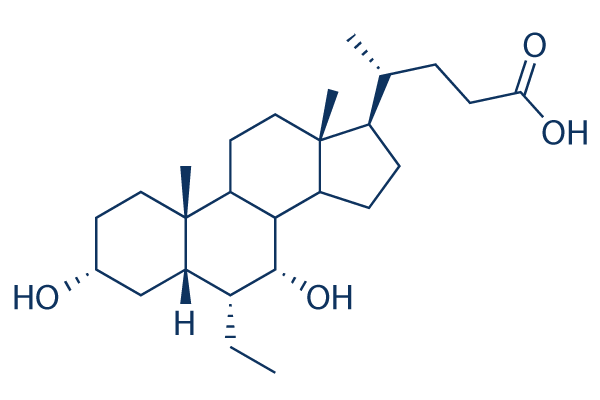
Chemische Struktur
Molekulargewicht: 420.63
Qualitätskontrolle
Zellkultur, Behandlung & Arbeitskonzentration
| Zelllinien | Assay-Typ | Konzentration | Inkubationszeit | Formulierung | Aktivitätsbeschreibung | PMID |
|---|---|---|---|---|---|---|
| insect cells | Function assay | 1 hr | Agonist activity at recombinant human GST-tagged FXR ligand binding domain (193 to 472 residues) expressed in baculovirus infected insect cells assessed as induction of interaction with biotin labelled SRC-1 after 1 hr by HTRF assay, EC50 = 0.01 μM. | 29148806 | ||
| HEK293T | Function assay | 24 hrs | Agonist activity at human FXR expressed in HEK293T cells assessed as BSEP promoter driven cellular transcriptional activity after 24 hrs by luciferase reporter gene assay, EC50 = 0.042 μM. | 29148806 | ||
| COS1 | Function assay | Agonist activity at FXR expressed in COS1 cells by cell-based bioluminescence assay, EC50 = 0.099 μM. | 20014870 | |||
| HeLa | Function assay | 24 hrs | Agonist activity at human full length FXR expressed in HeLa cells cotransfected with pSG5-human RXR after 24 hrs by Dual-Glo luciferase reporter gene assay, EC50 = 0.16 μM. | 25934227 | ||
| HeLa | Function assay | Agonist activity at human FXR expressed in human HeLa cells assessed as receptor activation by BSEP promoter-driven firefly luciferase reporter gene assay, EC50 = 0.16 μM. | 25255039 | |||
| insect cells | Function assay | 1 hr | Agonist activity at recombinant human GST-tagged FXR LBD (193 to 472 residues) expressed in baculovirus-infected insect cells assessed as recruitment of biotinylated SRC1 peptide measured after 1 hr by Alphascreen assay, EC50 = 0.18 μM. | 29259742 | ||
| COS1 | Function assay | 5 hrs | Agonist activity at human FXR expressed in COS1 cells after 5 hrs by CRE-driven luciferase reporter gene assay, EC50 = 0.361 μM. | 17685603 | ||
| CHO | Function assay | 5 hrs | Agonist activity at human TGR5 expressed in CHO cells after 5 hrs by CRE-driven luciferase reporter gene assay, EC50 = 0.755 μM. | 17685603 | ||
| HEK293 | Function assay | 1 hr | Agonist activity at human TGR5 expressed in HEK293 cells assessed as increase in intracellular cAMP level after 1 hr by TR-FRET assay, EC50 = 0.84 μM. | 29259742 | ||
| NCI-H716 | Function assay | Agonist activity at human TGR5 receptor expressed in NCI-H716 cells assessed as intracellular cAMP level by TR-FRET assay, EC50 = 20 μM. | 21459580 | |||
| HepG2 | Function assay | 20 uM | Induction of FXR-mediated SHP mRNA expression in human HepG2 cells at 20 uM by RT-PCR | 21459580 | ||
| HepG2 | Function assay | 1 uM | Induction of FXR-mediated SHP mRNA expression in human HepG2 cells at 1 uM by RT-PCR | 21459580 | ||
| HepG2 | Function assay | 20 uM | Induction of FXR-mediated BSEP mRNA expression in human HepG2 cells at 20 uM by RT-PCR | 21459580 | ||
| HepG2 | Function assay | 20 uM | Induction of FXR-mediated Ostbeta mRNA expression in human HepG2 cells at 20 uM by RT-PCR | 21459580 | ||
| HepG2 | Function assay | 1 uM | Induction of FXR-mediated down-regulation of Cyp7A1 mRNA expression in human HepG2 cells at 1 uM by RT-PCR | 21459580 | ||
| HepG2 | Function assay | 20 uM | Induction of FXR-mediated down-regulation of Cyp7A1 mRNA expression in human HepG2 cells at 20 uM by RT-PCR | 21459580 | ||
| HepG2 | Function assay | 20 uM | Agonist activity at human FXR expressed in HepG2 cells assessed as renilla luciferase activity at 20 uM by luciferase based transactivation assay | 21459580 | ||
| HepG2 | Function assay | 1 uM | Induction of FXR-mediated BSEP mRNA expression in human HepG2 cells at 1 uM by RT-PCR | 21459580 | ||
| HepG2 | Function assay | 1 uM | Induction of FXR-mediated Ostbeta mRNA expression in human HepG2 cells at 1 uM by RT-PCR | 21459580 | ||
| HepG2 | Function assay | 10 uM | Transactivation of human FXR transfected in human HepG2 cells at 10 uM by beta-galactosidase reporter gene assay | 24387325 | ||
| HepG2 | Function assay | 10 uM | 18 hrs | Agonist activity at FXR in human HepG2 cells assessed as upregulation of OST-alpha mRNA expression at 10 uM after 18 hrs by RT-PCR analysis | 24387325 | |
| GLUTag | Function assay | Agonist activity at GP-BAR1 in mouse GLUTag cells assessed as increase in intracellular cAMP level | 24387325 | |||
| HepG2 | Function assay | 10 uM | 18 hrs | Agonist activity at FXR in human HepG2 cells assessed as upregulation of SHP mRNA expression at 10 uM after 18 hrs by RT-PCR analysis | 24387325 | |
| HepG2 | Function assay | 10 uM | 18 hrs | Agonist activity at FXR in human HepG2 cells assessed as upregulation of BESP mRNA expression at 10 uM after 18 hrs by RT-PCR analysis | 24387325 | |
| GLUTag | Function assay | Agonist activity at GP-BAR1 in mouse GLUTag cells assessed as increase in GLP-1 release | 24387325 | |||
| Klicken Sie hier, um weitere experimentelle Daten zu Zelllinien anzuzeigen | ||||||
Chemische Informationen, Lagerung & Stabilität
| Molekulargewicht | 420.63 | Formel | C26H44O4 |
Lagerung (Ab dem Eingangsdatum) | |
|---|---|---|---|---|---|
| CAS-Nr. | 459789-99-2 | SDF herunterladen | Lagerung von Stammlösungen |
|
|
| Synonyme | 6-ECDCA, 6-Ethylchenodeoxycholic acid | Smiles | CCC1C2CC(CCC2(C3CCC4(C(C3C1O)CCC4C(C)CCC(=O)O)C)C)O | ||
Löslichkeit
|
In vitro |
DMSO
: 84 mg/mL
(199.7 mM)
Ethanol : 84 mg/mL Water : Insoluble |
Molaritätsrechner
|
In vivo |
|||||
In-vivo-Formulierungsrechner (Klare Lösung)
Schritt 1: Geben Sie die untenstehenden Informationen ein (Empfohlen: Ein zusätzliches Tier zur Berücksichtigung von Verlusten während des Experiments)
Schritt 2: Geben Sie die In-vivo-Formulierung ein (Dies ist nur der Rechner, keine Formulierung. Bitte kontaktieren Sie uns zuerst, wenn es im Abschnitt "Löslichkeit" keine In-vivo-Formulierung gibt.)
Berechnungsergebnisse:
Arbeitskonzentration: mg/ml;
Methode zur Herstellung der DMSO-Stammlösung: mg Wirkstoff vorgelöst in μL DMSO ( Konzentration der Stammlösung mg/mL, Bitte kontaktieren Sie uns zuerst, wenn die Konzentration die DMSO-Löslichkeit der Wirkstoffcharge überschreitet. )
Methode zur Herstellung der In-vivo-Formulierung: Nehmen Sie μL DMSO Stammlösung, dann hinzufügenμL PEG300, mischen und klären, dann hinzufügenμL Tween 80, mischen und klären, dann hinzufügen μL ddH2O, mischen und klären.
Methode zur Herstellung der In-vivo-Formulierung: Nehmen Sie μL DMSO Stammlösung, dann hinzufügen μL Maisöl, mischen und klären.
Hinweis: 1. Bitte stellen Sie sicher, dass die Flüssigkeit klar ist, bevor Sie das nächste Lösungsmittel hinzufügen.
2. Achten Sie darauf, das/die Lösungsmittel der Reihe nach hinzuzufügen. Sie müssen sicherstellen, dass die bei der vorherigen Zugabe erhaltene Lösung eine klare Lösung ist, bevor Sie mit der Zugabe des nächsten Lösungsmittels fortfahren. Physikalische Methoden wie Vortex, Ultraschall oder ein heißes Wasserbad können zur Unterstützung des Lösens verwendet werden.
Wirkmechanismus
| Targets/IC50/Ki |
FXR
99 nM(EC50)
|
|---|---|
| In vitro |
In HuH7-Zellen fungiert Obeticholic Acid (INT-747) als potenter FXR-Agonist mit einem EC50 von 85 nM. |
| Kinase-Assay |
Bindungsstärke von Obeticholic Acid an FXR
|
|
Obeticholic Acid (INT-747) wurde in einem etablierten zellfreien Ligandensensierungsassay getestet, der die Liganden-abhängige Rekrutierung eines SRC1-Peptids zu FXR durch Fluoreszenzresonanzenergietransfer misst.
|
|
| In vivo |
Im Ratten-Cholestasemodell fördert Obeticholic Acid (INT-747) den Gallenfluss und schützt Hepatozyten vor akuter Nekrose, die durch LCA verursacht wird. Diese Verbindung (p.o.) verbessert Proteinurie, lindert renale strukturelle Veränderungen und moduliert renale Entzündungen und oxidativen Stress bei WD-gefütterten DBA-Mäusen. Bei thioacetamid-(TAA)-intoxikierten und gallengangligierten (BDL) Ratten reaktiviert es (30 mg/kg p.o.) den FXR-nachgeschalteten Signalweg und senkt den Pfortaderdruck durch Reduzierung des gesamten IHVR ohne schädliche systemische Hypotonie. |
Literatur |
|
Anwendungen
| Methoden | Biomarker | Bilder | PMID |
|---|---|---|---|
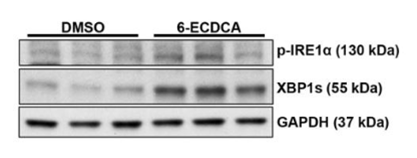
| Western blot | p-IRE1α XBP1s |
|
29377207 |
Klinische Studieninformationen
(Daten von https://clinicaltrials.gov, aktualisiert am 2024-05-22)
| NCT-Nummer | Rekrutierung | Erkrankungen | Sponsor/Kooperationspartner | Startdatum | Phasen |
|---|---|---|---|---|---|
| NCT05740631 | Recruiting | Healthy |
Universitaire Ziekenhuizen KU Leuven|Intercept Pharmaceuticals |
August 22 2022 | Not Applicable |
| NCT02633956 | Completed | Nonalcoholic Steatohepatitis |
Intercept Pharmaceuticals |
December 4 2015 | Phase 2 |
| NCT02548351 | Terminated | Non Alcoholic Steatohepatitis (NASH) |
Intercept Pharmaceuticals |
September 22 2015 | Phase 3 |
Technischer Support
Tel: +1-832-582-8158 Ext:3
Wenn Sie weitere Fragen haben, hinterlassen Sie bitte eine Nachricht.
Häufig gestellte Fragen
Frage 1:
What formulation can we use to dissolve it for mice in vivo study?
Antwort:
You can use the vehicle of: 1% wt/vol methyl-cellulose as indicated in this paper, http://www.sciencedirect.com/science/article/pii/S0925443911000883 "daily oral gavage with 5 mg/kg/day of this compound or vehicle (1% wt/vol methyl-cellulose) from 3 days prior to induction of colitis"

Produkte sind nur für Forschungszwecke bestimmt. Nicht für den menschlichen Gebrauch. Wir verkaufen nicht an Patienten.
©Copyright 2013 Selleck Chemicals. Alle Rechte vorbehalten.