
nur für Forschungszwecke
SB269970 HCl 5-HT Receptor Antagonist
Kat.-Nr.S2849
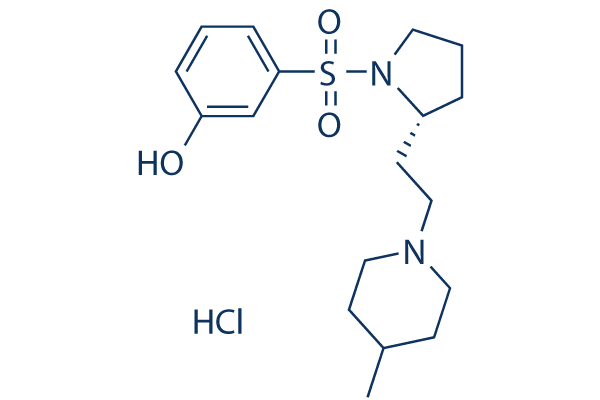
Chemische Struktur
Molekulargewicht: 388.95
Qualitätskontrolle
- In Nature Medicine für seine erstklassige Qualität zitiert
- COA
- NMR
- SDS
- Datenblatt
| Verwandte Ziele | Adrenergic Receptor AChR COX Calcium Channel Histamine Receptor Dopamine Receptor GABA Receptor TRP Channel Cholinesterase (ChE) GluR |
|---|---|
| Weitere 5-HT Receptor Inhibitoren | WAY-100635 Maleate Serotonin (5-HT) HCl Puerarin BRL-15572 Dihydrochloride Ketanserin RS-127445 Nuciferine Flopropione BRL-54443 SB742457 |
Chemische Informationen, Lagerung & Stabilität
| Molekulargewicht | 388.95 | Formel | C18H28N2O3S.HCl |
Lagerung (Ab dem Eingangsdatum) | |
|---|---|---|---|---|---|
| CAS-Nr. | 261901-57-9 | SDF herunterladen | Lagerung von Stammlösungen |
|
|
| Synonyme | N/A | Smiles | CC1CCN(CC1)CCC2CCCN2S(=O)(=O)C3=CC=CC(=C3)O.Cl | ||
Löslichkeit
|
In vitro |
DMSO
: 11 mg/mL
(28.28 mM)
Water : Insoluble Ethanol : Insoluble |
Molaritätsrechner
|
In vivo |
|||||
In-vivo-Formulierungsrechner (Klare Lösung)
Schritt 1: Geben Sie die untenstehenden Informationen ein (Empfohlen: Ein zusätzliches Tier zur Berücksichtigung von Verlusten während des Experiments)
Schritt 2: Geben Sie die In-vivo-Formulierung ein (Dies ist nur der Rechner, keine Formulierung. Bitte kontaktieren Sie uns zuerst, wenn es im Abschnitt "Löslichkeit" keine In-vivo-Formulierung gibt.)
Berechnungsergebnisse:
Arbeitskonzentration: mg/ml;
Methode zur Herstellung der DMSO-Stammlösung: mg Wirkstoff vorgelöst in μL DMSO ( Konzentration der Stammlösung mg/mL, Bitte kontaktieren Sie uns zuerst, wenn die Konzentration die DMSO-Löslichkeit der Wirkstoffcharge überschreitet. )
Methode zur Herstellung der In-vivo-Formulierung: Nehmen Sie μL DMSO Stammlösung, dann hinzufügenμL PEG300, mischen und klären, dann hinzufügenμL Tween 80, mischen und klären, dann hinzufügen μL ddH2O, mischen und klären.
Methode zur Herstellung der In-vivo-Formulierung: Nehmen Sie μL DMSO Stammlösung, dann hinzufügen μL Maisöl, mischen und klären.
Hinweis: 1. Bitte stellen Sie sicher, dass die Flüssigkeit klar ist, bevor Sie das nächste Lösungsmittel hinzufügen.
2. Achten Sie darauf, das/die Lösungsmittel der Reihe nach hinzuzufügen. Sie müssen sicherstellen, dass die bei der vorherigen Zugabe erhaltene Lösung eine klare Lösung ist, bevor Sie mit der Zugabe des nächsten Lösungsmittels fortfahren. Physikalische Methoden wie Vortex, Ultraschall oder ein heißes Wasserbad können zur Unterstützung des Lösens verwendet werden.
Wirkmechanismus
| Merkmale |
A hydrochloride salt form of SB-269970 which is a potent 5-HT 7 receptor antagonist.
|
|---|---|
| Targets/IC50/Ki |
5-HT7
8.3(pKi)
|
| In vitro |
SB-269970 hemmt die 5-CT-stimulierte Adenylylcyclase-Aktivität in Meerschweinchen-Hippocampusmembranen. SB-269970 (0,03 μM, 0,1 μM, 0,3 μM und 1 μM) bewirkt eine konzentrationsabhängige Rechtsverschiebung der 5-CT-Konzentrations-Wirkungs-Kurve ohne signifikante Veränderung der maximalen Reaktion auf 5-CT. SB-269970 (1 μM) hat keine Wirkung auf den 5-HT-Efflux, wenn es allein perfundiert wird.
|
| In vivo |
SB-269970 (10 mg/kg und 30 mg/kg) reduziert die Wirkung von Amphetamin signifikant um 25 bzw. 27 % und blockiert die Wirkung von Ketamin um 38 % (10 mg/kg) und 30 % (30 mg/kg). SB-269970 reduziert signifikant die Amphetamin-induzierte Hyperaktivität bei Wildtyp-Mäusen und hat keine Wirkung bei 5-HT7-Knockout-Mäusen. Die systemische Verabreichung von SB-269970 (30 mg/kg) kehrt die Amphetamin-bedingte Störung der PPI signifikant um und verstärkt die PPI im Vergleich zur Kontrolle nicht selbst. SB-269970 kehrt die durch MK-801, aber nicht durch Scopolamin, induzierten Defizite signifikant um. SB-269970 normalisiert die MK-801-induzierte Glutamat-, aber nicht die Dopaminfreisetzung im Kortex. SB-269970 (in einer mittleren Dosis von 0,5 oder 1 mg/kg) übt eine spezifische anxiolytische Wirkung im Vogel-Trinktest an Ratten, im Elevated Plus-Maze-Test an Ratten und im Vier-Platten-Test an Mäusen aus. Darüber hinaus zeigt SB-269970 (in einer mittleren Dosis von 5 oder 10 mg/kg) eine antidepressivumähnliche Aktivität in den Forced-Swimming- und Tail-Suspension-Tests an Mäusen. SB-269970 in Dosen von 0,3, 1 und 3 μg zeigt eine antikonfliktive Wirkung, die schwächer ist als die von Diazepam (40 μg), während SB-269970 in Dosen von 3 und 10 μg eine ausgeprägte Anti-Immobilitätswirkung aufwies, die mit der von Imipramin (0,1 μg) vergleichbar ist.
|
Literatur |
|
Technischer Support
Tel: +1-832-582-8158 Ext:3
Wenn Sie weitere Fragen haben, hinterlassen Sie bitte eine Nachricht.

Produkte sind nur für Forschungszwecke bestimmt. Nicht für den menschlichen Gebrauch. Wir verkaufen nicht an Patienten.
©Copyright 2013 Selleck Chemicals. Alle Rechte vorbehalten.